


A Delightful & Beautiful Early to Mid Edo Period 1598-1863 Samurai War Arrow Yanone (Arrow), With Togari-ya (Pointed Head) of Yanagi-ha ("Willow-Leaf"). WithYadake Bamboo Haft & Sea Eagle Flights & Traditional Tamagahane, In Incredibly Rare Full Polish
It is most rare to find original, antique samurai war arrows {ya} that still have beautifully polished tamagahane steel blades, that they would all have had originally, that often show the traditional hamon, the same as a traditional samurai sword would have had.
Acquired by us by personally being permitted to select from the private collection one of the world's greatest, highly respected and renown archery, bow and arrow experts. Who had spent his life travelling the world to lecture on archery and to accumulate the finest arrows and bows he could find. .
With original traditional eagle feathers, probably the large edge-wing feathers of a Japanese sea eagle. The armour piercing arrow tip, that is swollen at the tip to have the extra piercing power to penetrate armour and helmets {kabuto}, is a brightly polished, traditional tamagahane steel hand made, by a sword smith, long arrow head, originally hand made with folding and tempering exactly as would be a samurai sword blade, possibly signed on the tang under the binding but we would never remove it to see. The Edo period early eagle feathers are now slightly worn. It is entirely indicative of the Japanese principle that as much time skill and effort be used to create a single 'fire and forget' arrow, as would be used to make a tanto or katana. A British or European blacksmith might once have made ten or twenty arrows a day, a Japanese craftsman might take a week to make a single arrow, that has a useable combat life of maybe two minutes, the same as a simplest British long bow arrow.
The Togari-Ya or pointed arrowheads look like a small Yari (spear) were pointed arrowheads were used only for war and are armour piercing arrows . Despite being somewhat of a weapon that was 'fire and forget' it was created regardless of cost and time, like no other arrow ever was outside of Japan. For example, to create the arrow head alone, in the very same traditional way today, using tamahagane steel, folding and forging, water quench tempering, then followed by polishing, it would likely cost way in excess of a thousand pounds, that is if you could find a Japanese master sword smith today who would make one for you. Then would would need hafting, binding, and feathering, by a completely separate artisan, and finally, using eagle feathers as flights, would be very likely impossible. This is a simple example of how incredible value finest samurai weaponry can be, items that can be acquired from us that would cost many times the price of our original antiques in order to recreate today. Kyu Jutsu is the art of Japanese archery.The beginning of archery in Japan is pre-historical. The first images picturing the distinct Japanese asymmetrical longbow are from the Yayoi period (c. 500 BC – 300 AD).
The changing of society and the military class (samurai) taking power at the end of the first millennium created a requirement for education in archery. This led to the birth of the first kyujutsu ryūha (style), the Henmi-ryū, founded by Henmi Kiyomitsu in the 12th century. The Takeda-ryū and the mounted archery school Ogasawara-ryū were later founded by his descendants. The need for archers grew dramatically during the Genpei War (1180–1185) and as a result the founder of the Ogasawara-ryū (Ogasawara Nagakiyo), began teaching yabusame (mounted archery) In the twelfth and thirteenth century a bow was the primary weapon of a warrior on the battlefield. Bow on the battlefield stopped dominating only after the appearance of firearm.The beginning of archery in Japan is pre-historical. The first images picturing the distinct Japanese asymmetrical longbow are from the Yayoi period (c. 500 BC – 300 AD).
The changing of society and the military class (samurai) taking power at the end of the first millennium created a requirement for education in archery. This led to the birth of the first kyujutsu ryūha (style), the Henmi-ryū, founded by Henmi Kiyomitsu in the 12th century. The Takeda-ryū and the mounted archery school Ogasawara-ryū were later founded by his descendants. The need for archers grew dramatically during the Genpei War (1180–1185) and as a result the founder of the Ogasawara-ryū (Ogasawara Nagakiyo), began teaching yabusame (mounted archery) Warriors practiced several types of archery, according to changes in weaponry and the role of the military in different periods. Mounted archery, also known as military archery, was the most prized of warrior skills and was practiced consistently by professional soldiers from the outset in Japan. Different procedures were followed that distinguished archery intended as warrior training from contests or religious practices in which form and formality were of primary importance. Civil archery entailed shooting from a standing position, and emphasis was placed upon form rather than meeting a target accurately. By far the most common type of archery in Japan, civil or civilian archery contests did not provide sufficient preparation for battle, and remained largely ceremonial. By contrast, military training entailed mounted maneuvers in which infantry troops with bow and arrow supported equestrian archers.
Mock battles were staged, sometimes as a show of force to dissuade enemy forces from attacking. While early medieval warfare often began with a formalized archery contest between commanders, deployment of firearms and the constant warfare of the 15th and 16th centuries ultimately led to the decline of archery in battle. In the Edo period archery was considered an art, and members of the warrior classes participated in archery contests that venerated this technique as the most favoured weapon of the samurai. In the gallery is from an Edo exhibition of archery that shows a tagari ya arrow pierced completely through, back and front, an armoured steel multi plate kabuto helmet. Another photo shows an unmounted arrow head with the considerable length of the tang that is concealed by the haft.
In the gallery is from an Edo exhibition of archery that shows a tagari ya arrow pierced completely through, back and front, an armoured steel multi plate kabuto helmet. Another photo shows an unmounted arrow head with the considerable length of the tang that is concealed by the haft.
Image in the gallery is our classic, original Japanese print 'The Last Stand of the Kusunoki Heroes at Shijo-Nawate 1851'. by Utagawa Kuniyoshi. The last original triptych example of this wonder that we had for sale sold for £3,450 {to a museum in the States}.
Please note, almost all the war arrows in the print are most similar to this one.
"The warrior in the vanguard of the three, Wada Shinbei Masatomo, is carrying a couple of decapitated heads – the one we can see so clearly is grinning even in death – swinging them out in front of him in a gesture of defiance. Their leader, Kusunoki Masatsura, the last of the three, pausing momentarily to lean against the corpse of a horse, is labouring under the weight of a dead body sprawled across his back, which may be that of his fallen younger brother. That corpse helps to shield him from the mighty, unstoppable spray of arrows. The central figure is driving forward beneath the inadequate protection of a woefully collapsing battle standard. Only the leader for the day forges ahead, eyes in a kind of trance-like engagement with those of the enemy, as he shakes those heads like a brandished fist."
Quoted from an article written in the Independant by Michael Glover May 2012
In the gallery is from an Edo exhibition of archery that shows a tagari ya arrow pierced completely through, back and front, an armoured steel multi plate kabuto helmet. Another photo shows an unmounted arrow head with the considerable length of the tang that is concealed by the haft.
Every item is accompanied with our unique, Certificate of Authenticity. Of course any certificate of authenticity, given by even the best specialist dealers, in any field, all around the world, is simply a piece of paper,…however, ours is backed up with the fact we are the largest dealers of our kind in the world, with over 100 years and four generation’s of professional trading experience behind us read more
685.00 GBP

A Superb, Original 16th Century, Circa 1500's, Italian Glaive Polearm, A Simply Remarkable and Historical Piece Used in the 1500's. with An Incredible Slashing Blade & Counter Double Hook To Dismount Knights From Their Horses. In Excellent Condition
Also known as a fauchard. 34.5 inch head. glaive is a European polearm weapon, consisting of a single-edged blade on the end of a pole. It is similar to the Japanese naginata, the Chinese guandao, Russian sovnya and Siberian palma
Typically, the blade was from around 45 cm (18 inches) long, on the end of a pole 2 m (6 or 7 feet) long, and the blade was affixed in a socket-shaft configuration similar to an axe head, rather than having a tang like a sword or naginata. Occasionally glaive blades were created with a small hook on the reverse side such as this one to better catch riders on horseback. Such blades are called glaive-guisarmes.
According to the 1599 treatise Paradoxes of Defence by the English gentleman George Silver, the glaive is used in the same general manner as the quarterstaff, half pike, bill, halberd, voulge, or partisan. Silver rates this class of polearms above all other individual hand-to-hand combat weapons.
The Maciejowski Bible (Morgan Bible) depicts an example of a two-handed glaive used on horseback. Two images in our gallery are taken from the Morgan Bible (Folio 10 Verso - top). Notice the Warbrand in the forefront slicing into a mounted soldier with his glaive. Another early engraving of a knight with a glaive, and a group of men behing the king all with forms of glaive.
The contemporary term for this weapon may have been faussart, which was used for a variety of single-edged weapons seen as related to the scythe (along with terms such as falchion or falcata derived from falx, the Latin term for "scythe"). 96.75 inches long overall haft is so long it would need to be expertly but only temporarily halved by our workshop for shipping This superb glaive was formerly part of the Higgin's Collection and exhibited in the wonderful Higgins Museum Collection in Massachusetts for many decades, and it still bears, for its provenance, its original John Woodman Higgins Armoury Museum collection label.
https://www.worcesterart.org/collection/arms-and-armor/history/ read more
2450.00 GBP

A Beautiful, Original, 16th Cent. Italian Knight’s ‘Close’ Helmet From William Randolph Hearst’s Castle, San Simeon Formerly the Most Famous Private Museum Collection in the World. He Was Portrayed in Orson Welles Film Masterpiece ‘Citizen Caine’.
Although Orson Welles, possibly the greatest genius filmmaker Hollywood ever produced, hid the depiction of W.R. Hearst as the near despotic millionaire fictional character Charles Foster Caine, in his masterpiece, not a single person ever believed it not to be a depiction of Hearst, {least of all Hearst himself} thus, it resulted in Orson to be, possibly the first, movie star and director to be effectively ‘cancelled’, and his career henceforth was thus ruined and destroyed by Hearst’s media empire. Many believed, and some still do, this was the greatest tragedy to befall Hollywood film making in its 20th century history. Like the death of Mozart in his youthful prime, when mentioned, Orson Welles, is often followed by one of the saddest of remarks “what might have been?”.
A similar form of helmet is illustrated in the *treatise of René of Anjou, Duke of Anjou, Count of Provence, King of Jerusalem and Sicily. See picture of the similar helmet from the treatise in the gallery.
A fine original close helmet, probably Italian, with funerary face visor. Fine original brass rose head rivets. The front visor was adapted when the knight perished and this helm would have been mounted above his tomb with his achievements, in circa 1590, likely with his sword. Such as two other helmets *King Henry Vth (d. 1422), buried in Westminster Abbey. Set up over the dead king’s monument until the 20th century was his funerary helmet, a finely decorated jousting helm, now kept in the abbey museum.
Edward the Black Prince or Edward of Woodstock (15 June 1330 - 8 June 1376), eldest son of Edward III, King of England. Dating from 1376 his funerary visored helmet is to be found above his funerary monument in Canterbury Cathedral.
This helmet we offer is a stunning piece with amazing provenance, was owned by one of the greatest yet notorious men in world publishing history. William Randolph Hearst ( April 29, 1863 - August 14, 1951) was an American newspaper Mogul, a publisher who built the nation’s largest newspaper chain and whose methods profoundly influenced American journalism. His collecting took his agents around the Europe to acquire the finest treasures available, for his project of building the largest and finest private estate in the world, Hearst Castle in San Simeon. In much of this he succeeded. Hearst entered the publishing business in 1887 after taking control of The San Francisco Examiner from his father. Moving to New York City, he acquired The New York Journal and engaged in a bitter circulation war with Joseph Pulitzer's New York World that led to the creation of yellow journalism sensationalized stories of dubious veracity. Acquiring more newspapers, Hearst created a chain that numbered nearly 30 papers in major American cities at its peak. He later expanded to magazines, creating the largest newspaper and magazine business in the world.
He was twice elected as a Democrat to the U.S. House of Representatives, and ran unsuccessfully for Mayor of New York City in 1905 and 1909, for Governor of New York in 1906, and for Lieutenant Governor of New York in 1910. Nonetheless, through his newspapers and magazines, he exercised enormous political influence, and was famously blamed for pushing public opinion with his yellow journalism type of reporting leading the United States into a war with Spain in 1898.
His life story was the main inspiration for the development of the lead character in Orson Welles's film Citizen Kane. His mansion, Hearst Castle, on a hill overlooking the Pacific Ocean near San Simeon, California, halfway between Los Angeles and San Francisco, was donated by the Hearst Corporation to the state of California in 1957, and is now a State Historical Monument and a National Historic Landmark, open for public tours. Hearst formally named the estate La Cuesta Encantada (The Enchanted Slope), but he usually just called it the ranch. This helmet was acquired by Hearst for his mansion, Hearst Castle, but when his empire began to crumble much of his collection was sold at Gimbels In New York in 1941, which is where the Higgins Armory acquired this helmet. Orson Welles film, Citizen Kane, is thought by many to be one of the greatest masterpieces of film ever made, and it's portrayal of Charles Foster Kane was so mirroring WR Hearst that there was no doubt in any mind what it was meant to represent. So much so, Hearst dedicated some considerable time and effort during the next 10 years in order to destroy Orson Welles' career, and prevent him fulfilling his obvious potential as one of the greatest directors of all time. In much of this, once more, Hearst succeeded. Items from Hearst's collection rarely surface, as owners tend to keep hold of them for obvious reasons of historical posterity and provenance, and to be able to offer such a piece from that collection is a great privilege, and a rare opportunity for it's next fortunate owner.
*Ref; The saddle, helmet, sword and shield of King Henry V, which once formed part of his funeral 'achievements', are displayed in Westminster Abbey Museum, located in the abbey's eleventh century vaulted undercroft of St Peter. They were carried at his funeral in 1422 and later suspended on the wooden beam above the Henry V chantry for centuries, but in 1972 they were restored and placed in the abbey museum.
We show in the gallery an illustration from ‘Traictie de la Forme et Devis D'ung Tournoy’, that was written circa 1460 by King Rene of Anjou, King of Jerusalem and Sicily. The tournament book shows how a helmet, such as this one, would have been dressed for the tournament and it describes a style of tournament which Rene says he has adapted from the ancient customs of France and other countries. read more
8995.00 GBP

Incredible 'Great War' Aeronautical "Trench-Art" Painting, WW1. A Watercolour of LZ 62. Signed By Claus Bergen, Luftschiffer Zeppelin L30, Member of The Naval Airship Crew. As Property of a WW1 POW, Sent Home From Wurtemberg to England In 1919
Painted by Luftschiffer Claus Bergen in 1917, a very skilled and artistic hand.
Painted by a German Zeppelin Crew Member, and owned by a British WW1 POW. It is possible it was given to him by the artist.
Titled at the bottom in German
"Zeppelin, flieg, Hilf uns im krieg, Flieg nach England, England wird abgebrannt, Zeppelin, flieg."
Translation
"Zeppelin, fly,
Help us win the war, Fly against England, England will be burned, Zeppelin, fly"
.
Words from a popular Zeppelin propaganda song in Germany during WW1. Original rare German WW1 Zeppelin artwork.
Signed Claus Bergen, of the German Navy, Luftschiff Crew, L30 formerly LZ62, dated 1917.
Titled, and also bearing the name of the Zeppelin forces commander, Peter Strasser.
The painting was sent back from Danzig by a British POW who was imprisoned in Germany during WW1.
The Zeppelin LZ 62 was the 69th Airship of Count Zeppelin and the 25th Airship for the Imperial Navy , where it was designated L 30 .L 30 was the type ship of the class "R" , the so-called Superzeppeline with two additional motor gondolas with pressure propellers laterally offset below the centre of the fuselage. The hull was now approaching a slender teardrop shape that had both lower air resistances well as increased carrying gas volume ensured. The new type was 20 metres longer than its predecessor, had a significantly larger diameter. The new type had an almost double payload with now 32.5 t. The construction of the larger model with significant changes led to a longer construction period; In the meantime, several Zeppelin shipyards made airships, so that not only did the numbers and identifiers differ, but they also did not exactly represent the order of completion and takeover. LZ 63 to LZ 69 had already been completed before LZ 62. In addition, the Navy decided to give the first "Superzeppelin" the ID L 30 , although she had previously lost only 24 Zeppelins. LZ 62 made its first trip on 28 May 1916 and was put into service as L 30 in July 1916. The first commander of the airship became lieutenant to the See of Buttlar , who had already commanded L 6 and L 11 . The first in the north woods stationed ship was from 21 August from Ahlhorn used from. On January 11, 1917 Lieutenant Lake Friemel new commander, who moved with the ship in early April 1917 to T?nder . There took over on April 20, 1917, the Lieutenant Lake Boedecker the command of L 30 , the airship in early May to Seerappenrelocated near Konigsberg . There remained the airship until the autumn of 1917 together with L 37 and four army airships, which were used primarily for reconnaissance. The back bears details of commanders of Zeppelins and information of Kapitan-Leutnant Alois Bocker's crew of L33, and also of a shooting down near Potters Bar Kapitan Mathy's L31.
This painting had been owned after its artist by a British POW soldier, and it was sent home as war souvenir from Wurtemberg in early 1919 for a cost of 71/2 pfennigs.
Unframed 26cm x 19.5 cm read more
895.00 GBP
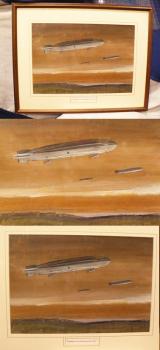
A Most Rare Original, Antique, Watercolour Painting of "Zeppelins Over Eastchurch" Signed By The Famous Royal Flying Corps Official War Artist Lt. Norman G. Arnold RFC, dated 1917. His Paintings Are Exhibited in The Imperial War Museum
Nicely framed and mounted, signed Norman Arnold, dated 1917.
His original artworks very rarely appear, and most of his surviving pieces are in the Imperial War Museum
Norman G. Arnold (19 September 1892 – 7 December 1963) was a British art director who designed the sets for over a hundred and twenty films. Arnold studied architecture, interior decoration & design. During the First World War, Arnold served in the Royal Flying Corps with the rank of Lieutenant and worked in the Armaments School. In 1918, Arnold was appointed to be an official war artist, tasked with portraying types of aircraft, methods of aerial fighting and specific famous air battles on the Western Front. He produced a number of water-colour paintings which are now housed in the Imperial War Museum in London, including his 24 x 36 inch painting,
The Last Flight of Albert Ball VC. Which we show in our gallery for historical interest and context only
The Last Flight of Albert Ball V.C.
Arnold, N G Last Flight of Captain Ball
"The Blind Spot" - A Camel attacks a Hannover CL type from its blind spot.
Arnold 1892-1963 two WW1 aircraft engaged in a dog-fight
A Zeppelin Raid on London October 1917.
arnold_Oct raid on London 1917 Seen from the Royal College of Science by Norman G Arnold, 1918
A Bristol goes after an Albatros.
N.G.Arnold 20 Dec 1917
Zeppelin L 70.
Arnold WWI War Artist
Original Great War memorabilia is very much in the forefront of collectors minds these days and especially so are original works by official war artists, especially aeronautical subjects.
The best-known German strategic bombing campaign during World War I was the campaign against England, although strategic bombing raids were carried out or attempted on other fronts.
The main campaign against England started in January 1915 using airships. From then until the end of World War I the German Navy and Army Air Services mounted over 50 bombing raids on the United Kingdom. These were generally referred to as "Zeppelin raids": although both Zeppelin and Schutte-Lanz airships were used, the Zeppelin company was much better known and was responsible for producing the vast majority of the airships used. Weather conditions and night flying conditions made airship navigation and therefore bombing accuracy difficult. Bombs were often dropped miles off target (one raid on London actually bombed Hull) and accurate targeting of military installations was impossible.
The civilian casualties made the Zeppelins an object of hatred, and they were widely dubbed 'baby-killers'. With the development of effective defensive measures the airship raids became increasingly hazardous, and in 1917 the airships were largely replaced by aeroplanes.
Although the direct military effect of the raids was small, they caused widespread alarm, leading to the diversion of substantial resources from the Western Front and some disruption to industrial production. Concern about the conduct of defence against the raids, the responsibility for which was divided between the Admiralty and the Army, led to a parliamentary inquiry under Jan Smuts, whose report was to lead to the creation of the Royal Air Force on 1 April 1918. The defence organisation developed by the British was an important precursor of the fighter direction system that would prove vital in winning the Battle of Britain. The raids were also influential because they led to an overestimation of both the material and psychological effects of the bombing of cities.
Airships made about 51 bombing raids on England during the war. These killed 557 and injured another 1,358 people. More than 5,000 bombs were dropped on towns across Britain, causing £1.5 million in damage. 84 airships took part, of which 30 were lost, either shot down or lost in accidents. Aeroplanes carried out 27 raids, dropping 246,774 lb (111,935 kg) of bombs for the loss of 62 aircraft, resulting in 835 deaths, 1972 injured and £1,418,272 material damage. the painting is in superb condition, the glass is showing a little odd reflection in our photos.
17.3/4 inches x 14 inches in the frame read more
1240.00 GBP

An Fabulous Bronze and Iron Archemeanid Empire Sword From the Time of the Greco-Persian Wars of Xerxes the Great Against the Spartans at Thermopylae. The Very Type of Sword Actually Used As Depicted in The Movie 300 Spartans
To place this wonderful historical piece in a modern context. If one saw the incredible movie ‘300 Spartans’, this is exactly the same kind of sword that would have been used in that extraordinary battle, and into the period of the greatest Empire ever known of Alexander the Great.
It is 7th century to 6th century BC, and was a most rare and incredibly valuable weapon of war during that time, utilising as it does a combination of steel and bronze, as iron steel was a most rare, valuable and highly prized metal in the early ancient Bronze Age period. This wonderful sword would likely have been used and held by warriors of nobility for likely several hundred years.
A complete sword, of both blade and hilt, with leaf-shaped russetted iron blade, double-waisted grip with transverse collar, the pommel formed as two crescentic iron spayed lobes, the hilt clad with bronze. Approx 635 grams, 19.25 inches. very good condition hilt for age. Approximately 2500 years old, Achaemenid Empire era, 550 bc to 330 bc From the the Greco-Persian War, such as includes the iconic battles of Marathon, Thermopylae and Plataea, up to the time of Alexander the Great. This wonderful antiquity, from one of the most eventful and ground breaking periods of classical history, is in amazing condition and beautifully decorated 6th-4th century BC. A bronze long dagger with narrow lentoid-section blade, collared grip with crescentic ears to the pommel. By the 7th century BC, the Persians had settled in the south-western portion of the Iranian Plateau in the region of Persis, which came to be their heartland. From this region, Cyrus the Great advanced to defeat the Medes, Lydia, and the Neo-Babylonian Empire, establishing the Achaemenid Empire. The Ionian Greek Revolt in 499 BC, and associated revolts in Aeolis, Doris, Cyprus and Caria, were military rebellions by several regions of Asia Minor against Persian rule, lasting from 499 to 493 BC. At the heart of the rebellion was the dissatisfaction of the Greek cities of Asia Minor with the tyrants appointed by Persia to rule them, along with the individual actions of two Milesian tyrants, Histiaeus and Aristagoras. In 499 BC, the then tyrant of Miletus, Aristagoras, launched a joint expedition with the Persian satrap Artaphernes to conquer Naxos, in an attempt to bolster his position in Miletus (both financially and in terms of prestige). The mission was a debacle, and sensing his imminent removal as tyrant, Aristagoras chose to incite the whole of Ionia into rebellion against the Persian king Darius the Great. In 490 BC the Persian forces were defeated by the Athenians at the Battle of Marathon and Darius would die before having the chance to launch an invasion of Greece. The Battle of Marathon took place in 490 BC, during the first Persian invasion of Greece. It was fought between the citizens of Athens, aided by Plataea, and a Persian force commanded by Datis and Artaphernes. The battle was the culmination of the first attempt by Persia, under King Darius I, to subjugate Greece. The Greek army decisively defeated the more numerous Persians, marking a turning point in the Greco-Persian Wars. Xerxes I (485–465 BC, "Hero Among Kings"), son of Darius I, vowed to complete the job. He organized a massive invasion aiming to conquer Greece. His army entered Greece from the north, meeting little or no resistance through Macedonia and Thessaly, but was delayed by a small Greek force for three days at Thermopylae. A simultaneous naval battle at Artemisium was tactically indecisive as large storms destroyed ships from both sides. The battle was stopped prematurely when the Greeks received news of the defeat at Thermopylae and retreated. The battle was a strategic victory for the Persians, giving them uncontested control of Artemisium and the Aegean Sea.
Following his victory at the Battle of Thermopylae, Xerxes sacked the evacuated city of Athens and prepared to meet the Greeks at the strategic Isthmus of Corinth and the Saronic Gulf. In 480 BC the Greeks won a decisive victory over the Persian fleet at the Battle of Salamis and forced Xerxes to retire to Sardis. The land army which he left in Greece under Mardonius retook Athens but was eventually destroyed in 479 BC at the Battle of Plataea. The final defeat of the Persians at Mycale encouraged the Greek cities of Asia to revolt, and the Persians lost all of their territories in Europe; Macedonia once again became independent. Alexander the Great, an avid admirer of Cyrus the Great, conquered most of the empire by 330 BC. Upon Alexander's death, most of the empire's former territory came under the rule of the Ptolemaic Kingdom and Seleucid Empire, in addition to other minor territories which gained independence at that time. The Iranian elites of the central plateau reclaimed power by the second century BC under the Parthian Empire
See Khorasani, M.M., Arms and Armour from Iran. The Bronze Age to the End of the Qajar Period, Tübingen, 2006, p.384, no.20, for similar. As with all our items it comes complete with our certificate of authenticity. read more
3950.00 GBP

We Speculate That This 2400 Year Old Sword Was Once The Sword of an Ancient Chinese King of Yueh, One Of the Nine Kings of Yueh, As It Is So Similar To The Sword of Goujian, King of Yueh, Now In The Hubei Museum in China, As to Be Remarkable
This fabulous treasure is so similar to another, that is now determined to have been made for one of the nine Kings of Yue, Goujian.
Goujian’s sword was discovered in a waterlogged tomb in the 1960's.
Ours is likely a combat fighting sword {as opposed for just for ceremonial dress, due to it's width of the blade at the ricasso}. One can see in the detailed photos this sword is covered in gold overlay but the natural ancient aging green surface encrustations now obscure most of this decor. See photo 4 in the gallery.
It was viewed the other day here by a Chinese visitor who is an assistant to the curator of an esteemed Chinese museum of antiquities, and he informed us that ancient Chinese swords such as this, decorated with enamels and gold, could only ever be carried and worn by the very highest ranked in the land.
Photo 8 shows our sword's hilt and another, very similar, to ours, very likely another King’s sword, exhibited in the Musee Guimet in Paris.
Formerly our sword was part of the Anthony Dove Collection, one of the foremost collectors of ancient Chinese swords, and joint author on the seminal academic research paper on the authentication of ancient Chinese swords and their metallurgical construction.
How often does a collector have the opportunity to acquire a fabulous sword that was likely once the sword of an ancient king.
Now known and established as 'The Sword of Goujian'. The sword in the museum in Hubei in China, has superbly chiselled or cast patterning at the forte of the blade that still contains some blue crystals and tortoise. Our sword has near identical stunning patterning {made by chiselling or casting} but our sword also has chiselling on the two grip rings and the pommel, that undoubtedly once contained the same crystals and turquoise inlays, but are no longer present.
With help from Wu's enemy Chu, Yue won after several decades of conflict. The famous Yue King Goujian destroyed and annexed Wu in 473 BC. During the reign of Wuqiang (無彊), six generations after Goujian, Yue was partitioned by Chu and Qi in 306 BC.
During its existence, Yue was famous for the quality of its metalworking, particularly its swords. Examples include the extremely well-preserved Swords of Goujian and Zhougou.
The King's Sword of Goujian still has, remarkably, all its original pure gold decor to the blade, ours has some remaining viewable as well, but much less so, due to aging.
Although the Hubei Museum’s king's sword is still amazingly sharp, thanks to its pristine condition, remarkably, so is ours. The exquisitely forged blade was made primarily of copper, but the edges likely have a higher tin content, making them harder and able to keep a sharper edge.
The Sword of Goujian still has its bird-worm script in gold engraved upon the blade face, and that script has been translated and thus after extensive research, has determined its ownership by the king, Goujian, ours may have indeed had such script, some of which is visible, possibly naming another such king, but no longer.
The Goujian King's sword, currently in Hubei Museum, has a total length of 22 inches, with a 3.3-inch hilt. The exquisitely forged blade was made primarily of copper, but the edges have a higher tin content, making them harder and able to keep a sharper edge. Both sides of the blade are decorated with a repeating rhombi pattern, their dark lines standing out from the sword’s overall golden hue. The guard, meanwhile, is inlaid with blue crystals and turquoise.
On one side of the blade are eight characters engraved in what is known as bird-worm seal script. Six of these ancient characters have been deciphered. The script reads: “King of Yue” and “made this sword for his personal use.” The other two characters could not be identified, but analysts believe that they state the name of the aforementioned King of Yueh.
These intriguing details provoked much debate as to the owner of the sword. Nine kings had ruled Yue during the period attributed to the sword, making identifying one as the true owner no easy task. But after studying both the sword and the tomb for many months, archaeologists, historians and Chinese linguists came to a consensus: The sword belonged to Goujian, who ruled the Kingdom of Yueh from 496 to 465 BC.
The earliest swords in China date back to the Bronze Age, around 1600 BC. This was a critical period in the development of ancient Chinese civilization. It was during this time that metalworking techniques were first developed and applied to the creation of weapons, swords included.
The earliest known examples of hand-forged bronze swords date back to the Shang Dynasty, and they were primarily used for ceremonial and symbolic purposes, rarely seeing real combat. The very first variations were quite simple, featuring a straight blade, some of which were single-edged and others were double-edged, as well as no guard or handle.
It wasn’t until the rise of the Zhou Dynasty that swords started becoming a lot more intricate. The blades of these swords were typically quite heavy and were often decorated with intricate patterns and designs to symbolize the prestige of the owner. Swordsmiths also began implementing a guard to their designs, as a means of protection for the wielder’s hand.
We describe below some of the known history of Goujian (句踐) (who reigned from 496–465 BC) as the king of the Kingdom of Yue (越國, present-day northern Zhejiang) near the end of the Spring and Autumn period (春秋).
He was the son of Marquis Yunchang.
Goujian's reign coincided with arguably the last major conflict of the Spring and Autumn period, the struggle between Wu and Yue, wherein he eventually led his state to victory, annexing the rival. As such, King Goujian is sometimes considered the last of the Five Hegemons.
The war between Wu and Yue comprised several separate phases. It began when a Yue princess, who was married to one of the princes of the neighboring state of Wu, left her husband and fled back to the State of Yue. This became the spark for the war to come. Also, as Yunchang developed Yue's strength, he came into conflict with King Helü of Wu, causing a feud between the two states.
Upon the death of Yunchang and the accession of Goujian, Helü seized the opportunity and launched an attack on Yue. At the Battle of Zuili (槜李之战), however, Yue defeated Wu, and King Helü was mortally wounded. Before his death, he instructed his son, the later King Fuchai of Wu, "Never forget Yue!" Yue would be defeated three years later by a resurgent Wu, and Goujian captured, to serve as Fuchai's servant for three years before he was eventually allowed to return to his native state.
Upon resuming his rule, King Goujian quickly appointed skilled politicians as advisors, such as Wen Zhong and Fan Li, to help build up the kingdom. During this time, his ministers also worked to weaken the State of Wu internally through bribes and diplomatic intrigue.
Whilst ruling his kingdom, Goujian never relished kingly riches, but instead ate food suited for peasants, as well as forcing himself to taste bile, in order to remember his humiliations while serving under the State of Wu. The second half of a Chinese idiom, wòxīn-chángdǎn (臥薪嚐膽, "sleeping on sticks and tasting gall"), refers to Goujian's perseverance.
After ten years of economic and political reforms, the last phase of the war began, by which time the State of Yue had come a long way from its previous defeat; as described in the Shiji, Ten years of reforms; the state is rich, the warriors well-rewarded. The soldiers charge in the face of arrows like thirsty men heading for drink... (修之十年,國富,厚賂戰士,士赴矢石,如渴得飲).
Taking advantage of Fuchai's expedition to his north to defeat Qi, Goujian led his army and successfully attacked the Wu capital, killing the Wu crown prince, You. In the 24th year of his reign (473 BC), Goujian led another expedition against Wu, laying siege to the capital for three years before it fell. When a surrender from Fuchai was refused, Fuchai committed suicide and Wu was annexed by Yue. After his victory, Goujian ruthlessly killed Fuchai's scholars, even those who helped him (including Bo Pi), not allowing himself to make the same mistake Fuchai had made by sparing the lives of his enemies. However, Goujian would not stop there; he would later force Wen Zhong to commit suicide; Fan Li, knowing that Goujian was a man who can share woe but not wealth together, left Goujian after the defeat of Wu.
King Goujian's army is known for a common misconception: scaring its enemies before battle with a front line formed by criminals sentenced to death who committed suicide by decapitating themselves. However, in the passage, "越王句踐使死士挑戰,三行,至吳陳,呼而自剄。", the literal translation of "死士" is "soldiers (who are) willing to die", not "criminals sentenced to death". "自剄" means to "commit suicide by cutting one's throat," which was a common way to end one's own life in Ancient China
In the gallery, photograph 2 shows our sword in the middle, to its left is the sword of Goujian, and to its right, a sword in the Metropolitan Museum. all incredibly similar, but in different stages of preservation. Photo 3 in the gallery is our sword's hilt on the left, and the Sword of Goujian on its right. the similarity is amazing. Photo 4 in the gallery is a close up of our blade sections that shows the original surface of gold, with what appears to be what remains of archaic script characters, possibly, one could speculate, it was the name of the king for whom it made and thus belonged. Photo 8 shows our sword's hilt and another, very similar, now in a Paris museum, the Musee Guimet. The Paris sword hilt still has its turquoise and enamel inlay still present and in place.
From a large collection of antiquities, swords daggers that recently arrived, many pieces sold for the part benefit of the Westminster Abbey fund, and the Metropolitan Museum fund
This is from part two of a stunning collection of original archaic bronze age Zhou dynasty weaponry . Many are near identical to other similar examples held in the Metropolitan in New York, the British royal collection, and such as the Hunan Provincial Museum, Hunan, China.
From the Tony Dove F.S.A. Collection, formed circa 1970's, one of England’s most revered and respected collectors, especially early silver, & he was a past honorary President of London’s Silver Spoon Society, and learned joint contributor to many scientific appraisals on ancient Chinese swords
Sword total length 20 1/4 inches long, 4 inch hilt
Ref; SOME OBSERVATIONS ON EARLY CHINESE BRONZE SWORDS
By
Anthony Dove, and Alan Williams {The Wallace Collection} 65 publications read more
34995.00 GBP

A Wonderful, 18th Century Shinto Period Samurai Horse Armour Abumi, Made by Master Katsuo Nagatsugu of Kanezawa In Kaga. Used By The Samurai To Stand Up, Off The Saddle Upon The Horse, At The Gallop, And Simulatanously Fire His War Bow.
This incredibly beautiful Kaga zougan abumi, a stunning work of art as much as a piece of vital samurai battle armour, is a signed armoured samurai stirrup, made in wrought iron and silver of exceptional quality, and craftsmanship and bears stunningly beautiful silver inlay of scrolling vines, leaves and berries. Made by one of the great master armour makers in Kaga province.
We have only ever had one other made by this great master in 50 years, and that was around six years ago.
This is truly noteworthy museum grade work of art in its own right. An absolutely singular example, perfectly displaying the skill and technical craftsmanship of the highest order, for antique Japanese accoutrements, handmade for a samurai Daimyo clan lord or for a Seieibushi samurai the highest ranking of the samurai Made and used as part of his armour saddle fittings, but also for use as much when the samurai was in full armour or in regular daytime wear. The signature, of the master craftsman, is inlaid in pure silver to match the decor, translates to 'Made by Katsuo Nagatsugu residing in Kanezawa in Kaga province' a most highly rated and famous maker of finest abumi.
Some examples of his work are in the Kanezawa Museum in Japan.
Abumi, Japanese stirrups, were used in Japan as early as the 5th century, and were a necessary component along with the Japanese saddle (kura) for the use of horses in warfare. Abumi became the type of stirrup used by the samurai class of feudal Japan Early abumi were flat-bottomed rings of metal-covered wood, similar to European stirrups. The earliest known examples were excavated from tombs. Cup-shaped stirrups (tsubo abumi) that enclosed the front half of the rider's foot eventually replaced the earlier design.
During the Nara period, the base of the stirrup which supported the rider's sole was elongated past the toe cup. This half-tongued style of stirrup (hanshita abumi) remained in use until the late Heian period (794 to 1185) when a new stirrup was developed. The fukuro abumi or musashi abumi had a base that extended the full length of the rider's foot and the right and left sides of the toe cup were removed. The open sides were designed to prevent the rider from catching a foot in the stirrup and being dragged.
The military version of this open-sided stirrup, called the shitanaga abumi, was in use by the middle Heian period. It was thinner, had a deeper toe pocket and an even longer and flatter foot shelf. It is not known why the Japanese developed this unique style of stirrup, but this stirrup stayed in use until European style-stirrups were introduced in the late 19th century. The abumi has a distinctive swan-like shape, curved up and backward at the front so as to bring the loop for the leather strap over the instep and achieve a correct balance. Most of the surviving specimens from this period are made entirely of iron, inlaid with designs of silver or other materials, and covered with lacquer. In some cases, there is an iron rod from the loop to the footplate near the heel to prevent the foot from slipping out. The footplates are occasionally perforated to let out water when crossing rivers, and these types are called suiba abumi. There are also abumi with holes in the front forming sockets for a lance or banner. Seieibushi (Elite Samurai)
Traditionally the highest rank among the samurai, these are highly skilled fully-fledged samurai. Most samurai at the level of Seieibushi take on apprentices or Aonisaibushi-samurai as their disciples.
Kodenbushi (Legendary Samurai)
A highly coveted rank, and often seen as the highest attainable position, with the sole exception of the rank of Shogun. These are samurai of tremendous capability, and are regarded as being of Shogun-level. Kodenbushi are hired to accomplish some of the most dangerous international missions. Samurai of Kodenbushi rank are extremely rare, and there are no more than four in any given country.
Daimyo (Lords)
This title translates to 'Big Name' and is given to the heads of the clan.
Shogun (Military Dictator)
The apex of the samurai, the Shogun is the most prestigious rank possible for a samurai. Shoguns are the leaders of their given district, or country, and are regarded as the most powerful samurai.Beautiful and sophisticated patterns in Kaga zougan have an outstanding, keen feel for designs and such fine expression is supported by the minute methods. The craftsman carves the pattern part on the metallic basis material with a burin (tagane in Japanese), making the bottom wider than the surface (this method is called "ari wo kiru" in Japanese) and inserts and drives in a different metal in the part.
Then, the metallic part for the pattern is pressed and spread inside and does not come off itself. This bonding technology was closely employed especially in Kaga to enable to express variously on the metal for expressive work and gained a high reputation as for the solid work.
Of all the techniques, "Abumi" (stirrup) has been a synonym for Kaga zougan and well known for the scrupulous technique making sure that the metallic parts of Kaga zougan never come off, in addition to its excellent novel designs and beauty. read more
2950.00 GBP
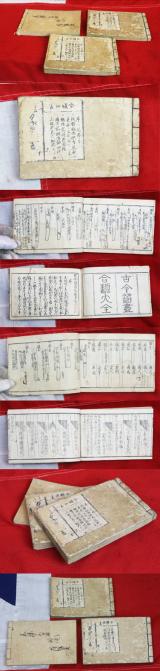
A Rare Collection of Three Original Early Edo Woodblock Hand Printed Books of Samurai Sword Oshigata, of Blade Forms Hamon and Kanji. Ideal For A Scholar Of Samurai Sword Master Makers, Or, A Collector Of Rare Samurai Sword History. Rarely Seen In England
Genealogy, history, plus hundreds of Samurai blades, engravings, blade patterns plus more
swords and sword making. An early printing and of amazing interest. For the not only academic study of the signatures on blade tangs, plus hamon patterns and horimono {blade decorative carvings} by old samurai sword master swordsmiths, but to wonder of the unique aspects of each sword blade and how the reverential study of all aspects of sword making that is unique to Japan for over 1000 years. These superb and beautiful hand made volumes are thus also fascinating and unique works or art, in themselves, hundreds of years old, and created for the study and enjoyment of the art of the true samurai sword.
These volumes of hand made, hand woodblock printed books, detail many aspects of very special swords and their makers. For example, one section of the volumes show hand drawn versions of smiths hamon temper lines the specialised hardening process of every sword’s edge.
Yaki-ire: Hardening the Edge
The hardening of the edge is in many ways the most important, and the most difficult, aspect of the sword-making process. It is the hardening of the edge that gives the blade its ability to take and retain amazing sharpness. To begin with, the blade is coated in yakibatsuchi, a mixture of water, clay, ash, and other ingredients. Every smith has his own special recipe, often a closely kept secret. The yakibatsuchi is applied over the surface, thicker along the spine and thinner at the edge. Working in a darkened forge room using only the light of the glowing coals, the smith carefully heats the blade. As the temperature rises, crystal structures within the metal begin to change. The smith carefully observes the color of the glowing blade, and when the critical temperature is reached the sword is quickly quenched in a trough of water.
At the critical temperature, around 750°C, the structure of steel changes to austenite, a phase where carbon thoroughly combines with iron. When the blade is quickly cooled by quenching, austenite changes to martensite, the hardest type of steel. However, where the thick yakibatsuchi was applied, the blade will cool more slowly, turning not into martensite but instead forming ferrite and pearlite, which are softer and more flexible. Like the kawagane and shingane, this combination of hard edge and softer body is what gives the blade its desirable qualities.
The hardening of the edge also creates a visible change in the surface of the metal. Depending on the way in which the clay mixture was applied, a variety of effects can be produced. This edge pattern is called the hamon, and is one of the most important aspects in the aesthetic appearance of a blade. Like the jihada, each of these patterns has a specific name. Suguha, for example, is a very straight hamon, while sanbonsugi describes a zigzag line in clusters of three.
After the hardening of the edge, if the smith is satisfied with the appearance and quality of the blade, it is then passed on to the polisher, who will give the blade its final partial mirrorlike polish, with a mixture of light and shade, displaying many different shades of grey steel, and then other craftsmen will make the scabbard {saya} and sword mountings {koshirae}. Complete mountings have many elements, including metalwork such as tsuba and menuki, lacquered wood, silk cords and wrapping, and ray-skin grips. Though these are all works of art in themselves, and some of these fittings can indeed be almost priceless in their beauty quality and indeed value, in their own right, but the blade remains the true centerpiece of the finished work, and in fact the age of the blade dictates the time period of the age of the whole sword, despite how ever old or young it’s additional fittings may be. It combines to be an example of the ingenuity of centuries of Japanese smiths and their desire to achieve the perfect blend of technology and art. read more
895.00 GBP
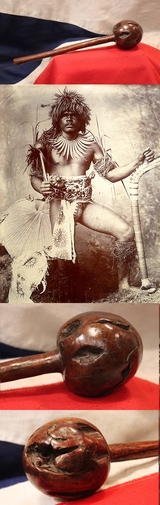
A Most Fine & Beautiful, Rare 18th Century Antique, Fijian Ula Drisia South Seas Island Warrior’s Throwing Club. From the Captain Cook Period Showing Excellent Natural Age Patination
Captain James Cook sighted Fiji during his second voyage in 1774, specifically sighting the island of Vatoa. However, he did not land on or explore any other Fijian islands during that voyage. While Cook's sighting is noted, some travel sites say he's credited with combining the Tongan name "Fisi" and the Fijian name "Viti" to arrive at the name "Fiji".
Superbly patinated root ball with geometrically carved handle. The ula was the most personal weapon of the Fijian warrior and was inserted into a man's fibre girdle sometimes in pairs like pistols. The throwing of the ula was achieved with great skill, precision and speed. It was often carried in conjunction with a heavier full length club or spear which served to finish an opponent after initially being disabled by a blow from the ula. Was made by a specialist from a variety of uprooted bushes or shrubs. Across 1,000 kilometres (620 miles) from east to west, Fiji has been a nation of many languages. Fiji's history was one of settlement but also of mobility. Over the centuries, a unique Fijian culture developed. Constant warfare and cannibalism between warring tribes were quite rampant and very much part of everyday life. During the 19th century, Ratu Udre Udre is said to have consumed 872 people and to have made a pile of stones to record his achievement."Ceremonial occasions saw freshly killed corpses piled up for eating. 'Eat me!' was a proper ritual greeting from a commoner to a chief. The posts that supported the chief's house or the priest's temple would have sacrificed bodies buried underneath them, with the rationale that the spirit of the ritually sacrificed person would invoke the gods to help support the structure, and "men were sacrificed whenever posts had to be renewed" . Also, when a new boat, or drua, was launched, if it was not hauled over men as rollers, crushing them to death, "it would not be expected to float long" . Fijians today regard those times as "na gauna ni tevoro" (time of the devil). The ferocity of the cannibal lifestyle deterred European sailors from going near Fijian waters, giving Fiji the name Cannibal Isles; as a result, Fiji remained unknown to the rest of the world. The handle has a natural age split at the base. read more
1650.00 GBP