
Japanese


An Ancient Nambokochu Han Dachi Mounted Nambokochu Period Samurai Koto Era Katana up to 600 Years Old
The sword in many ways looks just as it looked many centuries ago, and it has been lovingly cared for since it came from Japan to England 150 years ago, in the reign of the Meiji emperor .
The blade looks stunning with a typical ancient Koto, very narrow, suguha hamon of great simplicity and elegance.
All original Edo period han dachi mounts and the menuki, under the blue silk ito, are dragon with gold eyes over traditional samegawa.
Made during the late Nambokochu 1333 to 1391 period, to the early Muramachi period, that dates from 1392 to 1573. Han dachi mounted, with a very nice, original Edo period, matching suite of full mounts with gold and silver tendrils inlaid over iron. Round iron tsuba with inlays. Original ishime stone finish lacquer saya.
Han-dachi semi-tachi} can be displayed on a tachi stand (tachi-kake), usually with the handle pointing down, blade up for respect/preservation (preventing sheath damage), and sometimes the signature (mei) facing outward, though it's a matter of preference and historical context.
Han-dachi originally appeared during the Muromachi period when there was a transition taking place from Tachi to katana. The sword was being worn more and more edge up when on foot, but edge down on horseback as it had always been. The handachi is a response to the need to be worn in either style. The samurai were roughly the equivalent of feudal knights. Employed by the shogun or daimyo, they were members of hereditary warrior class that followed a strict "code" that defined their clothes, armour and behaviour on the battlefield. But unlike most medieval knights, samurai warriors could read and they were well versed in Japanese art, literature and poetry.
Samurai endured for almost 700 years, from 1185 to 1867. Samurai families were considered the elite. They made up only about six percent of the population and included daimyo and the loyal soldiers who fought under them. Samurai means one who serves."
Samurai were expected to be both fierce warriors and lovers of art, a dichotomy summed up by the Japanese concepts of bu to stop the spear expanding into bushido (the way of life of the warrior) and bun (the artistic, intellectual and spiritual side of the samurai). Originally conceived as away of dignifying raw military power, the two concepts were synthesised in feudal Japan and later became a key feature of Japanese culture and morality. The quintessential samurai was Miyamoto Musashi, a legendary early Edo-period swordsman who reportedly killed 60 men before his 30th birthday.
In Japan the term samurai evolved over several centuries
In Japanese, they are usually referred to as bushi (武士,) or buke (武家). According to translator William Scott Wilson: "In Chinese, the character 侍 was originally a verb meaning 'to wait upon', 'accompany persons' in the upper ranks of society, and this is also true of the original term in Japanese, saburau. In both countries the terms were nominalized to mean 'those who serve in close attendance to the nobility', the Japanese term saburai being the nominal form of the verb." According to Wilson, an early reference to the word samurai appears in the Kokin Wakashū (905–914), the first imperial anthology of poems, completed in the first part of the 10th century.
Originally, the word samurai referred to anyone who served the emperor, the imperial family, or the imperial court nobility, even in a non-military capacity.It was not until the 17th century that the term gradually became a title for military servants of warrior families, so that, according to Michael Wert, "a warrior of elite stature in pre-seventeenth-century Japan would have been insulted to be called a 'samurai'".
In modern usage, bushi is often used as a synonym for samurai
40 inches in saya blade 28 inches
Every item is accompanied with our unique, Certificate of Authenticity. Of course any certificate of authenticity, given by even the best specialist dealers, in any field, all around the world, is simply a piece of paper,…however, ours is backed up with the fact we are the largest dealers of our kind in the world, with over 100 years and four generation’s of professional trading experience behind us read more
7450.00 GBP

A Most Fine & Attractive Antique Pre Edo Period Koto Han Dachi Mounted {Semi Tachi Style} Samurai Katana With A Superb Blade in Near Pristine Condition
With two part hidden secret compartment fuchi, for concealing small intelligence notes.
Circa 550 years old, and a delight to observe the wonderful elegant curvature to the blade. It has all original Edo period mounts fittings and saya, with original saya intricately patterned pine needle urushi lacquer. Typical original Edo period handachi mounts of matching, kashira, sayajiri, kurigata in a crashing wave takebori design of gilded brass, and a brass fuchi that is disguised to conceal it seperates into two parts to reveal a very narrow section to conceal small script notes. With a beautiful Edo mokko form iron tsuba with gold onlay of immortals one holding a staff, another reading a scroll held by a third figure, beneath a prunus tree . All untouched for over 150 years since it arrived in England in the 1870's. It has a very active undulating notare hamon, and fine grain within the hada, on the stunning blade, and it’s all original Edo period tsukaito binding to the hilt, in black silk, wrapped over a pair of gilt dragon menuki, and overall it has usual light signs of wear and use upon the saya, with age appropriate wear as to be expected.
Han-dachi originally appeared during the Muromachi period when there was a transition taking place from Tachi to katana. The sword was being worn more and more edge up when on foot, but edge down on horseback as it had always been. The handachi is a response to the need to be worn in either style. The samurai were roughly the equivalent of feudal knights. Employed by the shogun or daimyo, they were members of hereditary warrior class that followed a strict "code" that defined their clothes, armour and behavior on the battlefield. But unlike most medieval knights, samurai warriors could read and they were well versed in Japanese art, literature and poetry.
The samurai were roughly the equivalent of feudal knights. Employed by the shogun or daimyo, they were members of hereditary warrior class that followed a strict "code" that defined their clothes, armour and behaviour on the battlefield. But unlike most medieval knights, samurai warriors could read and they were well versed in Japanese art, literature and poetry.
Samurai endured for almost 700 years, from 1185 to 1867. Samurai families were considered the elite. They made up only about six percent of the population and included daimyo and the loyal soldiers who fought under them. Samurai means one who serves."
Samurai were expected to be both fierce warriors and lovers of art, a dichotomy summed up by the Japanese concepts of bu to stop the spear expanding into bushido (the way of life of the warrior) and bun (the artistic, intellectual and spiritual side of the samurai). Originally conceived as away of dignifying raw military power, the two concepts were synthesised in feudal Japan and later became a key feature of Japanese culture and morality.The quintessential samurai was Miyamoto Musashi, a legendary early Edo-period swordsman who reportedly killed 60 men before his 30th birthday and was also a painting master. Members of a hierarchal class or caste, samurai were the sons of samurai and they were taught from an early age to unquestionably obey their mother, father and daimyo. When they grew older they may be trained by Zen Buddhist masters in meditation and the Zen concepts of impermanence and harmony with nature. The were also taught about painting, calligraphy, nature poetry, mythological literature, flower arranging, and the tea ceremony.
it has been said that part of their military training, samurai were taught to sleep with their right arm underneath them so if they were attacked in the middle of the night and their the left arm was cut off the could still fight with their right arm. Samurai that tossed and turned at night were cured of the habit by having two knives placed on either side of their pillow.
Samurai have been describes as "the most strictly trained human instruments of war to have existed." They were expected to be proficient in the martial arts of aikido and kendo as well as swordsmanship and archery---the traditional methods of samurai warfare---which were viewed not so much as skills but as art forms that flowed from natural forces that harmonized with nature.
Some samurai, it has been claimed, didn't become a full-fledged samurai until he wandered around the countryside as begging pilgrim for a couple of years to learn humility. When this was completed they achieved samurai status and receives a salary from his daimyo paid from taxes (usually rice) raised from the local populace.
Japanese lacquer, or urushi, is a transformative and highly prized material that has been refined for over 7000 years.
Cherished for its infinite versatility, urushi is a distinctive art form that has spread across all facets of Japanese culture from the tea ceremony to the saya scabbards of samurai swords
Japanese artists created their own style and perfected the art of decorated lacquerware during the 8th century. Japanese lacquer skills reached its peak as early as the twelfth century, at the end of the Heian period (794-1185). This skill was passed on from father to son and from master to apprentice.
Some provinces of Japan were famous for their contribution to this art: the province of Edo (later Tokyo), for example, produced the most beautiful lacquered pieces from the 17th to the 18th centuries. Lords and shoguns privately employed lacquerers to produce decorated samurai sword saya and also ceremonial and decorative objects for their homes and palaces. read more
6950.00 GBP

A Beautiful Unokubi Zukuri Blade Samurai Armour Piercing Tanto. Ise-ebi or Kamakuraebi Sayajiri 鞘尻, & Matching Matsushiro Sinano School Kozuka and Kogai. 16th To 17th Century Blade, Original Edo Koshirae, Of Nagano Province
A wonderful earliest Shinto bladed armour piercing tanto, with its unique original Edo period “Matsushiro” koshirae made in Matsuro-han in Shinano (Nagano) province, with a Matsuhiro kamakuraebi lobster tail mount on the end of the deep red urushi lacquer saya, that is overdecorated with black speckling and dragonflies.
Sometimes called "the old man of the sea" because of its bent back, the Japanese lobster (ise-ebi or kamakuraebi) is a symbol of longevity. Here it appears on the saya as a sayajiri but it can also appear in many ways, such as the back of a vest worn for theatrical performances. Kyōgen is a comic form of Japanese theatre performed together with the more serious Noh. Boldly patterned overvests (kataginu) were worn for important kyōgen roles, such as Tarōkaja, the comical servant.
Unokubi (鵜首): Is an uncommon tantō blade style akin to the kanmuri-otoshi, with a back that grows abruptly thinner around the middle of the blade; however, the unokubi zukuri regains its thickness just before the point. There is normally a short, wide groove {hi} extending to the midway point on the blade, this is a most unusual form of unokubi zukuri blade tanto with a short wide hi. It has a copper, habaki, with original Edo period lacquered saya large with lobster form Sayajiri 鞘尻 & a fully matching suite of sinchu and contrasting silver line mounts to the kozuka and kogai of the fine Matsushiro Sinano school, including the tsuba and fuchi kashira. Carved buffalo horn fittings and kurikata. the original Edo urushi lacquer is over decorated with speckles and black dragonflies in flight. The tsuka is also bound in rare, original Edo period micro thin tsuka-ito. Over a fine pair of shakudo menuki of butterflies and a bird combined.
Japan was once known as the “Land of the Dragonfly”, as the Emperor Jimmu is said to have once climbed a mountain in Nara, and looking out over the land, claimed that his country was shaped like two Akitsu, the ancient name for the winged insects, mating.
Dragonflies appeared in great numbers in 1274 and again in 1281, when Kublai Khan sent his Mongol forces to conquer Japan. Both times the samurai repelled the attackers, with the aid of huge typhoons, later titled Kamikaze (the Divine Winds), that welled up, destroying the Mongol ships, saving Japan from invasion. For that reason, dragonflies were seen as bringers of divine victory.
Dragonflies never retreat, they will stop, but will always advance, which was seen as an ideal of the samurai. Further, although the modern Japanese word for dragonfly is Tombo, the old (Pre Meiji era) word for dragonfly was Katchimushi. “Katchi” means “To win”, hence dragonflies were seen as auspicious by the samurai.
Japanese lacquer, or urushi, is a transformative and highly prized material that has been refined for well over 7000 years. The use of natural lacquer, known as urushi, has a 9,000-year history in Japan. Lacquered artifacts dating back to the prehistoric Jomon period (10,000–300 BCE) have been found at various archeological sites throughout Japan.
Cherished for its infinite versatility, urushi is a distinctive art form that has spread across all facets of Japanese culture from the tea ceremony to the saya scabbards of samurai swords
Japanese artists created their own style and perfected the art of decorated lacquerware during the 8th century. Japanese lacquer skills reached its peak as early as the twelfth century, at the end of the Heian period (794-1185). This skill was passed on from father to son and from master to apprentice.
The blade has an amazingly vibrant and active hamon.
It has spent two full weeks in our workshop being conserved and cleaned by hand by our artisans for around 65 hours, returning it to near exactly how it looked 150 years ago. Of course there are slight signs of natural wear and aging on the exterior etc., but it was important to leave this as intact as possible to complete a museum grade conservation.
Every item is accompanied with our unique, Certificate of Authenticity. Of course any certificate of authenticity, given by even the best specialist dealers, in any field, all around the world, is simply a piece of paper,…however, ours is backed up with the fact we are the largest dealers of our kind in the world, with over 100 years and four generation’s of professional trading experience behind us read more
4550.00 GBP
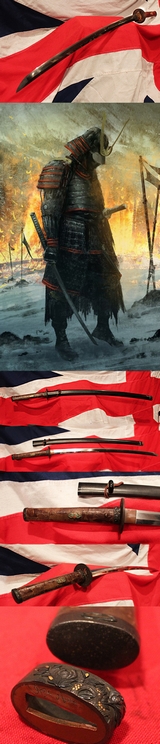
A Most Fine & Beautiful Koto Period Katana Signed Sukesada of Bizen Dated 1560. With Original & Exceptionally Rare Original Dutch Black-ship 1540’s Imported Leather Bound Tsuka. With Original Japanese Insect Pattern Embossing
Signed Bizen kuni ju Osafune Sukesada. One of the Sukesada, Bizen smiths. A very nice Koto blade, that has seen battle, with fine mounts and, most unusually, a very interestingly, embossed Dutch leather, called goudleer, bound tsuka, with cloisonne enamel menuki. Embossed Dutch leather goudleer was imported to Japan by the Dutch and Portuguese in the 16th century and was highly prized as screens and other decorative works of art. We have also seen, although most rarely, other items decorated with this distinctive Dutch leatherwork such as samurai purses and saya coverings. The embossing on the leather are various insects, highly popular in samurai fittings decor. The fushi tsuka mount is very fine, signed by the maker, and decorated with flowers and gold buds.
Insects in general have been celebrated in Japanese culture for centuries. The Lady Who Loved Insects is a classic story of a caterpillar-collecting lady of the 12th century court; the Tamamushi, or Jewel Beetle Shrine, is a seventh century miniature temple, once shingled with 9,000 iridescent beetle forewings. In old Japanese literature, poems upon insects are to be found by thousands, Daisaburo Okumoto is director of the Fabre Insect Museum. An avid insect collector and a scholar of French literature, he has translated many of Fabre's works. He ascribes the popularity of insects in Japan to national character. It seems like Japanese eyes are like macro lenses and Western eyes are wide-angle, he says. A garden in Versailles, it's very wide and symmetrical. But Japanese gardens are continuous from the room and also very small. We feel calm when we look at small things. The medieval Japanese monk Yoshida Kenko put it this way: “If man were never to fade away like the dews of Adashino, never to vanish like the smoke over Toribeyama, how things would lose their power to move us”
Harima, Mimasaka and Bizen provinces were prospering under the protection of the Akamatsu family. Above all, Bizen province turned out a great many talented swordsmiths. A large number of swords were made there in the late Muromachi period not only supplying the demand of the Age of Provincial Wars in Japan but also as an important exporting item to the Ming dynasty in China. At the onset of the decline of the Ashikaga shogunate in 1565 ad., and Yoshiteru's assassination the shogunate of Yoshiteru was filled by his two-year old son, Yoshiaki. Yoshiteru's brother was the abbot of a Buddhist monastery. He resigned this position and attempted to assume the shogunate. These efforts ultimately failed. The demand for swords began an accent to unimaginable levels. The national unrest and violent civil war did not cease until the successful takeover of the shogunate by Tokugawa Iyeyasu. The "Osafune - Kozori" group was the major supplier of blades for these events. 29 inch blade Tsuba to tip. On just one side of the blade there are combat stress hagire marks near the top section. This blade has certainly seen combat, and is simply ideal for the historical collector of beautiful samurai weaponry of battle, rather than those seeking blade condition perfection. 40 inches long approx overall in saya read more
6450.00 GBP

This Is A Truly Fabulous Ancestral Bladed WW2 Officer's Katana With A Rare Shinto Blade, Circa 1615, Signed Hizen no Kuni Ju Nin {Suriage, Tadayoshi} 肥前国住人 & 忠吉作 相模守義道 Bearing the Signatures of Two Master Sword Smiths of Both Hizen and Osaka
We have spent numerous decades, seeking the best and most historical ancestral bladed WW2 Japanese officers swords to be found. All with original, early samurai sword blades, many hundreds of years old, but this week we have found from impeccable sources three superb examples, two of them extraordinary rare examples.
This beauty has a most historical and unique Shinto blade, which is both signed by Hizen no Kuni Ju Nin (suriage} Tadayoshi {the original master smith} and further inscribed and signed on the reverse side of the nakago, Tadayoshi, followed further down with, "shortened {in 1737} by Sagami no Kami Minamoto Yoshimichi ". This fine ancestral blade, with two udenka-ana, is fitted within its very fine, hand made bespoke shin gunto military mounts, with its tsuka {hilt} field service fully leather covered, a traditional Edo circular iron sukashi tsuba, and the saya is matching with its field service leather covered over wood. Interestingly the tsuka field service leather has, on half its length, traditional diamond 'windows' carved through the surface leather, to reveal its traditional Edo period menuki beneath. A very special, yet small feature, but incredibly interesting, and we can't recall ever seeing such work of its like created before. Especially since we have handled, likely more Japanese swords {in our 104 years} than any other company in the world
The phrase "Tadayoshi shortened by Sagami no Kami Minamoto Yoshimichi" refers to a specific type of Japanese sword inscription where a famous Tadayoshi (often Hizen Tadayoshi lineage) sword had its signature shortened or altered by another renowned smith, Sagami no Kami Minamoto Yoshimichi (possibly 3rd Gen), often for quality control or to indicate a collaboration/re-tempering, showcasing two major Edo-period sword-making schools in one blade, a significant find for collectors.
Tadayoshi: Refers to the famous Hizen Tadayoshi school of swordsmiths from Saga, prominent in the early Edo period, known for their domain-sponsored production.
Sagami no Kami Minamoto Yoshimichi was a skilled Osaka-based smith, often associated with the Mishina school, known for his exceptional hamon (temper lines), particularly choji midare.
"Shortened by": This usually means Yoshimichi re-worked or finished a sword originally made by a Tadayoshi smith, sometimes signing his own name (Sagami no Kami Yoshimichi) alongside or over the original signature, perhaps to enhance quality or attest to its excellence.
Effectively this is a most rare blade showing two master swordsmith's names that worked upon a single blade. The second smith inscribed it when he re-worked the blade, around 100 years after the first smith originally crafted the blade: It combines two highly respected names from different major sword-making centres (Hizen and Osaka).
Such rare blades are much prized by collectors, highlighting master craftsmanship and unique historical moments in Japanese sword history,
The subject smith Yoshimichi 義道 with Sagami-no-kami 相模守 title was a student {and later master} of 2nd gen. Ouomi-no-kami Hisamichi 近江守久道. He was born in Hyuga Province (now in Miyazaki pref.) in Kyushu island. His real name was Tomita Jin-uemon 冨田甚右衛門. It is said that he also lived and worked in Hiroshima, Aki province (now in Hiroshima pref.).
'If' this katana was indeed made by the 1st generation Tadayoshi 忠吉, the recognized production year is judged on about Kencho 20 (ca.1615) from it's inscription. His katana's preserved the typical shape that became widespread during Keicho (1596-16) period. From his workmanship, Tadayoshi was very much influenced by the Soshu-Bizen works during Nanbokucho period
The first generation Tadayoshi was born in Genki 3 (1572) as a son of sword maker Hashimoto Michihiro 橋本道弘 in Nagase town, Saga district. He became separated from his father Michihiro 道弘 who died of a disease and grandfather Morihiro 盛弘 who met death in the battle of Shimabara at the same time in the 3rd month Tensho 12 (1584) when he was as young as 13 years old. He was compelled to serve his apprenticeship to the other local sword makers in his young ages. However he excelled in as a superior sword maker since teen age and finally was picked out by feudal lord Nabeshima Katsushige 鍋島勝茂.
Keicho 1 (1596), when he was 25 years old, he went up to Kyoto to join the famed school of Umetada Myouju 埋忠明寿 and learn the most updated culture and technique for three years.
From on about Keicho 18 (1613) down to Kanei 1 (1624) he intentionally used the other inscription of "Hizen-koku-junin Tadayoshi-saku" 肥前国住人忠吉作 mainly for those unconventional artworks which are out from the standard works of Tadayoshi's studio as if he challenged to make an innovative artworks to try using different sence of technique from antcient times and regions.
He passed away in the 15th day, the 8th month of Kanei 9 (1632), was 61 years old.
There is one most intriguing point about this fine blade. It was intentionally shortened by another master smith, Minamoto Yoshimichi, of high repute, thus, if it wasn't highly revered at the time {in 1727} why do this?, and thus, inscribe it accordingly.
Surely, one would never contemplate such a very special and most expensive treatment for the blade, if it was not of great significance of its owner at that time. Additionally, the master smith who shortened it and signed it accordingly, {Minamoto Yoshimichi} would likely never put his name to a blade he considered not correct, and thus, inferior to his efforts.
The blade is in good, original Edo polish, with small aged surface thinning, and a few minuscule edge nicks and the koshirae are in superb condition for a WW2 mounted officer's sword read more
5450.00 GBP

A Simply Stunning Ancestral Bladed WW2 Officer's Sword With a Blade Circa 1665, Signed, Yamashiro Koku Jyu Minamoto Tsunahiro (山城国住源綱廣). It Is Extremely Likely An Ancestral Bladed War Service Sword Of a Surrendered General Or at Very Least a Colonel.
The condition of the full original koshirae is exemplary for age, which certainly indicates it was carried by an officer of the highest rank, plus, the small hole in the kabutogane {tsuka pommel} indicates it once held a silver clan mon {family crest}, that was removed, by design, just before its surrender, so as not to insult the memory of his noble clan and ancestors for his ignoble surrender. Plus, it has, and this is always a very good indicator of a blade of high standing and esteem, a two part gold habaki {blade collar} with two distinct types of design that interlock together, the top section with vertical takebori multi ribbing, the bottom section with diagonal engraving.
This blade is in fabulous condition for age showing a stunning midare hamon and nashiji hada, signed Yamashiro Koku Jyu Minamoto Tsunahiro(山城国住源綱廣). He was active as a master smith, and sword-forging during the Kanbun-Jyokyo era (1661-1688: the early Edo period), and judging from his remaining work and historical records. Therefore, we believe it was made about 350 years ago.
Yamashiro koku is the province’s name in the Kyoto area, and Jyu means living {in Japanese}. The signature indicates that this blade was created when Tsunahiro lived in Yamashiro Koku. There are also records of him signing as Omi no Kami Minamoto Tsunahiro. Omi no Kami is the title given to only selected swordsmiths whose sword-forging techniques were excellent.
Yamashiro province was famous for its sword-making style called Yamashiro-Den. Yamashiro-Den's origin dates back to the Heian period (794 A.D) when the capital city was moved from Nara to Kyoto. The swordsmiths in Yamashiro province initially prospered by forging swords for court nobles and imperial families. Later on, they also forged swords for feudal lords after Samurai military government took control of Japan. There are so many renowned swordsmiths from this region. It is said that the founder of Yamashiro-Den was Sanjo Munechika. And there are seven prestigious schools in this region. One of the most characteristics of Yamashiro-Den is its elegant design and beautiful Jigane.
Tsunahiro would certainly be the smith of choice for samurai nobles in the 17th century of very high rank, and their descendants could, or indeed would, certainly be likely such as Generals, and army commanders during WW2. read more
5750.00 GBP

A Stunning, Antique, Edo Period Circa 1660 'Dragon Horimono' Shinto Horseman's Katana. With A Carved Horimono Blade of a Dragon. With a Superb Suguha Hamon That Transforms With Choji Elements At The Top Section
A very impressive, beautiful and substantial original katana of a horseman samurai, that has both incredible beauty, yet conveys a considerable sense of power through its length and heft. From the Shinto period likely from 1640 to around 1680-1700. All the koshirae and the blade are in super condition for age.
A large iron plate mokko tsuba with mimi, decorated with a village scene with gold highlights. the fuchi kashira are matching with a rattan screen pattern showing gold decorated blooms. a superb black isheme stone finish saya, and finest black tsukaito binding wrapped over fine menuki, and traditional samegawa {giant rayskin}.
Horimono, a type of carving, often adds other decorative Horimono to the blade in addition to grooves. The properties of horimono are usually traditional images, such as swords, dragons, deities, Buddhist patterns, bonji, Chinese characters, and so on.Among the blades of the Koto period of sword manufacture (1600), many of the carvings display religious meaning: Bonji (sanskrit), Su-ken, Fudo Myo-o,Kurikara, Sanko-tsuki-ken, Goma-bashi, Hachiman-daibosatsu, Namu-myoho-renge-kyo, and Sanjuban-shin.In the Shinto period of swordmaking (1600), the carvings become more decorative with depictions of cranes and turtles, ascending and descending dragons, shochikubai (pine, bamboo and plum), and the deity of wealth, Daikoku.These images are carved with hammers hitting small chisels of various sizes. The internal surface of horimono is ground smoothly and finely, and polished during the polishing process. Making horimono is both difficult and time-consuming; Swordsmiths mostly carve grooves and simple Sanskrit characters themselves, while the more magnificent horimono is made by specialized craftsmen. After deciding which image to use, carefully draw a detailed pattern with a brush at the position to be carved, and then complete the horimono. The ideal horimono has a moderate proportion, the size matches the word to be carved, and is engraved in the appropriate position
The decorative horimono were introduced during the Edo period on the katanas and are generally larger than the votive ones. They often depict a dragon, taking up traditional iconography but using superfine techniques to embellish the blade.
The blade is in super condition for age with just a few very small thin natural age surface marks. See photo 3, on the far right hand blade picture in the photo group read more
7450.00 GBP

A Truly Beautiful Antique Koto Period, 'Dragon Head' Hamon, Unokubi (鵜首) Zukuri Blade Tantō. In a Chesnut and Sable Livery, Matsushiro Sinano Koshirae With Kozuka and Kogai, with Higo Scool Tsuba Inlaid With Pure Gold Sakura {Cherry Blossom}
Mounted with a fully matching suite of sinchu and contrasting silver line mounts, including the kozuka and kogai of the fine Matsushiro Sinano school. The Edo period iron tettsu Higo school tsuba is inlaid with pure gold cherry blossom. A very similar Higo school tsuba can be seen in the Osafune sword Museum in Japan, mounted upon a Tomonari, Sukesada blade tanto sword.
The kozuka and kogai pockets in the saya are lined with delicate, doe skin, decorated with a black and red pattern, on a natural white skin ground, in the same form as can see seen to embellish kabuto and armour {see photo 8 in the gallery}.
Wonderful chessnut brown ishime stone finish lacquer saya, with a contrast of sable brown tuskaito silk binding, wrapped over pure gold kiri mon menuki, on shakudo bar ground, over traditional samegawa {giant rayskin}.
The stunning blade has a beautiful intricate hamon, including, where the yakiba meets the hada the detailed head of a dragon. A very small combat surface mark to one side of the blade, likely made by a blade tip {see both detailed in photo 10}.
Unokubi (鵜首): An uncommon tantō style akin to the kanmuri-otoshi, with a back that grows abruptly thinner around the middle of the blade; however, the unokubi zukuri regains its thickness just before the point. There is normally a short, wide groove {hi} extending to the midway point on the blade, this is a most unusual form of unokubi zukuri blade tanto without a hi.
Historically significant and intricately crafted, Japanese swords offer a unique glimpse into Japanese society. Compared to traditional Japanese blades, the Tanto stands out for its beauty, adaptability, and rich cultural importance. But of course, not everyone is well-familiar with this samurai sword form. Despite being traditional dagger sized all Japanese blades are titled as swords however short they may be.
The Matsushiro Shinano Koshirae is a distinctive style of antique Japanese sword mounting (koshirae) that originated in the Matsushiro domain of Shinano Province (present-day Nagano Prefecture) during the Edo period. This style is specifically characterized by the use of brass (shinchu) for all of its metal fittings.
Key Characteristics
The defining feature is the uniform use of brass for all components of the sword furniture, including the fuchi (hilt collar), kashira (pommel), tsuba (handguard), kojiri (scabbard tip), kozuka (small utility knife handle), and kogai (spike).
These fittings often feature intricate decorations, such as bamboo or other natural patterns, sometimes with silver striping or designs.
Matsushiro was a castle town developed by the Sanada family in the early Edo period. It is believed that many domains developed their own distinct styles of koshirae during this era, and the Matsushiro koshirae was a local specialty.
The koshirae was the ornate, functional exterior of a samurai's sword, designed for both aesthetic appeal and practical use, in contrast to the plain wooden shirasaya used for storage.
Swords with original Matsushiro koshirae are considered unique historical artifacts and are highly valued by collectors for their complete, matching sets of fittings.
For example one of the great tanto swords of samurai history is “Tanto Mei Bishu Osafune Jyu Nagayoshi” (短刀 銘 備州長船住長義) it is a tanto made by the swordsmith “Osafune Nagayoshi” (Osafune Nagayoshi / Chogi) who was active in Bizen Province (currently eastern Okayama Prefecture) during the Nanbokucho period. This tanto was a favorite of Toyotomi Hideyoshi, and later it was received by Toyotomi’s retainer “Maeda Toshiie” at Osaka Castle (Osaka Castle), and since then it has been handed down to the Maeda family of Kaga Domain, making it a prestigious famous sword.
The swordsmith, Osafune Nagayoshi, is one of the “Osafune Four Heavenly Kings” representing the “Osafune School”, a group of swordsmiths that flourished in Bizen Province, and is also listed among the “Masamune Jittei” (Masamune’s Ten Disciples), the ten high disciples of the swordsmith Masamune, who is called the “Ancestor of the Revival of Japanese Swords”.
Photo in the gallery of a Tanto sword, by Sadamune, Kamakura period, 1300s AD - Tokyo National Museum - Ueno Park, Tokyo, Japan. This shows how their samurai swords are displayed in the greatest Japanese museum in Tokyo. The koshirae {fittings} are always shown separately, if at all.
The antique Chinese display stand the tanto is shown upon is a superb hand carved hongmu hardwood piece, Ching Dynasty, and originally displayed a piece of the of finest Chinese Imperial Jade once featured in a Mandarin's palace in Peking, and you will see it featured throughout our online Japanese sword gallery to display wakazashi and tanto. It isn't for sale as it has been used by the family in our gallery for around 100 years.
Over the centuries some extraodinarily talented bladesmiths have integrated within their blades a form of identfiable mark, one smith creates rabbit ears in his hamon, several others feature the profile of Mount Fuji, and even one features Mount Fuji with birds flying over head. This smith has created a dragon's head into his hamon, with utterly remarkable skill. It is possible you may never ever see another surviving example.
Overall 13.5 inches long, blade 8.25 inches long tip to tsuba. read more
4950.00 GBP
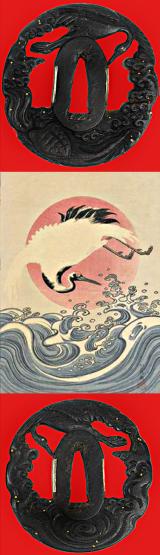
A Beautiful Omori School Tsuba Turbulant Sea With Crashing Waves and A Crane Swooping Over Turtle Below.. Edo Period
The crane and the turtle have a significant position in Japanese folk lore and tradition, as both symbolically represent longevity in Japanese art.
The shibuichi tsuba of marugata shape, with a kozuka and kogai hitsu-ana, the nakago-ana with some suaka sekigane, finely worked takabori and takazogan to depict breaking waves carved in the typical manner of the Omori school with inlaid gold spray drops. Sekigane. Late 18th century, Edo period (1615-1868)
Tsuba were made by whole dynasties of craftsmen whose only craft was making tsuba. They were usually lavishly decorated. In addition to being collectors items, they were often used as heirlooms, passed from one generation to the next. Japanese families with samurai roots sometimes have their family crest (mon) crafted onto a tsuba. Tsuba can be found in a variety of metals and alloys, including iron, steel, brass, copper and shakudo. In a duel, two participants may lock their katana together at the point of the tsuba and push, trying to gain a better position from which to strike the other down. This is known as tsubazeriai pushing tsuba against each other.
A closely related shibuichi tsuba with waves {omitting the crane and turtle} by Omori Teruhide is in the Museum of Fine Arts, Boston, accession number 11.5454.
Koryūsai Isoda, woodblock print, of a crane flying over crashing waves.
64mm read more
625.00 GBP
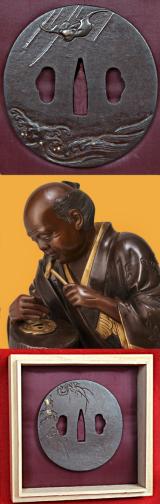
A Beautiful & Stunning Edo Period Tetsu Round Tsuba Of a Bat Flying in Rain Over Turbulant Seas.
The reverse is a willow carved in sunken relief, all upon a russet ground. somewhat reminiscent of the work my master Kenzui,
In Japanese folklore, bats are often associated with good luck and prosperity. One popular folktale is the story of "Bakeneko," a mythical creature resembling a cat with bat-like features. Bakeneko is believed to bring blessings and protection to households, particularly during times of hardship.
In the context of kimono designs, the depiction of bats holds specific symbolism. Bats are often featured alongside other auspicious motifs such as the pine, bamboo, and plum—traditional symbols of longevity, resilience, and prosperity. When bats are included in these designs, they reinforce the notion of good fortune and longevity, making them popular motifs for celebratory occasions such as weddings and New Year's festivities.
During the Meiji period (1868-1912), Japan underwent significant cultural and societal transformations. Bats continued to be prominent symbols during this era, often depicted in art and textiles as representations of prosperity and modernisation. As Japan embraced Western influences and embarked on industrialisation, the symbolism of bats evolved to reflect aspirations for economic growth and social advancement. Bats were frequently incorporated into decorative arts, such as ceramics and textiles, to convey wishes for prosperity and success in the changing landscape of Meiji Japan.
72mm read more
895.00 GBP