
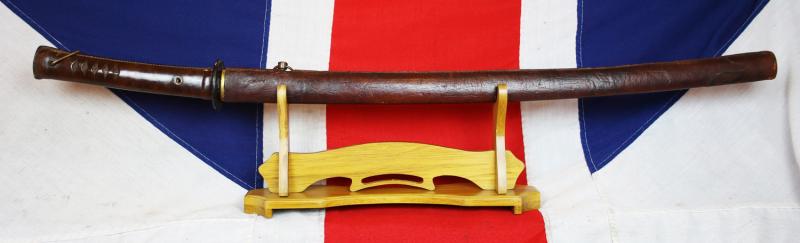
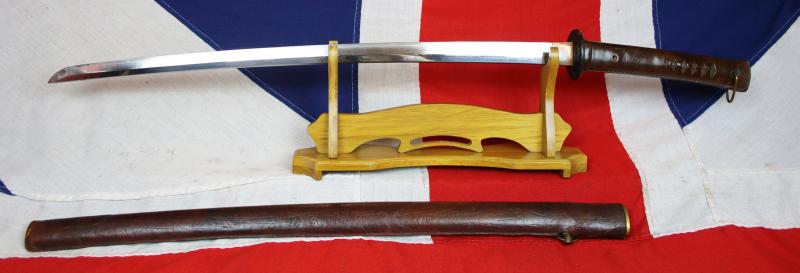


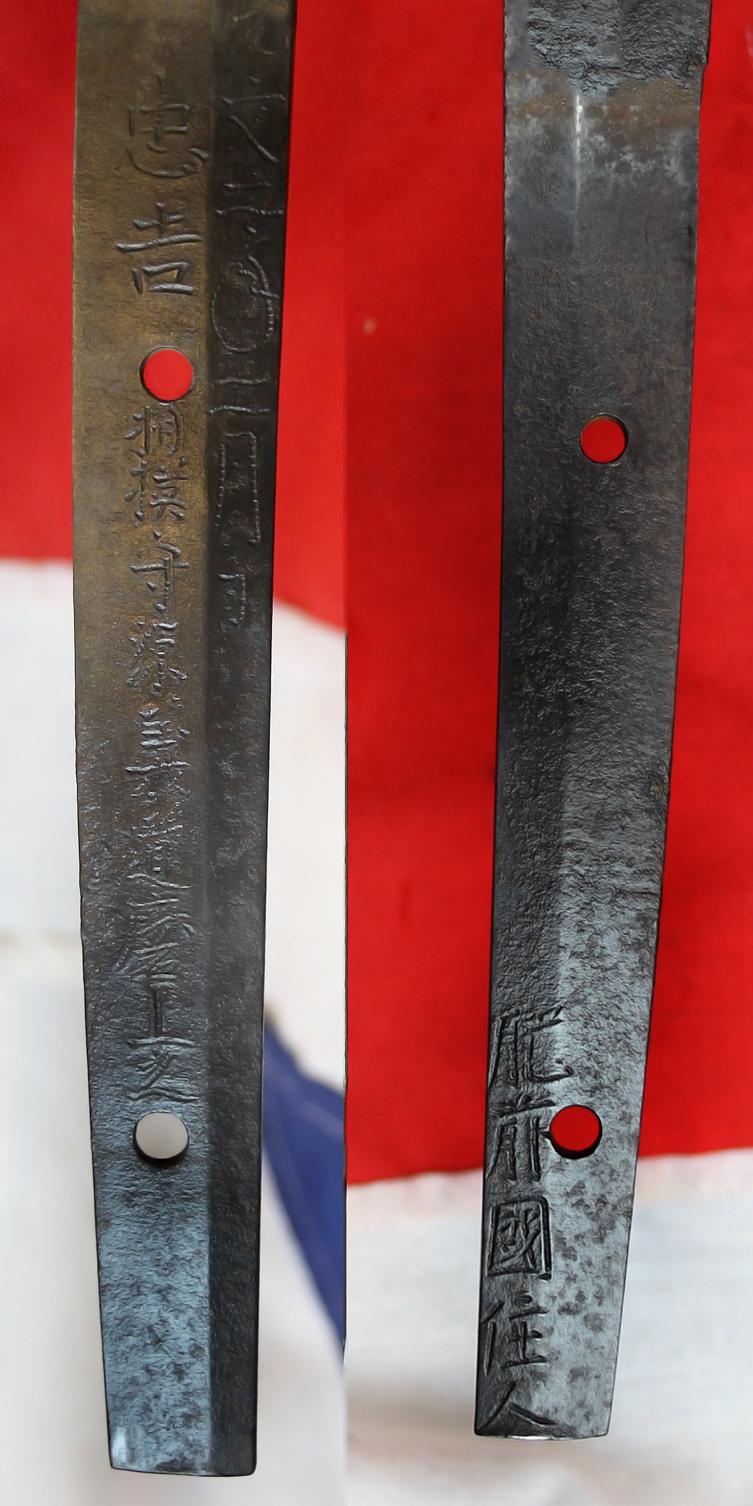
This Is A Truly Fabulous Ancestral Bladed WW2 Officer's Katana With A Rare Shinto Blade, Circa 1615, Signed Hizen no Kuni Ju Nin {Suriage, Tadayoshi} 肥前国住人 & 忠吉作 相模守義道 Bearing the Signatures of Two Master Sword Smiths of Both Hizen and Osaka
We have spent numerous decades, seeking the best and most historical ancestral bladed WW2 Japanese officers swords to be found. All with original, early samurai sword blades, many hundreds of years old, but this week we have found from impeccable sources three superb examples, two of them extraordinary rare examples.
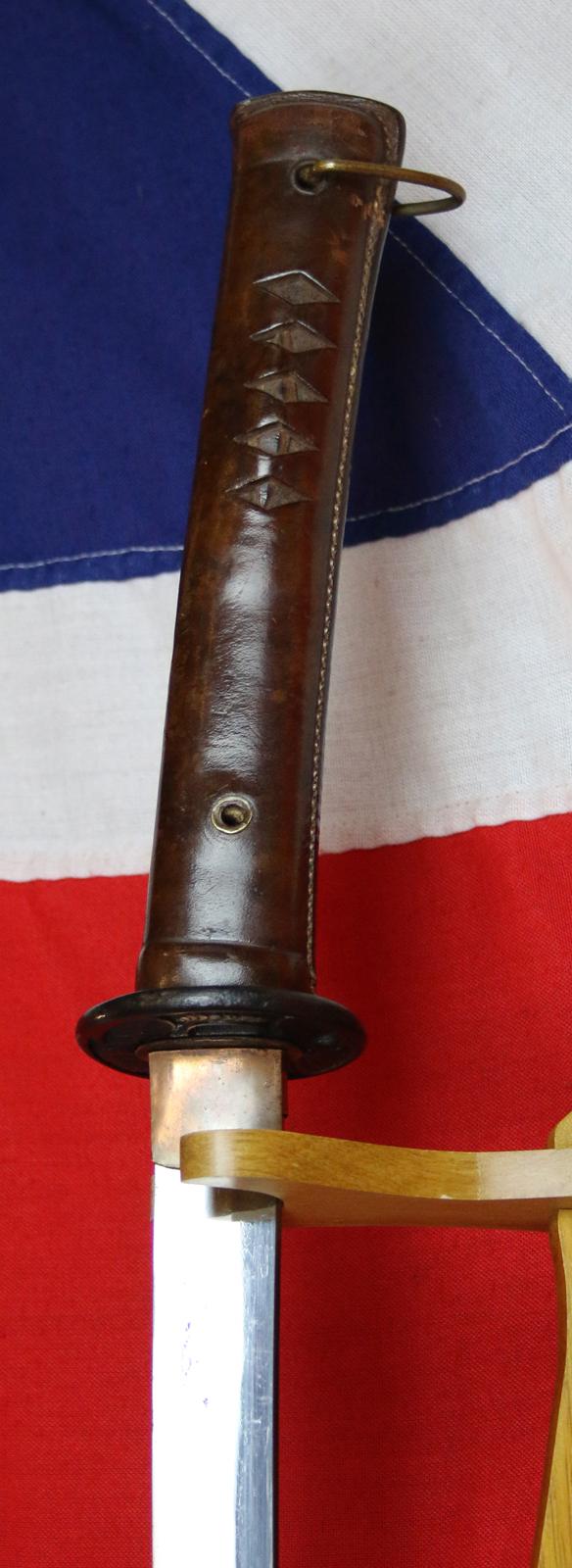
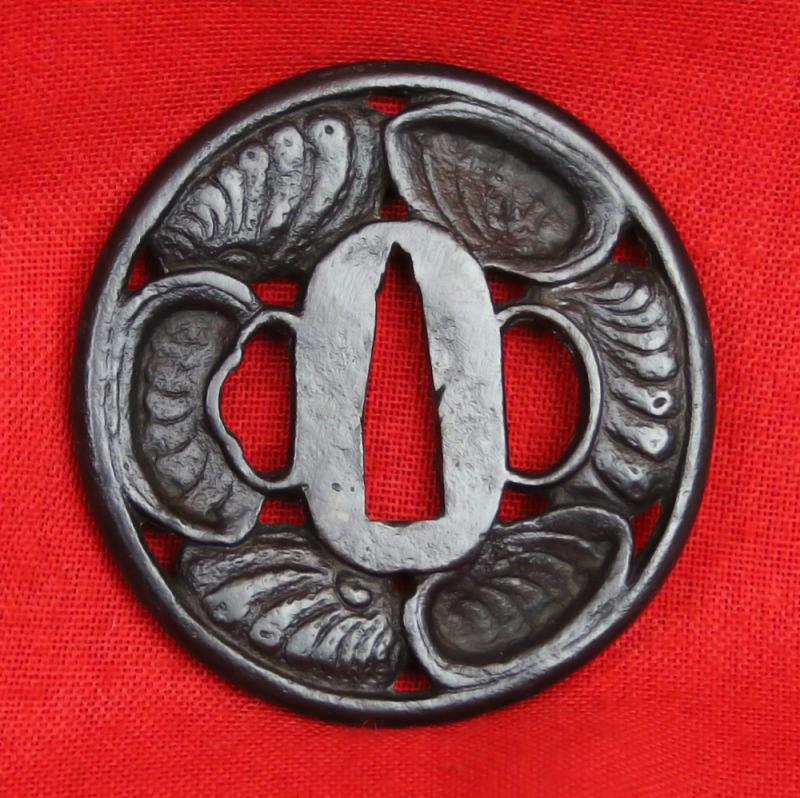
This beauty has a most historical and unique Shinto blade, which is both signed by Hizen no Kuni Ju Nin (suriage} Tadayoshi {the original master smith} and further inscribed and signed on the reverse side of the nakago, Tadayoshi, followed further down with, "shortened {in 1737} by Sagami no Kami Minamoto Yoshimichi ". This fine ancestral blade, with two udenka-ana, is fitted within its very fine, hand made bespoke shin gunto military mounts, with its tsuka {hilt} field service fully leather covered, a traditional Edo circular iron sukashi tsuba, and the saya is matching with its field service leather covered over wood. Interestingly the tsuka field service leather has, on half its length, traditional diamond 'windows' carved through the surface leather, to reveal its traditional Edo period menuki beneath. A very special, yet small feature, but incredibly interesting, and we can't recall ever seeing such work of its like created before. Especially since we have handled, likely more Japanese swords {in our 104 years} than any other company in the world
The phrase "Tadayoshi shortened by Sagami no Kami Minamoto Yoshimichi" refers to a specific type of Japanese sword inscription where a famous Tadayoshi (often Hizen Tadayoshi lineage) sword had its signature shortened or altered by another renowned smith, Sagami no Kami Minamoto Yoshimichi (possibly 3rd Gen), often for quality control or to indicate a collaboration/re-tempering, showcasing two major Edo-period sword-making schools in one blade, a significant find for collectors.
Tadayoshi: Refers to the famous Hizen Tadayoshi school of swordsmiths from Saga, prominent in the early Edo period, known for their domain-sponsored production.
Sagami no Kami Minamoto Yoshimichi was a skilled Osaka-based smith, often associated with the Mishina school, known for his exceptional hamon (temper lines), particularly choji midare.
"Shortened by": This usually means Yoshimichi re-worked or finished a sword originally made by a Tadayoshi smith, sometimes signing his own name (Sagami no Kami Yoshimichi) alongside or over the original signature, perhaps to enhance quality or attest to its excellence.
Effectively this is a most rare blade showing two master swordsmith's names that worked upon a single blade. The second smith inscribed it when he re-worked the blade, around 100 years after the first smith originally crafted the blade: It combines two highly respected names from different major sword-making centres (Hizen and Osaka).
Such rare blades are much prized by collectors, highlighting master craftsmanship and unique historical moments in Japanese sword history,
The subject smith Yoshimichi 義道 with Sagami-no-kami 相模守 title was a student {and later master} of 2nd gen. Ouomi-no-kami Hisamichi 近江守久道. He was born in Hyuga Province (now in Miyazaki pref.) in Kyushu island. His real name was Tomita Jin-uemon 冨田甚右衛門. It is said that he also lived and worked in Hiroshima, Aki province (now in Hiroshima pref.).
'If' this katana was indeed made by the 1st generation Tadayoshi 忠吉, the recognized production year is judged on about Kencho 20 (ca.1615) from it's inscription. His katana's preserved the typical shape that became widespread during Keicho (1596-16) period. From his workmanship, Tadayoshi was very much influenced by the Soshu-Bizen works during Nanbokucho period
The first generation Tadayoshi was born in Genki 3 (1572) as a son of sword maker Hashimoto Michihiro 橋本道弘 in Nagase town, Saga district. He became separated from his father Michihiro 道弘 who died of a disease and grandfather Morihiro 盛弘 who met death in the battle of Shimabara at the same time in the 3rd month Tensho 12 (1584) when he was as young as 13 years old. He was compelled to serve his apprenticeship to the other local sword makers in his young ages. However he excelled in as a superior sword maker since teen age and finally was picked out by feudal lord Nabeshima Katsushige 鍋島勝茂.
Keicho 1 (1596), when he was 25 years old, he went up to Kyoto to join the famed school of Umetada Myouju 埋忠明寿 and learn the most updated culture and technique for three years.
From on about Keicho 18 (1613) down to Kanei 1 (1624) he intentionally used the other inscription of "Hizen-koku-junin Tadayoshi-saku" 肥前国住人忠吉作 mainly for those unconventional artworks which are out from the standard works of Tadayoshi's studio as if he challenged to make an innovative artworks to try using different sence of technique from antcient times and regions.
He passed away in the 15th day, the 8th month of Kanei 9 (1632), was 61 years old.
There is one most intriguing point about this fine blade. It was intentionally shortened by another master smith, Minamoto Yoshimichi, of high repute, thus, if it wasn't highly revered at the time {in 1727} why do this?, and thus, inscribe it accordingly.
Surely, one would never contemplate such a very special and most expensive treatment for the blade, if it was not of great significance of its owner at that time. Additionally, the master smith who shortened it and signed it accordingly, {Minamoto Yoshimichi} would likely never put his name to a blade he considered not correct, and thus, inferior to his efforts.
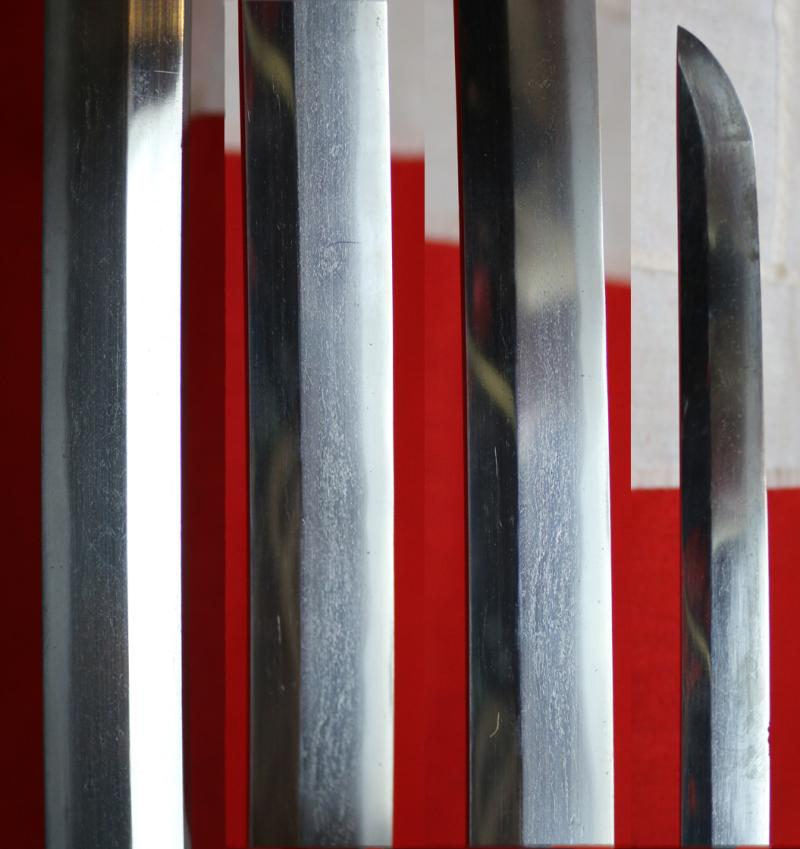
The blade is in good, original Edo polish, with small aged surface thinning, and a few minuscule edge nicks and the koshirae are in superb condition for a WW2 mounted officer's sword
Code: 26010
5450.00 GBP