
WW1 / WW2 / 20th Century

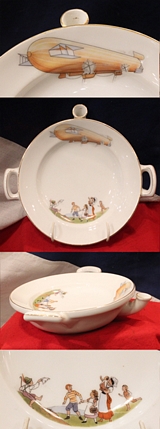
A Very Good German 1900's & WW1 Porcelain Zeppelin Plate Warmer
Items made in Germany with representations of the pre war and WW1 Zeppelin airships are scarce and much sought after. This is a most unusual very early piece of very nice quality, but also a funtional piece of finest German porcelain. The best-known German strategic bombing campaign during World War I was the campaign against England, although strategic bombing raids were carried out or attempted on other fronts. The main campaign against England started in January 1915 using airships. From then until the end of World War I the German Navy and Army Air Services mounted over 50 bombing raids on the United Kingdom. These were generally referred to as "Zeppelin raids": although both Zeppelin and Sch?tte-Lanz airships were used, the Zeppelin company was much better known and was responsible for producing the vast majority of the airships used. Weather conditions and night flying conditions made airship navigation and therefore bombing accuracy difficult. Bombs were often dropped miles off target (one raid on London actually bombed Hull) and accurate targeting of military installations was impossible. The civilian casualties made the Zeppelins an object of hatred, and they were widely dubbed ?baby-killers?. With the development of effective defensive measures the airship raids became increasingly hazardous, and in 1917 the airships were largely replaced by aeroplanes.
Although the direct military effect of the raids was small, they caused widespread alarm, leading to the diversion of substantial resources from the Western Front and some disruption to industrial production. Concern about the conduct of defence against the raids, the responsibility for which was divided between the Admiralty and the Army, led to a parliamentary inquiry under Jan Smuts, whose report was to lead to the creation of the Royal Air Force on 1 April 1918. The defence organisation developed by the British was an important precursor of the fighter direction system that would prove vital in winning the Battle of Britain. The raids were also influential because they led to an overestimation of both the material and psychological effects of the bombing of cities.
Airships made about 51 bombing raids on England during the war. These killed 557 and injured another 1,358 people. More than 5,000 bombs were dropped on towns across Britain, causing ?1.5 million in damage. 84 airships took part, of which 30 were lost, either shot down or lost in accidents. Aeroplanes carried out 27 raids, dropping 246,774 lb (111,935 kg) of bombs for the loss of 62 aircraft, resulting in 835 deaths, 1972 injured read more
245.00 GBP
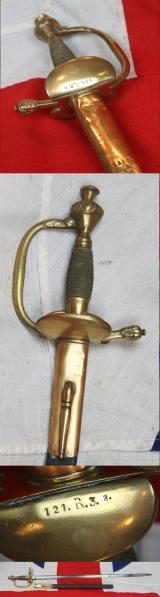
A Scarce Pattern of Imperial German 121st infantry Officers Sword XIII Royal Wurtemberg Corps
Bronze hilt with folding guard. Overall very nice condition and beautiful regimental markings to hilt and scabbard. Made by Gebruder Wayersberg of Solingen. Scabbard bottom section lacking. Potentially used by a Wurttemberg officer who knew or fought with another Wurttemberg officer at the same time, Erwin Rommel. On mobilization in 1914, the corps was subordinated to the 5th Army and saw action on the Western Front. It was transferred to the 6th Army during the Race to the Sea. In October 1914, the corps headquarters formed Corps Fabeck, which by the end of the month had become a provisional army group, commanding XV Corps, II Bavarian Corps and Corps Urach. In November, the XIII Army Corps was transferred from the 6th Army to the 9th Army on the Eastern Front. By 1916, the corps had returned to the Western Front and was subordinated to the 4th Army under Army Group Crown Prince Rupprecht. From April 1917 to March 1918, the corps commanded Group Caudry, another provisional command. In September 1918, it took over command of Group Ebene under Army Group Duke Albrecht of Württemberg, and commanded Group Ebene until war's end.
It was still in existence at the end of the war in Armee-Abteilung C, Heeresgruppe Gallwitz on the Western Front.
Württemberg mountain battalion
In 1915 a Württemberg mountain battalion was also formed, on drafts from the Württemberg line regiments, which became a part of the Alpenkorps division in 1917. This was the unit in which the young Erwin Rommel distinguished himself on the Romanian and Italian fronts, winning the Pour le Mérite (Imperial German equivalent of the Victoria Cross) at the Batlle of the Isonzo in 1917. Erwin Rommel was undoubtedly one of the finest generals of the Second World War, his strategic mind and patient approach led his men to victory after victory early in the war. But, while his fame and glory came as a General and Field Marshal, it was as a Lieutenant in the First World War that he earned his greatest honor.
Rommel started out the war in command of a reserve artillery company but immediately transferred to the 124th Wurtemberg Infantry regiment. By the middle of August 1914, he was in contact with the French, and showed his daring and genius in combat. The II Battalion, to which Rommel’s platoon was attached, halted at Bleid, a small French farming town. They sent out scouting parties, testing the various hedgerows and farms for French resistance.
Taking just three men from his platoon Rommel advanced to the edge of the town, where they found 15 French soldiers taking a nervous breakfast in the dense fog. Rather than retrieving his full platoon and assaulting, Rommel gave the order to open fire, and this four man party scattered the French troops, killing 5 of them. After receiving a stiff bout of rifle fire in response, he and his men returned to their platoon, then advanced with the rest of the battalion. read more
325.00 GBP
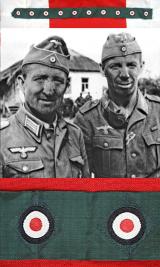
A Most Scarce Strip of 10 Heer EM/NCO Overseas M43 Cap Cockade Insignia
Made of a a machine embroidered cotton, this insignia is in very good un-issued condition! The colours are still vibrant! Features tri-colour national emblem. Perfect for any collection or display of German WW2 Very rare to find an un-issued strip of any form of German Bevo uniform insignia. A most rare discovery read more
375.00 GBP
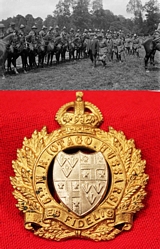
Superb WW1 Slouch Hat Badge of the 5th Mounted Rifle Ortago Hussars
A super original badge of one of the great and heroic New Zealand Horse Regiments. Probably for officers as it is gilded and manufactured with a separate silver central shield attached. Bears a small makers affixed label, Gaunt of London. The Otago Mounted Rifle Regiment was a New Zealand Mounted Regiment formed for service during the Great War. It was formed from units of the Territorial Force consisting of the 5th Mounted Rifles (Otago Hussars) the 7th (Southland) Mounted Rifles and the 12th (Otago) Mounted Rifles. They saw service during the Battle of Gallipoli, with the New Zealand Mounted Rifles Brigade and was later withdrawn to Egypt. They later left the brigade and served in served in France with the New Zealand Division becoming the only New Zealand Mounted troops to serve in France. Battle of Gallipoli
Battle of Flers - Courcelette. 15-22 Sep 1916.
Battle of Morval. 25-28 Sep 1916.
Battle of Le Transloy. 1-18 Oct 1916.
Battle of Messines. 7-14 Jun 1917.
Battle of Polygon Wood. 26 Sep - 3 Oct 1917.
Battle of Broodseinde. 4 Oct 1917.
Battle of Passchendaele. 12 Oct 1917.
Battle of Arras. 28 Mar 1918.
Battle of the Ancre. 5 Apr 1918.
Battle of Albert. 21-23 Aug 1918.
Battle of Bapaume. 31 Aug - 3 Sep 1918.
Battle of Havrincourt. 12 Sep 1918.
Battle of the Canal du Nord. 27 Sep - 1 Oct 1918.
Battle of Cambrai. 8-9 Oct 1918.
Pursuit to the Selle. 9-12 Oct 1918.
Battle of the Selle. 17-25 Oct 1918.
Battle of the Sambre. 4 Nov 1918, including the Capture of Le Quesnoy. read more
295.00 GBP
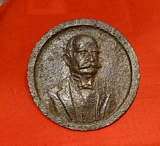
A Cast Iron Plaque of Graf Von Zeppelin The Pioneer of German Airship Travel, & The First To Realise The Potential of Airship’s Ability of Bombing Combat Against Cities Far Behind Enemy Lines
Dated 1920. Count Ferdinand von Zeppelin (German: Ferdinand Adolf Heinrich August Graf von Zeppelin; 8 July 1838 – 8 March 1917) was a German general and later inventor of the Zeppelin rigid airships. His name soon became synonymous with airships and dominated long-distance flight until the 1930s. He founded the company Luftschiffbau Zeppelin.
Ferdinand von Zeppelin served as an official observer with the Union Army during the American Civil War. During the Peninsular Campaign, he visited the balloon camp of Thaddeus S. C. Lowe shortly after Lowe's services were terminated by the Army. Von Zeppelin then travelled to St. Paul, MN where the German-born former Army balloonist John Steiner offered tethered flights. His first ascent in a balloon, made at Saint Paul, Minnesota during this visit, is said to have been the inspiration of his later interest in aeronautics.
Russet finish overall. Approx 4 inches read more
45.00 GBP
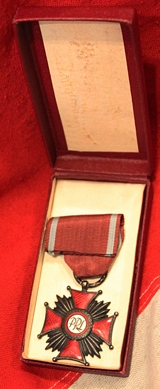
A Polish Republic Order Of Merit Medal with Miniature in Original Box
Originated in 1923. At the time of its establishment in 1923, the Cross of Merit was the highest civilian award in Poland. It was awarded to citizens who went beyond the call of duty in their work for the country and society as a whole. May be awarded twice in each grade to the same person. 1950's PRL centre read more
110.00 GBP
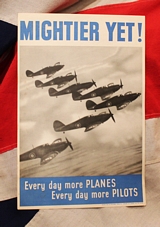
Mightier Yet! Every Day More Planes Every Day More Pilots Original WW2
Propaganda poster for the British wartime RAF and the mighty Hurricane. Printed for HM Stationary Office by J. Weiner Ltd London WC1. A propaganda information and recruitment poster. The size as were used in the underground trains advertising panels, or the back of black cabs. Britain re-created the World War I Ministry of Information for the duration of World War II to generate propaganda to influence the population towards support for the war effort. A wide range of media was employed aimed at local and overseas audiences. Traditional forms such as newspapers and posters were joined by new media including cinema (film), newsreels and radio. A wide range of themes were addressed, fostering hostility to the enemy, support for allies, and specific pro war projects such as conserving metal and growing vegetables. In 1940 in particular, Winston Churchill made many calls for the British to fight on, and for British units to fight until they died rather than submit. His calls for fight to victory inspired a hardening of public opinion. Determination raised the numbers of the Home Guard and inspired a willingness to fight to the last ditch, in a manner rather similar to Japanese determination, and the slogan "You can always take one with you" was used in the grimmest times of the war. British victories were announced to the public for morale purposes, and broadcast to Germany for purposes of undermining morale.
Even during Dunkirk, an optimistic spin was put on how the soldiers were eager to return.
When the U-boat commander Gunther Prien vanished with his submarine U-47, Churchill personally informed the House of Commons, and radio broadcasts to Germany asked, "Where is Prien?" until Germany was forced to acknowledge his loss.
The turn of the war made BBC's war commentaries much more stirring.
We never normally comment on the investment potential of any collectable, but the potential for all underpriced WW1 and WW2 posters must be incredible, for example the more famed poster, 'Keep Calm and Carry On' can now sell for over £20,000.
Good condition 10 inches x 15 inches read more
395.00 GBP
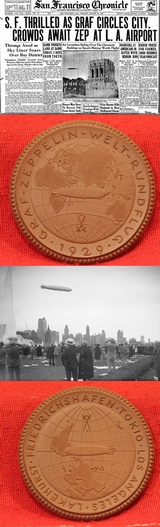
Meissen Porcelain Round The World Zeppelin Flight Medal
1929 GERMANY. 1929 Graf Zeppelin World Flight Medal. Red Porcelain, 50.7mm. Near mint condition.
Obv. Airship over Eastern
Hemisphere globe, GRAF ZEPPELIN WELT
RUNDFLUG . Rev. Airship over Western Hemisphere globe, FRIEDRICHSHAFEN. TOKIO. LOS ANGELES. LAKEHURST . A classic Zeppelin
issue made by the State Porcelain Factory of Meissen, mintmark crossed swords, Kurschwertern . MEISSEN TABLE MEDAL - GRAF ZEPPELIN "AROUND THE WORLD VOYAGE" - 1929. Meissen was one of the premier makers of tableware and porcelain items in Imperial Germany. The firm is hundreds of years old, and has survived to this day. A large-format table medal that salutes the Graf Zeppelin?s (LZ-127) "Around the World Tour." The tour began in Friedrichshafen, Germany, where the Graf Zeppelin was built, and continued on to Tokyo, Los Angeles, and Lakehurst, NJ (where her sister ship, the Hindenburg, exploded in May 1937) before returning to Germany. It measures 2" in diameter and is chocolate brown. It shows hallmarking for Meissen on both sides.In 1929, the Graf Zeppelin, LZ-127, made a world flight, stopping at Friedrichshafen, Tokyo, and Los Angeles. Although the Graf was not the first aircraft to circle the globe, it took only 21 days, 7 hours, 34 minutes, a new record for round-the-world travel by any means. Furthermore, it carried a full passenger load over much previously uncharted land. read more
235.00 GBP
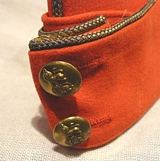
An Edwardian Colonel's Scarlet Cloth Sidecap, of 15th The Kings Hussars. With Gold Bullion Trim.
Good condition overall. With two Lion and Crown buttons for the rank of Colonel and Brigadier, used in WW1.
In the First World War, they landed at Rouen in France on 18 August 1914: the squadrons were attached to different infantry divisions to form the divisional reconnaissance element: A Squadron was attached to 3rd Division, B Squadron was attached to 2nd Division and C Squadron was attached to 1st Division. On 14 April 1915, the squadrons returned to regimental control and the regiment was placed under the command of the 9th Cavalry Brigade in the 1st Cavalry Division. The regiment remained on the Western Front throughout the war. It participated in most of the major actions where cavalry were used as a mounted mobile force. They were also used as dismounted troops and served effectively as infantry. On 11 November 1918, orders were received that the 1st Cavalry Division would lead the advance of the Second Army into Germany, by 6 December 1918, having passed through Namur, the division secured the Rhine bridgehead at Cologne.
The regiments battle honours in the Great War: Mons, Retreat from Mons, Marne 1914, Aisne 1914, Ypres 1914 '15, Langemarck 1914, Gheluvelt, Nonne Bosschen, Frezenberg, Bellewaarde, Somme 1916 '18, Flers-Courcelette, Cambrai 1917 '18, St. Quentin, Rosières, Amiens, Albert 1918, Bapaume 1918, Hindenburg Line, St. Quentin Canal, Beaurevoir, Pursuit to Mons, France and Flanders 1914-18
One of the famed of the regiment, Louis Nolan, was an officer of the 15th Hussars who gained notoriety as the bearer of the ill-fated order precipitating the Charge of the Light Brigade.
Around 30 years ago we were honoured to have acquired the undress sabretache of Captain Nolan of the 15th that carried the order in the ‘Charge’. It was recovered from beneath his slain body and steed, and was previously on loan for display in two museums, including Alexandra Palace, for over 100 years after its return to the family. read more
160.00 GBP
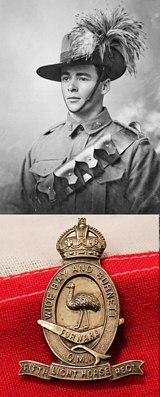
A Superb Silver Australian 5th Light Horse Mobile Infantry Badge
Excellent rare and original example [Wide Bay and Burnett Light Horse] Queensland Mobile Infantry. The history of the 5th Light Horse is distinguished and goes thus; The 5th Light Horse Regiment was raised in Brisbane in September 1914, entirely from men who had enlisted in Queensland, and became part of the 2nd Light Horse Brigade. Sailing from Sydney on 21 December 1914, the regiment disembarked in Egypt on 1 February 1915.
The light horse were considered unsuitable for the initial operations at Gallipoli, but were subsequently deployed without their horses to reinforce the infantry. The 2nd Light Horse Brigade landed in late May 1915 and was attached to the 1st Australian Division. The 5th Light Horse played a defensive role for most of the campaign but was involved in several minor attacks. It left the peninsula on 20 December 1915.
Back in Egypt, the 2nd Light Horse Brigade became part of the ANZAC Mounted Division and in February 1916 joined the forces defending the Suez Canal from a Turkish advance across the Sinai Desert. The 5th Light Horse?s main activity in the Sinai was long-range patrolling, but it was involved in several small engagements during August, as the Turks retreated after their defeat at Romani.
The ANZAC Mounted Division advanced into Palestine in late December 1916. The 5th?s work predominantly continued to be patrols and raids until the advance stalled before the Turkish bastion of Gaza. The regiment participated in all three battles aimed at capturing the town, most notably the first abortive attempt on 27 March 1917. On this occasion the 5th attacked Gaza from the rear and was fighting its way through streets and gardens when ordered to withdraw.
With the fall of Gaza on 7 November 1917, the Turkish position in southern Palestine collapsed. The 5th was involved in the pursuit that followed, and then spent much of the first half of 1918 holding the west bank of the Jordan River. During this time it was involved in the Amman (24?27 February) and Es Salt (30 April?4 May) raids, both of which were tactical failures but helped to convince the Turks that the next offensive would be launched across the Jordan.
Instead, the offensive was launched along the coast in September 1918, with the 5th taking part in a subsidiary effort east of the Jordan. It attacked at Amman on 25 September, and on 29 September 4,500 Turks surrendered to just two squadrons from the regiment at Ziza. Turkey surrendered on 31 October 1918, but the 5th Light Horse was employed one last time to assist in putting down the Egyptian revolt of early 1919. It sailed for home on 28 June 1919. Text from AWM
One of the most famous men of the 5th Light Horse was sniper Trooper Sing at Gallipoli. Trooper Sing sniped from a position known as Chatham's Post, his tally stated as 150 confirmed, but a higher informal estimate puts his tally at 201. The discrepancy can be accounted for by the way such hits were recorded. On 23 October 1915, General Birdwood issued an order containing his compliments on Trooper Billy Sing's performance accounting for the 201 Turks. Private Sing was awarded the Belgian Croix de Guerre in early 1918, probably for his role in leading a patrol eliminating some German snipers at Polygon Wood in September 1917. Studio portrait in the gallery is of 1707 Lance Corporal (L Cpl) John James Marsh, 5th Light Horse Regiment from Murraria, Queensland. A 21 year old grocer prior to enlisting on 18 August 1915, he embarked for overseas with the 11th Reinforcements from Sydney on 21 October 1915 aboard HMAT Hawkes Bay. He served with the regiment in the Middle East where he was wounded in action at Gaza and died on 6 November 1917. L Cpl Marsh is buried in the Beersheba War Cemetery, Israel. Original badge, pattern1930/42, with two lug fixing in superb order and superb quality definition. read more
295.00 GBP