
WW1 / WW2 / 20th Century

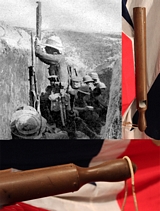
A Superb WW1 ‘Trench Made’ Trench Periscope
Trench Periscope, manufactured in the trenches, comprising: a rolled metal cylinder with timber inserts to mount 2 mirrors [top round, was oval] and wooden "rolling pin" type handle. Unmarked unofficial pattern circa 1915 -18. They were very popular in the Gallipoli campaign as much as in the trenches of the Western Front. The threat of succumbing to a sniper's bullet was a reality for all who inhabited the trenches of the First World War. Keeping one's head below the line of sight was essential. In order to see out of a trench, loopholes were constructed into the parapets. These might be a simple gap in the sandbags or a steel plate, however with the increased use of armour piercing bullets different solutions needed to be explored.
The trench periscope was a device by which soldiers could fire their rifles from the safety of the trench. All sides developed various types of periscope, the simplest being a stick with two angled pieces of mirror at the top and bottom. By 1915 more advanced types were being manufactured. British born William Beech, veteran of the Second South African War enlisted with the Australian Imperial Force in 1914 and was the inventor of a type of trench periscope. The Beech periscope was a simple design on which the main body of the periscope was attached to the butt of the rifle at a point behind the trigger guard. A cord or wire was then wrapped around the butt in order to secure the rifle to the periscope. Using the mirror at the bottom of the device a view onto the battlefield could be obtained. However, to fire the rifle one would have to lean far forward in order to the reach the trigger. This could potentially alter the aim of the rifle affecting the accuracy of the shot. read more
245.00 GBP

A Fabulous And Incredibly Rare Museum Piece. An Original WW2 SOE {Special Operations Executive} Secret Espionage Agent's Suitcase Radio Transmitter & Reciever of an Agent of the Secret Army 1942/3 Issue
SOLD
SOE Special forces
Role; Espionage Irregular warfare (especially sabotage and raiding operations) Special reconnaissance
Nickname "The Baker Street Irregulars" "Churchill's Secret Army" "Ministry of Ungentlemanly Warfare"
A phenomenally rare, complete mid war WW2 SOE spy radio set, transceiver, with Morse key, earphone headset and various and numerous components, including five crystal units and four frequency ranges, L1B, L2A, L3A and L4A. in it's original case with the early central lock and two catches. {later models changed to just two catches}. Handle detached. Parts with some damage, overall, completely untouched condition since the 1940's. An iconic and most rarest of so-called ‘barn finds’. It may indeed be one of the rarest in the world, and as such an incredible and unique piece of original spy-craft history.
Developer of the transceiver was Captain John Brown (SOE).
The type used by SOE and OSS agent Virginia Hall. Dubbed by the Gestapo as the Limping Lady, as she had a wooden leg! { that she called Cuthbert}.
She had all the makings of a diplomat. Impeccably educated, fluent in multiple languages, and worldly from her years spent abroad from her native Baltimore, Virginia’s dream of a life in the foreign service was shattered when a hunting accident led to the amputation of her left leg. Attitudes toward disabilities were different in the 1930s, and even fitted with a prosthetic leg (which she named “Cuthbert”) Virginia was deemed unfit for the life of a diplomat.
The outbreak of WWII changed that attitude. Virginia, by then living in France, was well-placed to act as a forward agent for the Allies. Volunteering first for the British Special Operations Executive (SOE), Virginia worked agents, ran safehouses, and reported intelligence from Vichy France. Later, she volunteered with the US Office of Strategic Services (OSS), forerunner to the CIA. Her efforts earned her a place on the Gestapo’s “Most Wanted” list as “The Limping Lady”. She and Cuthbert continued to work against the Nazis right up through the Normandy invasion and liberation and earned a Distinguished Service Cross for her efforts – a rare honour for a civilian, and rarer still for a woman.
This is the first we have ever seen, in 80 years since WW2, to be complete, original, and untouched, outside of the Imperial War Museum or the very few dedicated spy and espionage museums. In the world of the most valuable vintage car collecting, this would be an iconic ‘barn find’ of the very rarest kind. In that most exclusive of worlds ‘barn finds’ are now achieving prices equal to fully restored and now mint equivalent motor cars. Millions of pounds can now change hands for an abandoned rarely seen car newly discovered as a total wreck in, say, a barn, garage or field, that has lain untouched, rotting and unloved for many decades.
After France signed an armistice with Germany in June 1940, Great Britain feared the shadow of Nazism would continue to fall over Europe. Dedicated to keeping the French people fighting, Prime Minister Winston Churchill pledged the United Kingdom’s support to the resistance movement. Charged with “set(ting) Europe ablaze,” the Special Operations Executive, or SOE, was born.
Used by the most dedicated and bravest of people, men and women, who have ever served their country. Agents, such as Violette Szabo and Noor Inayat Khan, code name Madeleine, who only too well knew their chances of surviving without capture, torture and execution were slim at best. For them, and many, many others, survival was not to be.
Headquartered at 64 Baker Street in London, the SOE’s official purpose was to put British special agents on the ground to “coordinate, inspire, control and assist the nationals of the oppressed countries.” Minister of Economic Warfare Hugh Dalton borrowed irregular warfare tactics used by the Irish Republican Army two decades before. The “Baker Street Irregulars,” as they came to be known, were trained in sabotage, small arms, radio and telegraph communication and unarmed combat. SOE agents were also required to be fluent in the language of the nation in which they would be inserted so they could fit into the society seamlessly. If their presence aroused undue suspicion, their missions could well be over before they even began.
Portable communication devices were of utmost importance as radio and telegraph communication ensured the French resistance (and SOE agents) were not cut off from the outside world. Radio operators had to stay mobile, often carrying their radio equipment on their backs as they moved from safe house to safe house. Their survival depended on their ability to transmit messages rapidly and move quickly.
Along with irregular tactics and unusual materiel, the British government knew an irregular war required irregular warriors. Women proved to be invaluable as couriers, spies, saboteurs and radio operators in the field. Though female agents received the same training as the men, some balked at the idea of sending women behind enemy lines. They grudgingly agreed female spies would have distinct advantages over the men on the ground. Women could travel freely because they were not expected to work during the day. Gender stereotypes also helped keep the women above suspicion. After all, who could possibly imagine a woman could be a viable combatant in war?
Women were more than viable, however: they were critical to SOE mission success. Though they would later be honored for their “conspicuous courage,” the female spies of the SOE were successful because they learned to be inconspicuous. They took on secret identities, went on secret missions and were trusted with their nation’s greatest secrets. Thirty-nine of the 470 SOE agents in France were women, with an additional sixteen deployed to other areas.
The Gestapo gave Nancy Grace August Wake the nickname “the white mouse” because of her uncanny ability to evade capture. When she learned one of the resistance groups no longer had a radio for communication, she rode almost 300 kilometers on a bicycle to make radio contact with the SOE headquarters and arrange for an equipment drop. Despite many close calls, Wake survived the war. First Aid Nursing Yeomanry (FANY) member Odette Hallowes also cheated death. Embedded with the resistance in Cannes, Hallowes was captured and sent to the Ravensbrück concentration camp. She survived two years in prison, often in solitary confinement, before the camp was liberated by the Allied forces.
Other women were not so fortunate. Noor Inayat Khan, code name Madeleine, was a radio operator in France. After her entire team was ambushed and arrested, she was betrayed to the Gestapo by a French national hoping for a large reward. Khan did not break during interrogation and attempted escape from her captors several times. Sent to Dachau in September 1944, she was executed upon arrival. Violette Szabo, an agent inserted into Limoges, faced a similar fate at Ravensbrück. She was 23 years old.
By Kate Murphy Schaefer {abridged}. Kate Murphy Schaefer holds a MA in History with a Military History concentration for Southern New Hampshire University. She is also the author of a woman’s history blog, www.fragilelikeabomb.com.
Type 3 Mk. II B2
Clandestine suitcase transceiver · 1942
Type 3 Mark II, commonly referred to as B2, is a British WWII portable clandestine transceiver, also known as a spy radio set, developed in 1942 by (then) Captain John Brown at SOE Station IX, and manufactured by the Radio Communication Department of the SOE at Stonebridge Park. The set was issued to agents, resistance groups and special forces, operating on occupied territory. The official designator is Type 3 Mk. II but the radio is also known as Type B Mk. II, B.II and B2.
The B2 came in two versions. The initial version came in an unobtrusive leather suitcase that allowed an agent to travel inconspicuously. This is the most well-known variant. Later in the war it was dropped by parachute in two water-tight containers, that were more suitable for use by resistance groups operating in the field.
The images show the Type 3 Mk.II in its original brown simulated leather suitcase, which can easily be recognized as it has three locks at the front: two simple locks at the sides, and one that can be locked with a key at the centre.
Operating the Type 3 Mark II (B2)
The radio set consists of three units: a receiver (RX), a transmitter (TX) and a Power Supply Unit (PSU), plus a box with spares and accessories. When mounted in the suitcase, the transmitter is located at the center top, with the receiver mounted below it. The PSU is at the right in such a position that the two other units can be connected to it. The spares box is generally positioned at the left, with the Morse key mounted on its lid. When operating the B2, the lid of the spares box should be placed on the table, so that the Morse key can be operated.
The Type 3 Mk.II (B2) was relatively small for its day and produced an HF output power of 20 Watts. Nevertheless, it was too big to carry around unobtrusively especially when travelling by public transport. For this reason, later radios, such as the Model A Mk. III (A3) were made much smaller, albeit with a limited frequency range (3.2-9.55 MHz) and reduced power output (5 Watt).
The most well-known appearance of the B2 is the suitcase version, but hardly any surviving B2 is found in its original red leather suitcase. In fact, the B2 was delivered in a variety of different suitcases, ranging from sturdy leather cases to simple cardboard and even wooden variants.
The original leather case is easily recognised, as it has three locks rather than the usual two. In many cases, the original case was swapped for a more common two-lock version, as it was easily recognised by the enemy. Later in the war, cheaper cardboard suitcases were used instead.
Louis Meulstee's excellent book Wireless for the Warrior, volume 4 even shows an example of a wooden carpenter's toolbox in which a B2 is fitted. The dimensions of the suitcase are pretty standard for the era. This B2 in it's original issue simulated leather cardboard covered wood frame suitcase with 3 locks. The cases were changed later in the war for twin catched cases, as three, one lock and two catches, became too identifiable by the Gestapo.
A photograph in the gallery was taken during WWII, probably in 1942 or 1943, and shows this B2 radio's production line at the Bontex Knitting Mills, which became SOE Station VIIa (7a) . This facility is also known as Stonebridge Park,
While Virgina Hall {see her photo in the gallery} was adept in all aspects of tradecraft, one of the most powerful tools at her disposal was the suitcase radio, a catch-all term used to describe any transceiver small enough to be transported into the field and operated covertly. A suitcase was often used to house the radio as it would be less likely to arouse suspicion if the spy’s lair was discovered. The B2 suitcase radio was also a great form factor for a portable transceiver – just the right size for the miniaturized radios of the day, good operational ergonomics, and perfect for quick setup and teardown. You can even imagine a spy minimally obfuscating the suitcase’s real purpose with a thin layer of folded clothing packed over the radio.
Great care was given to ensure that the field agent would have every chance of using the radio successfully and that it would operate as long as possible under adverse conditions. With a power budget often limited to five watts or so, these radios were strictly QRP affairs. Almost every suitcase rig operated on the high-frequency bands between 3 MHz and 30 MHz, to take advantage of ionospheric skip and other forms of propagation. An antenna optimized for these bands would likely be a calling card to the enemy, especially in an urban setting, so controls were provided to tune almost any length of wire into a decent antenna.
Footnote; it is estimated around 7,000 of this form of clandestine spy-craft equipment were made by the British. It’s historical WW2 Nazi equivalent, the German made Enigma Machine, over 100,000 of those were manufactured, almost 15 times as many. Yet, surviving examples of the Enigma Machine can now achieve between $250,000 to $800,000. Thus, it is entirely possible that these suitcase transceivers can one day approach these figures, if not even likely. In fact in almost all respects they should be on a value parity already, as the operators of the Enigmas were based in relatively comfortable German bases, ships or field commands. Safe and relatively well protected and far away from fear and terror. The operators of these transceivers, men and women, many barely out of their teenage years, were, every single minute of every single day at appalling risk of capture and the inevitable, unspeakable torture {especially the women}, at the hands of the Gestapo, and summary execution, after being transferred to a concentration camp, sometimes simply within a few weeks of the start of their clandestine service in Nazi occupied Europe.
A dear friend of the partners {Mark and David's} late mother, Camilla Hawkins, was Anita Vulliamy, daughter in law of Major-General C.H.H. Vulliamy. She was a simply a remarkable lady, who, during the war, was captured by the Gestapo, horrifyingly tortured, but managed to survive captivity. During her months in the Gestapo prison she crocheted a holy cross, made of prison cell straw bedding. After the war, her cross was exhibited alongside a similar piece, a straw doll, made by British SOE heroine Odette Churchill at a Charity event in London in 1956 and they raised £875 for the Polio Fund in one week. A huge sum in those days. Camilla mentioned that her friend, Anita, almost always wore fine leather gloves in company, as her finger nails had been torn out by her Gestapo interrogators. They grew back in part, but not well enough for Anita to feel comfortable to show her hands in public. Anita and Odette survived, and both considered themselves to be the extraordinarily lucky ones. read more
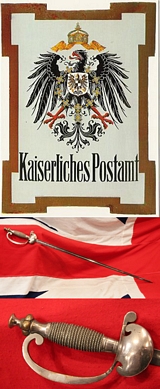
A Most Rare Imperial German State's 'Postal Protection Officer's' Sword
Nickel plated hilt, wire grip, plain single shell guard, single edged etched blade. This is a very scarce sword, we have only previously had the Prussian type [with Prussian Eagle Guard] see page 399 John R Angolia 'Swords of Germany 1900/1945'. This has the plain guard for another Imperial State's service, not the Prussian. Blade half etched with fancy scrolls and trumpets drums, stands of arms, cannon etc. Upon the Austro-Prussian War of 1866 and the break-up of the German Confederation in the Peace of Prague, the North German Confederation was established, instigated by the Prussian minister-president Otto von Bismarck. Originally a military alliance, it evolved to a federation with the issuing of a constitution with effect from 1 July 1867. In the course of the war, Prussian troops had occupied the Free City of Frankfurt and the King of Prussia (later to become Emperor of Germany) had purchased the remnants of the Thurn-und-Taxis Post organisation. According to article 48, the federal area of the Northern German states, de facto an enlarged Prussia, came under the united postal authority, led by director Heinrich von Stephan.
With the German unification upon the Franco-Prussian War of 1870?1871, the Deutsche Reichspost was established as a state monopoly and became the official national postal authority of the German Empire including the annexed province of Alsace-Lorraine. Its official name was Kaiserliche Post und Telegraphenverwaltung. The Southern German federated states of Baden (until 1872), W?rttemberg (until 1902) and Bavaria initially maintained separate state post authorities, that nevertheless were integrated into the nationwide administration. On 1 January 1876 a Reichspostamt under Postmaster General von Stephan was split-off from Bismarck's Reich Chancellery as a government agency in its own right. In the First World War, a Reichsabgabe tax was levied on the postal traffic from 1 August 1916 in order to finance the war expenses.
Deutsche Reichspost logo, 1925
With the establishment of the Weimar Republic upon the German Revolution of 1918?1919, the former Reichspostamt in Berlin became the Reichspostministerium. After the hyperinflation period, the Deutsche Reichspost (DRP) agency was again spun off in 1924 and operated as a state-owned enterprise. On 2 June 1932 Paul Freiherr von Eltz-R?benach was appointed Reichspost Minister by Chancellor Franz von Papen and he maintained his office upon the Machtergreifung of the Nazi Party in 1933, "assisted" by Nazi state secretary Wilhelm Ohnesorge. The postal area was significantly enlarged with the incorporation of the Saar territory in 1935, the Austrian Anschluss in 1938, and the annexation of the Sudetenland according to the Munich Agreement. It was during this time that the Reichspost installed the first public videophone.
In the Second World War the Reichspost authority spread out to the Polish areas annexed by Nazi Germany, such as the Reichsgau Wartheland, the Reichsgau Danzig-Westpreu?en, and the Polish General Government. In 1941 postal codes were introduced. The Feldpost military mail organisation of the Wehrmacht not only served Army, Luftwaffe and Kriegsmarine service members, but also SS-Verf?gungstruppen, Waffen-SS and Reichsarbeitsdienst members in the field, becoming the general postal authority of the occupied territories. No scabbard. read more
425.00 GBP

A Most Scarce Edwardian Hampshire Yeomanry Carabiniers Regimental Silver Place Badge With 'Battle Honour' Scroll, South Africa 1900-1901
The Hampshire rose to the centre of a crowned oval bearing the title, Hampshire Yeomanry, backed by a pair of crossed rifles, with the 'Carabiniers' scroll across the rifle butts and surmounted by Edward VIIth's King's crown, with the regimental 'Battle Honour' scroll of South Africa 1900-1. Tension sprung silver half hoop at the rear to insert a card, menu or regimental seating place name. In very good condition for age.
Between 1794 and 1803, a large number of cavalry units such as the North Hampshire Yeomanry Cavalry, the New Forest Volunteer Cavalry, the Fawley Light Dragoons and the Southampton Cavalry were raised in southern England as independent groups of Yeomanry. The Prime Minister, William Pitt the Younger, proposed that the English Counties form a force of Volunteer Yeoman Cavalry that could be called on by the King to defend the country against invasion or by the Lord Lieutenant to subdue any civil disorder within the country. These units were brought together under the collective title of North Hampshire Regiment of Yeomanry Cavalry in 1834, renamed Hampshire Regiment of Yeomanry Cavalry by 1848. The Regiment adopted the title 'Carabiniers' in 1887.
On 13 December 1899, the decision to allow volunteer forces serve in the Second Boer War was made. Due to the string of defeats during Black Week in December, 1899, the British government realized they were going to need more troops than just the regular army, thus issuing a Royal Warrant on 24 December 1899. This warrant officially created the Imperial Yeomanry. The Royal Warrant asked standing Yeomanry regiments to provide service companies of approximately 115 men each. In addition to this, many British citizens (usually mid-upper class) volunteered to join the new regiment.
The first contingent of recruits contained 550 officers, 10,371 men with 20 battalions and 4 companies, which arrived in South Africa between February and April, 1900. Upon arrival, the regiment was sent throughout the zone of operations. The Hampshire Yeomanry raised the 41st Company, 12th Battalion, and the first company left Southampton on 31 January 1900, bound for Cape Town read more
275.00 GBP
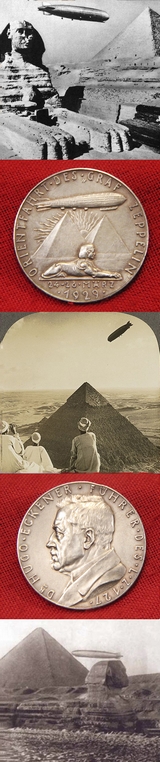
Original. Most Rare, A1929 Zeppelin Orientfahrt Over Egypt. The Zeppelin's Oriental Flight Over The Pyramids & Sphinx'. An Awarded Table Medal In Solid, Fine Silver. Len Deighton, World Renown Thriller & Spy Novelist Wrote a Book on The Very Flight
Only the second we have had or seen in 25 years. the only other we have seen is in the Landesmuseum in Wurttemberg.
Of all the medals issued in Europe for the very significant aeronautical occasions involving balloons and airships, this is one of the most artistically beautiful, capturing the flight over the great pyramids spectacularly in the typical Art Deco style. Just regard the amazing font, simple elegant but unique to that brief period. It was just a few short years since Carter had discovered the finest and fabulous golden treasures ever excavated in the history of the world, from the tomb of the boy king, the Pharoah Tutankhamen, and just three years before the great Boris Karloff starred in the iconic Hollywood movie, The Mummy.
Egypt and the art it inspired was all the rage around the world, in the news, art, film and decor, and this is just a fabulous representation of that amazing period.
This is a very rare and valuable medal, in super condition, made in fine silver, awarded and issued in 1929, for Dr. Hugo Eckener, depicting the Orientfahrt Orient flight of the airship Graf Zeppelin in 1929 Another rare surviving example of this fine medal is in the Landesmuseum in Wurttemberg.
In Britain it is regarded that a medal is only a wearable decoration, worn using either a chest ribbon, neck ribbon, or sash, or with a rear mounted uniform dress mounting pin, but in Europe, a medal is more often than not a display piece, issued for the same reasons as a wearable medal, for individuals as a reward, for commemoration or celebration, but not for personal adornment. Either displayed in a table mounted glass case or free standing cabinet.
On 24/03/1929 - the LZ127 Graf Zeppelin Orient Flight was launched for the reintroduction of air flight post-office mail.
Len Deighton, world renown thriller and spy novelist, under his psuedonym Cyril Deighton, wrote a rare and desirable book on this very flight, due to his love of airships and philately.
The Orientfahrt is distinguished for being one of the most controversial - in purely philatelic terms - of the Graf Zeppelin's history, mostly because there are no detailed sources of the flight that are completely reliable. The book records in great detail the flight from Germany which was like a theatrical event, where dinner was served over the Dead Sea and breakfast would be over the Acropolis; the ship subsequently flew over Rome, Naples and Cyprus.
Dropping mail at Jaffa, Athens, Budapest, Vienna
And flew over Palestine and Egypt.
Dr Eckner Born in Flensburg in 1868. Hugo Eckener came into contact with Count Zeppelin as a correspondent for the Frankfurter Zeitung through one of his reports on the Zeppelin airship. This resulted in a long-term cooperation. At the end of the 1890s, Eckener moved from Flensburg to Friedrichhafen and became tour leader and authorized representative of the German Airship Company (DELAG), founded in 1909. After the death of Count Zeppelin, Eckener awoke the interest in airships through the Atlantic crossing of the Zeppelin 126 and the world tour of LZ 127 in the 1920s. Between 1931 and 1937 a regular transatlantic regular service between Frankfurt, the USA and Brazil with the two Zeppelinen 127 and 129 was furnished.
The front of the medal from 1929 shows the bust of Eckener to the left. The back shows an airship over the sphinx and pyramids, behind the rising sun. See in reference to this medal; Hans Kaiser, 1998: medals, plaques, badges of German aviation. The coined chronicle of the German aviation, Gutersloh, S. 137 No. 494.1 &
Kienast, Gunter W., 1967: The medals of Karl Goetz, Cleveland, Ohio, S. II, 284 S.: No. op.428 read more
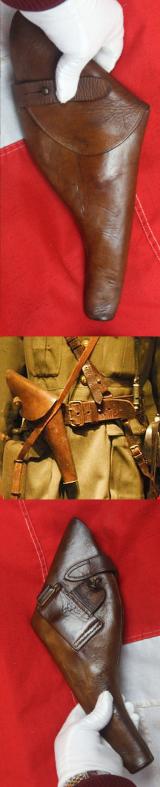
A Finest Leather Field Service, .455 Revolver Holster, For WW1 Officers
Excellent condition, WW1 service officer use, for the Webley.455 MK VI revolver. It has a full flap cover with retaining strap and brass stud fastener
The Webley Revolver (also known as the Webley Top-Break Revolver or Webley Self-Extracting Revolver) was, in various designations, a standard issue service revolver for the armed forces of the United Kingdom, and countries of the British Empire and the Commonwealth of Nations, from 1887 to 1970.
The Webley is a top-break revolver and breaking the revolver operates the extractor, which removes cartridges from the cylinder. The Webley Mk I service revolver was adopted in 1887 and the Mk IV rose to prominence during the Boer War of 1899–1902. The Mk VI was introduced in 1915, during wartime, and is the best-known model.
Firing large .455 Webley cartridges, Webley service revolvers are among the most powerful top-break revolvers produced.
The Webley RIC (Royal Irish Constabulary) model was Webley's first double-action revolver, and adopted by the RIC in 1868, hence the name. It was a solid frame, gate-loaded revolver, chambered in .442 Webley. General George Armstrong Custer was known to have owned a pair, which he is believed to have used at the Battle of the Little Bighorn in 1876.
The Royal Canadian Mounted Police and Shanghai Municipal Police received Webley Mk VI revolvers during the interwar period. read more
165.00 GBP
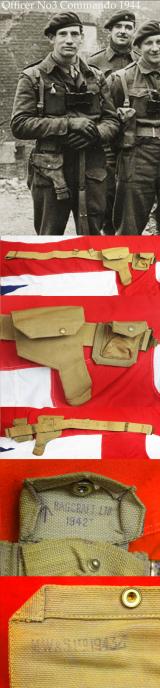
A Scarce Original WW2 British '37 Pattern Commando Officer's 9mm Browning Hi-power Holster, Ammunition Pouch & Waistbelt 1942/3 in Excellent Plus Condition
This 3 commando holster set was acquired with a German Luftwaffe officers PPK holster but sold seperately. After WW2 the officer kept his Browning and the Walther PPK as souvenirs, but surrendered his Browning and the Walther to the police in the 1960's. We acquired both holsters from his grandson
The 9mm automatic holster was easily identifiable by its level top edge almost all revolver holsters being angled upwards. With top hooks to connect underneath an ammunition pouch as an option. The neat ammunition pouch could accommodate two 12 round packets, a fabric strip went over the brace adaptor and a fabric loop fitted at the bottom accepted the top hook of a holster. dated 42/43.
No. 3 Commando was a battalion-sized Commando unit raised by the British Army during the Second World War. Formed in July 1940 from volunteers for special service, it was the first such unit to carry the title of "Commando". Shortly afterwards the unit was involved in a largely unsuccessful raid upon the German-occupied Channel Island of Guernsey.
In 1941 they were involved in successful raids on the Lofoten Islands and Vaagso, in Norway, before taking part in the costly Dieppe raid in August 1942, where the unit was tasked with knocking out a German coastal artillery battery on the eastern flank of the main landings, although due to a chance encounter in the Channel with a German convoy, a large majority of the unit failed to make it ashore.
In early 1943, the unit was sent to Gibraltar before moving to North Africa in April from where they were involved in the Allied invasion of Sicily and operations in Italy prior to being withdrawn to Britain to prepare for Operation Overlord. On D-Day they went ashore on 6 June 1944 as part of the 1st Special Service Brigade tasked with linking up with the 6th Airborne Division on the eastern flank of Sword before being withdrawn. Later they took part in the Allied counterattack during the Ardennes Offensive in early 1945 before taking part in the advance into Germany as part of Operation Plunder.
Following the end of the war, No. 3 Commando carried out occupation duties in Germany before it was disbanded on 4 January 1946. read more
190.00 GBP
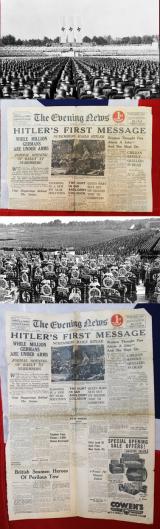
Front Page of the Evening News Sept 6th 1938. 'Hitler's First Message', From the Nuremberg Rally
A most intriguing original historical souvenir of Hitler's National Socialist pre-war Germany in 1938 during his rise to power, and the start of his imminent move to all out total war, and the destruction of freedom throughout all Europe.
5-12 September 1938. Nuremberg. The last X Party Rally called ‘Reichsparteitag Großdeutschland’ (The Congress of Great Germany) once again praised the triumphs of the Third Reich, including the Annexation of Austria six months before. The grand opening was accompanied by Wagner’s ‘Meistersinger von Nürnberg’ opera to inspire Hitler himself and Goebbels with enthusiasm. This Party Congress was the last of that kind as the XI Rally, pre-planned as the “The Party Conference of Peace” for September 1939 was denied on the threshold of the invasion of Poland.
Nürnberg Rally, the massive Nazi Party rallies held in 1923, 1927, and 1929 and annually from 1933 through 1938 in Nürnberg (Nuremberg) in Bavaria. The rallies were primarily propaganda events, carefully staged to reinforce party enthusiasm and to showcase the power of National Socialism to the rest of Germany and the world.
The emotional power generated by the rallies has been preserved in films, most notably in Leni Riefenstahl’s classic Triumph des Willens (1935; Triumph of the Will), which presents a carefully orchestrated version of the 1934 rally.
The paper has discoloured areas and the left hand side is hand torn, but its interest in a historical context more that makes up for it. It would be ideal for framing read more
95.00 GBP
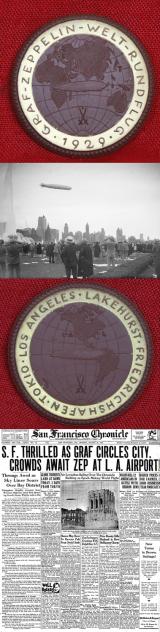
1929 Graf Zeppelin Round the World, Meissen Medal. Beaded Rim in Caramel Brown Bisque Porcelain with Gold Edge
From a small collection of most rare Meissen porcelain medals of the Graf Zeppelin round the world flight. three different variations of the same medal. Perfect for either early aviation and airship collectors, rare medal collectors, or collectors of finest German porcelain from the Weimar period
1929 GERMANY. 1929 Graf Zeppelin World Flight Medal. Red Porcelain, 50.7mm. Mint condition.
Obv. Airship over Eastern
Hemisphere globe, GRAF ZEPPELIN WELT
RUNDFLUG . Rev. Airship over Western Hemisphere globe, FRIEDRICHSHAFEN. TOKIO. LOS ANGELES. LAKEHURST . A classic Zeppelin
issue made by the State Porcelain Factory of Meissen, mintmark crossed swords, Kurschwertern . MEISSEN TABLE MEDAL - GRAF ZEPPELIN "AROUND THE WORLD VOYAGE" - 1929. Meissen was one of the premier makers of tableware and porcelain items in Imperial Germany. The firm is hundreds of years old, and has survived to this day. A large-format table medal that salutes the Graf Zeppelin?s (LZ-127) "Around the World Tour." The tour began in Friedrichshafen, Germany, where the Graf Zeppelin was built, and continued on to Tokyo, Los Angeles, and Lakehurst, NJ (where her sister ship, the Hindenburg, exploded in May 1937) before returning to Germany. It measures 2" in diameter and is chocolate brown. It shows hallmarking for Meissen on both sides.In 1929, the Graf Zeppelin, LZ-127, made a world flight, stopping at Friedrichshafen, Tokyo, and Los Angeles. Although the Graf was not the first aircraft to circle the globe, it took only 21 days, 7 hours, 34 minutes, a new record for round-the-world travel by any means. Furthermore, it carried a full passenger load over much previously uncharted land.
With its extraordinary fineness and silky matt surface, bisque porcelain exudes an unmistakable charm. Sculptural qualities, modelling skills and decorations such as reliefs are shown to full effect and are further accentuated by the material’s fascinating tactile quality. Developed in the 18th century by the French painter Jean-Jacques, the fine material rose to prominence as a substitute for ivory, alabaster and marble in the manufacture of the Château Vincennes. To this day, bisque porcelain is often compared to marble because of its unique way of diffusing light rather than reflecting it. At MEISSEN, this effect and material quality is achieved by polishing the unglazed surface of fired porcelain pieces in painstaking detail, resulting in the bisque's characteristic velvety soft surfaces.
Porcelain in its purest form. Contrary to popular belief, bisque porcelain has the same properties as its glazed counterparts in terms of density, hardness, strength and resistance. By omitting the glaze, details, such as sculptural swerves, elaborate embossing work and decorations, such as reliefs, are highlighted and given a unique tactile quality, showing off the skills of Meissen artisans in a particularly compelling way. read more
295.00 GBP
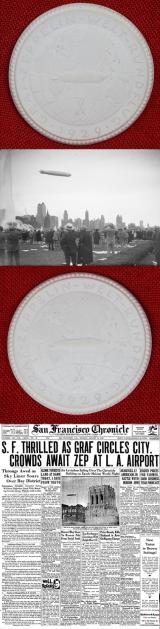
1929 Graf Zeppelin Round the World, White Bisque Porcelain Meissen Medal 1929
From a small collection of most rare Meissen porcelain medals of the Graf Zeppelin round the world flight. three different variations of the same medal. Perfect for either early aviation and airship collectors, rare medal collectors, or collectors of finest German porcelain from the Weimar period
This rare medal was made by the famous Meissen factory in Germany to commemorate the first circumnavigation of the world by an airship, the ‘Graf Zeppelin’ in August 1929. Designed by Ludwig Durr but conceived and operated by Dr Hugo Eckener, Chairman of the German company Luftschiffbau Zeppelin, the rigid airship was built at their works at Friedrichshafen between 1926 and 1928 and was intended to demonstrate the viability of intercontinental commercial air travel. It was the largest airship in the world at that time.
Co-sponsored by the American newspaper magnate William Randolph Hearst, the round the world flight took off from Lakehurst Naval Air Station, New Jersey, on 8 August heading east with Eckener in command. As well as the crew there were 20 passengers on board and four Hearst staff including the Australian explorer Hubert Wilkins, a cameraman and a British reporter, Lady Grace Drummond-Hay, who became the first woman to circumnavigate the world by air. Having refuelled at Friedrichshafen the flight continued across Eastern Europe and the Soviet Union to Tokyo, then on to California, landing at Los Angeles to complete the first ever nonstop flight across the Pacific Ocean. The final leg from Los Angeles to Lakehurst ended on 29 August, three weeks after the airship had departed. Actual flying time was 12 days, 12 hours, and 13 minutes, the fastest circumnavigation of the globe at the time.
The company then used the airship on its transatlantic service and for 5 years provided a commercial passenger and mail service between Germany and Brazil. ‘Graf Zeppelin’ made 590 flights totalling almost 1.7 million kilometres and was the first aircraft to fly over a million miles. It flew a total of 17,177 hours (nearly two years), without injuring a passenger or crewman. It was operated by a crew of 36, and could carry 24 passengers, who were treated to 3 hot meals a day with fine wines in the dining room and entertainment on board. The operational spaces, common areas, and passenger sleeping cabins were built into a gondola structure beneath the airframe.
Eckener had been outspoken in his dislike of the Nazi Party so that when they took power in 1933 he was replaced by his former colleague Lehmann and the ‘Graf Zeppelin’ was commandeered for a new airline. The Nazis used the airship as a propaganda tool until it was withdrawn from service after the Hindenburg disaster in 1937. The airship was scrapped and the metal airframes melted down for military aircraft production in 1940 - a dismal end for the most successful airship of all time, about which Lady Drummond-Hay had written:
“The Graf Zeppelin is a ship with a soul. You have only to fly in it to know that it's a living, vibrant, sensitive and magnificent thing”
With its extraordinary fineness and silky matt surface, bisque porcelain exudes an unmistakable charm. Sculptural qualities, modelling skills and decorations such as reliefs are shown to full effect and are further accentuated by the material’s fascinating tactile quality. Developed in the 18th century by the French painter Jean-Jacques, the fine material rose to prominence as a substitute for ivory, alabaster and marble in the manufacture of the Château Vincennes. To this day, bisque porcelain is often compared to marble because of its unique way of diffusing light rather than reflecting it. At MEISSEN, this effect and material quality is achieved by polishing the unglazed surface of fired porcelain pieces in painstaking detail, resulting in the bisque's characteristic velvety soft surfaces.
Porcelain in its purest form. Contrary to popular belief, bisque porcelain has the same properties as its glazed counterparts in terms of density, hardness, strength and resistance. By omitting the glaze, details, such as sculptural swerves, elaborate embossing work and decorations, such as reliefs, are highlighted and given a unique tactile quality, showing off the skills of Meissen artisans in a particularly compelling way read more
265.00 GBP