


A Very Good & Fine Original Medieval 'Crusader' Knight's Bronze Battle Mace & Scorpion Flail Mace Head Circa 12th Century. Around 900 Years Old, In Superb Condition and With Excellent Natural Age Patination
Made of Bronze Copper Alloy. A weapon made at the time at great cost, and only for the most affluent knight, a battle mace for the crushing and smashing of armour. The mace head is approx. the width of a pool or billiard ball. This fabulous mace could be mounted upon a haft {pretty much none of the original hafts from that period are now still in existence, being organic they decay very quickly once buried} or the aperture filled with lead and a large hand wrought iron staple, that would then be chained, and further mounted upon a short wooden haft to use as a flail mace.
Although no original early mace heads, in reality, were that large, they were heavy and powerful enough, combined with the impetus of a powerful swing, to be incredibly and dramatically effective at smashing through armour, and even iron plate helmets.
This bronze mace was made and used in the era of the first, through to all the knightly crusades to the Holy Land to reclaim Jerusalem.
The Crusades were a series of religious wars initiated, supported, and sometimes directed by the Christian Latin Church in the medieval period. The best known of these military expeditions are those to the Holy Land in the period between 1095 and 1291 that had the objective of reconquering Jerusalem and its surrounding area from Muslim rule after the region had been conquered by the Rashidun Caliphate centuries earlier. Beginning with the First Crusade, which resulted in the conquest of Jerusalem in 1099, dozens of military campaigns were organised, providing a focal point of European history for centuries. Crusading declined rapidly after the 15th century.
In 1095, after a Byzantine request for aid, Pope Urban II proclaimed the first expedition at the Council of Clermont. He encouraged military support for Byzantine emperor Alexios I Komnenos and called for an armed pilgrimage to Jerusalem. Across all social strata in Western Europe, there was an enthusiastic response. Participants came from all over Europe and had a variety of motivations. These included religious salvation, satisfying feudal obligations, opportunities for renown, and economic or political advantage. Later expeditions were conducted by generally more organised armies, sometimes led by a king. All were granted papal indulgences. Initial successes established four Crusader states: the County of Edessa; the Principality of Antioch; the Kingdom of Jerusalem; and the County of Tripoli. A European presence remained in the region in some form until the fall of Acre in 1291. After this, no further large military campaigns were organised. read more
1250.00 GBP

An Amazing WW1 British Trench Howitzer Maker Marked and Dated 1915, An Intriguing and Fascinating Souvenir of The Great War's Trench Warfare. Known as The Infamous ‘Toffee Apple Mortar’.
What an amazing display and conversation piece!
This is only second example in such great condition we have had in twenty years as almost every WW1 surviving example was disposed of on site at the wars conclusion, as they were so specific for the area of its use, and likely more dangerous to the operator than to its ‘hoped for’ enemy recipient, {ie; the Germans}.
Imagine using a piece of ordnance with almost the same destructive power of a 9” Battleship shell, that was fired and detonated within less than a couple of hundred yards of its operator, using only the flimsiest and incredibly fragile of percussion detonation heads at its point of impact. The very thought of operating such a piece of incredibly powerful, yet highly sensitive ordnance, must have been terrifying.
See photo 9 in the gallery, the very young infantryman is smiling next to the head of an unexploded mortars head, yet his head is just a few inches away from the small protective cylindrical cap at the shells impact point. When that safety cover was removed it revealed just a simple percussion cap detonator, no complex timing head for safety, just a cap that could detonate the massive explosion with just a few pounds of pressure!.
Trench mortars were the army’s most forward artillery, right up on the front line. These short range weapons were able to throw large, high explosive projectiles, short distances across No Man’s Land at the enemy trench system opposite.
Llewelyn Wyn Griffith, a captain with the 15th Royal Welch Fusiliers, described a battery of 2 inch mortars opening fire on enemy lines:
“A pop, and then a black ball went soaring up, spinning round as it went through the air slowly; more pops and more queer birds against the sky. A stutter of terrific detonations seems to shake the air and the ground, sandbags and bits of timber sailed up slowly and then fell in a calm deliberate way. In the silence that followed the explosions, an angry voice called out in English with a distinct German accent no doubt across No Man’s Land, ‘YOU BLOODY WELSH MURDERERS.’
Somewhat ironic, since the Kaiser invaded France and Belgium, slaughtered the allies, both civilians and combatants, in their hundreds of thousands, yet when the British -Welsh have the temerity to fight back, and thus kill the German invaders, they are called the murderers by the German combatants… sound familiar?
The 2 inch mortar named for the size of the rod not the huge explosive head was considered accurate out to 350 yards with a maximum effective range out to just under 600 yards.
Introduced in 1915, the 2 inch mortar was originally crewed by men taken from the battalion it was stationed with, along with some specialists from the Royal Artillery. However, with the introduction of the 3 inch Stokes mortar which was operated by the infantry themselves the 2 inch mortars became the sole responsibility of the Royal Field Artillery.
The British Army entered the First World War with very few mortars, and certainly none at the battalion level. As the stalemate of trench warfare set in and the effectiveness of enemy mortars became clear it was decided that trench mortars of various sizes would be needed.
Nicknamed ‘plum pudding’ or ‘toffee apple’ mortars after their projectile’s characteristic shape, the 2 inch Medium Mortar or 2 inch Trench Howitzer, was one of Britain’s first effective light trench mortars to be introduced.
Mortar positions were often in secondary trenches just behind the infantry’s frontline. This was to help protect the infantry from potential counter-battery fire. The trench mortars were often deployed to sectors to provide counter battery fire against German minenwerfers or in the run up to an offensive or local action. A British Army report on artillery use, drawn up in February 1917, noted that “Owing to their liability to be destroyed by hostile artillery fire it may often be advisable to defer opening fire with these mortars till the last day of bombardment.” The mortars were also tasked with keeping gaps made in the wire clear and with supporting any feint attacks made by infantry during gaps in the bombardment running up to a larger offensive.
Llewelyn Wyn Griffith, a captain with the 15th Royal Welch Fusiliers and later a novelist, recalled in his war memoir:
“At night a trench mortar officer set his guns in a derelict trench about twenty yards behind the line and carried up his ammunition, heavy globes of iron with a little cylindrical projection like a broken handle. In the morning I moved the men from the bays between the trench mortars and their target, to lighten the risk of loss from retaliatory fire.”
The 2 inch medium mortar entered service in spring 1915 and remained in use into 1917 with British and Empire troops. It was used on the Western Front and in Mesopotamia. Over 800 were ordered initially with 675,000 bombs, many of the mortars were made in railway and agricultural machinery workshops, allowing larger factories to focus on more complex weapons. The 2 inch mortar was superseded by the larger bore Newton 6 inch mortar later in the war. Some of the remaining 2 inch projectiles were re-purposed as makeshift anti-tank mines, buried in no man’s land in anticipation of possible German tank attacks.
Not suitable for export, inert, safe and perfectly harmless, but of substantial heft. UK mainland delivery only. 34 inches long overall head 9 inch diameter. read more
450.00 GBP

An Incredible & Substantially Formidable, Around 1,100 Year Old Viking War-Hammer-Axe. An Impressive, Beautiful, & Most Powerful & Formidable Combination Battle-Axe-Hammer. As Effective At Cleaving An Enemy Anglo-Saxon As Smashing & Crushing His Helmet
In superb condition for its age, and stunningly conserved.
The front edge has a fine blade, with the reverse, forged into a flat, helmet smashing hammer.
For combat, as a middle-heavyweight axe, it could have been mounted with a single or double handed haft.
In a discussion on axes from the medeavil ages, that we had together with Howard Blackmore {deputy curator at the Tower}, and Dennis Ottrey {our former gun and armour smith of over 40 years} the service of the war axe in hand to hand combat was critical in all the major battles for over a millennia. The lighter wide bladed axe, perfect for deep slicing and cutting, the heavy axe, for smashing and crushing, but often the most formidable, like the hand and a half sword in the world of long edged weapons, aka the bastard sword, the middle weight axe was the most functional.
At home, set in either a single handed short, or a two handed long haft, it was almost ideal for all purposes, and like the ‘bastard’ sword, it was perfect {in the right hands} for all fighting conditions.
The hand-and-a-half sword was known as the ‘bastard’ sword because in trained hands it was far more powerful than the shorter, knightly cruciform sword, and much faster than the considerably longer zweihander {two handed} sword. Thus the middle-heavyweight axe could well have been classified as the ‘bastard’ axe. Although in hand-to-hand combat the only ideal defence against the war axe was the shield {or, possibly, superior agility} not another axe, unlike sword-to-sword combat, where the best defence against the sword, was yet another sword.
Knowledge about the arms and armour of the Viking age is based on archaeological finds, pictorial representation, and to some extent on the accounts in the Norse sagas and Norse laws recorded in the 13th century. According to custom, all free Norse men were required to own weapons and were permitted to carry them all the time. These arms were indicative of a Viking's social status: a wealthy Viking had a complete ensemble of a helmet, shield, mail shirt, and sword. However, swords were rarely used in battle in the same quantity as axes, as few Vikings were of the status to own or carry a sword, A typical bondi (freeman) was more likely to fight with a spear, axe, with shield and most also carried a seax as a utility knife and side-arm. Bows were used in the opening stages of land battles and at sea, but they tended to be considered less "honourable" than a melee weapon.
The warfare and violence of the Vikings were often motivated and fuelled by their beliefs in Norse religion, focusing on Thor and Odin, the gods of war and death. In combat, it is believed that the Vikings sometimes engaged in a disordered style of frenetic, furious fighting known as berserkergang, leading them to be termed berserkers. Such tactics may have been deployed intentionally by shock troops, and the berserk-state may have been induced through ingestion of materials with psychoactive properties, such as the hallucinogenic mushrooms, Amanita muscaria, or large amounts of alcohol. Perhaps the most common hand weapon among Vikings was the axe swords were more expensive to make and only wealthy warriors could afford them. The prevalence of axes in archaeological sites can likely be attributed to its role as not just a weapon, but also a common tool. This is supported by the large number of grave sites of female Scandinavians containing axes. Several types of larger axes specialized for use in battle evolved, with larger heads and longer shafts.
Vikings most commonly carried sturdy axes that could be thrown or swung with head-splitting force. The Mammen Axe is a famous example of such battle-axes, ideally suited for throwing and melee combat.
An axe head was mostly wrought iron, possibly with a steel cutting edge. This made the weapon less expensive than a sword, and was a standard item produced by blacksmiths, historically.
Like most other Scandinavian weaponry, axes were often given names. According to Snorri Sturluson's Prose Edda, axes were often named after she-trolls, such as the bearded 10th century Viking battle axe, that could double as a throwing axe, from the time of the last Viking, English King, Eric Bloodaxe, King of Northumbria.
Probably the eldest son of King Harald Finehair The first King of all Norway. Eric's name probably derives from the legend that he murdered most of his 20 brothers, excepting Hakon. This was an unfortunate error as, upon Harald’s death, Hakon returned to Norway from Britain to claim Harald's throne, and removed Eric from his Kingship.
His elder brother Eric then fled Norway to Britain and to King Athelstan, an old friend of his father's, whereupon he took the Kingdom of Northumbria in around 947 a.d.
While the sagas call him 'Bloodaxe', one of the Latin texts calls him fratris interfector (brother-killer), but, for whatever reason his name was derived, it was certainly a fine example of the descriptive titles the Viking warriors had, and that we are told of in the Viking sagas.
Weighing just under 2.5 pounds, 6.75 inches x 2.75 inches read more
1295.00 GBP

A Most Beautiful Early 18th Century Austrian Flintlock, A Royal Castle Gun, Originally Made in Vienna Possibly by Fowler & Riflemaker Casper Zelner. Latterly Used in the American Revolutionary War of the 1770's
Somewhat reminiscent of the beautiful guns produced by Caspar Zelner of Vienna, as his long guns utilized the rifle style trigger guard combined with stock cheekpiece despite being a fowler, Likely to make the gun more accurate than a regular fowler, but an expensive addition to the guns initial cost, but if it was indeed made as a royal castle gun for the hunts of the dukes and princes, this would be an inconsequential expense.
The brass trigger guard bow and front tang are have deep scroll carving. The brass buttplate tang is also nicely carved and engraved. The brass wrist escutcheon has a royal coat of arms in the center. The brass sideplate is very well executed. The carved half stock is fine. It has edge lines along the ramrod channel, carving and edge lines along the trigger guard, carving around the barrel tang, and decorative lines at the forward part of the comb. The action functions correctly. It's unusual to find an early fowler with its original full length barrel as most were shortened during their period of use. This could very well be a castle gun, originally used for royal hunts. Then possibly taken by an officer nobleman who fought in the American Revolutionary War with the Prussians for the British, or, for the American Continental Army
From the American Revolutionary War period. Banana shaped lock, good swan necked cock and walnut stock with finest brass mounts.
The great military arms collections in the US such as the Smithsonian and the Metropolitan have numerous guns of this very type, all once the property of officers serving in the American Continental Army during the War of Independence. This is a very nice example in very good order with a good sound action. The mounts are beautiful quality, in all brass, superbly deluxe engraved.
Ethnic Germans, and indeed Austrians, served on both sides of the American Revolutionary War. Large numbers of Germans had emigrated to Pennsylvania, New York, and other American colonies, and they were generally neutral. Some belonged to pacifist sects such as the Amish, but many were drawn into the Revolution and the war.
Germans in Europe lived in numerous separate states. Some of these states had been in alliance with Britain during the Seven Years' War, and were eager to assist Great Britain. Britain had used auxiliary forces in every one of its 18th century wars, their use in suppressing rebellion seemed consistent with previous policy. Their use against British subjects was controversial, however. Despite British Whig opposition to using German soldiers to subjugate the "sons of Englishmen," Parliament overwhelmingly approved the measure in order to quickly raise the forces need to suppress the rebellion.
The leasing of soldiers to a foreign power was also controversial to some Europeans, but the people of these continental states generally took great pride in their soldiers' service in the war. Prussia notably rejected the request to send soldiers. Germans living in America did not enlist in the auxiliary units but some enlisted in British units. The 60th (Royal American) Regiment recruited both from the Americas and from Germany.
Colonial-era jurists drawing a distinction between auxiliaries and mercenaries, with auxiliaries serving their prince when sent to the aid of another prince, and mercenaries serving a foreign prince as individuals.13 By this distinction, the troops which served in the American Revolution were not mercenaries, but auxiliaries. Early Republican historians, however, defended the term "mercenaries" to distinguish the foreign, professional armies from the idealized citizen soldier who altruistically fought for independence.14 Mercy Otis Warren promoted the idea of German auxiliaries as barbarians, but also as victims of tyranny.15
Throughout the war, the United States attempted to entice the hired men to stop fighting. In April 1778, Congress issued a letter, addressed "To the officers and soldiers in the service of the king of Great Britain, not subjects of the said king", which offered land and livestock to defecting German units, in addition to increased rank.16 At the conclusion of the war, Congress offered incentives—especially free farmland—for these ethnic Germans to remain in the United States. Great Britain also offered land and tax incentives to its Loyalist soldiers willing to settle in Nova Scotia in present-day Canada.
41.5 inch barrel, 57 inches long overall read more
1395.00 GBP

A Most Fine 18th to Early 19th Century Ottoman Empire Jannisaries Yatağan Sword, Carved Horn 'Eared' Hilt & Original Hide Covered Wooden Combat Scabbard
Overall in superb condition, the patina on both the hilt and leather scabbard is exceptional. The carved horn eared hilt is composed of two carved horn grip plates attached by three iron rivets, and is very fine indeed. It has a naturally patinated brass, fully encompassing, reinforcing strap that forms into the ricasso and shaped blade plate. The yataghan form blade, in the traditional form, is beautifully geometrically engraved upon the back edge. The polished hide covered wooden scabbard has an iron belt loop fixing. The Yatağan sword is a Turkish sword that is believed to have originated sometime in the late middle ages, around the 14th century. The first authentic findings that there are for the Yatağan are from the 15th century belonging to Suleiman the Magnificent. That sword has an inscription written on it dating it to 1526.
The formation of the Janissaries has been dated to the reign of Murad I (r. 1362–1389), the third ruler of the Ottoman Empire. The Ottomans instituted a tax of one-fifth on all slaves taken in war, and from this pool of manpower the sultans first constructed the Janissary corps as a personal army loyal only to the sultan. They were subjected to strict discipline, but were paid salaries and pensions upon retirement and formed their own distinctive social class. As such, they became one of the ruling classes of the Ottoman Empire, rivalling the Turkish aristocracy. The brightest of the Janissaries were sent to the palace institution, Enderun. Through a system of meritocracy, the Janissaries held enormous power, stopping all efforts to reform the military
Yatağan was widely used in the Ottoman period from the 16th century to the 19th century; is a famous and effective sword. It is also known as the Turkish Sword among foreigners and Kulakli among the people. Yatagan was a weapon of janissaries and other infantry troops.
The centre of gravity of the sword, the angle known as the Turkish curve in making swords, and the ideal strokes are difficult to use because they differ from other swords. The reason for this difference in form is to swing the enemy’s sword strokes more easily. But the destruction and chiselling power of a good user is much higher than that of contemporary swords. Although the motives and writings in Yatağan are sometimes a poem and sometimes a concise word, mostly the verses, the name of the owner of the sword, the prayers and the seal of the master making the sword are seen.
The Yatagan was mostly used by soldiers known as the Janissaries. These soldiers often had to walk long distances to defend the empire or expand its borders. That is why the scabbard was mostly made out of leather so that it would be light. It was usually carried on the side or the back of the belt.
The scabbard of the Yatagan is curved just like the blade and made wider than needed so the broadened tip can easily fit inside. It was made out of wood, leather, and even silver. It was also usually heavily decorated, especially if it was owned by a nobleman.
The Yatagan is truly a one-of-a-kind sword. There simply doesn’t seem to be a sword that can compare to it during the time period it was used. The inwardly curved blade, the lack of a crossguard, and the “ears” all contribute to the item’s one-of-a-kind appearance.
It is possible that the Greek Kopis and, in particular, the Iberian Falcata or Sica had some sort of influence on the Yatagan. However, these swords hadn’t been used for almost a thousand years by the time the Yatagan began to see use in the 14th to 19th centuries.
This sword was used throughout many regions of the Ottoman Empire that it has several different legends connected to its origins. One of the legends is about Yatagan Baba. This was a Seljuk blacksmith as well as a military commander. He conquered a village in modern-day Denizli, Turkey, and made his new home there. Being a master blacksmith, Yatagan Baba developed the Yatagan sword, which was named after him and the village he conquered.
Another legend is that at one point during the Ottoman Period, the sultan had forbidden the use of long swords by the Janissaries in peacetime because of their insubordination. They were then forced to improvise, and ordered weapons made that didn’t technically constitute a long sword.
Last photo in the gallery of Mustafa Kemal Atatürk wearing the traditional Janissary uniform Turkish yatagan swords that were the signature weapon of the Janissaries, almost a symbol of the corps. read more
1495.00 GBP

Most Rare, For Over 60 Missions, WW2 Issue, Frontflugspange für Schlachtflieger. The Luftwaffe Squadron Combat Clasp, Awarded For Ground-Attack Pilots, For Air-to-Ground Support. Established by Reichmarshal Hermann Göring in 1944
Silver grade, awarded for over 60 combat missions, with single riveted centre. A most rare Frontflugspange fuer Schlachtflieger Front Flying Clasp for Heavy-Fighter pilots of the Luftwaffe, not maker marked, as usual as it is a late war zinc issue. Its retaining bar was detached as the commando pulled the combat award off the pilot's tunic during his raid.
A souvenir of a Special Ops, British, 'X force' Commando looted during an intelligence commando raid on a German airfield.
Third Reich WWII military decoration award of Nazi Germany air force. Damaged. The pin is seperated from old repair, and hair line crack by oak leaf branch as it meets the wreath. However, priced accordingly. Due to their rarity, and being issued so late in the last year of the war 1944-45, they are one of the most collectable Luftwaffe awards granted for combat missions specifically to Ground Attack pilots
Established in April 1944 as the war demanded specialized recognition for ground-attack units; prior to this, these aircrews received the general Front Flight Clasp with an inverted winged arrow.
Features a pair of crossed swords encircled by a laurel leaf wreath, set between stylized oak leaf wings with a swastika at the base.
• Bronze: Awarded for 20 operational flights.
• Silver: Awarded for 60 operational flights.
• Gold: Awarded for 110 operational flights (though baseline general clasps started gold at 110/100 depending on early/late criteria).
Hans-Ulrich Rudel: The most decorated German serviceman of World War II and the premier ground-attack pilot, credited with destroying over 500 tanks, a battleship, and hundreds of ground vehicles while flying over 2,000 combat missions in the Junkers Ju 87 Stuka and Focke-Wulf Fw 190
Alfred Druschel: A prominent ground-attack leader and commander within Schlachtgeschwader 1 (SG 1) and SG 4, who flew over 800 to 1,000 missions and earned the Knight's Cross with Oak Leaves and Swords before going missing in action on January 1, 1945.
German Luftwaffe pilot and ground-attack aviation commander Dr. Ernst Kupfer. He flew 636 combat missions on the Eastern Front and in other major theatres, commanding Sturzkampfgeschwader 2 (StG 2) "Immelmann" during the Kuban bridgehead and Operation Citadel.
Primary Aircraft: Included the rugged biplane Henschel Hs 123, the twin-engine tank-buster Henschel Hs 129, the Junkers Ju 87 Stuka, and later ground-attack variants of the Focke-Wulf Fw 190
Originally taken by a commando of 30 Commando, X troop, while on clandestine missions as part of 30 Commando reconnaissance and sabotage.
From a former special engineering unit {Ian Fleming’s so called ‘Red Indians} in wartime Europe were a vital part of clandestine warfare, and all parts of the units combat service were then trained in recognising enemy mines, booby traps, handling of explosives, demolitions, counter-demolitions, bomb disposal, and combined with recognition of enemy uniforms and equipment for intelligence gathering. Reporting all elements of their findings back to Co CO, and by then to the Admiralty. Fleming referred to such brave men as his ‘Red Indians’. See text within his first James Bond novel Casino Royale for his referral to Bonds connection to the WW2 Red Indians.
The brain child of naval commander Ian Fleming & Lord Louis Mountbatten, 30 Commando, this wartime unit was a secret well kept for over 50 years after the war by the Official Secrets Act, some remains classified. At the time, officially, they didn’t exist. The members of this unit were forbidden to discuss or document their activities, a pledge that many of the men kept even many years after the war was over, or even for their entire lives!
Due to the fact these men operated in very small groups on ‘need-to-know’ basis it is very difficult to get clear picture of everything they were doing.
Fleming’s/NID30AU secretary Miss Margaret Priestley (a history professor from Leeds University) played a vital role in the running and administration of 30AU and became his inspiration for Miss Petty Pettaval - the original character name that became Miss Moneypenny.
As revealed here for the first time! (see Beau Bête)
Miss Preistley transferred over to NID30AU during the winter of 1943-44 from DNR - (Department of Naval Research) where she worked as a civilian, although there were obvious links between DNR and NID30AU as intelligence on enemy targets was collected for Fleming’s ‘Black List’.
Also Known as: Fleming's 'Red Indians'
Fleming himself referred to the men of the unit as behaving like 'Red Indians'. (A reference he also used when referring to his character, James Bond, four times in his first novel Casino Royale. Which effectively makes this unit the ‘literary James Bond’s wartime unit’.)
Formerly:- (NID30 Command Office at Admiralty),
Special Engineering Unit.
'RED' Marines.
Latterly:- 30 Assault Unit,
30 Advanced Unit, 30AU
and incorrectly as 30th Assault Unit.
The number '30' was used for no better reason than it was NID/Miss Priestley’s Office Door number at the Admiralty. (Fleming’s Office was No. 39, see photo in the gallery of Fleming in room 39 of the Admiralty) 'Assault Unit' was 'overt' cover for the fact that they were intelligence gathering.
Date Founded: 30 September 1942
Date Disbanded: 26 March 1946
Date Reformed: February 2010 - 30 Cdo IXG
Mission When Founded:
The collection of technical intelligence and personnel from enemy headquarters and installations. Ahead of allied advances and before enemy could destroy it, to ‘Attain by Surprise’.
30 Commando consisted of Royal Marine, Army and Royal Navy elements that were organised into three Sections: No. 33, No. 34 and No.36 respectively. Initially code-named the Special Engineering Unit, the unit reported to the Chief of Combined Operations, though the Admiralty retained ultimate control of No.36 Section. No.35 Section was left vacant for the RAF to utilise but they never raised a troop to participate in 30 Cdo. Although they did supply intelligence officers and specific targets to pursue after D-Day for ‘Operation Crossbow’.
Unit members were given general commando skills and weapons training, and were then trained in recognising enemy mines, booby traps, handling of explosives, demolitions, counter-demolitions, recognition of enemy uniforms and equipment. Parachute training, small boat handling, recognition of enemy documents, search techniques including lock picking and safecracking, prisoner handling, photography and escape techniques were also taught.
A significant number of the initial recruits were formerly policemen. Although at least one ‘expert’ was recruited straight from prison, thought by the police to be the best safe-breaker in England at the time.
30 Cdo’s operational tactic was to move ahead of advancing Allied forces, or to undertake covert missions into enemy territory by land, sea or air, to capture intelligence, in the form of equipment, documents, codes or enemy personnel. 30 Cdo often worked closely with the Intelligence Corps' Field Security sections. More often than not each team consisted of two special operations Jeeps (As used by the SAS and 30AU) manned by one Naval Commander in possession of a ‘Black Book’ which listed targets from Ian Fleming’s famous ‘Black List’. The Naval Commander was the only man in each team who knew where and what the targets actually were. This Naval Commander was usually accompanied by at least one weapons expert or scientist who he relied on to evaluate the information or equipment they encountered. There were also usually at least six Royal Marines and one RM Officer whose main job was to do any fighting required and to keep the Naval Commander and any experts alive and out of trouble. (For details Reading section.)
The individual Sections served in all the Mediterranean and NW European operational theatres, usually operating independently, gathering information from captured facilities. The unit served in North Africa, the Greek Islands, Norway, Pantelleria, Sicily, Italy, and Corsica, 1942-1943 as 30 Commando.
As the Allies broke through 30AU split into many ‘Field Teams’ and these were responsible for capturing many and varied targets throughout Germany.
Team 2 under Curtis captured Prof. Helmut Walter, designer of the Me163 Rocket Plane and Midget Submarines at Kiel. (Kept by the British!).
Team 5 under USN Lambie captured Prof. Herbert Wagner (Handed to US Agents) designer of the guided flying bomb Hs293, already used to sink HMS Egret and to kill over 1000 troops on HMT Rohna. He went on to work for the US Navy. He did not surrender in Bavaria with Dornberger and the von Braun brothers as the Allied military would have us believe..
The capture of Prof. Magnus von Braun (Martin) V2 fuel chemist. (Handed to US Agents). He did not surrender in Bavaria as the Allied military want us to believe.
The capture of the designer of the Nazi V2 (who went on to the NASA Saturn V), Prof. von Braun and his brother. (Some men were convinced they were some of the scientists they caught!) Did they surrender in Bavaria as the Allied military want us to believe or was that staged afterwards? (see Beau Bête for details and FREE preview PDF, in Reading)
Team 55 under Glanville captured the entire Nazi Naval records collection at ‘Tambach Castle’.
Team 4 under Job(e) captured the Bremen dockyards with type 21; 25 submarines and destroyers. Then took the surrender of Bremerhaven and captured Naval HQ SS Europa and Z29 Destroyer. (All handed over to US Agents).
Team 2 Postlethwaite captures the Torpedo testing facility at Ekenförde.
Another team captured Admiral Dönitz (as Führer).
Portrait photo of German Luftwaffe pilot and ground-attack aviation commander Dr. Ernst Kupfer in the cockpit of his fighter. read more
475.00 GBP
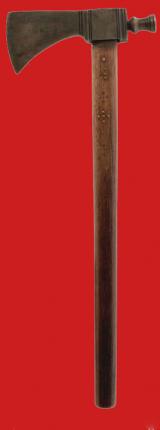
A Superbly Attractive Native American Trade Style Tomahawk Axe, Typical Import Pattern With Trader’s Inventory Stamp. Reservation Period
With studded wooden haft, the axe with single curved blade and rounded opposing pole hammer. Probably 19th century or later. The metal trade tomahawk has long been an object of fascination for both the amateur collector and the ethnologist. Few other implements have ever combined so many different
functions: tool, weapon, sceptre, symbol and smoking pipe. In this one instrument is collected the lore of handicraft, warfare, prestige, ceremony and personal comfort. Captain John Smith is beheved to have been the first to bring the word into English in his brief vocabulary of Indian terms prepared sometime during the years 1607-1609, when he defined tomahaks simply as meaning "axes." Later he added that the term was applied to both the native war club and the imported iron trade hatchet. Almost from the moment the Native American Indian first saw the metal hatchet or tomahawk, likely made in Sheffield, England, he coveted it, and sought to possess one for himself. The efficiency of the new implement was readily apparent : it was deadlier in combat, more efficient in cutting wood, and just as useful as a ceremonial object. Although it was an excellent weapon, the new American man was not as reluctant to trade it as he was to dispense guns. The axe was also self-sufficient; it could function without such components as powder and ball that had to be obtained from the traders. Thus the hatchet could and did spread rapidly through Indian trade routes far from the points of frontiersman’s contact, reaching tribes and areas as yet unknown to the few Europeans along the coast. The first contact of the Indian with the iron or steel axe undoubtedly occurred with the arrival of the Vikings, and to judge from accounts in the sagas, the meetings were not auspicious. Two instances are recounted which may well be the first recorded encounters of the Indian with the weapon which later was to become almost synonymous with his warfare. The Saga of Eric the Red recalls the first reported battle of the Vikings with the natives of America
“The Skrellings Indians, moreover, found a dead man, and an axe lay beside him. One of their number picked up the axe and struck at a tree with it, and one after another they tested it and it seemed to them to be a treasure, and to cut well; then one of their number seized it, and hewed at a stone with it so that the axe broke, whereat they concluded that it could be of no use, since it would not withstand stone, and they cast it away.”
But not all Indians thought the same.
The potentialities of the axe as a weapon were apparent to the Indian from the outset. Garcilaso de la Vega tells of a bloody fight between an Indian armed with a captured battle axe and several of De Soto's soldiers, in which he even includes a i6th century version of the old story of a man being cut in two so quickly by a keen blade that he remains standing and has time to pronounce a benediction before falling. In Florida, Jacques LeMoyne illustrated the murder of a colonist by an Indian with an axe during the brief French settlement at Fort Caroline, 1564-1565. By the early 17 th century the tomahawk was firmly established in the minds of the white settlers as the Indians' primary weapon, and was much more feared than the bow and arrow. Even after the Indians had obtained a sizeable number of firearms, the tomahawk retained its popularity and importance. Once a gun had been fired, it was useless until it could be reloaded ; an edged weapon was needed as a supplement, and this was the tomahawk. Moreover, for surprise attacks and raids, a firearm was frequently out of the question. This axe’s trade stamp could be a weight mark, or even a quantity mark. Lists of trade goods and treaty gifts indicate that the axe, hatchet, or tomahawk were among the most desired objects. As many as a quantity of 300 axes might be handed out at one treaty meeting, and Sir Wilham Johnson estimated that the Northern Indian Department needed 10,000 axes for trade purposes in the year 1765 alone. This is a 19th century trade axe.
Head 7.5 inches, x 3.25 inches length 20.5 inches. We cannot ship this item to the US.
Interestingly it is now illegal to export all Native American art and artefacts from America , which many believe is completely understandable in order to keep what is left in the homeland, so to speak. But very curiously, it is also illegal to import, and thus return, original Native American art and artefacts into America, this is an extremely contradictory law which many find highly perplexing. One might ask if it is so important that original art and artifacts be saved to remain in America why make it illegal to return pieces previously removed?. That is a question of ‘squaring the the proverbial circle’ only a certain kind of political mind might be able to reconcile. read more
975.00 GBP

A Stunning Original 11th,12th Century Crusader’s Battle Axe of War, Used From The Time Kings Henry Ist, King Stephen, Queen Matilda and King Henry IInd, During The Early Crusades to the Holy Land. Regarded as the The Weapon of Choice of Kings, and Knight
In the Norman through to the Plantagenet eras, War Axes were often the weapon of choice of Kings of England in battle. Used from the time of Henry Ist of England, King of England from 1100 to 1135. King Stephen and Queen Matilda, in the age of Anarchy, and through to King Henry IInd 5 March 1133 to 6 July 1189.
Henry 1st was the fourth son of William the Conqueror. Considered by contemporaries to be a harsh but effective ruler, Henry skilfully manipulated the barons in England and Normandy. In England, he drew on the existing Anglo-Saxon system of justice, local government and taxation, but also strengthened it with additional institutions, including the royal exchequer and itinerant justices. Normandy was also governed through a growing system of justices and an exchequer. Many of the officials that ran Henry's system were "new men" of obscure backgrounds rather than from families of high status, who rose through the ranks as administrators. Henry encouraged ecclesiastical reform, but became embroiled in a serious dispute in 1101 with Archbishop Anselm of Canterbury, which was resolved through a compromise solution in 1105. He supported the Cluniac order and played a major role in the selection of the senior clergy in England and Normandy. The early years of Stephen's reign were largely successful, despite a series of attacks on his possessions in England and Normandy by David I of Scotland, Welsh rebels, and the Empress Matilda's husband, Geoffrey of Anjou.
In 1138 the Empress's half-brother Robert of Gloucester rebelled against Stephen, threatening civil war. Together with his close advisor, Waleran de Beaumont, Stephen took firm steps to defend his rule, including arresting a powerful family of bishops. When the Empress and Robert invaded in 1139, however, Stephen was unable to crush the revolt rapidly, and it took hold in the south-west of England. Captured at the battle of Lincoln in 1141, Stephen was abandoned by many of his followers and lost control of Normandy. Stephen was freed only after his wife and William of Ypres, one of his military commanders, captured Robert at the Rout of Winchester, but the war dragged on for many years with neither side able to win an advantage. Henry Iind was an energetic and sometimes ruthless ruler, driven by a desire to restore the lands and privileges of his royal grandfather, Henry I. During the early years of the younger Henry's reign he restored the royal administration in England, re-established hegemony over Wales and gained full control over his lands in Anjou, Maine and Touraine. Henry's desire to reform the relationship with the Church led to conflict with his former friend Thomas Becket, the Archbishop of Canterbury. This controversy lasted for much of the 1160s and resulted in Becket's murder in 1170. Henry soon came into conflict with Louis VII and the two rulers fought what has been termed a "cold war" over several decades. Henry expanded his empire, often at Louis' expense, taking Brittany and pushing east into central France and south into Toulouse; despite numerous peace conferences and treaties no lasting agreement was reached. By 1172, he controlled England, large parts of Wales, the eastern half of Ireland and the western half of France, an area that would later come to be called the Angevin Empire.
Normans were very strongly represented in the First Crusade, in 1096–1099. At that time, the Normans were the best fighters, the shock troops, of Western Christendom, and looking for places to fight and rule. Different groups of Normans had recently taken over England, and were in the process of taking over Sicily (plus the southern half of Italy), defeating the last Muslim Emir of Sicily in 1091. Moreover, they were the newly reformed Papacy’s greatest allies and supporters, as ferocious in piety as in war.
Among the Norman leaders of the 1st Crusade were Robert Curthose (first son of William the Conqueror and later Duke of Normandy himself), Bohemond of Taranto, who masterminded the capture of Antioch and became its first crusader Prince, Tancred of Hauteville, who became Prince of Galilee in the new Kingdom of Jerusalem, and Richard of Salerno, who later acted as regent in the crusader County of Edessa.
By the time the Second Crusade took place, in 1147–1150, Norman greatness was already starting to wane. When the last Norman King of England died at that point the Duchy of Normandy lost its independence and ceased to be a major force in French affairs. The most famous of all English crusaders was, of course, Richard I, the “Lionheart,” but we should not forget that his father too had taken a strong interest in the fate of the crusader kingdoms. Two years before the fateful Battle of Hattin in 1187, Henry promised to support 200 knights annually in the Holy Land as part of his penance for the murder of Thomas of Becket. In consequence, 200 “English” knights fought at Hattin, although sources are unclear as to whether these knights were Englishmen, subjects of Henry Plantaget, or simply knights financed by Henry II.
Regardless of their exact nationality, two hundred knights out of a total of 1200 to 1500 is significant. Furthermore, Henry II personally took crusading vows after the fall of Jerusalem to Saladin. Although many question Henry II’s sincerity – and he certainly had good reasons for thinking he should not leave his vast domains unprotected or his unruly vassals without royal oversight for too long – there can be no doubt that he did introduce a “Saladin Tithe.”These revenues were collected directly by the Knights Templar and were certainly employed to help finance the Third Crusade. Thus, while Henry II did not personally take part in a crusade, he provided something arguably more important at this juncture in time – the means to outfit, transport and sustain many other fighting men.
Almost every iron weapon that has survived today from this ancient era is now in a fully russetted condition, as is this one, because only the weapons of kings, that have been preserved in national or royal collections, are today, still in a relatively fair state and condition. Surviving ancient medieval axes, such as we offer here, can be incredibly inexpensive and great value, compared to their combat cousins, the knightly sword. Firstly, because knightly swords cost far more in their day, and were thus rarer, and secondly, when a knightly sword is lost in combat and buried in the ground very few survive, due to the thin iron blade structure, whereas the axe has far more 'meat on the bone' so to speak, and will fare much better from the vagaries and corruption of time. Wooden hafts and sword handles on the other hand never survive
5.5 inch blade's edge read more
1195.00 GBP
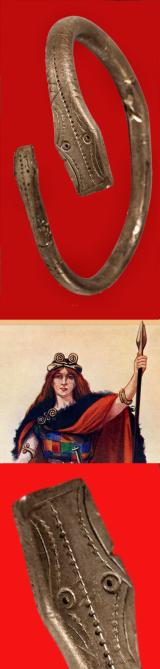
Stunning 2000 Year Old, Ancient Celt, Pagan, Status Jewel. An Original Celtic Silver Coiled Serpent Bracelet Armilla From the Time of King Prasutagus & Used By Nobility Of The Era of Queen Boadicea, Queen of the Iceni,, The Ancient Briton Ruler
Representing Cernunnos, the ram horned serpent A Celtic pagan deity, sometimes depicted with horns, and as a serpent, Cernunnos represents the earth, fertility, and the cycles of nature. A Cernunnos high status ‘serpent’ form armilla of a round spiral coil body in worked silver, punch engraved with zig-zag scales, with a flattened head with punched decoration for its eyes and curved flat horns. The ram-horned serpent (as depicted with its flattened head) was a cult image found in north-west Europe before and during the Roman period. It appears three times on the incredible Celtic historical artefact the Gundestrup cauldron, similarly decorated with punch engraving, and in ancient Romano-Celtic culture was closely associated with the horned or antlered god Cernunnos, in whose company it is regularly depicted, being held in his left hand. This pairing is found as early as the fourth century BC in Northern Italy, where a huge antlered figure with torcs and a serpent was carved on the rocks in Val Camonica.
Queen Boudicea of the Iceni {also known as Queen Boudicca} was the very first recorded warrior queen of Briton and one of the most famous rulers of all early British history before 1066. Famously depicted by a larger than life bronze statue in London driving into combat, her chariot into the imagined Roman legions This stunning and iconic piece of Celtic silver pagan status jewellery, the armilla, was made from, circa, early to mid 1st century. The Latin name for a bracelet in Antiquity, an armilla, applied to the Greek, Celt and Roman peoples. Boudicca is frequently depicted in art adorned with at least one coiled status serpent form armilla on an arm, often clasping her spear.
The Iceni, whose name might have come from Iken, the original name of the River Ouse, where the tribe are said to have come from, had settlements across Norfolk, in north Suffolk and east Cambridgeshire. One of them was at Brettenham on the Peddars Way, east of Thetford, which was built by Romans to quickly transport troops up to The Wash and Brancaster, where they had a fort protecting north Norfolk.
Queen Boudicca waged war against the Romans in Britain from 60 AD after the Romans decided to rule the Iceni directly and confiscated the Norfolk property of the leading tribesmen. The uprising was motivated by the Romans' failure to honour an agreement they had made with Boudica's husband, Prasutagus, regarding the succession of his kingdom upon his death, and by the brutal mistreatment of Boudica and her daughters by the occupying Romans.
Boudicca's warriors successfully defeated the Roman Ninth Legion and destroyed the capital of Roman Britain, then at Colchester. They went on to destroy London and Verulamium (St Albans).
Thousands were killed. Finally, Boudicca was defeated by a Roman army led by Paulinus. Many Britons were killed and Boudicca is thought to have poisoned herself to avoid capture.
The site of the battle, and of Boudicca's death, are unknown.
Iceni warriors may have laid waste to Silchester
Professor Fulford said that in excavations at Silchester they had found evidence of a major military occupation at Calleva (now called Silchester) in 40 AD, then destruction between 60 and 80 AD, including wells that were filled in at this time and burned buildings.
"The settlement is completely wiped out somewhere between 60 AD and 80 AD.
Not only an incredibly beautiful ancient work of art, it is a unique artefact of ancient Celtic history, and a fabulous statement piece for any fine collection. It could look amazing frame mounted.
Queen Boudicea was also spelt Boudicca, or Boudica In the time of the Ancient Briton Celts revolt against the might of Rome. A wonderful original There is so few opportunities to own a wonderful piece from the time of Boudicca Queen of the Iceni of ancient Briton. There are no known surviving artefacts of hers, but to own a significant piece of potentially one of her nobles is wonderful. About the time of Claudius' triumph in AD 43 (a century after Caesar's expeditions), Pomponius Mela, the first Roman geographer, says of the Britons that
"they fight not only on horseback and on foot, but also in wagons and chariots bigis et curribus, and are armed after the manner of the Gauls. They call those chariots covines which are set with scythes round about the naves falcatis axibus" (De Chorographia, III.43; first translated by Arthur Golding in 1585 and modernized here). In AD 60 or 61, when the Roman governor Gaius Suetonius Paulinus was campaigning on the island of Mona (modern Anglesey) on the northwest coast of Wales, Boudica led the Iceni, the Trinovantes, and others in revolt. They destroyed Camulodunum (modern Colchester), earlier the capital of the Trinovantes but at that time a colonia, a settlement for discharged Roman soldiers and site of a temple to the former Emperor Claudius. Upon hearing of the revolt, Suetonius hurried to Londinium (modern London), the 20-year-old commercial settlement that was the rebels' next target. He lacked sufficient numbers to defend the settlement, and he evacuated and abandoned Londinium. Boudicca led a very large army of Iceni, Trinovantes, and others against a detachment of Legio IX Hispana, defeating them, and burning Londinium and Verulamium.
An estimated 70,000-80,000 Romans and British were then killed in the three cities by those following Boudicca, many by torture. Suetonius, meanwhile, regrouped his forces, possibly in the West Midlands; despite being heavily outnumbered, he decisively defeated the Britons. The crisis caused Nero to consider withdrawing all Roman forces from Britain, but Suetonius's victory over Boudicca confirmed Roman control of the province. Boudicca then either killed herself to avoid capture (according to Tacitus), or died of illness (according to Cassius Dio) Beginning around the 3rd century BC, Celts of the regions around the Marne and the Moselle Rivers began burying their chieftains in light, two-wheeled chariots with their sword, shield, spears, and drinking vessels. Similar chariot graves from this era are also found in the British coastal regions of Yorkshire. The evidence for the use of these vehicles is clear. A Roman coin from 110 BC dramatically depicts the naked Gallic warrior-king Bituitus of the Averni casting spears from his chariot. And documentary evidence of the chariot in combat on the European continent is left to us by the Roman poet Propertius. In describing the fighting between the forces of Republican Rome and 30,000 howling Celtic warriors in 222 BC, Propertius depicts the chieftain Viridomar ‘clothed in striped trousers’ hurling javelins from his chariot with deadly accuracy. In fact, many of the Latin words for chariot-carpentium, carrus, essendum have Gaulish roots.
The use of chariots in combat in Gaul apparently died out before Caesar’s campaign of the 50s BC, because Caesar makes no mention of them, though he did of Gallic cavalry, in his Gallic Wars. But chariots certainly remained in Britain, though few have been found there into the Caesarian era and beyond, because they are included in the writings of Caesar, Tacitus, and in the old Irish epic the ‘Tain Bo Cuailnge’ (The Cattle Raid of Cooley) composed in part around the 2nd century AD. Evidence of early Celtic chariot use is gleaned primarily from the excavation of graves of noble warriors.The first Roman expedition to Britain was a reconnoiter of the island by Julius Caesar in 55 BC, purportedly to suppress the reinforcements being given the native tribes in Gaul. There, chariots no longer were being used, and the ambush of a legion caught in the open and but surrounded by the cavalry and chariots of the Britons provides an excursus by Caesar on their tactics, so unfamiliar to the Romans.
"In chariot fighting the Britons begin by driving all over the field hurling javelins, and generally the terror inspired by the horses and the noise of the wheels are sufficient to throw their opponents' ranks into disorder. Then, after making their way between the squadrons of their own cavalry, they jump down from the chariot and engage on foot. In the meantime their charioteers retire a short distance from the battle and place the chariots in such a position that their masters, if hard pressed by numbers, have an easy means of retreat to their own lines. Thus they combine the mobility of cavalry with the staying power of infantry; and by daily training and practice they attain such proficiency that even on a steep incline they are able to control the horses at full gallop, and to check and turn them in a moment. They can run along the chariot pole, stand on the yoke, and get back into the chariot as quick as lightning" (Gallic War, IV.33). An example from Ingolstadt, Germany, in Megaw, R.& V. Celtic Art. From its Beginnings to the Book of Kells,
London, 1989. For example a denarius coin was minted by the moneyer Lucius Hostilius Saserna in 48 BC, following Caesar's campaign in Gaul. The reverse depicts a naked Celtic warrior holding a spear and small shield, while a crouched figure drives the horses with a whip.
The armilla is 8 cm wide overall weighing approx two ounces
for reference;
Cf. Megaw, R.& V., Celtic Art. From its Beginnings to the Book of Kells, London,
The Megaws investigate the antecedents of Celtic art, the styles and motifs employed, the relationship of the Celts and their art to the ancient civilizations of the Mediterranean, and the magnificent maturity of Celtic art in Britain and Ireland. They include major discoveries that have been made as the result of highway and rail construction and the results of detailed surveys of known sites, such as the recovery of the remarkable stone sculpture from the Glauberg northwest of Frankfurt. Continuing work at old sites such as the saltmining complex of the Durrnberg just south of Salzburg has produced new treasures, and important finds in Central and Eastern Europe and in the British Isles have necessitated a change in emphasis with regard to questions of origin and development. Vincent Megaw is currently Professor of Visual Arts and Archaeology, Flinders University, Adelaide, Australia, and Visiting Professor in the Department of Archaeology, University of Edinburgh; he is also Honorary Research Fellow in the Department of Archaeology, University of Glasgow.
The Armilla, a bracelet or armlet, was worn by both men and Celtic women of status in ancient times. In Roman it could be of such high status it was awarded to a Roman legionary as regard for great feats of combat.
See; the Celt cauldron Gundestrup boiler, inside Description Gundestrup boiler, inner plates, Y.FRJ, Rævemosen, Ålborg County, in the gallery with the depiction of the flattened horn headed deity serpent held in Cernunnos‘s hand.
Every single item from The Lanes Armoury is accompanied by our unique Certificate of Authenticity. Part of our continued dedication to maintain the standards forged by us over the past 100 years of our family’s trading, as Britain’s oldest established, and favourite, armoury and gallery.
https://creativecommons.org/share-your-work/licensing-considerations/compatible-licenses/. https://natmus.dk/museer-og-slotte/nationalmuseet/ read more
2450.00 GBP

A Most Rare, Original, Romanov, Russian Cossack Solid Silver Shashka & Silver Cossack Whip With Concealed Dagger, 'The Imperial Russian Honour Sword & Nagaika Awards of Gallantry' Awarded by The Czar The Russian Version of the British Victoria Cross
Awarded by Czar Alexander Romanov IIIrd in 1883, and it is dated 1883. The superbly deluxe etched presentation blade bears the personal crest cypher of the Czar. A crowned A III, and the crest of the Romanovs.. See photo 9 in the gallery.
In 50 years we have never seen a matching pair of honour sword and dagger complete and together, they may not even have an ioriginal pair in the Hermitage Museum in St Petersburg. One of the greatest museum collections in the world.
A Most Rare 19th Century Romanov era, Russian Shashka, 'Sword of Chivalry' complete with its matching, rare, and fabulous silver Niello presentation Romanov Cossack's nagaika Cossack whip with hidden dagger. Both were awarded for gallantry and heroism in combat during the Romanov era of Czarist Russia, in the reign of Czar Alexander IIIrd, father of Czar Nicolas IInd the last Czar, who was executed with his wife and children by firing squad in Yekaterinburg, by the Russian Bolshevik revolutionaries in July 1918 .
The sword and whip combination are the Imperial Russian equivalent to the Victoria Cross {or the American Medal of Honour}.
For such a great honour, as well as the silver and enamel 'Badge of Honour of St Anne' the recipient may also be awarded a presentation silver sashqua sabre, engraved with the award presentation and emblazened with a silver enamel badge of the Order of St. Anne.
A Cossack could also be awarded, as a very special extra honour, a silver Niello nagaika Cossack whip with a concealed thrusting dagger which also has a matching silver and enamel St Anne award for gallantry badge mounted on the body of the whip. The dagger was for use against attacking wolves or for close combat battle use. We show in the gallery a picture of a Cossack lieutenant with his awarded silver Cossack sashqua of gallantry, and also with his matching presentation nagaika. Also we show a cossack charge with sabres and the nagaika on the cossack's wrists. The picture is a standing lieutenant, of the 2nd Volgski Regiment, Terek Host.
The epitome of the Caucasian Cossack officer; the highly decorated weapons and kaftan are typical of these units throughout the war. The cartridge pockets on each breast, gaziri, were functional as well as decorative. The undershirt, beshmet, was often privately made and did not always conform to regulations. During the war supply problems led to khaki replacing the grey kaftans. The rank of this sotnik or first lieutenant is identified by the three stars and single stripe on his shoulder boards, which also bear the regimental number '2 and the Cyrillic initial of the Terek Cossacks, which resembles 'Br. Light blue was the traditional distinguishing color of the Terek Host. He wears the Order of Vladimir 4th Class with Swords, the Order of St. Anne 4th Class with Swords, a Terek Cossack badge and that of the Novocherkask Cossack School. His handsome weapon is a St. Anne's Sword 'for Bravery' - note the rosette in the pommel. He carries the matching silver Cossack nagaika whip with badge. A most rare desirable and collectable sword of the Imperial, Russian, Romanov period. A sword of gallantry and honour awarded to an officer who displayed the finest valour serving his Czar, the equivalent at the time to the Victoria Cross medal in England or the US Medal of Honour in America. The hilt is silver surrounding a central carved ribbed grip of bone and it is engraved on the pommel in Russian to represent gallantry and there's the red enamel badge of Saint Anna of Russia the blade is simply superb decorated in fine scrolls and imperial scenes of cavalry, stands of arms and flags, and the crest of Czar Alexander of Russia, the father of Czar Nicholas II, the executed last Czar of all the Russias. The spine of the blade bears a cyrillic Russian inscription by the maker Zlatoust, and date 1883. The silver pommel is engraved in Russian, the closest translation in English is 'for Bravery'. The blade is superbly etched with panels of charging cossack cavalry, the crest of the Romanov Czar, Alexander III, the Cross of St Anna, and numerous scrolls and geometric designs, plus traces of original blue and gilt in the fullers. Swords of this nature are some of the most desirable Russian swords ever made and collected from the old Imperial Romanov Russia, and this one is certainly one of the finest we have ever seen. The Order of Saint Anna ("Order of Saint Ann" or "Order of Saint Anne") was established as a Holstein ducal and then Russian imperial order of chivalry established by Karl Friedrich, Duke of Holstein-Gottorp, on 14 February 1735, in honour of his wife Anna Petrovna, daughter of Peter the Great of Russia. The motto of the Order is "Amantibus Justitiam, Pietatem, Fidem" ("To those who love justice, piety, and fidelity"). Its festival day is 3 February (New Style, 16 February). Originally, the Order of Saint Anna was a dynastic order of knighthood; but between 1797 and 1917 it had dual status as a dynastic order and as a state order. The Head of the Imperial House of Russia always is Master of the imperial Order of Saint Anna. The Order of St. Anna continued to be awarded after the revolution by Grand Duke Kirill Vladimirovich, Grand Duke Vladimir Kirillovich, and Grand Duchess Maria Vladimirovna.
Membership of the Order was awarded for a distinguished valour and distinguished service in the military. The Order of Saint Anna entitled recipients of the first class to hereditary nobility, and recipients of lower classes to personal nobility. For military recipients, it was awarded with swords such as this wonderful superior rank example. The blade makers marks of Zlatoust. The House of Romanov was the second dynasty to rule Russia, after the House of Rurik, reigning from 1613 until the abdication of Tsar Nicholas II on 15 March 1917, as a result of the February Revolution.
The Romanovs achieved prominence as boyars of the Grand Duchy of Moscow, later the Tsardom of Russia. In 1613, following years of interregnum (Time of Troubles), the zemsky sobor offered the Russian crown to Mikhail Romanov. He acceded to the throne as Michael I, becoming the first Tsar of Russia from the House of Romanov. His grandson Peter I established the Russian Empire and transformed the country into a continental power through a series of wars and reforms.
The direct male line of the Romanovs came to an end when Elizabeth of Russia died in 1762. After an era of dynastic crisis, the House of Holstein-Gottorp, a cadet branch of the House of Oldenburg that reigned in Denmark, ascended the throne in 1762 with Peter III, a grandson of Peter I. All rulers from the middle of the 18th century to the revolution of 1917 were descended from that branch. Though officially known as the House of Romanov, these descendants of the Romanov and Oldenburg dynasties are sometimes referred to as Holstein-Gottorp-Romanov.
In early 1917 the Romanov dynasty had 65 members, 18 of whom were killed by the Bolsheviks. The remaining 47 members went into exile abroad. In 1924, Grand Duke Kirill Vladimirovich, the senior, surviving male-line descendant of Alexander II of Russia by primogeniture, claimed the headship of the defunct Imperial House of Russia. Since 1991, the succession to the former Russian throne has been in dispute, largely due to disagreements over the validity of dynasts' marriages, especially between the lines of Grand Duchess Maria Vladimirovna of Russia and Prince Nicholas Romanovich Romanov, succeeded by Prince Andrew Romanov. The sword has no scabbard.
Every single item from The Lanes Armoury is accompanied by our unique Certificate of Authenticity. Part of our continued dedication to maintain the standards forged by us over the past 100 years of trading read more
12950.00 GBP