

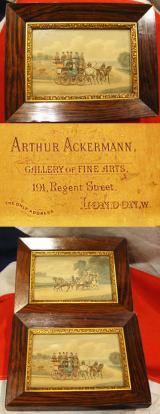
What a Superb Antique Christmas Gift Idea. A Pair of Simply Delightful Original Victorian Royal Mail Coaching Prints in Fine Rosewood Veneer Frames
With their original and super old retailer's labels of the most distinguished Arthur Ackerman Gallery of Fine Arts, 191 Regent St. London, W. A charming pair of original Victorian coloured prints in fine quality frames. 6.75 inches x 8.75 inches framed In the 18th century travel was hazardous to all. Highwaymen stalked the roads and those leading into London were said to be ‘infested’ with robbers. Romantic tales of masked, gallant gentleman were far from the truth: highwaymen were ruthless and deadly.
On 4 December 1775, a Norwich stagecoach was attacked by a gang of seven highwaymen. The guard shot three robbers before being killed and the coach robbed. Richard ‘Dick’ Turpin, a famous highwayman of the time, was known to torture his victims and would even kill one of his companions to aid his own escape.
‘… recommending the Guarding of all the Horse Mails, as a measure of national importance to which the Public in some degree conceived themselves entitled…’
Francis Freeling, Resident Surveyor, 14th March 1796
A plan was written to guard all horse mails, which included the arming of all guards. In doing so the Post Office would not only secure the vast property conveyed by horse, but also save the expenses incurred in prosecuting a robber. Furthermore, it would maintain regularity of service and eliminate what was seen as a disgrace to both the Office and to the nation.
Surveyors observed that the revenue lost to robbery was twice the sum it would cost to guard the mail: it was the obvious choice. In 1784, John Palmer introduced the first mail coach from Bristol to London. This faster and well-armed postal service proved to be a great deterrent to robbers, as they risked being shot or, if caught, tried and hanged. The first recorded robbery of a mail coach did not occur until 25 July 1786.
A letter to joint Postmaster Generals asking for the establishment of a regional mail coach was signed by over 100 people, whose businesses had been damaged due to the frequency of robberies. Mail coaches were a better way of securing the post’s safe passage, though there are a few recorded instances of attempted robberies even of them.
In January 1816, an Enniskillen coach was attacked and robbed by a gang of 14 men who had barricaded the road. The guards fired off all of their ammunition but the mail bags and weapons were all stolen. the Mail Guard was issued with a a pair of flintlock pistols read more
375.00 GBP
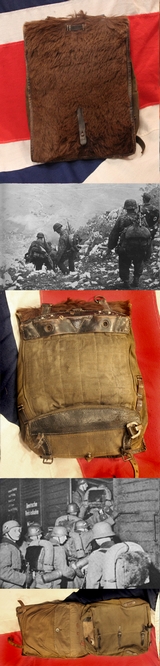
A Very Good WW2 1942 German Infantry Fur Backed Tornistor Back-Pack
In very good condition overall, maker stamped and dated 1942 by Lunschloss. This cowhide-covered rucksack was known as the Tornister 34 (developed in 1934) and was later fitted with new style straps in 1939. As the war progressed the design was simplified for economical and practical reasons so the cowhide cover was eliminated making these packs especially scarce on today's collector market.
The M39 has one vertical loop with quick release sewn at the bottom of the front flap for retaining the A-frame and comes with or without carrying straps. Troops that were isssued infantry Y-straps received the version without carrying straps (replaced by two hooks), while troops with no Y-straps received the version with carrying straps.
All of them were produced with a fur front flap (and some without fur) and it was called "Affe" in the German Army read more
295.00 GBP

A Fine Edo Period 17th Cent. Samurai Armour Gosuko, Dangae dou Part Suit of Armour. Shown With A Kabuto For Display Only, {Kabuto Now Sold}
17th century body armour {kabuto helmet sold seperately} comprising full a cuirass {do}, of front and back plates, constructed of iron plates over lacquered and fully laced, and linked with chain mail.
Dangae dou (dō) meaning "step-changing" is a Japanese (samurai) chest armor that is a combination of two or more other styles. The main part of the dou (dō) may be an okegawa dou (dō), but the bottom two lames are laced (kebiki or sugake) instead of riveted or vice versa, or an armour is laced in sugake but the tateage and bottom lames are in kebiki.
Plus, steel chain mail and armour plate arm defences, inner lined with blue green material. The kabuto we show in photos 4 and 5, would compliment it beautifully, and for sale separately {code number 24030}.
During the Heian period (794-1185), the Japanese cuirass evolved into the more familiar style of armour worn by the samurai known as the dou or do. Japanese armour makers started to use leather (nerigawa) and lacquer was used to weather proof the armor parts. By the end of the Heian period the Japanese cuirass had arrived at the shape recognized as being distinctly samurai. Leather and or iron scales were used to construct samurai armours, with leather and eventually silk lace used to connect the individual scales (kozane) which these cuirasses were now being made from.
In the 16th century Japan began trading with Europe during what would become known as the Nanban trade. Samurai acquired European armour including the cuirass and comb morion which they modified and combined with domestic armour as it provided better protection from the newly introduced matchlock muskets known as Tanegashima. The introduction of the tanegashima by the Portuguese in 1543 changed the nature of warfare in Japan causing the Japanese armour makers to change the design of their armours from the centuries-old lamellar armours to plate armour constructed from iron and steel plates which was called tosei gusoku (new armours). Bullet resistant armours were developed called tameshi gusoku or (bullet tested) allowing samurai to continue wearing their armour despite the use of firearms. Please note the helmet is not with the armour. The silk lacing on the breast and back plate is 400 years old and very frayed throughout.
In Japan the term samurai evolved over several centuries
In Japanese, they are usually referred to as bushi (武士,) or buke (武家). According to translator William Scott Wilson: "In Chinese, the character 侍 was originally a verb meaning 'to wait upon', 'accompany persons' in the upper ranks of society, and this is also true of the original term in Japanese, saburau. In both countries the terms were nominalized to mean 'those who serve in close attendance to the nobility', the Japanese term saburai being the nominal form of the verb." According to Wilson, an early reference to the word samurai appears in the Kokin Wakashū (905–914), the first imperial anthology of poems, completed in the first part of the 10th century.
Originally, the word samurai referred to anyone who served the emperor, the imperial family, or the imperial court nobility, even in a non-military capacity.It was not until the 17th century that the term gradually became a title for military servants of warrior families, so that, according to Michael Wert, "a warrior of elite stature in pre-seventeenth-century Japan would have been insulted to be called a 'samurai'".
In modern usage, bushi is often used as a synonym for samurai read more
2850.00 GBP
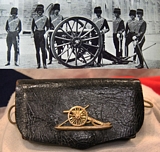
A Very Good Victorian 19th Century Royal Artillery Officer's Pouch
Patent leather with gilt badge of an artillery cannon. A cross belt is two connected straps worn across the body to distribute the weight of loads, carried at the hip, across the shoulders and trunk. It is similar to two shoulder belts joined with a single buckle at the center of the chest. The cross belt was predominantly used from the 1700s (American Revolutionary War) to the 1840s they were not part of a soldier's equipment in the American Civil War and Anglo-Zulu War/First Boer War.
For most line infantry, skirmishers, light infantry, grenadiers and guard regiments during much of Europe's Age of Gunpowder, either a cross belt or two shoulder belts were worn.citation needed One configuration for the belts would be the cartridge box on the right hip and sword scabbard on the left. Such equipment would be attached to the belt at its lowest point, where it rests on the hip. Officers almost never carried muskets or rifles, so they typically wore only one shoulder belt, such as for the pistol cartridge box or for a sabre scabbard. As officers were often aristocratic and used many independent symbols for their family, rank, and command, their uniforms and gear organisation could be highly variable.
For British infantry, the cross belt had a metal belt plate with the regiment of the soldier inscribed on it read more
245.00 GBP

Very Rare Circa 1700’s Japanese Nagasaki Emigre Sword Maker. A ‘Sawasa’ Naval Hanger A Japanese Hangar in The European Style, For a Senior Officer of the Dutch East India Company ( the VOC). A VOC Naval Captain of A So Called ‘Black Ship’
Made by Japanese emigre samurai sword koshirae makers and artisans, after 1639, by exiled Japanese sword fitting craftsmen working in Batavia, for a VOA Naval Admiral or Captain, likely a permitted trading black ship voyaging to the trading post at the Nagasaki island Dejima.
The Black Ships (in Japanese: 黒船, romanized: kurofune, Edo period term) were the names given to Portuguese and Dutch merchant ships,
In 1543, Portuguese initiated the first contacts, establishing a trade route linking Goa to Nagasaki. The large carracks engaged in this trade had the hull painted black with pitch, and the term came to represent all Western vessels. In 1639, after suppressing a rebellion blamed on the influence of Christian thought, the ruling Tokugawa shogunate retreated into an isolationist policy, the Sakoku. During this "locked state", contact with Japan by Westerners was restricted to Dutch traders on Dejima island at Nagasaki.
European hanger swords were the weapon of choice for senior maritime officers employed by the Dutch East India Company VOC , in fact by all senior naval officers at the time, including notorious pirates such as Edward Teach, aka ‘Blackbeard’. The hilt and fittings of this sword were probably added to the European blade by Japanese émigrés in the Dutch colony of Batavia (Jakarta).
They were made using the sawasa technique of gilded copper alloy with black shakudo detailing. Japanese samegawa grip {giant rayskin}, with a vertical panel, engraved with an exotic bird in front of two Indonesian mosque temple domes.
The level of workmanship suggests that the sword belonged to a high-ranking company official.
A fine and jolly rare Japanese export Sawasa hunting hanger. It features a straight blade with a double-edged tip and wide fuller, flanked by a narrow groove near the spine. In the base of the fuller on either side are a running stag and a boar, both prized hunting animals, and French motto of honour.
Sometimes referred to as 'Tonkinese chiseled work', these 18th century export wares became highly sought after, such as this 18th century Sawasa sword
The desiring incorporates a single shell-guard, chased and gilded in high relief against a blackened fish-roe shakudo ground, chisseled with reclining Eros with his bow and quiver. the hilt quilon block is chisseled on one sade by a collared hunting hound and tiger to the other side. The knuckle bow is chisseled with the figure of a turbanned Jakartan figure. the pommel is chisseled with a stag, and the quillon end is a stag hoof, and a covering in panels of Japanese samegawa {giant rayskin}. Overall the hilt is decorated with a combination of artistic styles of the Dutch East Indies, and Europe, made by Japanese emigre artistry with japanese samegawa binding, finished in a mixture of shakudo and gilt.
This sword is a beauty in a superb state of preservation.
Sawasa is the Japanese name given to objects made by Asian artisans, adopting European models combined with Japanese and Chinese materials and decorative motifs. This decoration consists of refined gilt relief and engraving on a lustrous lacquered surface. Sawasa wares are the result of cultural interaction between Asia and Europe. As a consequence of global trade in the 17th century, mutual interest arose in the peculiarities of each other’s culture. The Dutch and other Europeans brought rare objects back from their travels which whetted the appetite for exotic rarities. The earliest Sawasa objects are sword and hanger hilts and tobacco boxes ordered in Japan from Batavia, now Jakarta. Sawasa demonstrates not only the intercontinental commercial connections created by the Dutch East India Company (VOC) but also mutual cultural influences between Europe and Asia.
The decoration of the fittings are of the Japanese export style, in the European manner, but with fine and typical Japanese influences for a black ship naval captain of the VOC, in the late seventeenth or early eighteenth centuries, a style of metalwork known as sawasa that was produced for the Dutch East India Company in and around Nagasaki. Following Japan’s closed country (sakoku) edicts, from around 1639, exiled Japanese sword fitting craftsmen began working in Batavia, where the market for sawasa was a profitable one. The idea of sawasa was that objects made from a copper alloy were given gilt relief decoration with black lacquered highlights to achieve the appearance of shakudō. The extensive metalwork here resembles shakudō, but is likely to be sawasa with highlights in gold. The ground is covered with fine punch marks in a pattern resembling fish roe (nanako), although the punch marks are not completely uniform. The wooden hilt is covered on each side with panels of brass alloy, over Japanese samegawa giant ray skin and once overlaid with gold leaf;
Blade is engraved, on both sides, Ne me Tirez pas sans Raisons.. Ne me Remette point sans Honneur
Do not shoot me without reason do not hand me over without honour.
The hilt and blade is exceptionally sound and great condition, but with all the due appropriate age and surface wear from the past three hundred years
Picture in the gallery, a Japanese woodblock print, of a 17th century Dutch East India Co. vessel trading in Japan, a so-called Black Ship.
Another example of a Sawasa sword sold last May 24 for £14,080. It was a small sword, with an engraved blade. the engraving on that sword looks incredibly like it was created by the same hand as ours. Although the gilt on that small sword was mostly near perfect, where ours is not perfect.
For reference;
Sawasa – Japanese Export Art in Black and Gold 1650-1800 Rijksmuseum Amsterdam.
Every item is accompanied with our unique, Certificate of Authenticity. Of course any certificate of authenticity, given by even the best specialist dealers, in any field, all around the world, is simply a piece of paper,…however, ours is backed up with the fact we are the largest dealers of our kind in the world, with over 100 years and four generation’s of professional trading experience behind us.
See Bas Kist et al, Sawasa Japanese export art in black and gold 1650-1800, exhibition catalogue, Rijksmuseum Amsterdam, 28 November 1998 - 28 February 1999, pp. 53-54, A.13.1 - A.14.1 (illustrated)
For a related example formerly in the collection of the late A.R. Dufty F.S.A., past Master of the Armouries, H.M. Tower of London, see Christie's South Kensington, Antique Arms and Armour, 15 July 1998, lot 28 read more
2450.00 GBP

A German 'Wedding Gift' Presentation Grade Adolf Hitler's 'Mein Kampf' Published in 1939. Presentation & Personally Signed by Dr. Wiard Bronleewe Burgomeister & SA District Leader of Peine
Presented for the wedding of Kurt Wachholz to Margarete gebr. Vogt after some research apparently Kurt Wachholz was a German SS-Hauptscharführer who died by execution after capture in around 1969 in East Germany
Adolf Hitler Mein Kampf Wedding Edition, being an excellent condition example with cream hardboard covers having gilt tooled town emblem and the spine being blue leather covered with gilt tooled details. Inside page with printed page and inked details from the local official and dated 14th 1939, just six weeks after the start of WW2. Published by the official publisher of the NSDAP. The book also bears a facsimile signature of Adolf Hitler beneath his photograph, on the inside frontispiece, and the signed presentation certificate to the marrying couple from the Burgomeister. Originally when SS men were married the book may have been contained in a carved wooden SS box, some surviving boxes do exist but their definitive connection to the Wedding presentation Mein Kampf is unrecorded.
Leather bound with cream covers. Given just six weeks after the beginning of WW2 by the Burgermiester Dr. Wiard Bronleewe of Peine. Bearing the state crest of arms of Piene on the front cover. Condition very good to excellent. Mein Kampf ("My Struggle") is an autobiographical manifesto by Nazi leader Adolf Hitler, in which he outlines his political ideology and future plans for Germany. Volume 1 of Mein Kampf was published in 1925 and Volume 2 in 1926. The book was edited by the former Hieronymite friar Bernhard Stempfle, who was murdered during the Night of the Long Knives.
Hitler began dictating the book to his deputy Rudolf Hess while imprisoned for what he considered to be "political crimes" following his failed Putsch in Munich in November 1923. Although Hitler received many visitors initially, he soon devoted himself entirely to the book. As he continued, Hitler realized that it would have to be a two-volume work, with the first volume scheduled for release in early 1925. The governor of Landsberg noted at the time that "he Hitler hopes the book will run into many editions, thus enabling him to fulfill his financial obligations and to defray the expenses incurred at the time of his trial."
The lawyer Dr. Wiard Bronleewe joined the NSDAP in 1933 at the age of 36. Four years later he was appointed First Deputy Mayor of the city of Peine. After Mayor Erich Krüger was killed in an accident on a trip to the battlefields of the First World War, he took over his office. In addition, he was a member of the NSDAP district leadership in Peine as district office manager for local politics.
In his dual role as mayor, who was able to make all important decisions independently according to the "Führer principle", and member of the NSDAP district leadership, he was responsible for implementing the increasingly radical National Socialist policy during the war years. He played a particularly important role in the persecution of the Jewish community. In 1941 he planned to "level the Jewish cemetery and make it available to the public". His knowledge of the finality of the deportation of the Jewish population is shown by the fact that in early 1942 he coordinated the process of "distributing Jewish housing".
His behavior at the end of the war is controversial, when negotiations with the Americans succeeded in surrendering Peine without a fight and thus saving it from a feared bombing. Some reports describe him as a rather passive participant who had to be pressured to surrender the city, while others see him as the driving force of events, a view that he himself promoted.
Deposed by the Allies in 1945, he became active again in political parties and various associations in 1947, including the German Party. Bronleewe was a member of the Peine City Council again in 1952; after lengthy disputes, including legal ones, over his NSDAP past, he was able to become a city councillor and thus deputy city director in 1954. As a department head, he headed the legal department and social affairs. In 1957, he was promoted to senior city councillor. He retired in 1962 and lived in Peine until his death in 1976. Bronleewe's rapid rise to prominence in Peine politics and administration after 1945 is exemplary of the rapid integration of former NSDAP members, even when they had held leading positions of responsibility.
Photo in the gallery of Mayor Dr. Wiard Bronleewe giving a speech in front of the Peine town hall, 1940. in his full SA political leader uniform.
Another photo in the gallery of Kurt Wachholz in the uniform of SS-Hauptscharführer.
We also have another 'Mein Kampf', a regular English Edition, 'My Struggle' published by Hurst and Bracket Ltd. London, in 1938/9. Please enquire for details read more

A Superb Solid Sterling Silver Cigarette & Cigar Box, Early H.M. Queen Elizabeth IInd Period With The Crest of the Royal Borough of Windsor, & The Castle
Presented to officers of the Household Cavalry, the mounted bodyguard of her Late Beloved Majesty, Queen Elizabeth IInd, in 1965 at Windsor Castle. Silver Birmingham hallmarked by William Neale & Son Ltd (their mark from 1909). William Neale & Son Ltd
Birmingham, 1933 hallmark. Firm established by William Neale in 1850 in Birmingham. Later the firm became William Neale & Sons as a partnership of William Neale Sr., William Neale Jr. and Arthur Neale, building new premises at 29 Warstone Lane, Birmingham (1896). In 1905, the firm was converted into a limited liability company under the style of William Neale & Sons Ltd moving in 1910 at 34 Cox Street, St. Paul's Square, Birmingham. In 1941,
The Arms of the Borough as shown upon the silver box are officially recorded in the College of Arms as having been entered in 1566 at the Visitation of Berkshire made in that year by William Hervey Clarenceux, King of Arms, in the following form:
Per fesse Argent and Vert a Stag's Head caboshed of the first in chief between the attires Sable an Escutcheon of France Modern and England quarterly in base a Castle Wall with three Towers also Argent in the central tower a open Port with Portcullis raised Or.
Origin
Arms entered (without tinctures) at the Visitation of 1532; Confirmed with tinctures at the Visitation of 1566;
The castle is, of course, a reference to Windsor's famous royal fortress, and the stag's head recalls that the Windsor Great Park around the town formed a hunting ground for the Norman kings. The shield depicts the old 1405-1603 Royal Arms and is appropriate as New Windsor is a Royal Borough.
The Freedom Of Windsor: The freedom of the Royal Borough of Windsor was given to the Household Cavalry at a special ceremony held in the home Park, Windsor Castle, today. Immediately following this ceremony the Household Cavalry exercised their right by marching through the town of Windsor with bands plkating. Armoured cars from the Lifeguards took part in the parade. May 05, 1965.
Gross weight 22.8 ozs approx 6.75 inches x 4.65 inches x 2 inches. Hallmarked silver lined with cedarwood interior. read more
675.00 GBP

A Superb 'Valet de Pied a la Maison' Footman's Livery Frock Coat, in Dark Blue Velvet, Silk Damask, Silver Bullion and Fine Lace, With Handmade Cut-Steel Marquesite Buttonning
Such beautiful examples of the finest and elaborate clothing is considered very much a fabulous piece of object d'art, with museum collections displaying many such surviving pieces of now long gone finery with much attention to the their fine detail, their craftsmanship, tailoring and beauty. In stunning condition. Any well considered location for such a stunning piece could only be improved by such an admirable piece. A 19th century form footman’s livery frock coat, the dark blue velvet coat with five pairs of re-made 2” wide silver braided bands to front and similar double braided bands to flared pointed cuffs, reverse of coat pleated and cut to waist with banded tie and two large, pierced, cut handmade steel marquesite buttons. Black bow at rear of neck, collar and cuffs have finely worked white lace with matching cravat. The fine quality burgundy coloured damask waistcoat with floral and foliate worked decoration and six 1” wide braided silver bands en suite with coat. A false pocket flap on each side similarly trimmed with braid. Six dark metal waistcoat buttons of floral openwork design have star marquesite button centres. The whole in very good condition due to perfect storage. Male servants were paid more than female servants (because they were expected to support a wife and children) and footmen were something of a luxury and therefore a status symbol even among the servant-employing classes. They performed a less essential role than the cook, maid or even butler, and were part only of the grandest households. Since a footman was for show as much as for use, a tall footman was more highly prized than a short one, and good looks, including well-turned legs, which were shown off by the traditional footman's dress of stockings worn below knee breeches, were an advantage. Footmen were expected to be unmarried and tended to be relatively young; they might, however, progress to other posts, notably that of butler. One 19th-century footman, William Tayler, kept a diary which has been published. He was, in fact, married; but kept his marriage secret from his employers and visited his family only on his days off.
Once a commonly employed servant in great houses, footmen became much rarer after World War I as fewer households could by then afford retinues of servants and retainers. The position is now virtually a historic one although servants with this designation are still employed in the British Royal Household, wearing a distinctive scarlet livery on state occasions.The first footman was the designation given to the highest-ranking servant of this class in a given household. The first footman would serve as deputy butler and act as butler in the latter's absence, although some larger houses also had an under-butler above the first footman.
In a larger household, various footmen might be assigned specific duties (for which there might be a traditional sequence), such as the silver specialist. Usually the footmen performed a range of duties which included serving meals, opening and closing doors, carrying heavy items, or moving furniture for the housemaid to clean behind. The footmen might also double as valets, especially for visiting guests. As with all 19th century form clothing it is a small size. read more
1475.00 GBP

A Beautiful & Incredibly Impressive Original Antique Omani Silver Al Saidi 'Royal' Khanjar, Just The Type As Was Presented To The Famed Lawrence of Arabia Over 100 Years Ago
A rare and complete example of an Omani Sa'idiyyah khanjar, a Royal Khanjar with the distinctive ‘7 Rings’ to denote its owner is a person of high status, comprising of an all silver scabbard and hilt. Decorated in intricate silver filigree wirework with a pattern similar to the 'tree of life'.
Also known as the Jambiya, daggers of this quality were almost always usually custom made for presentation. Lawrence of Arabia had several very similar ones presented to him, they were his favourite dagger, and he was frequently photographed wearing them. One picture is a portrait of Lawrence with his silver Jambiya, near identical to this one. Information only not included Silver, usually more often than not, coin silver, not English hallmarked silver. The jambia, a curved Islamic dagger, is the main customary accessory to the clothing worn by Arabian men. For centuries the people of South Arabia have inherited the their jambiahs from generation to generation. There are several theories about the origin of the Jambia. There are historical facts, concerning the existence of the Jambia revealing that it used to be worn at Sheban times, in the Himiarite kingdom. They take the statue of the Sheban king (Madi Karb 500 bc ) as proof. This statue, which was discovered by an American mission in Marib in the 1950s, was found to be wearing a Jambia.
Since The most expensive and famous jambiya was purchased by Sheikh Naji Bin Abdul-Aziz Al-Sha'if, who was able to pay US $1 million for one prized and ancient piece. This jambiah had a historical importance, belonging to Imam Ahmed Hamid Al-Din, who ruled Yemen from 1948 to 1962. The Imam's most precious possession was transferred to Sheikh Hussein Al-Watari, who in turn sold it to Sheikh Al-Sha'if.
According to Sheikh Muhammad Naji, the son of current owner of the most precious jambiah, his father?s prize is the most expensive and famous one in the country. Its cost was made so high because it is one of the best jambiahs ever made by Al-Saifani, and a piece of history, as well.
The second highest price ever paid for a jambiah was for the one that Sheikh Ahmed Hamid Al-Habari sold to Sheikh Abdullah Bin Hussein Al-Ahmar for £440,000 GBP.
A picture in tha gallery from the 1950's shows a khanjar being given to a British member (Colonel Watson) of the Trucial Oman Levies
for reference see
Ernst Hieke; Zur Geschichte des Deutschen Handels Mit Oastafrika Teil, 1 Wm Oswald & Co, page 40 1939
Robert Elgood; The Arms and armour of Arabia
Approx 27 cm top to bottom read more
750.00 GBP

A fabulous Chinese Export Chinoisserie Black Lacquer and Gold Large Tea Caddy Chest of the Finest Quality, King George IIIrd, circa 1800's from the Estate of a 23rd Foot, Royal Welsh Fusiliers Peninsular War and Waterloo Officer George Fielding
An antique finest quality Chinese export hand gilded Chinoiserie tea chest caddy with hinged lid, and interior lidded pewter container, for the most precious tea, and made for the European market. Possibly made in Foo Chow.
Not only is the exterior stunningly decorated in the Chinoiserie style, the interior pewter container’s lid is exquisitely engraved to match, with another fabulous and highly elaborate oriental scene of figures and countryside. The lacquer shows scenes of a typical Southern Chinese scholar's garden with people in it, all done in black and gold. Surrounding these scenes are typical Chinese decorative motifs incorporating several auspicious symbols..
This is a superlative tea chest, and note that its exceptional size makes it a most rare type of tea 'chest' size caddy. It is hand crafted with hand painted chinoiserie gilt and ebonized black lacquer. It is painted on all sides with multiple figures, pagoda and palace gardens, with additional geometric and floral designs. It retains its original hand engraved pewter lidded tea casket; It has 2 carrying handles on the sides. It also has most satisfying heft in its weight. The lid’s gilding is worn as to be expected, but all the remaining 4 faces are in excellent near mint condition, as is the interior and the tea casket. The inner lid area contains the monogram of George Fielding, ‘G F’, a British army officer and a Peninsular War and Waterloo veteran, for whom it was commissioned. Captain George Fielding, of the 23rd Regiment of Foot, the Royal Welsh Fusiliers, was a veteran of the Battle of Waterloo who was wounded at the battle, and who resided at Startforth Hall, Startforth, County Durham.
Captain Fielding served in the Peninsular War from Aug 1811 to April 1814, at Aldea de Ponte, Badajoz, Cuidad Rodrigo, Nive, Toulouse, & Orthez. He died in Bath in 1830.
Chinoiserie, so called from 'Chinois' the French for Chinese, was a style inspired by the finest art and design imported from China, Japan and other Asian countries in the 18th century. At its height in Britain from the mid 18th century, this fanciful style relied more on the designer's and craftsman's imagination than on accurately portraying oriental motifs and ornament.
In it earliest days the tea it contained would have been valued by today’s standard thousands of pounds so one can understand why its container should be so fine and a superb work of art in it’s own right. In England in the 1700s, tea was an incredibly expensive commodity. To keep it safe, people would store it in a tea Chest or tea box, which eventually became known as a tea caddy (the word caddy is derived from the Malay "Kati", a unit of weight by which tea was sold). As tea was too expensive to risk leaving in the presence of servants, the caddy in which it was stored would generally be kept in the drawing-room. Subsequently, the tea caddy became an important & fashionable accessory for the home. Tea Caddies were made in a huge variety of styles and materials..
In the manufacture of lacquer-ware the lightest kinds of wood are used. After planing, the surface is covered with a coating of grasscloth fibre and Broussonetia paper, and a mixture of pigs' or buffaloes' gall and pulverised old red sandstone serves as a priming. The article is then placed in a dark room, and a coating of the prepared lacquer laid on with a brush and allowed to dry; and according to the fineness of the ware these coatings are repeated from 3 to 15 times. When the hut coat is dry the articles are painted and gilded. The lacquer, sap of the Vemix vemieiaf used in Canton, is imported from Szechuen or Kiangsi. The gold colouring (a solution of gold leaf in glue water) is laid on with lye of potash ; red is native cinnabar, pink a varnish prepared from Carthamus and green is formed by a mixture of hartall and indigo. Nearly all the lacquer-ware is manufactured in Canton, but magnificent specimens, far exceeding the Canton ware in beauty, colour and fineness are turned out at Foochow. They are made by a single family, said to be of Japanese origin, who brought the secret over with them and have retained it ever since.
From: Catalogue of the Chinese Imperial Maritime Customs Collection
at the United States International Exhibition, Philadelphia, 1876
Inspectorate General of Customs, 1876
13.5 inches x 9.75 inches x 8 inches read more
2150.00 GBP