


A Fabulous & Massive Antique Moro Keris Kalis, A Phillipines Pre Colonial Style Warrior's Sword
A kalis ( in Jawi script: كاليس ) is a type of Philippine sword. The kalis has a double-edged blade, which is commonly straight from the tip but can be wavy near the handle. Kalis exists in several variants, either with a fully straight or fully wavy blade. It is similar to the Javanese keris, but differs in that the kalis is a sword, not a dagger. It is much larger than the keris and has a straight or slightly curved hilt, making it a primarily heavy slashing weapon (in contrast to the stabbing pistol grip of the keris).
Blade length (incl. gangya): 58.5 cm (23 in.)
Width of blade (mid-point): 4 cm
Hilt length: 10.2 cm
OAL: 71 cm (27 7/8 in.)
Width of gangya {guard} tip to tip: 13.2 cm
This blade is of laminated construction. The ricikin shows a secah kasang (elephant trunk), gandhik, praen (tusk), and lambe gajah (elephant lips). The orientation of these features is similar to the much later forms of Indonesian Keris, although the lambe gajah straddle the line of separation between the gandhik and the gangya, instead of appearing low on the gandhik. There is no sogokan or blumbanggan. Greneng and jenggot are present, and both show wear. There is a single, one-piece, asang asang. The hilt is a single piece of carved banati wood, topped with cushion shaped pommel. The grip is bound with criss-crossing rattan, which also secures the extension of the asang asang. The scabbard is made of local wood and bound with plaited rattan strips. Its durability and sharpness can be comparable to the Japanese katana.
A collection of Moro keris types are archived in the United States National Museum.
Even before the arrival of Spain, the knowledge of metallurgy in the pre-colonial Philippines was neither tribal nor primitive. In fact, it was already sophisticated. Because if it was not, Panday Pira would not have come to be. The blades of these swords are a testament to the expertise of these early Filipinos.
The history of the Philippines from 1565 to 1898 is known as the Spanish colonial period, during which the Philippine Islands were ruled as the Captaincy General of the Philippines within the Spanish East Indies, initially under the Viceroyalty of New Spain, based in Mexico City, until the independence of the Mexican Empire from Spain in 1821. This resulted in direct Spanish control during a period of governmental instability there.
The first documented European contact with the Philippines was made in 1521 by Ferdinand Magellan in his circumnavigation expedition,1 during which he was killed in the Battle of Mactan. Forty-four years later, a Spanish expedition led by Miguel López de Legazpi left modern Mexico and began the Spanish conquest of the Philippines in the late 16th century. Legazpi's expedition arrived in the Philippines in 1565, a year after an earnest intent to colonize the country, which was during the reign of Philip II of Spain, whose name has remained attached to the country.
The Spanish colonial period ended with the defeat of Spain by the United States in the Spanish–American War and the Treaty of Paris on December 10, 1898, which marked the beginning of the American colonial era of Philippine history.
The scabbard throat have small side elements lacking read more
650.00 GBP

A Rare, Archaic Chinese Warrior's Bronze & Tinned Jian Sword, Around 2,300 to 2,800 Years Old, From the Zhou Dynasty to the Qin Dynasty, Including the Period of the Great Military Doctrine 'The Art of War' by General Sun-Tzu
Chinese Bronze 'Two Ring' wide bladed double edged Jian sword, of tin rich over bronze alloy construction used in the era of the Seven Kingdoms period, likely in the Kingdom of Wu, up to the latter part of the Eastern Zhou dynasty (475 – 221 BC). The surface amazingly still retains a lot of the fine tinned surface. Tinning was used in China from the Eastern Zhou period (770–221 BC), and various methods were employed. A special technique was amalgam tinning, documented since the seventh century BC .
This is one of a stunning collection of original archaic bronze age weaponry we have acquired and we have been cataloguing. Many are near identical to other similar examples held in the Metropolitan in New York, the British royal collection, and such as the Hunan Provincial Museum, Hunan, China. Many pieces we acquired were sold for the part benefit of the Westminster Abbey fund, and the Metropolitan Museum fund. From the Tony Dove F.S.A. Collection, formed circa 1970's, one of England’s most revered and respected collectors, especially early silver, & he was a past honorary President of London’s Silver Spoon Society, and learned joint contributor to many scientific appraisals on ancient Chinese swords
Sword total length 20 1/4 inches long, 4 inch hilt
Swords of this type are called “two-ring” swords because of the prominent rings located on the hilt. this is the very type of sword used by the warriors serving under the world renowned General Sun Tzu, in the Kingdom of Wu, who is thought by many to be the finest general, philosopher and military tactician who ever lived. His 2500 year old book on the methods of warfare, tactics and psychology are still taught and highly revered in practically every officer training college throughout the world.
We show a painting in the gallery of a chariot charge by a Zhou dynasty warrior armed with this very form of sword. We also show a photograph of warriors the world renown Chinese Tomb Army, discovered and excavated over the past recent decades. The figures apparently show the real image of the faces of each individual warrior of the first emperor of China, Qin Shi Huang, that each statue represents. Each one is adorned the typical combat armour that would have been worn by the past user of this sword, and used a same time as the Tomb Warriors were being created and buried for the tomb of Emperor Qin. China was the name created for the entire country, after their first emperor, although spelt Qin in the English form it is pronounced Chin, hence, China. The Qin emperors last resting place, the tomb and his buried imperial warrior army, covers a breathtaking 56.25 square kilometres, and may take the best part of another 100 years to excavate. By this measure one can see with respect and awe the size and power of ancient China, and this tomb region was created over 2300 years ago. Compare this to the only remaining example of the past recorded, and so called, Seven Wonders of the World, the great pyramid of Giza, it covers just one quarter of a square kilometre, yet it is still considered one of the largest single buildings ever created by man.
The Chinese term for this form of weapon is “Jian” which refers to a double-edged sword. This style of Jian is generally attributed to either the Wu or the Yue state. The sword has straight graduated edges reducing to a pointed tip, which may indicate an earlier period Jian.
The blade is heavy with a midrib and tapered edges from the hilt.
A very impressive original ancient Chinese sword with a long, straight blade with a raised, linear ridge down its centre. It has a shallow, short guard. The thin handle would have had leather or some other organic material such as leather or hemp cord, wrapped around it to form a grip. At the top is a broad, round pommel.
Although the manufacturing techniques used may have varied from region to region, it is generally believed that such tin-rich decoration was achieved by a deliberate tinning process,including cold-tinning hot-tinning (dipping or wiping) the use of a mercury-tin amalgam ,or the application of a tin-rich paste.
In 1965 a similar form sword from the same era was found in an ancient tomb in Hubei, it was also engraved with seal script, but of a different form. The Sword of Goujian (越王勾践剑) is a tin bronze sword, renowned for its unusual sharpness, intricate design and resistance to tarnish rarely seen in artifacts of similar age. The sword is generally attributed to Goujian, one of the last kings of Yue during the Spring and Autumn period.
On one side of the Hubei sword’s blade, two columns of text are visible. Eight characters are written in an ancient script, now known as Bird-worm seal script (literally "birds and worms characters", owing to the intricate decorations of the defining strokes), a variant of seal script. Initial analysis of the text deciphered six of the characters, "King of Yue" (越王) and "made this sword for his personal use" (自作用劍). The remaining two characters were assumed to be the name of the particular King of Yue.
The Seven Kingdom or Warring States period in Chinese history was one of instability and conflict between many smaller Kingdom-states. The period officially ended when China was unified under the first Emperor of China, Qin pronounced Chin Shi Huang Di in 221 BC. It is from him that China gained its name.
The Zhou Dynasty (1046-256 BCE) was among the most culturally significant of the early Chinese dynasties and the longest lasting of any in China's history, divided into two periods: Western Zhou (1046-771 BCE) and Eastern Zhou (771-256 BCE). It followed the Shang Dynasty (c. 1600-1046 BCE), and preceded the Qin Dynasty (221-206 BCE, pronounced “chin”) which gave China its name.
In the early years of the Spring and Autumn Period, (770-476 BC) chivalry in battle was still observed and all seven states used the same tactics resulting in a series of stalemates since, whenever one engaged with another in battle, neither could gain an advantage. In time, this repetition of seemingly endless, and completely futile, warfare became simply the way of life for the people of China during the era now referred to as the Warring States Period. The famous work The Art of War by Sun-Tzu (l. c. 500 BCE) was written during this time, recording precepts and tactics one could use to gain advantage over an opponent, win the war, and establish peace.
Sun Tzu was a Chinese general, military strategist, writer, and philosopher who lived in the Eastern Zhou period of ancient China. Sun Tzu is traditionally credited as the author of The Art of War, an influential work of military strategy that has affected both Western and East Asian philosophy and military thinking. His works focus much more on alternatives to battle, such as stratagem, delay, the use of spies and alternatives to war itself, the making and keeping of alliances, the uses of deceit, and a willingness to submit, at least temporarily, to more powerful foes. Sun Tzu is revered in Chinese and East Asian culture as a legendary historical and military figure. His birth name was Sun Wu and he was known outside of his family by his courtesy name Changqing The name Sun Tzu by which he is more popularly known is an honorific which means "Master Sun".
Sun Tzu's historicity is uncertain. The Han dynasty historian Sima Qian and other traditional Chinese historians placed him as a minister to King Helü of Wu and dated his lifetime to 544–496 BC. Modern scholars accepting his historicity place the extant text of The Art of War in the later Warring States period based on its style of composition and its descriptions of warfare. Traditional accounts state that the general's descendant Sun Bin wrote a treatise on military tactics, also titled The Art of War. Since Sun Wu and Sun Bin were referred to as Sun Tzu in classical Chinese texts, some historians believed them identical, prior to the rediscovery of Sun Bin's treatise in 1972.
Sun Tzu's work has been praised and employed in East Asian warfare since its composition. During the twentieth century, The Art of War grew in popularity and saw practical use in Western society as well. It continues to influence many competitive endeavours in the world, including culture, politics, business and sports.
The ancient Chinese people worshipped the bronze and iron swords, where they reached a point of magic and myth, regarding the swords as “ancient holy items”. Because they were easy to carry, elegant to wear and quick to use, bronze swords were considered a status symbol and an honour for kings, emperors, scholars, chivalrous experts, merchants, as well as common people during ancient dynasties. For example, Confucius claimed himself to be a knight, not a scholar, and carried a sword when he went out. The most famous ancient bronze sword is called the “Sword of Gou Jian”.
The Warring States period saw a transition in military styles, from bronze weaponry and chariot-based fighting to iron and cavalry. However, the old period was still revered. Despite the cost of manufacturing bronze swords like this on a mass scale, this particular style of duan jian – a double-edged straight sword – was used in China for approximately 2,500 years. Finely made bronze weapons such as this one were signs of prestige, wealth, and fighting prowess used in both ceremonial and funerary contexts. For example, swords were worn by the Emperor and his officials in ceremonial or official dress, attached to the belt with jade ornaments.
This is one of a stunning collection of original archaic bronze age Zhou dynasty weaponry we have just acquired. Many are near identical to other similar examples held in the Metropolitan in New York, the British royal collection, and such as the Hunan Provincial Museum, Hunan, China. As with all our items, every piece is accompanied by a certificate of authenticity. 22 inches long overall.
Ref; SOME OBSERVATIONS ON EARLY CHINESE BRONZE SWORDS
By
Anthony Dove and Alan Williams {The Wallace Collection} 65 publications read more
2795.00 GBP

A Fabulous Set of The Rifle Brigade Chronicle, Only The Second Near Complete Set We Have Had in 10 Years, Yearbooks Over 300 Available. Priced Per Volume!
A unique set of original regimental year books published during the past 120 years for and on behalf of the officers and men of the rifle Brigade. Over 300 copies are remaining, bound in regimental green cloth, up to 1967, and containing unique and hard to find information on the Rifle Brigade from the past century. One has a very special reference being supplied by Buckingham Palace sold seperately
For example;
The Rifle Brigade Chronicle for 1916 (Twenty-Seventh Year) compiled and edited by Colonel Willoughby Verner (London...
Title: The Rifle Brigade Chronicle for various years
Author: Colonel Willoughby Verner
Edition: 1st edition
Binding: Hardcover
Publisher: John Bale, Sons & Danielsson
Date published: various
====
THE RIFLE BRIGADE CHRONICLE FOR 1938 (FORTY-NINTH YEAR). Hardcover – 1 Jan. 1939
by Major H. G. (edit). Parkyn (Author)
=====
THE RIFLE BRIGADE CHRONICLE
Published by The Rifle Brigade Club and Association, Peninsula Barracks., Winchester (1965)
Buyers may email first direct to enquire for their preferred year, although we have duplicates of years some years are lacking. Some years contain the only known surviving records of the names of the men that served in the regiment. The last set we had, was originally over 400 volumes, all the years of editions published, and 5 original copies per year. read more
28.00 GBP
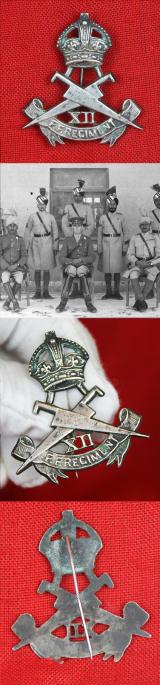
A Most Rare British Empire Raj Period XII Frontier Force Regt. Silver Cap or Turban Badge
Cast low grade silver, for NCO or officer, with needle pin fixing, which often indicates for wear on a puggaree or a turban. The King Emperor crown of King George, and a crossed pair of choora knives or Afghan Khyber knives. So far we can find no other example, and it is the first we have seen. The more commonly known 12th Frontier Force Regiment in the Indian Army was a Light Infantry regiment, with a bugle badge, so we don't know if this was their first and earliest badge, that was potentially replaced around 1922, or, another XIIth Frontier Force regiment altogether. Either way it is a most fine and intriguing authentic British Empire Raj period piece, but, surrounded by an element of mystery to us at least. The armies of the East India Company were recruited primarily from Muslims in the Bengal Presidency, which consisted of Bengal, Bihar and Uttar Pradesh, and high caste Hindus recruited primarily from the rural plains of Oudh. Many of these troops took part in the Indian Mutiny, with the aim of reinstating the Mughal Emperor Bahadur Shah II at Delhi.
The meaning of the term "Indian Army" has changed over time, initially as an informal collective term for the armies of the three presidencies–the Bengal Army, Madras Army and Bombay Army–between 1858 and 1894. In 1805, the Indian Army began its formal existence and was the "army of the government of India", including British and Indian (sepoy) units; this arrangement lasted until 1902.
Then in 1903, Lord Kitchener became the Commander-in-Chief of the Indian Army, his tenure continued until 1909. He instituted large-scale reforms, the greatest of which was the merger of the three armies of the Presidencies into a unified force. He formed higher level formations, eight army divisions, and brigaded Indian and British units. Following Kitchener's reforms, terminology used for military forces in India was altered, with the Indian Army referring to "the force recruited locally and permanently based in India, together with its expatriate British officers." Whereas the British Army in India referred to the British Army units posted to India for a tour of duty, and which would then be posted to other parts of the Empire or back to the UK. Comparatively, the term 'Army of India', meant the combined forces of both the Indian Army and the British Army in India. Militaria from the British Empire Indian Raj period over the past 30 years has become, extremely collectable, highly prized and most valuable. In many cases the rarer the better read more
295.00 GBP
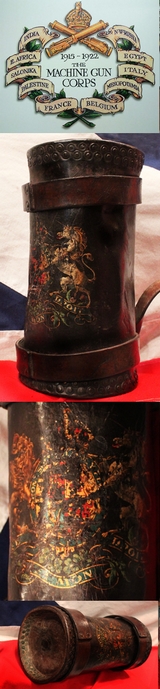
A Superb Original Antique WW1 Leather Machine Gun Company Munition Case. A Very Rare Piece as Most Surviving Cases Were For Cordite For the Artillery, But the Machine Gun Corps Example is Very Rare Indeed
Part of a Superb WW1 Machine Gunner's Collection, British and German.
WW1 issue. Bearing the royal crest of King George Vth and British Army stamped for the 6th, 261 Machine Gun Company 6 261 MGC. Substantially strong and robust hardened buffalo hide. This is a particularly rare type, not the usual Royal Artillery version.
It is of very heavy grade solid leather, that is top, bottom and side, brass seam riveted, and with a wide leather carrying strap at the rear. The more common version used by the British army was a cordite carrier type, that are plain, lightweight and have no rivets, cork lined and are wide rim banded top and bottom. At the outbreak of the First World War in August 1914, the tactical potential of machine guns was not appreciated by the British armed forces. The prevalent attitude of senior ranks at the outbreak of the Great War can be summed up by the opinion of an officer (albeit expressed a decade earlier) that a single battery of machine guns per army corps was a sufficient level of issue.
Despite the evidence of fighting in Manchuria (1905 onwards) the Army therefore went to war with each infantry battalion and cavalry regiment containing a machine gun section of just two guns.
These organic (embedded) units were supplemented in November 1914 by the formation of the Motor Machine Gun Service (MMGS) administered by the Royal Artillery, consisting of motor-cycle mounted machine gun batteries.
A machine gun school was also opened in France.
After a year of warfare on the Western Front it was self-evident that to be fully effective - in the opinion of former sceptics - that machine guns must be used in larger units and some commanders advocated crewing them with specially trained men who not only thoroughly conversant with their weapons but who understood how they should be best deployed for maximum effect. To achieve this, the Machine Gun Corps was formed in October 1915 with Infantry, Cavalry, and Motor branches, followed in 1916 by the Heavy Branch. A depot and training centre was established at Belton Park in Grantham, Lincolnshire, and a base dep?t at Camiers in France.
The Infantry Branch was by far the largest and was formed by the transfer of battalion machine gun sections to the MGC. These sections were grouped into Brigade Machine Gun Companies, three per division. New companies were raised at Grantham. In 1917, a fourth company was added to each division. In February and March 1918, the four companies in each division were formed into a Machine Gun Battalion.
The Guards Division formed its own machine gun support unit, the Guards Machine Gun Regiment.
The Cavalry Branch consisted of Machine Gun Squadrons, one per cavalry brigade.
The Motor Branch was formed by absorbing the MMGS and the armoured car squadrons of the recently disbanded Royal Naval Armoured Car Service. It formed several types of units: motor cycle batteries, light armoured motor batteries (LAMB) and light car patrols. As well as motor cycles, other vehicles used included Rolls-Royce and Ford Model T cars.
The Heavy Section was formed in March 1916, becoming the Heavy Branch in November of that year. Men of this branch crewed the first tanks in action at Flers, during the Battle of the Somme in September 1916. In July 1917, the Heavy Branch separated from the MGC to become the Tank Corps, later called the Royal Tank Regiment.
The MGC saw action in all the main theatres of war, including France, Belgium, Palestine, Mesopotamia, Egypt, Salonika, East Africa and Italy. In its short history, the MGC gained an enviable record for heroism as a front line fighting force. Indeed, in the latter part of the war, as tactics changed to defence in depth, it commonly served well in advance of the front line. It had a less enviable record for its casualty rate, with 62,049 becoming casualties, including 12,498 killed, earning it the nickname 'the Suicide Club'.
A fabulous and beautiful artifact of WW1 Machine Gun Corps history, that is now perfectly useable as a stunning display piece, or stick stand or waste paper basket. Top section of rear leather strap handle is now detached, but it should be easily repairable. 14 inches high x 7.5 inches across read more
795.00 GBP
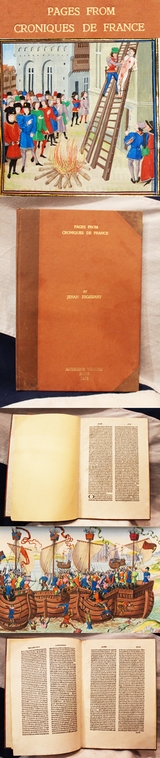
Two Original Medieval Pages From Sir John Froissart's Chronicles Of France Printed in 1495, of the 14th Century, From The Printing Personally Ordered By King Henry VIIth Of England.
Two original loose pages from the original medieval 1495 printed book, mounted and bound in folio form, within cloth hard back binding with gold titles, 13 x 9 inches. Original medieval pages taken from the book printed in Paris in 1495 by Verrard. This particular printing [that these pages came from] was personally ordered in book form by King Henry VIIth of England from Anthoine Verard in Paris, and his copy now resides in the British Museum. Froissart's Chronicles were initially in manuscript form with fine illustration but were first transformed in to book form in Paris in 1495. Full and complete copies of this book, published by Anthoine Verard in 1495, and as was ordered by King Henry, can now achieve six figure sums. Froissart might be called the great interviewer of the Middle Ages. The newspaper correspondent of modern times has scarcely surpassed this medieval collector of intelligence. He traveled extensively in the various countries of Europe; he conversed with gentlemen of rank everywhere; and he had the remarkable knack of persuading those about him to divulge all he wanted to know. He learned the details of battles from both sides and from every point of view. He delighted in the minutest affairs of every cavalry skirmish, of the capture of every castle, and of every brave action and gallant deed. He lived from 1337 to about 1410, and wrote chiefly of contemporaneous events. The Chronicles are universally considered as the most vivid and faithful picture we have of events in the 14th century. As a picture of the most favorable side of chivalry, the work has no equal (Adams, Manual of Historical Literature, 334-35). There has never been any difference of opinion on the distinctive merits of this great work. It presents a vivid and faithful drawing of the things done in the 14th-century. No more graphic account exists of any age. No historian has drawn so many and such faithful portraits? (Britannica). The Chronicles were originally circulated in manuscript form, with the first printed version appearing around 1498 in Paris. Froissart was one of the greatest of the medieval European writers. In his own century, -the fourteenth it is not easy to see anyone who can be put beside him as a prose-writer. But the literary language of the day was still predominantly verse, and prose was still regarded as something of a utility medium. Because
of this and because Froissart is known principally for his descriptions of warfare - the greatest and most famous chronicle of French and English medieval history. Jean Froissart (1338-C.1410) is the supreme annalist of medieval chivalry, historian, poet, traveller, friend of Chaucer, and by far the most entertaining source for our knowledge of the Hundred Years’ War. It is as much a profane romance as a history book. It is filled with delightful stories and adventures reported first-hand.
Froissart was born in Valenciennes. At the age of 18 he came to England where he entered the service of Queen Philippa of Hainaut, acting as her secretary and private diplomat. In 1366 he set off again on his long travels, settling for a time in the Duchy of Brabant. Much of his great chronicle was probably written in his home town of Valenciennes, and he continued it over his life to the events after the murder of Richard II in 1399.
Froissart began writing Book I sometime after 1370, possibly at the request of Robert de Namur, to whom the earliest version was dedicated. It covers the period from 1322 to 1377, including the accession of Edward III, his campaign in Scotland and his marriage to Philippa of Hainault, the battle of Sluys, the Siege of Tournai, the Breton war of succession, the Battle of Crécy, the Siege of Calais, the battle of Neville’s Cross, the battle of Winchelsea, the battle of Poitiers, Etienne Marcel’s merchant revolt in Paris, the Black Prince’s campaigns in the south of France, the peace of Brétigny, the death of king John II of France, the battle of Cocherel, the battle of Auray, the Castilian Civil War, the battle of Chizé, the deaths of the Black Prince and Edward III and the accession of Richard III. We show in the gallery three hand coloured illustrations that have been used to illustrate the various versions of his works in manuscripts or books. One shows the execution of Hugh the Younger Despenser. read more
795.00 GBP
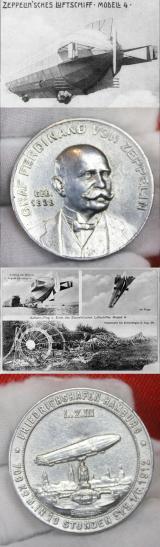
A Rare Aeronautical Medal, Dated 1912, Of The Zeppelin Z3 {AKA LZ12}, Count von Zeppelin Friedrichshafen to Hamburg Flight. Showing The Flight Over The Bismark Memorial
Original, 40.5mm scarce zinc medal of the 1912 flight of the zeppelin Z3 {also known as the LZ12} over Hamburg. The airship is shown sailing over the Bismark Memorial with the city view in background. Another, the more common bronze version sold in the Dr. Kallir auction for $360 in 1999.
Another example in the National Air and Space Museum, Smithsonian Institution.
Medal, Count von Zeppelin Friedrichshafen to Hamburg Flight Commemorative Medal of Count von Zeppelin's Friedrichshafen to Hamburg Flight; Obverse: relief profile bust of von Zeppelin depicted, embossed text "GRAF FERDINAND VON ZEPPELIN"; Reverse: relief of a Zeppelin airship over Hamburg cityscape depicted, embossed text "FRIEDRICHSHAFEN - HAMBURG 700 KoM. IN 10 STUNDEN 31 5.19.1912". read more
360.00 GBP
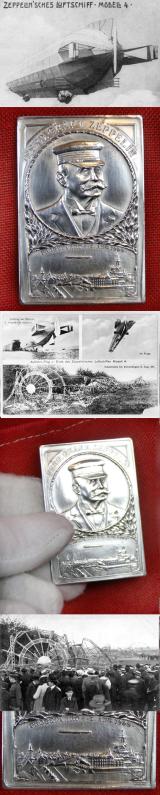
A Very Rare, Near Mint Condition Aeronautical Table Medal for The Graf Zeppelin LZ 4 Dirigible Test Flight To Strasbourg. Hallmarked Silver, {990} Plaque. Dated August 4th 5th 1908, For The Crew Of The Zeppelin That Exploded On Its Test Flight. By Lauer
Graf Zeppelin LZ 4 Dirigible 2 day Test Flight to Strasbourg Silver medal plaque August 1908. Hallmarked 990 silver on the edge, and maker marked by Ludwig Christian Lauer within the frontal design.
Silver plaque medal for presentation of the flight, but the flight was interrupted by several serious issues, which grounded the Zeppelin mid flight, but whereupon it was blown from its mooring, caught fire, and exploded.
The trial flight finally started on 4 August 1908, when the LZ 4 lifted off at 06:22 in the morning, carrying 12 people and sufficient fuel for 31 hours of flight. The flight to Zürich had excited considerable public interest, and large crowds gathered along the route to witness the flight, which took it over Konstanz, Schaffhausen, Basel and Strasbourg. Shortly after passing Strasbourg the forward engine had to be stopped since the fuel tank in the engine gondola had been exhausted, and needed to be refilled. At this point the airship was flying light due to the heat of the sun having caused the hydrogen to expand, and was being held at a low altitude by dynamic downforce generated by flying in a nose-down attitude: with the loss of the power of one engine, it rose to an altitude of 820 m (2,690 ft), venting gas from the relief valves as it did so. At 1:58 p.m the aft engine had to be stopped for refuelling: this time the airship rose to 884 m (2,900 ft), with a further loss of hydrogen. Two further engine stoppages caused further loss of gas: by now LZ 4 was only being kept in the air by dynamic lift generated by flying with a nose-up attitude, the resultant drag reducing its speed to 16 km/h (9.9 mph), and at 5:24 pm a landing was made on the Rhine near Oppenheim, 23 kilometres (14 mi) short of Mainz. All superfluous items and five crew members were unloaded, and the flight was resumed at 10:20. Mainz was reached half an hour later, and the ship turned to begin its return journey. Further engine problems followed: a crank bearing in the forward engine melted at 1:27 am, reducing airspeed to about 32 km/h (20 mph) and it was decided to land to have the engine repaired by engineers from the Daimler works at Untertürkheim. Accordingly, LZ 4 was set down at 7:51 am at Echterdingen.
The airship was tethered and engineers removed the forward engine to make repairs, but during the afternoon LZ 4 was torn from its moorings by a gust of wind. The soldiers present as a ground handling party could not hold it down, but it was brought to earth by a crew member who had remained on board. Unfortunately, the ship came into contact with a half-dead pear tree while landing, which damaged some of the gasbags, and it immediately caught fire. The cause of ignition was later ascribed to a static charge being produced when the rubberised cotton of the gasbags was torn.
The disaster took place in front of an estimated 40 to 50 thousand spectators and produced an extraordinary wave of nationalistic support for Zeppelin's work. Unsolicited donations from the public poured in: enough had been received within 24 hours to rebuild the airship, and the eventual total was over 6 million marks were donated, at last providing Zeppelin with a sound financial base for his experiments.
Made by Ludwig Christian Lauer was a medal maker in Nuremberg, Germany. He began his business in 1848. He expanded his business and in 1860 renamed it ‘coin mint L. Chr. Lauer’. He died in 1873 and the company continued under the supervision of his wife and three sons.
He was a leading 19th-century German manufacturer of medals
55mm x 36mm, 43 grams of 990 silver read more
595.00 GBP
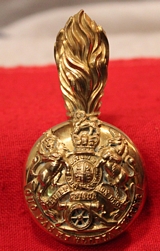
Royal Artillery, Victorian Officer's 'Busby' Helmet Plume Holder Circa 1859-78.
A simply stunning example in superb condition. A very fine gilt example. Flaming grenade (straight flames), the ball mounted with Royal Arms with 'Ubique' scroll below; beneath the scroll, a gun with mounted wheel and scroll 'Quo Fas et Gloria Ducunt'.
Reverse retains plume holder and slider fitting. Very good condition. read more
145.00 GBP
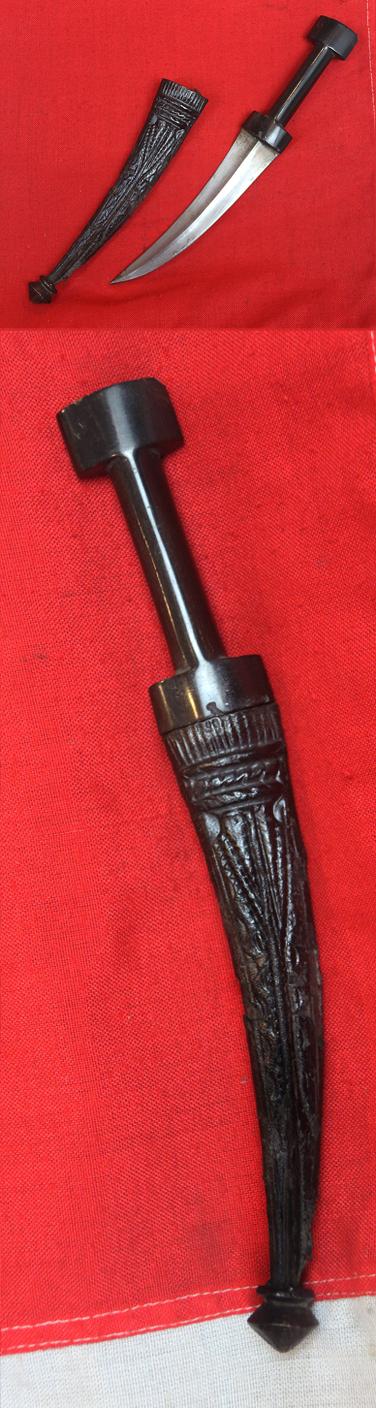
A Most Delightful, Original, Antique Carved Buffalo Horn Hilted Ottoman Empire Khanjar Dagger
this is a typical Ottoman Empire khanjar or jambiya of the 19th century, with traditional carved buffalo horn hilt.
Where they were adopted they had slight differences to the blade, hilt and scabbard. A significant part of a jambiya or khanjar is its hilt (handle). The saifani hilt is made of exotic horn, It is used on the daggers of wealthier men. Different versions of saifani hilts can be distinguished by their colour. Other jambiya hilts are made of different types of horn, wood, metal and ivory. Apart from the material used for the hilt, the design and detail is a measure of its value and the status of its owner. there are 53 different types of Jambiya in the Metropolitan museum Collection, some bear a similarity to this example, many with near identical blades.
The blade and carved hilt are in superb condition, the wooden scabbard is good and sound, but the embossed leather covering is thin and therefore now somewhat fragile with natural age losses.
Every item is accompanied with our unique, Certificate of Authenticity. Of course any certificate of authenticity, given by even the best specialist dealers, in any field, all around the world, is simply a piece of paper,…however, ours is backed up with the fact we are the largest dealers of our kind in the world, with over 100 years and four generation’s of professional trading experience behind us
Overall 11 inches long in scabbard. read more
245.00 GBP