
Antique Arms & Militaria


An Antique, 19th Century Long & Straight Sword of A Mandinka Warrior, West African, Very Long Fluted Broadsword Blade With Leather Covered Baluster Hilt, .
In some areas they are referred to locally as termed a 'kota' and in the scabbard was termed 'kotaholga' ( house 'for the sword')
The Mandinka are the descendants of the Mali Empire, which rose to power in the 13th century under the rule of king Sundiata Keita, who founded an empire that would go on to span a large part of West Africa. They migrated west from the Niger River in search of better agricultural lands and more opportunities for conquest. Nowadays, the Mandinka inhabit the West Sudanian savanna region extending from The Gambia and the Casamance region in Senegal to Ivory Coast. Although widespread, the Mandinka constitute the largest ethnic group only in the countries of Mali, Guinea and The Gambia. Most Mandinka live in family-related compounds in traditional rural villages. Their traditional society has featured socially stratified castes.Mandinka communities have been fairly autonomous and self-ruled, being led by a chief and group of elders. Mandinka has been an oral society, where mythologies, history and knowledge are verbally transmitted from one generation to the next. Their music and literary traditions are preserved by a caste of griots, known locally as jelis, as well as guilds and brotherhoods like the donso (hunters).
Between the 16th and 19th centuries, many Muslim and non-Muslim Mandinka people, along with numerous other African ethnic groups, were captured, enslaved and shipped to the Americas. They intermixed with slaves and workers of other ethnicities, creating a Creole culture. The Mandinka people significantly influenced the African heritage of descended peoples now found in Brazil, the Southern United States and, to a lesser extent, the Caribbean.
This high-status sword from The Gambia demonstrates the widespread African practice of importing European sword blades and supplying them with a hilt and scabbard of local style. The blades of such Mandinka dress swords are usually reflecting the economic networks of European colonial influence. These swords were the exclusive prerogative of Mandinka men of importance or social standing and were intended to enhance their impressive and martial appearance.
Photos in the gallery of 19th century Sudanese warriors but carrying very similar swords with cruciform broadsword blades like this one and the paddle ended scabbards read more
320.00 GBP

Historical 17th-18th Century Indian Tulwar Sword From the Siege and Relief Of Lucknow. Battle Trophy of Irish Captain Of the 32nd Foot, Capt. H.G.Browne From a Collection Swords From The Battles & Defence. Sword With Dozens Of Hand To Hand Combat Cuts
A typical Indian combat sword with good triple fullered blade and steel hilt, but the blade has dozens of incredibly evocative sword edge-to-edge cuts, indicating whoever used this sword at the siege and defence was very seriously in the very thick of the fighting.
The 32nd (Cornwall) Regiment of Foot played a key role in defending the Residency during the Siege of Lucknow in the Indian Mutiny (1857-1859). After the British annexation of Oudh, the 32nd's mess house, the Khursheed Manzil, was occupied by the regiment, which then helped fortify the Residency. Under Colonel John Inglis, the regiment held out for 140 days, winning four Victoria Crosses for acts of gallantry during the prolonged siege. The regiment was retitled the 32nd (Cornwall) Regiment of Foot (Light Infantry) in recognition of its heroic actions during the defense of Lucknow.
When the Indian Mutiny broke out, the 32nd Regiment of Foot was stationed at Lucknow and was a cornerstone of the British defence of the Residency.
The regiment's commander, Colonel John Inglis, took command of the garrison after the death of the Chief Commissioner, Sir Henry Lawrence.
The 32nd Regiment of Foot endured constant attacks, severe casualties from intense heat, and the ravages of cholera during the 140-day siege.
Gifted to the family by Irish born Capt. H.G.Browne {later Colonel of the 100th Foot} who died just before WW1 and was buried near his home on the Isle of Wight. A very early tulwar, and the blade was deeply pitted through great age even before the siege, but the hilt was damaged during the siege and battles at the Lucknow defences, very likely by a cannon shot as the impact seems too drastic and singular to be by musket fire, or by simple hand to hand combat. Very bright polished blade, and a nicely black patinated hilt. Perfect for an intriguiging historical collection or display.
The First Siege
Full-scale rebellion reached Lucknow on May 30 1857, and Lawrence was compelled to use the British 32nd Regiment of Foot to drive the rebels from the city. Improving his defenses, Lawrence conducted a reconnaissance in force to the north on June 30, but was forced back to Lucknow after encountering a well-organized sepoy force at Chinat. Falling back to the Residency, Lawrence's force of 855 British soldiers, 712 loyal sepoys, 153 civilian volunteers, and 1,280 non-combatants was besieged by the rebels.
Comprising around sixty acres, the Residency defenses were centered on six buildings and four entrenched batteries. In preparing the defenses, British engineers had wanted to demolish the large number of palaces, mosques, and administrative buildings that surrounded the Residency, but Lawrence, not wishing to further anger the local populace, ordered them saved. As a result, they provided covered positions for rebel troops and artillery when attacks began on July 1.
The next day Lawrence was mortally wounded by a shell fragment and died on July 4. Command devolved to Colonel Sir John Inglis of the 32nd Foot. Though the rebels possessed around 8,000 men, a lack of unified command prevented them from overwhelming Inglis' troops.
The sieges and reliefs of Lucknow cost the British around 2,500 killed, wounded, and missing while rebel losses are not known. Though Outram and Havelock wished to clear the city, Campbell elected to evacuate as other rebel forces were threatening Cawnpore. While British artillery bombarded the nearby Kaisarbagh, the non-combatants were removed to Dilkuska Park and then on to Cawnpore.
To hold the area, Outram was left at the easily held Alambagh with 4,000 men. The fighting at Lucknow was seen as a test of British resolve and the final day of the second relief produced more Victoria Cross winners than any other single day. Lucknow was retaken by Campbell the following March. read more
795.00 GBP

An Historical 16th-17th Century Indian Tulwar Sword From the Siege and Relief Of Lucknow. Battle Trophies of an Irish Captain Of the 32nd Foot, Capt. H.G.Browne From a Collection Swords From The Battles & Defence. Its Knuckle Bow Blasted By Cannon Fire
The 32nd (Cornwall) Regiment of Foot played a key role in defending the Residency during the Siege of Lucknow in the Indian Mutiny (1857-1859). After the British annexation of Oudh, the 32nd's mess house, the Khursheed Manzil, was occupied by the regiment, which then helped fortify the Residency. Under Colonel John Inglis, the regiment held out for 140 days, winning four Victoria Crosses for acts of gallantry during the prolonged siege. The regiment was retitled the 32nd (Cornwall) Regiment of Foot (Light Infantry) in recognition of its heroic actions during the defense of Lucknow.
When the Indian Mutiny broke out, the 32nd Regiment of Foot was stationed at Lucknow and was a cornerstone of the British defence of the Residency.
The regiment's commander, Colonel John Inglis, took command of the garrison after the death of the Chief Commissioner, Sir Henry Lawrence.
The 32nd Regiment of Foot endured constant attacks, severe casualties from intense heat, and the ravages of cholera during the 140-day siege.
Gifted to the family by Irish born Capt. H.G.Browne {later Colonel of the 100th Foot} who died just before WW1 and was buried near his home on the Isle of Wight. A very early tulwar, and the blade was deeply pitted through great age even before the siege, but the hilt was damaged during the siege and battles at the Lucknow defences, very likely by a cannon shot as the impact seems too drastic and singular to be by musket fire, or by simple hand to hand combat. Very bright polished blade, and a nicely black patinated hilt. Perfect for an intriguiging historical collection or display.
The First Siege
Full-scale rebellion reached Lucknow on May 30 1857, and Lawrence was compelled to use the British 32nd Regiment of Foot to drive the rebels from the city. Improving his defenses, Lawrence conducted a reconnaissance in force to the north on June 30, but was forced back to Lucknow after encountering a well-organized sepoy force at Chinat. Falling back to the Residency, Lawrence's force of 855 British soldiers, 712 loyal sepoys, 153 civilian volunteers, and 1,280 non-combatants was besieged by the rebels.
Comprising around sixty acres, the Residency defenses were centered on six buildings and four entrenched batteries. In preparing the defenses, British engineers had wanted to demolish the large number of palaces, mosques, and administrative buildings that surrounded the Residency, but Lawrence, not wishing to further anger the local populace, ordered them saved. As a result, they provided covered positions for rebel troops and artillery when attacks began on July 1.
The next day Lawrence was mortally wounded by a shell fragment and died on July 4. Command devolved to Colonel Sir John Inglis of the 32nd Foot. Though the rebels possessed around 8,000 men, a lack of unified command prevented them from overwhelming Inglis' troops.
The sieges and reliefs of Lucknow cost the British around 2,500 killed, wounded, and missing while rebel losses are not known. Though Outram and Havelock wished to clear the city, Campbell elected to evacuate as other rebel forces were threatening Cawnpore. While British artillery bombarded the nearby Kaisarbagh, the non-combatants were removed to Dilkuska Park and then on to Cawnpore.
To hold the area, Outram was left at the easily held Alambagh with 4,000 men. The fighting at Lucknow was seen as a test of British resolve and the final day of the second relief produced more Victoria Cross winners than any other single day. Lucknow was retaken by Campbell the following March. read more
695.00 GBP

A most Historical 17th-18th Century Indian Hodson's Horse Sikh Long Khanda Sword From the Siege and Relief Of Lucknow. Battle Trophies of an Irish Captain Of the 32nd Foot, Capt. H.G.Browne From a Collection Swords From the Siege and Relief Of Lucknow.
The 32nd (Cornwall) Regiment of Foot played a key role in defending the Residency during the Siege of Lucknow in the Indian Mutiny (1857-1859). After the British annexation of Oudh, the 32nd's mess house, the Khursheed Manzil, was occupied by the regiment, which then helped fortify the Residency. Under Colonel John Inglis, the regiment held out for 140 days, winning four Victoria Crosses for acts of gallantry during the prolonged siege. The regiment was retitled the 32nd (Cornwall) Regiment of Foot (Light Infantry) in recognition of its heroic actions during the defense of Lucknow.
When the Indian Mutiny broke out, the 32nd Regiment of Foot was stationed at Lucknow and was a cornerstone of the British defence of the Residency.
The regiment's commander, Colonel John Inglis, took command of the garrison after the death of the Chief Commissioner, Sir Henry Lawrence.
The 32nd Regiment of Foot endured constant attacks, severe casualties from intense heat, and the ravages of cholera during the 140-day siege.
Gifted to the family by Irish born Capt. H.G.Browne {later Colonel of the 100th Foot} who died just before WW1 and was buried near his home on the Isle of Wight.
17th to 18th century Indian tulwar swords and this super, long khanda, all to be sold seperately. Some could make a fabulous display paired and crossed. Some are in great condition, but obviously used in combat at Lucknow, so they all saw considerable service. Including one has had its knuckle bow blasted in half, possibly by cannon shot, and one has so many combat sword cuts on its edge they are almost too numerous to count. One has a very early blade that has considerable age pitting. A very impressive piece for the display of its historical context as a sword of battle.
This khanda was likely presented to Capt browne by an officer of Hodson's Horse, possibly Lt. Mecham. Hodsons horse were a loyal Indian regiment that were present at the victory of the final siege and capture of Lucknow.
Hodson's Horse went to the relief of Lucknow and participated in the operations leading to the city's final capture in March 1858.
Major Hodson's Death: Major Hodson was killed during the final assault on Lucknow.
The khanda has an open basket hilt with wide hand protection. The name firangi meaning foreigner was also apparently given to swords of this style these somewhat later in the 17th Century, as they were mounted with European blades, imported by the Portugese, which were highly valued. Some blades were locally made in the European style. The blades were mounted on the Khanda style hilt and with the long spike extending from the pommel which enabled them to be used as two handed swords. The firangi sword characteristically had a straight blade of backsword form (single edged). The blade often incorporated one, two, or three fullers (grooves) and had a spear-tip shaped point. The sword could be used to both cut and thrust. The longer blades were often rather flexible. Examples with narrow rapier blades have survived, though in small numbers. The hilt was of the type sometimes called the "Indian basket-hilt" and was identical to that of another Indian straight-bladed sword the khanda. The hilt afforded a substantial amount of protection for the hand and had a prominent spike projecting from the pommel which could be grasped, resulting in a two-handed capability for the sword. Like other contemporary Indian swords the hilt of the firangi was usually of iron and the tang of the blade was attached to the hilt using a very strong resin, additionally, the hilt to blade connection was reinforced by projections from the hilt onto either face of the forte of the blade which were riveted together though a hole passing through the blade. Because of its length the firangi is usually regarded as primarily a cavalry weapon. Illustrations suggest a 16th-century date for the development of the sword, though early examples appear to have had simpler cross-guard hilts, similar to those of the talwar. The sword has been especially associated with the Marathas, who were famed for their cavalry. However, the firangi was widely used by the Mughals and those peoples who came under their rule, including Sikhs and Rajputs. Images of Mughal potentates holding firangis, or accompanied by retainers carrying their masters' firangis, suggest that the sword became a symbol of martial virtue and power. Photographs of Indian officers of Hodson's Horse (an irregular cavalry unit raised by the British) show that the firangi was still in active use at the time of the Indian Mutiny in 1857-58 The khanda can generally be a double-edge but can be a single edged straight sword. It is often featured in religious iconography, theatre and art depicting the ancient history of India. Some communities venerate the weapon as a symbol of Shiva.
First Siege
Full-scale rebellion reached Lucknow on May 30 and Lawrence was compelled to use the British 32nd Regiment of Foot to drive the rebels from the city. Improving his defenses, Lawrence conducted a reconnaissance in force to the north on June 30, but was forced back to Lucknow after encountering a well-organized sepoy force at Chinat. Falling back to the Residency, Lawrence's force of 855 British soldiers, 712 loyal sepoys, 153 civilian volunteers, and 1,280 non-combatants was besieged by the rebels.
Comprising around sixty acres, the Residency defenses were centered on six buildings and four entrenched batteries. In preparing the defenses, British engineers had wanted to demolish the large number of palaces, mosques, and administrative buildings that surrounded the Residency, but Lawrence, not wishing to further anger the local populace, ordered them saved. As a result, they provided covered positions for rebel troops and artillery when attacks began on July 1.
The next day Lawrence was mortally wounded by a shell fragment and died on July 4. Command devolved to Colonel Sir John Inglis of the 32nd Foot. Though the rebels possessed around 8,000 men, a lack of unified command prevented them from overwhelming Inglis' troops.
The sieges and reliefs of Lucknow cost the British around 2,500 killed, wounded, and missing while rebel losses are not known. Though Outram and Havelock wished to clear the city, Campbell elected to evacuate as other rebel forces were threatening Cawnpore. While British artillery bombarded the nearby Kaisarbagh, the non-combatants were removed to Dilkuska Park and then on to Cawnpore.
To hold the area, Outram was left at the easily held Alambagh with 4,000 men. The fighting at Lucknow was seen as a test of British resolve and the final day of the second relief produced more Victoria Cross winners than any other single day. Lucknow was retaken by Campbell the following March.
A photo in the gallery picture shows members of Hodson's Horse, a body of loyal Indian horsemen formed during the Indian Mutiny by Lieutenant William Hodson. Their distinctive uniforms included scarlet turbans and shoulder sashes over beige tunics. Beato probably took this photograph shortly after the final capture of Lucknow in March 1858. Hodson was killed during the assault. There is some confusion over the identity of the two British officers, but it seems most likely to be Lieutenant Clifford Henry Mecham (standing) and Assistant Surgeon Thomas Anderson (sitting). Anderson cared for Hodson after he was wounded and was with him when he died on 11 March 1858. 37 inch long blade read more
995.00 GBP
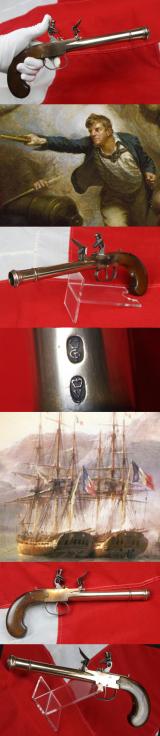
A Fabulous & Impressive 18th Century Ship Captain’s Beautiful & Large, Brass Barrel Naval Blunderbuss Flintlock Pistol, With Box-Lock Action.
6.5inch barrel with ring turned muzzle, nice action, sliding safety, bag-shaped wooden butt. Nicely proved barrel on the underside. This is truly a most beautiful piece.
The combination of polished bronze, walnut, horn, and steel make a most attractive pistol of colour and material contrasts. Finest walnut stock. Bronze cannon form blunderbuss barrel. Bronze blunderbuss barrel pistols were the weapon of choice for naval officers and ship's captains for use at sea. This is a superb example of its kind. The muzzle (and often the bore) was flared with the intent not only to increase the spread of the shot, but also to funnel powder and shot into the weapon, making it easier to reload in haste. The overtly flared muzzle is the defining feature of the blunderbuss. Ship's Captains found such impressive guns so desireable as they had two prime functions to clear the decks with one shot, and the knowledge to an assailant that the pistol hads the capability to achieve such a result. In the 18th and 19th century mutiny was a common fear for all commanders, and not a rare as one might imagine. The Capt. Could keep about his person or locked in his gun cabinet in his quarters a gun just as this. The barrel could be loaded with single ball or swan shot, ball twice as large as normal shot, that when discharged at close quarter could be devastating, and terrifyingly effective. Potentially taken out four or five assailants at once. The muzzle was swamped like a cannon for two reasons, the first for ease of rapid loading, the second for intimidation. There is a very persuasive psychological point to the size of this gun's muzzle, as any person or persons facing it could not fail to fear the consequences of it's discharge, and the act of surrender or retreat in the face of an well armed blunderbuss could be a happy and desirable result for all parties concerned. Action in excellent working order, recently fully serviced. 11 inches long overall. As with all our antique guns no license is required as they are all unrestricted antique collectables read more
2850.00 GBP
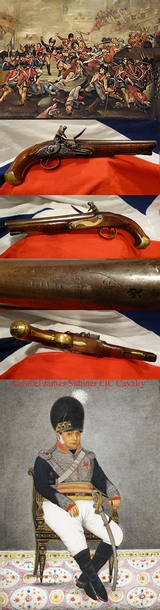
A Stunning King George IIIrd 1756 Pattern Light Dragoon Flintlock Pistol, 19th & 25th Light Dragoons, Part of The East India Company Cavalry Contingent Combating the ‘Tiger of Mysore’ Tipu Sultan
With finest walnut stock with amazing natural age patina, and traditional brass furniture and two British EIC traditional ‘heart’ marks, one on the stock the other on the barrel. From the historical 'Siege of Seringapatam' used by the British 19th & 25th Light Dragoons, serving with the East India Company. The 19th played a major role in the Anglo-Mysore Wars and Anglo-Maratha Wars. Their first campaign was against Tipu Sultan of Mysore from 1790 to 1792. After defeating Tipu, the 19th were on garrison duty until 1799 when war broke out with Tipu again. This time, the Sultan was killed during the Battle of Seringapatam.
Tipu Sultan was the ruler of the Kingdom of Mysore in Southern India. An enemy of many of his neighbours as much as he was of the British East India Company.
Tipu remained an implacable enemy of the British East India Company, sparking conflict with his attack on British-allied Travancore in 1789. In the Third Anglo-Mysore War, he was forced into the Treaty of Seringapatam, losing a number of previously conquered territories, including Malabar and Mangalore. He sent emissaries to foreign states, including the Ottoman Empire, Afghanistan, and France, in an attempt to rally opposition to the British.
In 1800, the 19th fought Dhoondia Wao's rebel army and in 1803, led by Major-General Arthur Wellesley (who later became the Duke of Wellington), they participated in the Battle of Assaye. In this battle, the outnumbered British troops defeated a Maratha army and the regiment was subsequently awarded the battle honour of "Assaye" and presented with an honorary colour.
They were stationed at Cheyloor in 1802, at Arcot in 1803, in Bombay in 1804, and at Arcot again from 1805 to 1806. The regiment was summoned to Vellore on the night of 10 July 1806 to rescue the 69th Regiment of Foot who had been the victims of a revolt by Indian sepoys. The 25th Dragoons (raised for service in India by F E Gwyn on 9 March 1794) was renumbered 22nd (Light) Dragoons in that year. This 22nd (Light) Dragoons regiment served throughout the Napoleonic Wars, which began in 1805, and was disbanded in 1820.
Hyder Ali and Tipu Sultan, the rulers of the Kingdom of Mysore, offered much resistance to the British forces. Having sided with the French during the Revolutionary war, the rulers of Mysore continued their struggle against the Company with the four Anglo-Mysore Wars. Mysore finally fell to the Company forces in 1799, with the death of Tipu Sultan.
Napoleon and Tipu Sultan
In 1794, with the support of French Republican officers, Tipu allegedly helped found the Jacobin Club of Mysore for 'framing laws comfortable with the laws of the Republic'. He planted a Liberty Tree and declared himself Citizen Tipoo. In a 2005 paper, historian Jean Boutier argued [likely wrongly] that the club's existence, and Tipu's involvement in it, was fabricated by the East India Company in order to justify British military intervention against Tipu.
One of the motivations of Napoleon's invasion of Egypt was to establish a junction with India against the British. Bonaparte wished to establish a French presence in the Middle East, with the ultimate dream of linking with Tippoo Sahib. Napoleon assured the French Directory that "as soon as he had conquered Egypt, he will establish relations with the Indian princes and, together with them, attack the English in their possessions." According to a 13 February 1798 report by Talleyrand: "Having occupied and fortified Egypt, we shall send a force of 15,000 men from Suez to India, to join the forces of Tipu-Sahib and drive away the English." Napoleon was unsuccessful in this strategy, losing the Siege of Acre in 1799 and at the Battle of Abukir in 1801. It was, as with all Napoleon’s ‘alliances’ simply a way to remove Britain’s ability to oppose his own Empire ambitions. His term ‘establish relations’ has been used for centuries since by controlling despots as a benign appearing phrase that is actually in reality an umbrella term for ‘control and dominate’.
It has been said in numerous quarters, especially by denigrators of the former British Empire, that the magnificent sub continent of India suffered much under British rule, however let’s not forget prior to the British arrival, and even during, despite their best efforts, India had been ruled with an iron fist for millennia by dozens of kings, nawabs, maharajahs, and princes who had stripped so much wealth from India that many became the richest men on earth, some worth 10 or 100 times the worth of the billionaires of today. So much wealth it is almost inconceivable to understand and comprehend today. There were of course a few benign and caring rulers, but as a rule they were deposed, murdered or imprisoned, often by sons with a somewhat less ‘sympathetic nature’ to their subjects.
As with all our antique guns no license is required as they are all unrestricted antique collectables. Very good and tight action. A horn tipped ramrod. As with all our antique guns they must be considered as inoperable with no license required and they are all unrestricted antique collectables read more
1895.00 GBP
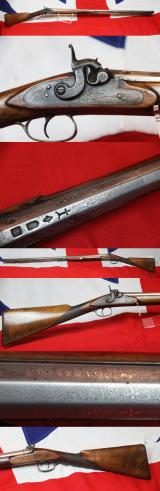
A Very Fine Early 19th Century, Anglo-Spanish Sporting Gun by Ignacio Bascaran, Dated 1822, One of Spain's Most Important Gunsmiths and Barrel Makers of His day, With His Bespoke Silver Inlaid Barrel
A fine English sporting gun bespoke mounted with a stunning Spanish barrel, by Bascaran of Eibar The main factory of arms, Bascarán de Eibar, was one of the most important Basque companies of the 19th century. It was founded by Bascarán in Eibar in 1820 and its factory continued working until year 1862, date in which the children and later their grandsons were given a position of the factory, the family name in gunsmithing goes back to the 18th century and a gun by Fernando Bascaran is in the Basque Museum . The last gunsmith of the Bascarán clan of which I have news was of Mr. Martín Bascarán, which made a semi-automatic pistol Ruby type until year 1918 to equip to the armies French and English during the I World war. The beautiful city of Eibar Guipúzcoa is a municipality belonging to the region of Bajo Deba in the Basque Country of Spain. It is known as the "City of Gunsmiths." In this illustrious city it has produced some of Spain's leading makers. The first written document referring to Eibar gunsmith industry is a request from Lombard dated 1481. Arms of this grade were incredibly expensive and more often than not made for presentation to important persons. As with all our antique guns no license is required as they are all unrestricted antique collectables. read more
995.00 GBP
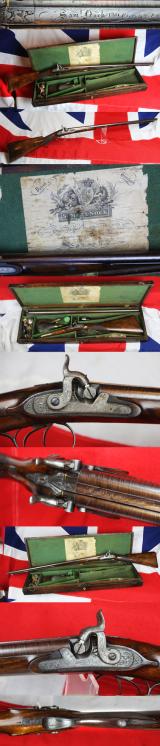
A Fabulous Quality King George IIIrd Cased Double Barrel Sporting Gun By World Renowned Gunsmith S.Nock, Early Transitional Flintlock To Percussion
Very fine sighted damascus barrels of the finest quality, engraved Saml. Nock 180 Fleet St. London Maker to His Majesty, case colour hardened gold lined breech engraved with a hound, border and foliate engraved, signed lock converted from flintlock using the drum and nipple principle, half stocked with chequered wrist, border and scroll engraved steel mounts, the trigger guard decorated with a hound, serial numbered to the underside of the barrels, contained in its green baize lined oak case, the lid with trade label for Samuel Nock at the Regent Circus address, complete with commensurate and later accessories.
Samuel Nock was the nephew of famed innovative gunmaker Henry Nock and apprenticed under him. He was also a highly rated and accomplished gunmaker and worked through the transitional period from flintlocks to percussion systems. He served as a royal gunmaker to the English monarchy from King George III in 1805 up to Queen Victoria starting in 1837. He died in 1851. To replicate such a fine hand made ‘bespoke’ double barrelled gun today, only Purdey or Boss of London could have the skills required to replicate it. A finely engraved, bespoke single Purdey side by side sporting gun, with a Damas barrels, costs today £113,500, with an 18 months to 2 year waiting time, and additional costs for casing and tools. The double-barrelled sporting gun was seen as a weapon of prestige and authority, especially in the days of the East India Company and the later Raj in India, where it was known as Dunali (literally "two pipes"). It was especially valued by the nobility in the Raj in Bihar, Purvanchal, Uttar Pradesh, Haryana and Punjab read more
7995.00 GBP
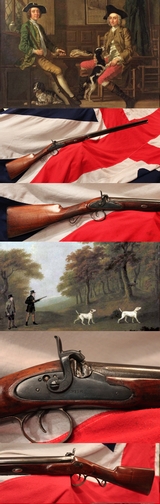
A King George IIIrd Late 18th Century English Fowling Musket By Smith
For the exponent of gentlemanly pursuits. Fine walnut stock, percussion action converted from flintlock in the 1840's, steel furniture with pineapple form trigger guard finial and rear scroll. Hook breech quick release barrel with barrel key attachment. Good condition for age, fine working action. Small very old pitting area on barrel near breech, very slight scuff mark on stock at reverse of lock plate area. Throughout much of its history, hunting in England was an activity of the upper class. Legally, only land owners could hunt in England and the vast majority of the land was in large estates owned by the wealthy. To reduce poaching, the right of a person to own a gun was greatly restricted unless he was a landowner. Thus, ownership of a gun was not even a choice for the average British citizens. Moreover, deer hunting was further restricted to the royalty and generally carried out on horseback with dogs.
The wealthy British sportsmen of the Eighteenth and Nineteenth Centuries were primarily interested in hunting various types of birds. Most of their arms were designed for wing shooting. Rifles were considered an oddity. In the book titled British Field Sports; William Henry Scott (1818) the author described rifle shooting as a ?nice and curious branch of gunnery.? Scott goes on to state that "Rifles ? were little known among us, in the first American War, when people were amused on this side of the water by the story of an American woodsman, who had actually shot an eagle with his rifle, when it was?out of sight, a thing by no means impossible."
Colonel Peter Hawker, one of the most prolific British hunters of the early nineteenth century, maintained detailed diaries relating to his hunting activities. Over the course of many seasons, Hawker shot more than ten thousand birds and other small game. Over the same period of time, Hawker harvested only three deer. Colonel Hawker records that the first time he ever fired a rifle was in June of 1813 (at the age of 27) in anticipation of shooting a deer which had been causing crop damage. (Colonel Hawker's Diary at page 74). As with all our antique guns no license is required as they are all unrestricted antique collectables read more
650.00 GBP
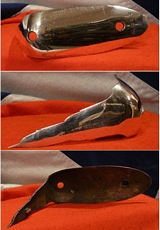
An 18th Century Hallmarked Solid Silver Butt Cap For A Gentleman's Musket
Heavy guage, cast, King George IIIrd London silver, dated either 1769 or 1789 [difficult to tell exactly]. This would enhance a musket or fowling piece up to a whole new level, either as a replacement for a plain brass type, or to replace a missing example. 147.5 grams weight, butt 50mm x 124mm, butt tang 105mm read more
225.00 GBP