


A Singularly Magnificent Original Antique Presentation Daimyo Samurai Daisho. A Signed Original Edo Period Daito By Muneyoshi Presented to Yoshifuji, In the Fortuitous Time of The Midwinter, In The Year of the Rabbit, in The Reign of Emperor Keio
The fantastic shoto {short sword} is Sukesada school, koto to shinto period, the stunning daito {long sword} is a shinshinto sword signed Muneyoshi.
The shoto blade has just returned from its traditional polish and conservation that took almost a year to complete, and looks amazing.
An incredibly Beautiful original antique Edo period (1596-1871) Daisho mounted with beautifully patinated copper koshirae based on hand carved botanical designs of incredible miniscule detail, gold tsukaito, with very finest, original Edo period, decoratively embossed two tone black urushi lacquer saya.
The kodzuka is gold to match the ito and decorated with cranes. The daito has a superb midare hamon of wondrous activity. The daito is, signed Muneyoshi, the shoto is mumei {unsigned}.
The shoto has a very fine and elegant suguha hamon and now looks absolutely amazing, and was well worth the wait.
The tsuka bore an inscription, signed on a parchment see photo under the tsukaito, to date the occasion when and to whom they were presented, during the Keio Emperor's reign in 1867. the daisho was already antique when it was presented to Yoshifuji san, no doubt a daimyo of great standing.
The presentation inscription reads;
“Keio san nen usagi Yoshi Chuto Kichi no tatsu Izumi ryu Koi, Koi Kawa Yoshifuji.’
Effectively, it translates to;
Presented to Yoshifuji, In the fortuitous time of the midwinter, in the year of the rabbit, the third year in the reign of Emperor Keio. Emperor Keio died in 1868, succeeded by the Meiji Emperor..
This form of parchment inscription, concealed under the tsuka-ito, is very rare indeed and we have never seen a complete inscription such as this to survive before.
The daisho has a pair of very fine kikubana sukashi daisho tsuba with a tetsumigakiji, possibly Sunagawa Masayoshi school, Edo period.
The Sunagawa tsuba school derived from the artists trained by teachers from within the Yokoya school founded by Yokoya Somin. The Ishiguro (by way of the Sunagawa school) and Iwamoto schools had the same antecedents. The botan (peony) was a common theme in this school.
The daisho is a Japanese term referring to the traditional weapons of the samurai. The daisho is composed of a katana daito and wakizashi shoto. The daito, meaning big sword, and shoto, meaning small sword, The katana, the longer of the two swords, was typically employed in man-to-man combat. The wakizashi made an effective main-gauche or close-combat weapon. A daisho allows for defense while fighting or the fighting of two enemies. Also, the daisho allows the fighter to have a longer or more widespread fighting range. The concept of the daisho originated with the pairing of a short sword with whatever long sword was being worn during a particular time period. It has been noted that the tachi would be paired with a tantō, and later the uchigatana would be paired with another shorter uchigatana. With the advent of the katana, the wakizashi eventually was chosen by samurai as the short sword over the tantō. The ancient custom of leaving the katana at the door of a castle or palace when entering facilitated the continuing to wear the wakizashi within the host's castle.
The wearing of daishō was strictly limited to the samurai class, and became a symbol or badge of their rank. Daishō may have became popular around the end of the Muromachi period (1336 to 1573) as several early examples date from the late sixteenth century. An edict in 1629 defining the duties of a samurai required the wearing of a daishō when on official duty. During the Meiji period an edict was passed in 1871 abolishing the requirement of the wearing of daishō by samurai, and in 1876 the wearing of swords in public by most of Japan's population was banned; this ended the use of the daishō as the symbol of the samurai, and the samurai class was abolished soon after the sword ban. Picture of Last Fight of the Soga Brothers, 1858 by Kuniyoshi (1797 - 1861). Both saya have small areas of natural wear and use. The stand shown is for illustration only and not included. however it will come with another complimentary daisho stand. The shoto blade is being carefully cleaned so can be photographed later.
Special offer item, part one of a personal private collection, sourced from a former Far Eastern specialist fine samurai sword collector read more
28995.00 GBP
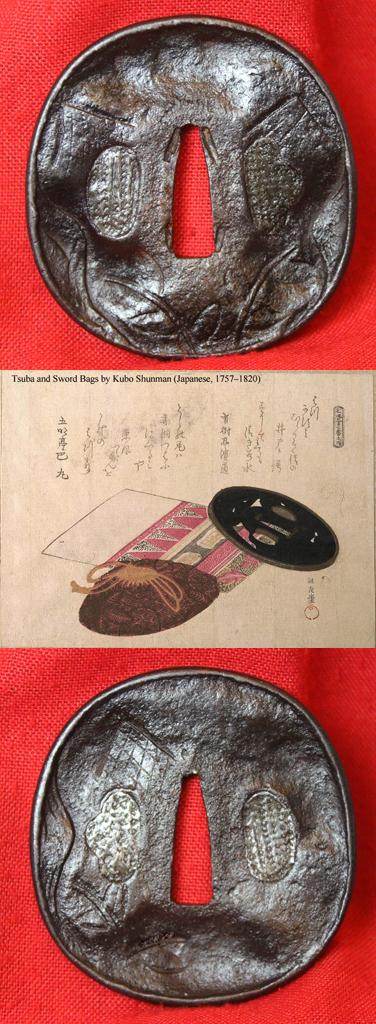
An Edo Period 1603 -1867, Katana Tsuba Tenbo Saotome Style, Hammered Iron With Formed Rim Mimi
A most attractive form of tsuba with fabulous patina, the hitsu-ana infills are extremely well done, and very nicely surface decorated. The hammering of the surface is superb and to us this is an exceptional piece for a collection or to compliment a suitable blade. Likely early Shinto, 1600’s. With pierced kozuka and kogai hitsu-ana both metal filled, possibly in a silver alloy. The tsuba, is a fundamental element in the mounting of the Japanese sword, it is the guard, the most important element of the fittings, and has two main functions: the first to protect the hand against the slashes and lunges of an opposing sword; the second is to prevent that the hand ends up directly on the cutting edge of the blade. Over the course of more than ten centuries of history, the tsuba has undergone a number of important changes, as regards the materials used for its manufacture and its appearance.
During the centuries of wars that characterised Japan until the advent of the Tokugawa Shogunate during the first half of the 17th century, the tsuba was essentially made of iron or steel. From the mid-17th century onwards the tsuba became a real work of art, with the use of soft metals used in various ways, with engravings, incrustations; well made tsuba were the pride of hundreds of craftsmen’s schools whose value sometimes exceeded that of the same blades of the mounting where tsuba was part of
75mm read more
445.00 GBP

A Very Rare, Original Medeavil Book, Classifield, Alongside The Gutenberg Bible, as An Incunabule,Titled, Vitae Pontificum, Ist Edition, of 1479, By Bartolomaeus Platina, Vitae Pontificum (Lives of the Popes) and Personally Presented It To Pope Sixtus IV
Only the second example of such an incunabule we have ever seen in almost 60 years. Written by Bartolomeo Sacchi, the Pope's personally appointed, very first prefect of the Vatican library known as the 'Vatican Librarian'. He was also the author of the very first printed cookbook, a wildly popular tract , entitled '
De honesta voluptate et valetudine'
(“On Respectable Pleasure and Good Health”).
It is believed by some gastronomic historians that it is from his cookbook that all the world's recipes of pasta originated, as it was the very first record of the staple Roman Italian diet.
As for his cookbook, it would go down as one of Sacchi’s most important literary contributions, if only because of the insight it provides into the dietary habits of Italians at the time. For one thing, it marks a fascinating stage in the evolution of the dish that is undoubtedly Italy’s best-loved and most widely imitated contribution to global food culture: Pasta with sauce.
Written by Pope Sixtus IVth's Appointed Vatican Librarian. This remarkable tome, an Incunabule, is over 547 years old. It may have been taken from the Vatican library during the Sack of Rome in 1527 by the Mutinous imperial Army, where, apart from wholesale murder and pillaging, millions of gold ducats worth of art was stolen or destroyed and much of the Vatican library looted and sold partly for ransom. The sack of Rome was so prolific and devastating, the population of Rome was diminished from 55,000 to less than 10,000. To understand, by comparison, this radical reduction of Rome's fortunes and population {once the very centre of the world's greatest empire} the City of Alexandria in Egypt, during the Ptolemaic era, 1,500 years before, had a population of between five hundred thousand to a million
Pope Sixtus IVth accomplishments as pope included the construction of the Sistine Chapel and the creation of the Vatican Library. A patron of the arts, he brought together the group of artists who ushered the early Renaissance into Rome with the first masterpieces of the city's new artistic age.
When Bartolomeo Sacchi ('Platina', 1421-1481) wrote this Vitae Pontificum (Lives of the Popes) and personally presented it to Pope Sixtus IV in 1475, he surely could not have imagined how influential it would become over the centuries. This volume by Platina was the first ever printed book on Papal history, the lives of the popes from the time of Jesus Christ, to the reign of Sixtus IV, composed as a humanist Latin narrative, and, as such, marked a distinct breakthrough in relation to the Liber Pontificalis, the standard medieval chronicle of the papacy.
Whatever Platina's intentions for the book that was published in 1479, it soon came to be regarded as the official history of the Roman pontiffs, an icon of the earliest printing.
This book was part of the conclusion of the infamous Pazzi conspiracy, which was was a failed plot in 1478 to overthrow the Medici family's rule in Florence, Italy. The Pazzi family, rivals of the Medici, alongside Pope Sixtus IV and others, aimed to assassinate Lorenzo and Giuliano de' Medici during a Mass in Florence Cathedral. While Giuliano was killed, Lorenzo survived with a wound. The failed coup triggered a brutal backlash against the conspirators.
The conspiracy involved the Pazzi family (Francesco and Jacopo Pazzi), Archbishop Francesco Salviati, and others, with backing from Pope Sixtus IV and his nephew Girolamo Riario.
The Pazzi family sought to regain political power and influence, which had been eclipsed by the Medici. Pope Sixtus IV was also motivated by a desire to expand papal power in the Romagna region, which Lorenzo de' Medici opposed.
The assassination attempt took place on April 26, 1478, during a Mass in Florence Cathedral.
Consequences:
The Pazzi family faced severe repercussions, including executions and banishment. The Medici family's power was solidified in Florence, demonstrating their strong political and financial resources.
The Pazzi conspiracy is a significant event in Florentine history, highlighting the intense power struggles and political machinations of the Italian Renaissance. It also underscores the Medici family's dominance and their ability to survive and even thrive after facing such a serious threat
This fabulous and rare book, an incunabula just as is the Gutenberg Bible, was formerly from the library of the renown Abolishionist William Roscoe, sold by him at auction in 1816 for £1.13/-, due to the financial difficulties of his banking house, and acquired by order of the Library Committee of the City of Bath Reference Library.
This book was likely commissioned due to the influences of Pope Sixtus IV Francesco della Rovere upon his librarian, it's author, Bartolomaeus Platina.
We show in the gallery a painting of Pope Sixtus appointing Platina as the official Vatican Librarian.
An Incunable is a most rarest of books, pamphlet, or broadside (such as the Almanach cracoviense ad annum 1474) that was printed, not handwritten, before the year 1501 in Europe.
They are the earliest form of printed books. Incunabula include the Gutenberg Bible of 1455, probably the most valuable book in the world. This is a First Edition of Bartholomaeus Platina's great history of the lives of the Popes, the first systematic papal history, not only to create the first detailed history of the Popes but also to villify his mortal enemy Pope Paul IInd Pietro Barbo. This book was created in the era of the great Rennaiscance, in the time of the notorious Borgias and in the year of the notorious Pazzi conspiracy, which was a plot by members of the Pazzi family and others to displace the de' Medici family as rulers of Renaissance Florence. It was printed at the time that Leonado De Vinci drew the hanging of a Pazzi conspiritor Bernardo di Bandino Baroncelli. On 26 April 1478 there was an attempt to assassinate Lorenzo de' Medici and his brother Giuliano de' Medici. Lorenzo was wounded but survived; Giuliano was killed. The failure of the plot served to strengthen the position of the de' Medici. The Pazzi were banished from Florence. During the time the Platina served as the first librarian at the Vatican under its modern founder, Sixtus IV. Platina started his career as a soldier employed by condottieri, before gaining long-term patronage from the Gonzagas, including the young cardinal Francesco, for whom he wrote a family history. He studied under the Byzantine humanist philosopher John Argyropulos in Florence, where he frequented other fellow humanists, as well as members of the ruling Medici family.
Around 1462 he moved with Francesco Gonzaga to Rome, where he purchased a post as a papal writer under the humanist Pius II (Enea Silvio Piccolomini) and became a member of the pagan-influenced Roman Academy founded by Pomponio Leto. Close acquaintance with the renowned chef Maestro Martino in Rome seems to have provided inspiration for a theoretical treatise on Italian gastronomy entitled De honesta voluptate et valetudine ("On honourable pleasure and health"), which achieved considerable popularity and has the distinction of being considered the first printed cookbook.
Platina's papal employment was abruptly curtailed on the arrival of an anti-humanist pope, Paul II (Pietro Barbo), who had the rebellious Platina locked up in Castel Sant'Angelo during the winter of 1464-65 as a punishment for his remonstrations. In 1468 he was again confined in Castel Sant'Angelo for a further year, where he was interrogated under torture, following accusations of an alleged pagan conspiracy by members of Pomponio's Roman academy involving plans to assassinate the pope.
Platina's fortunes were revived by the return to power of the strongly pro-humanist pope, Sixtus IV (Francesco della Rovere), who in 1475 made him Vatican librarian an appointment which was depicted in a famous fresco by Melozzo da Forli. He was granted the post after writing an innovative and influential history of the lives of the popes that gives ample space to Roman history and pagan themes, and concludes by vilifying Platina's nemesis, Paul Iia paragraph from Platina's Vitae Pontificum first gave rise to the legend of the excommunication of Halley's comet by Pope Callixtus III,
Vitae Pontificum ("Lives of the Popes", 1479) "Incunable" is the anglicised singular form of "incunabula", Latin for "swaddling clothes" or "cradle", which can refer to "the earliest stages or first traces in the development of anything." A former term for "incunable" is "fifteener", referring to the 15th century. Vitae pontificum, FIRST EDITION, 239 leaves (of 240, lacking first leaf), 39 lines, roman (and a little Greek) letter, capital spaces with guide letters, a few early marginal ink annotations, tears repaired to 2 leaves, small worm trace in upper margin of approximately 30 leaves (touching letters on approximately 20), inner margins of final leaves strengthened at gutter margins and a few other small paper repairs, gnawing to some fore-corners, blindstamp on approximately 6 leaves, late seventeenth/early eighteenth century red morocco gilt, sides panelled with corner, side and central decorations, spine gilt-tooled (including title and publication date) in 7 compartments within raised bands, rebacked preserving most of original spine. Venice, Johannes de Colonia and Johannes Manthen, 11 June 1479. William Roscoe's copy of the first editon of Platina's history of the Popes.
Provenance: William Roscoe (1753-1832), historian and author of Lorenzo de Medici (1796) and The Life of Pope Leo X (1805), with a 10-line pencil note in his hand, above which an ink note reads "Notes by Wm. Roscoe vide infra. Coll. By him". One of this books former owners was the renown William Roscoe (8 March 1753 , 30 June 1831). He was an English historian, leading abolitionist, art collector, M.P. Lawyer, banker, botanist and miscellaneous writer, perhaps best known today as an early abolitionist. 11.25 inches x 7.5inches x 2.25 inches. read more
6950.00 GBP
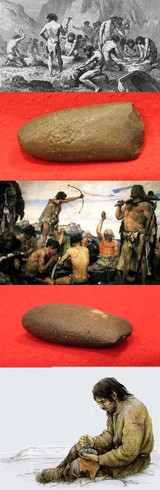
Around 6000 Year Old, A Fabulous Neolithic Period Stone-Age Polished Hand Axe. A truly Beautiful Example That Is Amazingly Tactile
Some of the most fascinating, interesting and intriguing hand made tools and weapons come from a time so far distant to us, it was thousands of years before history was ever recorded, yet they can be extraordinarily affordable. So beautiful and tactile, in fact as much an object d’art as an implement.
To hold within ones hands an implement that was last used by a person up to 4000 years before Julius Caesar even set foot upon this land with his cohorts of Roman Legionaries is simply awe inspiring. It is extraordinary that we have a remarkable knowledge about how they lived, farmed and thrived upon the earth, but not the remotest clue about how they spoke, what form of language they used, and even remotely how it might have sounded. Yet here one can be, holding a piece of amazing hand crafted Neolithica, a tool and vital artefact of person who had hopes, dreams, desires, fears, wants and needs just as we do, but not having the faintest clue how they thought, or communicated them, or even expressed them vocally to others. Ironically from a period around 4600 before the era known to the British as the Dark Ages, due to so precious little is known about British history between when the Roman’s left our shores and the Anglo Saxons ruled this land.
Mankind has effectively long past created a time machine, it is, simply, language, but only when combined with the ability to set it down, to be visually communicated from one to another, albeit on rock or stone, slate tablets, scrolls, parchment vellum or paper. That way once it can be understood, translated if you like, can we communicate with the past by knowing what they had recorded about their time. This is why the printed word, and not electronic data, is so absolutely vital to the continuation of humanity. Imagine, just, say 50 years into the future, it is possible that by then all recorded information around the world will be by electronic data alone, then imagine the simplest possibility of all electronic data being lost or inaccessible, by say an electro magnetic pulse. If that occurred 200 years in the future, without those 150 years being saved in print, we would have a new Dark Age, simply by not having any form of a hand held viewable and readable record.
Around 4,000-2,500BC, In the later Neolithic period, (known as the later stone age) people started to settle down and start farming. At places such as Springfield Lyons, these early settlements have been identified. It was also at this time when stone tools, which up until this point had been purely functional, started to take on a more symbolic meaning. Polished stone axes and other tools that were never used have been found across the county, showing changes in social hierarchy and possibly even the development of religion. The Neolithic also known as the "New Stone Age", the final division of the Stone Age, began about 12,000 years ago when the first development of farming appeared in the Epipalaeolithic Near East, and later in other parts of the world. The division lasted until the transitional period of the Chalcolithic from about 6,500 years ago (4500 BC), marked by the development of metallurgy, leading up to the Bronze Age and Iron Age. In Northern Europe, the Neolithic lasted until about 1700 BC, while in China it extended until 1200 BC. Other parts of the world (the New World) remained in the Neolithic stage of development until European contact.
The Neolithic comprises a progression of behavioral and cultural characteristics and changes, including the use of wild and domestic crops and of domesticated animals.
The term Neolithic derives from the Greek neos and lithos "New Stone Age". The term was coined by Sir John Lubbock in 1865 as a refinement of the three-age system2.5 inches long As with all our items it comes complete with our certificate of authenticity. read more
295.00 GBP

A Rare, Original, Ancient Viking Iron Battle Axe-Hammer. Around 1100 to 1200 Years Old. Almost Every Viking Warrior Used the Axe or Spear As Their Primary Combat Weapon. Swords Were the Prerogative of Kings or Earls {Jarls}
A most unusual and intriguing feature, it had an iron strenthening band that affixed to the axe haft, but when the haft rot away over the past millennia that it was buried, it left behind the iron band that welded itself obliquely within the axe's socket.
Renown scholar Alcuin of York was back at Charlemagne's court by at least mid-792, writing a series of letters, regarding the brutal Viking raid at Lindisfarne, to Æthelred, to Hygbald, Bishop of Lindisfarne, and to Æthelhard, Archbishop of Canterbury in the succeeding months, dealing with the Viking attack on Lindisfarne in July 793. These letters and Alcuin's poem on the subject, "De clade Lindisfarnensis monasterii", provide the only significant contemporary account of these events. In his description of the Viking attack, he wrote: "Never before has such terror appeared in Britain. Behold the church of St Cuthbert, splattered with the blood of God's priests, robbed of its ornaments.
The Vikings began arriving en masse with armies intent on conquest. These armies were led by Ivar the Boneless, Halfdan, and Ubba, three of the sons of Ragnar Lodbrok, who had been killed by the Northumbrian King Ælla. The first English city to fall to the invaders was York, conquered in 866. The Northumbrians tried in vain to retake the city, and King Ælla was killed in the process. One-by-one, other Saxon realms capitulated until virtually all of north and eastern England was under the direct control of the Danes.
At this point, the strongest Anglo-Saxon kingdom was Wessex, and upon the death of its king Æthelred, Alfred succeeded the throne and took the fight to the Vikings in England, who had begun annexing huge chunks of Mercia, an ally of Wessex. Alfred’s initial campaign against the Vikings was, however, a complete failure. Anglo-Saxon military tactics and defenses were incapable of dealing with Viking raids, and Alfred was eventually forced into hiding in the Somerset Marshes. The Vikings in England had succeeded in opening up the whole of Anglo-Saxon England to their mercy.
In 878, King Alfred came out of hiding and met with the lords still loyal to his cause. During his time in the Somerset Marshes, he had carefully planned a major counter-offensive against the Danish Viking army under Guthrum. Alfred’s campaign was successful, and Guthrum’s army was beaten, first in the field at Edington and then starved into submission at Chippenham. Several years later, a boundary was established, dividing England in two, with one half under Anglo-Saxon control and the other half, known as the Danelaw, under the control of the Vikings.
King Alfred organized better defenses, as well as a powerful free-standing army better equipped to deal with Viking tactics. As a result, subsequent raids and a major invasion attempt were thwarted. The Vikings who were part of this invasion attempt either ended up settling in Danelaw or sailing to Normandy and settling there.
Beyer, Greg. "The Vikings in England (Or were they Danes?)" TheCollector.com, March 11, 2023, https://www.thecollector.com/danes-or-vikings-in-england/
Title page of a late manuscript of the Prose Edda written by Snorri Sturluson (13th century), showing the Ancient Norse Gods Odin, Heimdallr, Sleipnir, and other figures from Norse mythology, plus the legendary axe hammer.
6.25 inches x 2 inches wide at the socket, approx 2 inches blade edge
The Tjängvide image stone with illustrations from Norse mythology
By Berig - Own work, CC BY-SA 4.0, https://commons.wikimedia.org/w/index.php?curid=3682858
Showing axe hammers in combat and a Viking longship read more read more
995.00 GBP
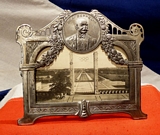
A Beautiful, Original, Third Reich 1936 Graf Zeppelin Brittannia Metal Frame with Original 1936 Olympics Photo Card
A beautiful easel mounted picture frame in florid relief patterned Britannia metal, with a portrait bust in relief of Graf Zeppelin.
It displays a Berlin stamped photo card of the Olympic rings in Berlin in 1936. A fantastic piece of original 1936 German Olympic memorabilia. read more
155.00 GBP

A Simply Wonderful Original Trojan War Period Full Length Bronze Sword Blade 28.75 Inches Long Circa 1200 B.C.Archean Greeks, the Mycenean Greeks, The Trojans & The Hitites. From The Warring Times Of Menalaus King of Sparta & King Agamemnon
2nd millennium BC. A bronze sword with tapering long multi fullered blade, flat, tapered tang originally fitted with a likely organic hilt of possibly ivory or carved horn or wood. A sword that would have been traded with the Archean Greeks, the Mycenean Greeks the Trojan peoples and The Hitites.
The trade of Bronze Age weaponry followed trade routes that started in the the Assyrian Empire, East of Babylon, right through to the Mediterranean region, and all of empires and kingdoms in between. Also, all manner of Bronze Age utilitarian wares, personal adornments, and tools came from this famed bronze smithing region and their trading merchants.
In Greek mythology, the Trojan War was waged against the city of Troy by the Achaeans (Greeks) after Paris of Troy took Helen from her husband Menelaus, king of Sparta. The war is one of the most important events in Greek mythology and has been narrated through many works of Greek literature, most notably Homer's Iliad. The core of the Iliad (Books II – XXIII) describes a period of four days and two nights in the tenth year of the decade-long siege of Troy; the Odyssey describes the journey home of Odysseus, one of the war's heroes. Other parts of the war are described in a cycle of epic poems, which have survived through fragments. Episodes from the war provided material for Greek tragedy and other works of Greek literature, and for Roman poets including Virgil and Ovid.
The ancient Greeks believed that Troy was located near the Dardanelles and that the Trojan War was a historical event of the 13th or 12th century BC, but by the mid-19th century AD, both the war and the city were widely seen as non-historical. In 1868, however, the German archaeologist Heinrich Schliemann met Frank Calvert, who convinced Schliemann that Troy was a real city at what is now Hisarlik in Turkey. On the basis of excavations conducted by Schliemann and others, this claim is now accepted by most scholars.
Whether there is any historical reality behind the Trojan War remains an open question. Many scholars believe that there is a historical core to the tale, though this may simply mean that the Homeric stories are a fusion of various tales of sieges and expeditions by Mycenaean Greeks during the Bronze Age. Those who believe that the stories of the Trojan War are derived from a specific historical conflict usually date it to the 12th or 11th century BC, often preferring the dates given by Eratosthenes, 1194–1184 BC, which roughly correspond to archaeological evidence of a catastrophic burning of Troy VII, and the Late Bronze Age collapse. Legend has it that the war originated from a quarrel between the goddesses Hera, Athena, and Aphrodite, after Eris, the goddess of strife and discord, gave them a golden apple, sometimes known as the Apple of Discord, marked "for the fairest". Zeus sent the goddesses to Paris of Troy, who judged that Aphrodite, as the "fairest", should receive the apple. In exchange, Aphrodite made Helen, the most beautiful of all women and wife of Menelaus of Sparta, fall in love with Paris, who quit Sparta with her and returned to Troy. Menelaus's brother Agamemnon, king of Mycenae, led an expedition of Achaean troops to Troy and besieged the city for ten years because of Paris' insult. After the deaths of many heroes, including the Achaeans Achilles and Ajax, and the Trojans Hector and Paris, the city fell to the ruse of the Trojan Horse. The Achaeans slaughtered the Trojans (except for some of the women and children whom they kept or sold as slaves) and desecrated the temples, thus earning the gods' wrath. Few of the Achaeans returned safely to their homes and many founded colonies in distant shores. The Romans later traced their origin to Aeneas, Aphrodite's son and one of the Trojans, who was said to have led the surviving Trojans to modern-day Italy.
Most of our antiquities and artefacts are from 200 year past souvenir accumulations from British ‘Grand Tours’. Beautiful Items and antiquities were oft acquired in the 18th and early 19th century by British noblemen and women touring battle sites in Northern France and Italy, in fact most of Europe and the Middle East, on their so-called ‘Grand Tour’. They were often placed on display upon their return home, within the family’s ‘cabinet of curiosities’, within their country house. Some significant British stately homes had entire galleries displaying the treasures and artefacts gathered and purchased on such tours, and some tours lasted many years, and the accumulated souvenirs numbered in their hundreds or even thousands
As with all our items it comes complete with our certificate of authenticity. read more
2950.00 GBP

Roman 1st century, Large, Lead Sling Bullet, Acquired Near Camulodunum-Colchester-In the 1820's
From part four of our original ancient arrow heads, spears, lead sling bullets, antiquities and rings from an 1820 Grand Tour Collection. The Battle of Camulodunum, also known as the Massacre of the Ninth Legion, was the major military victory of the Iceni and their allies over an organised Roman army during the revolt of Boudica against the Roman occupation of Britain. A large vexillation of the Legio IX Hispana were destroyed by the rebels. While attempting to relieve the besieged colonia of Camulodunum (Colchester, Essex), legionaries of the Legio IX Hispana led by Quintus Petillius Cerialis, were attacked by a horde of British tribes, led by the Iceni. Possibly 80% of the Roman foot-soldiers were killed in the battle. The event is recorded by the historian Tacitus in his Annals. The Iberian auxiliaries or legionaries were the most famous of the Roman 'slingers' in the roman armies.In AD 60 or 61, the southeastern area of the island rose in revolt under Boudica, while the Roman governor, Gaius Suetonius Paulinus, was campaigning in Wales. The Iceni were joined by the Trinovantes, and their first target was Camulodunum, formerly the Trinovantian capital, now a colonia or settlement of discharged Roman soldiers. Tacitus reports it was poorly defended, and archaeology confirms its former military fortifications had been levelled by this time. The colonists appealed for aid to the procurator, Catus Decianus, who sent only two hundred auxiliaries. Camulodunum was burned, and the temple, where the last of the defenders took refuge, fell after a two-day siege. The defenders were massacred.
The Ninth Legion, commanded by Quintus Petillius Cerialis, attempted to relieve the siege. It is unlikely that the entire legionary strength of some 5,000 men was involved in the battle. Detachments of the legion were spread out across a network of small forts; on short notice, Cerialis was likely able to call on only the first cohort, possibly two others, auxiliary infantry, and a unit of some 500 cavalry - a total of perhaps 2,500 men. Cerialis set out from his base in Lindum Colonia (Lincoln). From Lindum, it was a distance of at least 110 miles. They may have taken the Roman road to Camulodunum from Durovigtum (Godmanchester, Cambridgeshire), a march of some 75 miles which would have taken three days.
However, they arrived too late to relieve the colonia. The British tribes had gathered a considerable force by the time Cerialis and the Ninth approached Camulodunum. They overwhelmed the detachment in the field and defeated it, routing the Romans. Tacitus says their entire infantry strength was wiped out, with only Cerialis and his cavalry able to retreat to their fortified camp. According to George Patrick Welch, "In the initial contact and later rear-guard actions he lost about 2,000 men, or one-third of his infantry strength."
Slingers wore three slings. A large one tightened to the waist (to be used in distances of more than 60 metres.), a small, one tightened around his forehead (range 20-25 metres.) and a medium size one always on the hand (with a range up to 60 mts.). They carried the bullets in a goat fur bag hanging from the shoulder. With the large one they could launch 500 grams stones (like a tennis ball) that were able to destroy shields and wood defences. With the small and medium size slings the lead bullets could perforate at short distances (up to 60 metres.) thin armours and helmets. The sling as a weapon was widely used not only by Balearic warriors but by other Iberian warriors and also by Roman auxiliary troops like Greeks, Sicilians, North Africans, but after the Roman conquest of the Balearic Islands elite slingers were always the Balearic that fought in the legions of Julius Caesar. Bullets are usually found on the known battle fields of the Roman conquest.
Every single item from The Lanes Armoury is accompanied by our unique Certificate of Authenticity. Part of our continued dedication to maintain the standards forged by us over the past 100 years of our family’s trading
This bullet weighs 62.5grams, and is 48mm long. read more
235.00 GBP

A Good 1897 Pattern British Officer's Sword King Edward VIIth Period. Used in Both WW1 and WW2. The Pattern Still Used In Current Service Today
The blade is straight and symmetrical in shape about both its longitudinal axes. The thick blade has a deep central fuller on each side and is rounded on both its edge and back towards the hilt, giving a “dumbbell” or “girder” cross section. Through a gradual transition, the blade becomes double edged towards the tip, and the last 17 inches were sharpened when on active service. The blade ends in a sharp spear point.
The guard is a three-quarter basket of pressed, plated steel. It is decorated with a pierced scroll-work pattern and had the royal cypher of the reigning monarch set over the lower knuckle bow.
The 1897 pattern Infantry officer's sword has remained unchanged to the present day.
By the time of its introduction, the sword was of limited use on the battlefield against rapid-firing rifles, machine guns and long-range artillery. However, the new sword was regarded, when needed, as a very effective fighting weapon. Reports from the Sudan, where it was used in close-quarters fighting during the Reconquest of the Sudan 1896-99, were positive.
Field Marshal Montgomery advanced with his 1897 Pattern drawn during a counter offensive in the First World War. The actual sword he carried is exhibited in the Imperial War Museum, London.
One of the famous British officer's of WW2, who was a devoted exponent of hand to hand sword combat, using his sword in battle, was infantry officer 'Mad' Jack Churchill. After fighting at Dunkirk, he volunteered for the Commandos. On one occasion, a general who had commented on his weaponry, Churchill is said to have replied "Any officer who goes into action without his sword is improperly dressed."
Traces of old polished out light pitting throughout, the original leather bound field service scabbard is good but lacking the bottom chape. read more

A Most Fine 18th-19th Century Indo Persian Kulah Khud Helmet. One Of The Most Iconic Forms of Armoured Warrior Combat Dress in The World. A Form of Helmet Represented In Historical Texts & Illustrations Of The Holy Land Around 1000 Years Ago
The helmet has a hemi-spherical skull engraved throughout, the skull fitted at its apex with a high spike, a pair of plume-holders at the front and with a staple for a sliding nasal guard, decorated over the greater part of its surface with traces of gold koftgari of scenes of a hunt, and a band of koranic Islamic text, and mail neck-defence of butted links. Khula Khud {or kulah khud} helmets of this design originated in Central Asia, and this form were worn by Persian Empire soldiers in the 18th and 19th Centuries.
Despite the similarity in their design, the Khula Khud helmets were decorated with a wide degree of variations depending on the cultures from which they were created. Decorations often appeared in the skull and the nasal bar, which were often heavily decorated with patterned motifs of inlaid brass, silver or gold; or decorated with figurative images.
Some Mughal helmets feature calligraphic inscriptions from the Quran, supposedly to gain "Help from Allah and a speedy victory." Made of steel, these bowl-shaped helmets were designed as either low and flat, or high and pointed. They sometimes contained a spike socket such as this one, at the top of the helmet, which resembles a spearhead with a cross-like section.
Two or three plume holders were attached on either side of the skull, used to mount feathers from birds such as the egret or peacock.
As one can see their design was not only perfectly functional and effective for combat, but aesthetically, extraordinarily beautiful, and once fully armoured the Mughal warrior of the time would look incredibly impressive and remarkably intimidating.
The last picture in the gallery is a later interpretation of the legendary ruler Saladin, Sultan Salahuddin Ayyubi, wearing his version of the khula khud dome topped, chain mailed helmet.
“From his earliest days, Saladin exhibited qualities that would later define him as a leader. His upbringing introduced a strong sense of discipline, duty, and honor. The principles of martial ethics, integral to the Ayyubid household, became the pillars upon which his future actions would rest.
As he navigated the labyrinthine corridors of his youth in Tikrit, Saladin could not have known the extraordinary path that lay before him. It was a path carved by the hands of destiny; a journey that would see him rise from these modest beginnings to become a figure of global significance.
Saladin’s early life in Tikrit, steeped in the traditions of his Kurdish heritage and shaped by the legacy of his Ayyubid lineage, sowed the seeds of greatness. Little did he know that he would one day ascend to heights of power and leadership, leaving a permanent mark on the records of history. His journey was beginning, and the world would soon witness the remarkable destiny of Salah ad-Din Yusuf ibn Ayyub.”
Ref;
Mustafa Jamal Nasser. read more
1950.00 GBP