

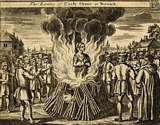
Amazing Facts You Might Not Know
Did you know the date that the last woman was lawfully executed by 'burning at the stake' was in Britain?. Believe it or not, it was Catherine Murphy, in only in 1788, just over a mere 230 years ago. Interestingly, only women warranted to be burnt at the stake, men were just hanged. Women were sentenced to be burnt at the stake for just two reasons only, 'Petty Treason', [the murder of a spouse] and 'High Treason' [interfering with the Crown's Coinage, known as coining, either by counterfiting, or chipping, cutting and the filing off of coins edges]. read more
Price
on
Request
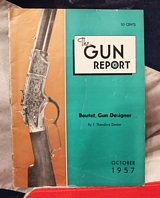
The Gun Report Volume III No 5 October 1957, Plus 200 Others All £15 Each
We have just acquired over two hundred archived copies of the Gun Report From the 1950's to 1980. All at £15 each or 10 for £100. They are simply wonderful reading, and fabulous reference works, with advertisements and reports that likely will never be seen again. A little bit of history with lots of information, photos and enjoyment, nicely bound. Contact for details on the other 200 issues we have. All sold for £15 each.
Aledo IL World-Wide Gun Report 1957 Soft cover. Very Good Example Magazine. Very good condition, light cover wear. Boutet Gun Designer by F Theodore Dexter, Specialization by Robert A Erlandson, Captain David L Payne by Chester C Heizer, Powder Horns by Chester Williams, Old Time Bullet Seaters by Richard H Chamberlain, 60070-60072, From Rodent Rifle to "Gangster's Gat" by James A Leftwich, Who's Who in the Gun World (Featuring John Roten, Wharton, TX) by Annie Lee Williams, A Restored Flintlock Pistol by Ronald Lister, The Story of the Alamo Part I by Paul C Janke. 48 pages. 11 1/2" X 8 1/2" format read more
15.00 GBP
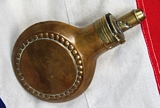
A Very Good Sykes Patent Disc Form Powder Flask
A most unusual shape of powder flask that due to a flat form would fit snugly in an overcoat pocket rather well. Good spring. 6.75 inches long x 4 inches wide x 1.5 inches deep at its widest read more
155.00 GBP
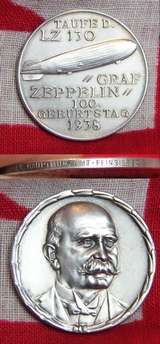
The LZ 130 "Graf Zeppelin" - 100th birthday 1938 Medal
By Bayer Hauptmanzampt Finesilber Silver Medal 1938 Medal, Zeppelin 100th Birthday of Count Zeppelin 1938 Bayer. Main Mint Office prfr. Mat. A rare fine silver German medal issued just before WW2. read more
265.00 GBP
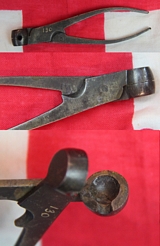
A Good Original 48 Bore 19th Century Pistol Ball Scissor Mould
Maker stamped I W, bore size stamped 48 read more
100.00 GBP
![A Shinto [1596-1781] Iron Tsuba Katana Guard With Brass Mimi](photos/22652t.jpg)
A Shinto [1596-1781] Iron Tsuba Katana Guard With Brass Mimi
Chisseled with scrolling chanels and a kozuka ana and kogai ana. The oviod tsuba has [south fitted] copper kuchi-beni. The copper plug of the nakago-ana. Their function is to secure the tsuba firmly when mounted on a blade. These plugs are sometimes called sekigane. 2.75 inches across, 3 inches high read more
375.00 GBP
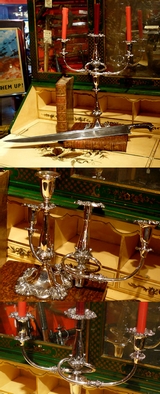
A George IIIrd Campaign Sheffield Plate Candelabra of Col. 10th Hussars
We acquired this stunning campaign, Sheffield silver plated candelabra, with his yataghan sword, used by a former Colonel of the 10th Hussars throughout his campaigning years in the army. The yataghan in these photographs we sold earlier, but we do have his other scabbarded yataghan. The Sheffield plating has wear on all the dominant edges and this is referred to as 'copper bleeding'. It is actually a traditional and good sign of originality for true Sheffield plate, as it shows it is early Sheffield hammered onto a copper base, not the later modern electrotype of plate, usually on nickel or brass. The use of "Sheffield plate" began in 1742 when Thomas Boulsover, a Sheffield cutler (blade smith), discovered that a sheet of silver fused to a piece of copper could then be rolled or hammered out without fracturing the bond.
This made possible the use of "plated" base metal, which appeared, outwardly, to be silver, but as the silver "skin" could be only a small proportion of the gauge of the metal the saving in expense was considerable and objects made from the product looked exactly like sterling silver, because the applied 'plate' was indeed sterling. Boulsover's idea was exploited in Sheffield, first by Joseph Hancock from 1755 onwards and Matthew Boulton, one of the greatest and successful manufacturers of his age. This candelabra from the early 1800's and the reign of King George IIIrd was used by Capt. Wood during his campaigns in the Victorian period. It disassembles into several smaller pieces and would likely have fitted into a wooden, leather bound travelling case for use in military campaigns around the Empire. It was used originally by his ancestor in the Napoleonic wars era. His medals were sold in auction some 17 years ago. Manners Charles Wood was born on 20 January 1852. He was appointed as Ensign to the 44th Foot on 1 September 1869, but was transferred on the same day to the 66th Foot, becoming Lieutenant in October 1871. He transferred to the 10th Hussars on 15 April 1874, and joined the regiment in India. In 1876 he was selected for escort duty with the Prince of Wales during his visit to India, and was given a silver commemorative medal struck on that occasion.
Promoted to Captain on 2 February 1878, Manners Wood accompanied the regiment from Rawal Pindi in the Afghan campaign of 1878-79, and commanded ?B? Troop at Fattehabad on the 2nd April 1879, in which action he was wounded, and his life saved by a brother officer, in an incident reported on the front page of the Illustrated London News, published on 17 May 1879.
?Captain Wood and Lieutenant Fisher dismounted with most of the men, leaving as few as possible to hold the horses and advanced up the hill in skirmishing order, to dislodge the enemy, who were firing upon them from their strong position. On approaching the top, Captain Wood and Lieutenant Fisher, who were well in front, noticed a Ghazi, lying on the ground, pointing his jezail at them. He was a typical hillman, of powerful build. Having fired and missed, he jumped to his feet, and rushed at Captain Wood, whose sword was of little use against the long jezail and impetuous rush of the Afghan. He was brought to his knees, and his fanatical assailant, discarding his firearm, with a ponderous knife made a cut at his head, which clove his helmet in two, but, fortunately, did not do more than inflict a slight wound.
?As Captain Wood lay on the ground, at the mercy of the Afghan, Lieutenant Fisher rushed at the Ghazi, and felled him with the butt end of a carbine which he was carrying and Private Hackett, who had by this time come up with other men of the Troop, gave him the coup-de-grace with his sword. The Troop now fired two volleys into the enemy, which completely dispersed them, and Captain Wood took his men back to Fattehabad. The casualties in the Troop were seven men wounded, one horse killed, eleven wounded, and one missing.?
Captain Wood served with the regiment throughout the remainder of the war, and accompanied it during the march of pestilence to Rawal Pindi, when so many Tenth Hussars died of cholera. He became Major in April 1882, and Lieutenant-Colonel in August 1892, on taking command of the 10th Hussars. The regiment served in Ireland throughout the 4 years of his command. He became Brevet Colonel in August 1896, and retired on 5 April 1899.
Wood was almost immediately recalled on the outbreak of the war in South Africa, and was appointed a Special Service Officer with the Rhodesian Field Force. He was afterwards in command of the troops in Rhodesia, from 7th January to 21st June 1901, graded as a Colonel on the Staff. He again left the Army, leading a very active life, and later became a Colonel in the Army Cadet Force. For his services with the Cadets, he received the 1935 Silver Jubilee medal, at the age of 83. Colonel Manners Wood died at Camberley on 12 September 1941, aged 89. read more
985.00 GBP
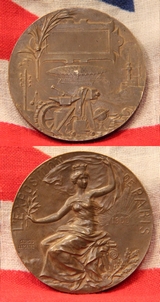
Bronze L'Exposition de Paris 1900 Commemorative Medal;
Santos Dumont dirigible / airship, Obverse: relief of a robed female figure depicted, embossed text "L'EXPOSTION DE PARIS 1900"
Reverse: relief of electric power lines, Santos Dumont dirigible, and steel battleship depicted. Condition: very good
Dimension: 55mm. Another example is Inventory Number
A19640401000 part of the collection of the National Air and Space Museum, the Smithsonian. Santos Dumont's first airship was his No. 1 (airship) ? First flown on 18 September 1898. Had a cylindrical envelope with conical ends containing a ballonet connected to an air pump: 25 m (82 ft) long, 3.5 m (11 ft 6 in) diameter, 180 m3 (6,400 cu ft) capacity. A square basket was suspended from wooden battens contained in pockets in the envelope, and a silk-covered rudder fitted behind and above the basket. Powered by a De Dion-Bouton tricycle engine (modified to have tandem cylinders) of 3 hp which was mounted outside and in front of the basket driving a small two bladed propeller. Fore and aft trim was achieved by moving a pair of ballast bags. Manoeuvred well, but the ballonet was too small to retain the necessary rigidity of the envelope, and loss of pressure caused it to be wrecked on its second flight on 20 September, from then he made another 10 versions and improvements of it. He also made his first helicopter in 1905 read more
120.00 GBP
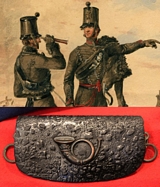
Victorian Crimean War Period Light Infantry Crossbelt Pouch
Black leather foul weather pouch with coiled horn bugle for the Light Division regiments. Opens to reveal a pouch for despatches and small documents, sovereigns etc. Small leather reataining tab lacking. The Light Division was a light infantry division of the British Army. Its origins lay in "Light Companies" formed during the late 18th century, to move at speed over inhospitable terrain and protect a main force with skirmishing tactics. These units took advantage of then-new technology in the form of rifles, which allowed it to emphasise marksmanship, and were aimed primarily at disrupting and harassing enemy forces, in skirmishes before the main forces clashed.
Formed in 1803, during the Napoleonic Wars, the Light Division was raised thrice thereafter: during the Crimean War, the First World War and from 1968 to 2007. Some light infantry units remained outside the Light Division. A Light Division was again formed for service, but this was in name only as no light infantry battalions were assigned to it. The division was involved in the Battle of the Alma (20 September 1854), which is usually considered the first battle of the Crimean War, took place in the vicinity of the River Alma in the Crimea. An Anglo-French force under General St. Arnaud and Lord Raglan defeated General Menshikov's Russian army, which lost around 6,000 troops. They were also engaged in the Siege of Sevastopol (1854?1855), and the battle of Battle of Inkerman (5 November 1854) before the end of hostilities. read more
265.00 GBP
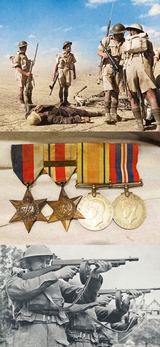
A Good Original 'Desert Rat' British WW2 British Infantry 4 Medal Group
From a former Desert Rat veteran of the 8th Army. Acquired with his helmet but sold separately. He fought Rommel's Afrika Korps, [who, under Montgomery's command, kicked the DAK's bottoms at El Alamein] and then with the 8th Army transferred to Italy in order to fight from the south right through to Rome, however, the owner of this medal group and helmet was severely wounded before he qualified for the Italy Star medal, however, he did get the Afrika Star with 8th Army bar, plus his other 3 medals. The Eighth Army was a field army formation of the British Army during the Second World War, fighting in the North African and Italian campaigns. Units came from Australia, British India, Canada, Free French Forces, Greece, New Zealand, Poland, Rhodesia, South Africa and the United Kingdom.
Significant formations which passed through the Army included V Corps, X Corps, XIII Corps, XXX Corps, I Canadian Corps and the II Polish Corps. On 26 November the Commander-in-Chief Middle East Command, General Sir Claude Auchinleck, replaced Cunningham with Major-General Neil Ritchie, following disagreements between Auchinleck and Cunningham. Despite achieving a number of tactical successes, Rommel was forced to concede Tobruk and was pushed back to El Agheila by the end of 1941. In February 1942 Rommel had regrouped his forces sufficiently to push the over-extended Eighth Army back to the Gazala line, just west of Tobruk. Both sides commenced a period of building their strength to launch new offensives but it was Rommel who took the initiative first, forcing the Eighth Army from the Gazala position.
Ritchie proved unable to halt Rommel and was replaced when Auchinleck himself took direct command of the army. The Panzer Army Afrika were eventually stopped by Auchinleck at the First Battle of El Alamein. Auchinleck, wishing to pause and regroup the Eighth Army, which had expended a lot of its strength in halting Rommel, came under intense political pressure from British Prime Minister Winston Churchill to strike back immediately. However, he proved unable to build on his success at Alamein and was replaced as Commander-in-Chief Middle-East in August 1942 by General Harold Alexander and as Eighth Army commander by Lieutenant-General William Gott. Gott was killed in an air crash on his way to take up his command and so Lieutenant-General Bernard Montgomery was appointed in his place. Alexander and Montgomery were able to resist the pressure from Churchill, building the Army's strength and adding a pursuit formation, X Corps, to the Army's XIII and XXX Corps.
At the beginning of November 1942 the Eighth Army defeated Rommel in the decisive Second Battle of El Alamein, pursuing the defeated Axis army across Libya and reaching the Mareth defensive line on the Tunisian border in February 1943, where it came under the control of 18th Army Group. The Eighth Army outflanked the Mareth defences in March 1943 and after further fighting alongside the British First Army, the other 18th Army Group component which had been campaigning in Tunisia since November 1942, the Axis forces in North Africa surrendered in May 1943 read more
175.00 GBP