
Japanese


A Stunning and Impressively Powerful Koto Katana, Circa 1500. With All Original Edo Period Koshirae Mountings. A Fabulous Sword of Likely a Seieibushi {the Highest Ranked Elite Samurai} Traditionally the Highest Rank of Elite Samurai
Originally made around 500 years ago for a samurai of considerable size and status befitting a sword of this power and presence. Photos of the blade to add Friday 12th
It bears a beautfully fine Koto blade, around 1500, yet, most rarely it shows it is ubu {unshortened} and it displays a very fine suguha hamon, very much the usual tradition during the Koto period.
Most blades of this age have had some element of shortening, which is entirely usual, and most normal.
Shortening most commonly occurs when a successor to the original katana owner, another samurai, was shorter than his predecessor, and thus so on, and thefore needs the blade slightly shortened {always from the bottom of the nakago under the hilt upwards, even if it’s just by an inch or so}. Very ancient blades can often show evidence of several shortenings, by the presence of numerous mekugi ana interspaced down the tang.
The all original Edo period mounts, fuchi kashira, are Higo style in tetsu, decorated with a takebori cormorant fisherman carrying his catch to market, on the fuchi, and his hanging nets on the kashira. The tsuba, also in finely aged tetsu, tsuchime, with very delicate Amidayasuri filemarks, or carving, representing the halo emanating from Amida Buddha, is very beautiful, impressive and signed, with two, most unusually still present, narrow bars of sinchu bordering the inner kogai hitsu-ana and kozuka hitsu-ana, these are more than often lost .
It appears the mei {signature} on the tsuba is 山吉 or Yamakichi bei who was originally an armour smith from Owari or modern Nagoya area.
The shodai worked around the same time as the first Nobuie (end of Muromachi) and nearly as highly regarded, but this example may well be later. Pale gold tsukaito silk binding over pure gold decorated shakudo menuki on the samegawa {giant rayskin}.
The saya is traditional and original Edo period, brown urushi, ishime style, stone finish lacquer, in very fine condition, and the saya is mounted with a Higo sayajiri depicting a dragon in light takebori tettsu.
When one considers this sword was carried by successive samurai from the British timeline of the Tudor kings, starting with King Henry VIIth, King Henry VIIIth’s father, it is in simply remarkable condition. We doubt of there is a single solitary example of a European sword of this great age, preserved anywhere near as well as this blade, that is appearing almost as new.
The samurai were roughly the equivalent of feudal knights. Employed by the Shogun or Daimyo, they were members of hereditary warrior class that followed a strict "code" that defined their clothes, armour and behaviour on the battlefield. But unlike most medieval knights, samurai warriors could read and they were well versed in Japanese art, literature and poetry.
Samurai endured for almost 700 years, from 1185 to 1867. Samurai families were considered the elite. They made up only about six percent of the population and included daimyo and the loyal soldiers who fought under them. Samurai means one who serves."
Samurai were expected to be both fierce warriors and lovers of art, a dichotomy summed up by the Japanese concepts of to stop the spear expanding into bushido (the way of life of the warrior) and bun (the artistic, intellectual and spiritual side of the samurai). Originally conceived as away of dignifying raw military power, the two concepts were synthesised in feudal Japan and later became a key feature of Japanese culture and morality.The quintessential samurai was Miyamoto Musashi, a legendary early Edo-period swordsman who reportedly killed 60 men before his 30th birthday and was also a painting master. Members of a hierarchal class or caste, samurai were the sons of samurai and they were taught from an early age to unquestionably obey their mother, father and daimyo. When they grew older they may be trained by Zen Buddhist masters in meditation and the Zen concepts of impermanence and harmony with nature. The were also taught about painting, calligraphy, nature poetry, mythological literature, flower arranging, and the tea ceremony.
it has been said that part of their military training, samurai were taught to sleep with their right arm underneath them so if they were attacked in the middle of the night and their the left arm was cut off the could still fight with their right arm. Samurai that tossed and turned at night were cured of the habit by having two knives placed on either side of their pillow.
Samurai have been describes as "the most strictly trained human instruments of war to have existed." They were expected to be proficient in the martial arts of aikido and kendo as well as swordsmanship and archery---the traditional methods of samurai warfare---which were viewed not so much as skills but as art forms that flowed from natural forces that harmonized with nature.
An individual didn't become a full-fledged samurai until he wandered around the countryside as begging pilgrim for a couple of years to learn humility. When this was completed they achieved samurai status and receives a salary from his daimyo paid from taxes (usually rice) raised from the local populace. Swords in Japan have long been symbols of power and honour and seen as works of art. 40 inches long overall, blade tsuba to tip, 28.5 inches read more
9450.00 GBP

A Simply Stunning Edo Period Mighty Samurai Armour and Helmet Piercer Tanto, Around 250 Years Old. An Absolute Beautiful Example of Samurai Sword Artistry & Skill
The blade is utterly amazing, with a great gunome hamon, superb grain in the hada, and powerful blade designed to pierce the strongest kabuto, iron plate war helmet, or even the strongest part of any gosuko armour, being an incredible 8 mm thick at the habaki.
Fully mounted with all its original Edo fuchi kashira decorated with takebori rabbits and reeds. Pure gold and silver rabbits on a shakudo nanako ground, with pure gold reeds. Pure gold menuki of shi shi lion dogs, under original edo black silk tsuka-itol.
It has a kozuka decorated on shakudo and gold of a herd of frolicking ponies . Original Edo period urushi lacquer ishime style, stone finish, lacquer saya with polished carved buffalo horn fittings. The only signs of age wear is on the lacquer saya, with three or four very small surface dings and slight blistering by the mid section on one side. The habaki is superb in shakudo. The tsuba is an iron tetsu oval inlaid with puer gold, with surface decoration of stylized serpent like beasts with gold stars both large and small with a pair of gold fronted seppa.
This would make a fabulous addition to any fine collection of original antique samurai weaponry or armour
Rabbits are one of the signs of the Japanese zodiac. They are considered lucky as the Japanese kanji used to write the word rabbit is similar to the kanji meaning "get rid of " or "make vanish". People believe that rabbits will make bad luck disappear! Rabbits are also known for jumping high. They can leap over nine feet! Rabbits symbolize everything going up in your life - improvement and success.
THE LANES ARMOURY, THE PREMIER HOME OF ORIGINAL AND AFFORDABLE ANCIENT ANTIQUITIES & ANTIQUE COLLECTABLES IN BRITAIN.
The Lanes Armoury, is world renown as Britain's favourite specialist collectors shop, and also a font of historical and educational information that is detailed with every single item. We detail each piece alongside its historical context, either generic or specific, for those that may wish to read, learn, or be informed, as opposed to simply acquire collectable items. We are probably one of the oldest companies of our kind in the whole of Europe and we have been established through generations, as specialists in armoury, military antiques, militaria collectables, and specialist books, since the early 1900’s, and thus we have continued to be one of the largest in the world today. The current partners were set on this path by their great grandfather, who while intrigued by historic antique arms and armour, was woefully under capitalised for his dream profession, so much so that even when starting his very small business, just after the first world war, he still kept up his original working class pre war trade as a scaffolder as his safety net in case his dreams folded. Just as well for his succeeding generations, he didn’t fail. However, true to his very old-fashioned working class ethics, every subsequent generation had to follow their own path, with no financial assistance whatsoever, with his son, grandson and great-grandsons having to make their own way, on their own skill and merits, whatever they may be.
We are also very pleased to know we are also studied and read by academics and students from hundreds of universities around the world, by those that are interested in not only British but worldwide history. Of course we are not perfect and errors can and will be made, but thanks to our viewers and visitors, errors can be corrected, and learnt from.
Our sacred principle is that every single country's history ought to be studied, and passed down, however good, or bad some of it may be. All history is knowledge, good, bad or indifferent.
Everyday we are contacted by historians that wish to make contributions to our detailed information for our pieces, and to thus add to our constant dedication to impart historical knowledge, that may be unknown to many of our millions of viewers.
As once told to us by an esteemed regular visitor to us here in our gallery, in order to view and study our Japanese edged weapons and armour gallery, and the same words that are repeated in his book;
“In these textures lies an extraordinary and unique feature of the sword - the steel itself possesses an intrinsic beauty. The Japanese sword has been appreciated as an art object since its perfection some time during the tenth century AD. Fine swords have been more highly prized than lands or riches, those of superior quality being handed down from generation to generation. In fact, many well-documented swords, whose blades are signed by their makers, survive from nearly a thousand years ago. Recognizable features of the blades of hundreds of schools of sword-making have been punctiliously recorded, and the study of the sword is a guide to the flow of Japanese history.”
Victor Harris
Curator, Assistant Keeper and then Keeper (1998-2003) of the Department of Japanese Antiquities at the British Museum. He studied from 1968-71 under Sato Kenzan, Tokyo National Museum and Society for the Preservation of Japanese Swords
Blade 12 inches long read more
4950.00 GBP
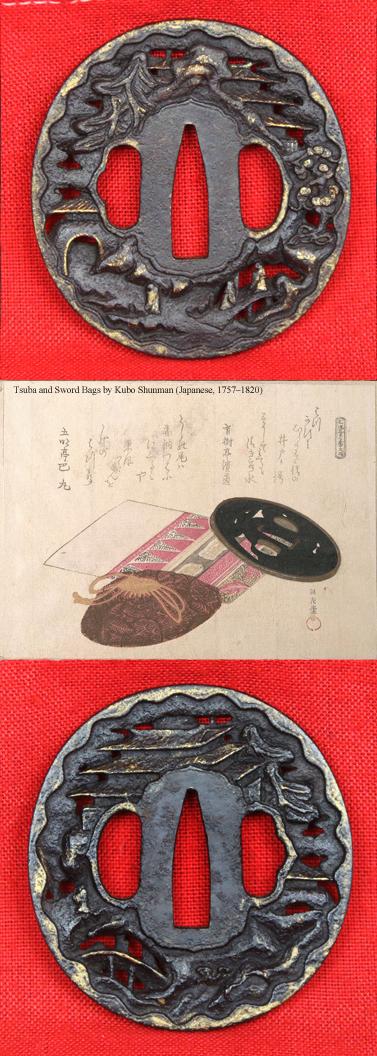
A Stunning and Fine Edo Period Antique Nanban Iron and Gold Sukashi Tsuba with Pagoda Scene
Superb Nanban tsuba in Iron and gold highlights Landscape scene of a pagoda, bridge, prunus tree and river.
Nanban often regarded as meaning Southern Barbarian, are very much of the Chinese influence. The Chinese influence on this group of tsuba was of more import than the Western one, however, and resulted not merely in the utilisation of fresh images by the existing schools, but also in the introduction of a
completely fresh style of metalworking.
The term 'namban' was also used by the Japanese to describe an iron of foreign origin.
Neither can the Namban group be considered to represent 'native Japanese art'.
The required presence in the group, by definition, of 'foreign influence', together with the possibility of their being 'foreign made', was probably responsible for their great popularity at the time.
Tsuba are usually finely decorated, and are highly desirable collectors' items in their own right. Tsuba were made by whole dynasties of craftsmen whose only craft was making tsuba. They were usually lavishly decorated. In addition to being collectors items, they were often used as heirlooms, passed from one generation to the next. Japanese families with samurai roots sometimes have their family crest (mon) crafted onto a tsuba. Tsuba can be found in a variety of metals and alloys, including iron, steel, brass, copper and shakudo. In a duel, two participants may lock their katana together at the point of the tsuba and push, trying to gain a better position from which to strike the other down.
68mm x 72mm read more
495.00 GBP

A Very Good Shinto Period, Circa Later 1600's, Samurai Spear, A Ryo-Shinogi Yari Pole Arm. Signed Hisatoshi, & Magari-Yari Saya
The magari-yari saya would indicate it would be used on a triple bladed magari-yari pole arm.
An Edo Period Samurai Horseman Ryo-Shinogi Yari Polearm on original haft, circa 1670. For use on or off horseback.
Beautiful bright polish with suguha straight hamon to both edges.
With original pole and iron foot mount ishizuki. Four sided double edged head. The mochi-yari, or "held spear", is a rather generic term for the shorter Japanese spear. It was especially useful to mounted Samurai. In mounted use, the spear was generally held with the right hand and the spear was pointed across the saddle to the soldiers left front corner.
The warrior's saddle was often specially designed with a hinged spear rest (yari-hasami) to help steady and control the spear's motion.
The mochi-yari could also easily be used on foot and is known to have been used in castle defense. The martial art of wielding the yari is called sojutsu. A yari on it's pole can range in length from one metre to upwards of six metres (3.3 to 20 feet). The longer hafted versions were called omi no yari while shorter ones were known as mochi yari or tae yari. The longest hafted versions were carried by foot troops (ashigaru), while samurai usually carried a shorter hafted yari.
Ryō-shinogi yari, a blade with a diamond shaped cross section
Honda Tadakatsu was famous as a master of one of The Three Great Spears of Japan, the Tonbokiri (蜻蛉切). One of The Three Great Spears of Japan, the Nihongō (ja:日本号) was treasured as a gift, and its ownership changed to Emperor Ogimachi, Shogun Ashikaga Yoshiaki, Oda Nobunaga, Toyotomi Hideyoshi, Fukushima Masanori, and so on, and has been handed down to the present day.
Yari are believed to have been derived from Chinese spears, and while they were present in early Japan's history they did not become popular until the thirteenth century.The original warfare of the bushi was not a thing for "commoners"; it was a ritualized combat usually between two warriors who may challenge each other via horseback archery and sword duels. However, the attempted Mongol invasions of Japan in 1274 and 1281 changed Japanese weaponry and warfare. The Mongol-employed Chinese and Korean footmen wielded long pikes, fought in tight formation, and moved in large units to stave off cavalry. Polearms (including naginata and yari) were of much greater military use than swords, due to their much greater range, their lesser weight per unit length (though overall a polearm would be fairly hefty), and their great piercing ability. Swords in a full battle situation were therefore relegated to emergency sidearm status from the Heian through the Muromachi periods.
The shaft (nagaye or ebu) came in many different lengths, widths, and shapes; made of hardwood and covered in lacquered bamboo strips, these came in oval, round, or polygonal cross section. These in turn were often wrapped in metal rings or wire (dogane), and affixed with a metal pommel (ishizuki; 石突) on the butt end. Yari shafts were often decorated with inlays of metal or semiprecious materials such as brass pins, lacquer, or flakes of pearl. A sheath (saya; 鞘) was also part of a complete yari.
The Three Great Spears of Japan are three individual spears (yari) that were made and crafted by the greatest historical blacksmiths of Japan:1
Tonbokiri (蜻蛉切): This spear once wielded by Honda Tadakatsu, one of the great generals of Tokugawa Ieyasu. It was forged by Masazane, a disciple of Muramasa. It is now owned by a private individual and lent to the Sano Art Museum for its collection. The type of blade shape is sasaho yari.2
Nihongo, or Nippongo (日本号): A famous spear that was once used in the Imperial Palace. Nihongo later found its way into the possession of Fukushima Masanori, and then Tahei Mori. It is now at Fukuoka City Museum. The type of blade shape is omi yari.2
Otegine (御手杵): It was a spear that Yuki Harutomo, a daimyo, ordered Shimada Gisuke, a swordsmith, to make. It was lost in the Bombing of Tokyo in 1945. The type of blade shape was omi yari.
this yari's blade is 17.5 inches including tang, blade 5 inches long, overall in pole 78 inches {not including saya} read more
1695.00 GBP

A Delightful & Beautiful Early to Mid Edo Period 1598-1863 Samurai War Arrow, Yanone. A Tagari-Ya With A Long Yadake Bamboo Haft , With Traces of Sea Eagle Flights and Traditional Tamagahane Steel Head In Incredibly Rare Stunningly Beautiful Polish
It is most rare to find original, antique samurai war arrows {ya} that still have a beautifully polished tamagahane steel blade, that they would all have had originally, that often show the traditional hamon, the same as a traditional samurai sword would have had.
Acquired by us by personally being permitted to select from the private collection one of the world's greatest, highly respected and renown archery, bow and arrow experts. Who had spent his life travelling the world to lecture on archery and to accumulate the finest arrows and bows he could find. .
With just slender remains of the traditional eagle feathers, due to its age, probably the large edge-wing feathers of a Japanese sea eagle.
The arrow head with a wide cutting blade, especially effective against flesh, is brightly polished, hand crafted of traditional tamagahane steel, by a sword smith A long elongated arrow head, original and bespoke with folding and tempering exactly as would be a samurai sword blade, possibly signed on the tang under the binding but we would never remove it to see. The Edo period early eagle feathers are now much worn.
It is entirely indicative of the Japanese principle that as much time skill and effort be used to create a single 'fire and forget' arrow, as would be used to make a tanto or katana. A British or European blacksmith might once have made ten or twenty arrows a day, a Japanese craftsman might take a week to make a single arrow, that has a useable combat life of maybe two minutes, the same as a simplest British long bow arrow.
This rare form of arrow head is very rarely seen with an extended polished haft.
Despite being somewhat of a weapon that was 'fire and forget' it was created regardless of cost and time, like no other arrow ever was outside of Japan. For example, to create the arrow head alone, in the very same traditional way today, using tamahagane steel, folding and forging, water quench tempering, then followed by polishing, it would likely cost way in excess of a thousand pounds, that is if you could find a Japanese master sword smith today who would make one for you. Then would would need hafting, binding, and feathering, by a completely separate artisan, and finally, using eagle feathers as flights, would be very likely impossible. This is a simple example of how incredible value finest samurai weaponry can be, items that can be acquired from us that would cost many times the price of our original antiques in order to recreate today. Kyu Jutsu is the art of Japanese archery.The beginning of archery in Japan is pre-historical. The first images picturing the distinct Japanese asymmetrical longbow are from the Yayoi period (c. 500 BC – 300 AD).
The changing of society and the military class (samurai) taking power at the end of the first millennium created a requirement for education in archery. This led to the birth of the first kyujutsu ryūha (style), the Henmi-ryū, founded by Henmi Kiyomitsu in the 12th century. The Takeda-ryū and the mounted archery school Ogasawara-ryū were later founded by his descendants. The need for archers grew dramatically during the Genpei War (1180–1185) and as a result the founder of the Ogasawara-ryū (Ogasawara Nagakiyo), began teaching yabusame (mounted archery) In the twelfth and thirteenth century a bow was the primary weapon of a warrior on the battlefield. Bow on the battlefield stopped dominating only after the appearance of firearm.The beginning of archery in Japan is pre-historical. The first images picturing the distinct Japanese asymmetrical longbow are from the Yayoi period (c. 500 BC – 300 AD).
The changing of society and the military class (samurai) taking power at the end of the first millennium created a requirement for education in archery. This led to the birth of the first kyujutsu ryūha (style), the Henmi-ryū, founded by Henmi Kiyomitsu in the 12th century. The Takeda-ryū and the mounted archery school Ogasawara-ryū were later founded by his descendants. The need for archers grew dramatically during the Genpei War (1180–1185) and as a result the founder of the Ogasawara-ryū (Ogasawara Nagakiyo), began teaching yabusame (mounted archery) Warriors practiced several types of archery, according to changes in weaponry and the role of the military in different periods. Mounted archery, also known as military archery, was the most prized of warrior skills and was practiced consistently by professional soldiers from the outset in Japan. Different procedures were followed that distinguished archery intended as warrior training from contests or religious practices in which form and formality were of primary importance. Civil archery entailed shooting from a standing position, and emphasis was placed upon form rather than meeting a target accurately. By far the most common type of archery in Japan, civil or civilian archery contests did not provide sufficient preparation for battle, and remained largely ceremonial. By contrast, military training entailed mounted maneuvers in which infantry troops with bow and arrow supported equestrian archers.
Mock battles were staged, sometimes as a show of force to dissuade enemy forces from attacking. While early medieval warfare often began with a formalized archery contest between commanders, deployment of firearms and the constant warfare of the 15th and 16th centuries ultimately led to the decline of archery in battle. In the Edo period archery was considered an art, and members of the warrior classes participated in archery contests that venerated this technique as the most favoured weapon of the samurai. In the gallery is from an Edo exhibition of archery that shows a tagari ya arrow pierced completely through, back and front, an armoured steel multi plate kabuto helmet. Another photo shows an unmounted arrow head with the considerable length of the tang that is concealed by the haft.
Image in the gallery is our classic, original Japanese print 'The Last Stand of the Kusunoki Heroes at Shijo-Nawate 1851'. by Utagawa Kuniyoshi. The last original triptych example of this wonder that we had for sale sold for £3,450 {to a museum in the States}.
Please note, almost all the war arrows in the print are most similar to this one.
"The warrior in the vanguard of the three, Wada Shinbei Masatomo, is carrying a couple of decapitated heads – the one we can see so clearly is grinning even in death – swinging them out in front of him in a gesture of defiance. Their leader, Kusunoki Masatsura, the last of the three, pausing momentarily to lean against the corpse of a horse, is labouring under the weight of a dead body sprawled across his back, which may be that of his fallen younger brother. That corpse helps to shield him from the mighty, unstoppable spray of arrows. The central figure is driving forward beneath the inadequate protection of a woefully collapsing battle standard. Only the leader for the day forges ahead, eyes in a kind of trance-like engagement with those of the enemy, as he shakes those heads like a brandished fist."
Quoted from an article written in the Independant by Michael Glover May 2012
In the gallery is a photograph from an Edo period exhibition of archery that shows a tagari ya arrow that has pierced completely through, back and front, an armoured steel multi plate kabuto helmet.
Another photo shows an unmounted arrow head set in an arrow head stand, with the considerable length of the tang that is completely concealed by the bamboo haft. The tangs of arrow were often signed just as swords.
Every item is accompanied with our unique, Certificate of Authenticity. Of course any certificate of authenticity, given by even the best specialist dealers, in any field, all around the world, is simply a piece of paper,…however, ours is backed up with the fact we are the largest dealers of our kind in the world, with over 100 years and four generation’s of professional trading experience behind us read more
625.00 GBP

A Delightful & Beautiful Early to Mid Edo Period 1598-1863 Samurai War Arrow Yanone (Arrow), With Togari-ya (Pointed Head) of Yanagi-ha ("Willow-Leaf"). WithYadake Bamboo Haft & Sea Eagle Flights & Traditional Tamagahane, In Incredibly Rare Full Polish
It is most rare to find original, antique samurai war arrows {ya} that still have beautifully polished tamagahane steel blades, that they would all have had originally, that often show the traditional hamon, the same as a traditional samurai sword would have had.
Acquired by us by personally being permitted to select from the private collection one of the world's greatest, highly respected and renown archery, bow and arrow experts. Who had spent his life travelling the world to lecture on archery and to accumulate the finest arrows and bows he could find. .
With original traditional eagle feathers, probably the large edge-wing feathers of a Japanese sea eagle. The armour piercing arrow tip, that is swollen at the tip to have the extra piercing power to penetrate armour and helmets {kabuto}, is a brightly polished, traditional tamagahane steel hand made, by a sword smith, long arrow head, originally hand made with folding and tempering exactly as would be a samurai sword blade, possibly signed on the tang under the binding but we would never remove it to see. The Edo period early eagle feathers are now slightly worn. It is entirely indicative of the Japanese principle that as much time skill and effort be used to create a single 'fire and forget' arrow, as would be used to make a tanto or katana. A British or European blacksmith might once have made ten or twenty arrows a day, a Japanese craftsman might take a week to make a single arrow, that has a useable combat life of maybe two minutes, the same as a simplest British long bow arrow.
The Togari-Ya or pointed arrowheads look like a small Yari (spear) were pointed arrowheads were used only for war and are armour piercing arrows . Despite being somewhat of a weapon that was 'fire and forget' it was created regardless of cost and time, like no other arrow ever was outside of Japan. For example, to create the arrow head alone, in the very same traditional way today, using tamahagane steel, folding and forging, water quench tempering, then followed by polishing, it would likely cost way in excess of a thousand pounds, that is if you could find a Japanese master sword smith today who would make one for you. Then would would need hafting, binding, and feathering, by a completely separate artisan, and finally, using eagle feathers as flights, would be very likely impossible. This is a simple example of how incredible value finest samurai weaponry can be, items that can be acquired from us that would cost many times the price of our original antiques in order to recreate today. Kyu Jutsu is the art of Japanese archery.The beginning of archery in Japan is pre-historical. The first images picturing the distinct Japanese asymmetrical longbow are from the Yayoi period (c. 500 BC – 300 AD).
The changing of society and the military class (samurai) taking power at the end of the first millennium created a requirement for education in archery. This led to the birth of the first kyujutsu ryūha (style), the Henmi-ryū, founded by Henmi Kiyomitsu in the 12th century. The Takeda-ryū and the mounted archery school Ogasawara-ryū were later founded by his descendants. The need for archers grew dramatically during the Genpei War (1180–1185) and as a result the founder of the Ogasawara-ryū (Ogasawara Nagakiyo), began teaching yabusame (mounted archery) In the twelfth and thirteenth century a bow was the primary weapon of a warrior on the battlefield. Bow on the battlefield stopped dominating only after the appearance of firearm.The beginning of archery in Japan is pre-historical. The first images picturing the distinct Japanese asymmetrical longbow are from the Yayoi period (c. 500 BC – 300 AD).
The changing of society and the military class (samurai) taking power at the end of the first millennium created a requirement for education in archery. This led to the birth of the first kyujutsu ryūha (style), the Henmi-ryū, founded by Henmi Kiyomitsu in the 12th century. The Takeda-ryū and the mounted archery school Ogasawara-ryū were later founded by his descendants. The need for archers grew dramatically during the Genpei War (1180–1185) and as a result the founder of the Ogasawara-ryū (Ogasawara Nagakiyo), began teaching yabusame (mounted archery) Warriors practiced several types of archery, according to changes in weaponry and the role of the military in different periods. Mounted archery, also known as military archery, was the most prized of warrior skills and was practiced consistently by professional soldiers from the outset in Japan. Different procedures were followed that distinguished archery intended as warrior training from contests or religious practices in which form and formality were of primary importance. Civil archery entailed shooting from a standing position, and emphasis was placed upon form rather than meeting a target accurately. By far the most common type of archery in Japan, civil or civilian archery contests did not provide sufficient preparation for battle, and remained largely ceremonial. By contrast, military training entailed mounted maneuvers in which infantry troops with bow and arrow supported equestrian archers.
Mock battles were staged, sometimes as a show of force to dissuade enemy forces from attacking. While early medieval warfare often began with a formalized archery contest between commanders, deployment of firearms and the constant warfare of the 15th and 16th centuries ultimately led to the decline of archery in battle. In the Edo period archery was considered an art, and members of the warrior classes participated in archery contests that venerated this technique as the most favoured weapon of the samurai. In the gallery is from an Edo exhibition of archery that shows a tagari ya arrow pierced completely through, back and front, an armoured steel multi plate kabuto helmet. Another photo shows an unmounted arrow head with the considerable length of the tang that is concealed by the haft.
In the gallery is from an Edo exhibition of archery that shows a tagari ya arrow pierced completely through, back and front, an armoured steel multi plate kabuto helmet. Another photo shows an unmounted arrow head with the considerable length of the tang that is concealed by the haft.
Image in the gallery is our classic, original Japanese print 'The Last Stand of the Kusunoki Heroes at Shijo-Nawate 1851'. by Utagawa Kuniyoshi. The last original triptych example of this wonder that we had for sale sold for £3,450 {to a museum in the States}.
Please note, almost all the war arrows in the print are most similar to this one.
"The warrior in the vanguard of the three, Wada Shinbei Masatomo, is carrying a couple of decapitated heads – the one we can see so clearly is grinning even in death – swinging them out in front of him in a gesture of defiance. Their leader, Kusunoki Masatsura, the last of the three, pausing momentarily to lean against the corpse of a horse, is labouring under the weight of a dead body sprawled across his back, which may be that of his fallen younger brother. That corpse helps to shield him from the mighty, unstoppable spray of arrows. The central figure is driving forward beneath the inadequate protection of a woefully collapsing battle standard. Only the leader for the day forges ahead, eyes in a kind of trance-like engagement with those of the enemy, as he shakes those heads like a brandished fist."
Quoted from an article written in the Independant by Michael Glover May 2012
In the gallery is from an Edo exhibition of archery that shows a tagari ya arrow pierced completely through, back and front, an armoured steel multi plate kabuto helmet. Another photo shows an unmounted arrow head with the considerable length of the tang that is concealed by the haft.
Every item is accompanied with our unique, Certificate of Authenticity. Of course any certificate of authenticity, given by even the best specialist dealers, in any field, all around the world, is simply a piece of paper,…however, ours is backed up with the fact we are the largest dealers of our kind in the world, with over 100 years and four generation’s of professional trading experience behind us read more
685.00 GBP

A Wonderful, 18th Century Shinto Period Samurai Horse Armour Abumi, Made by Master Katsuo Nagatsugu of Kanezawa In Kaga. Used By The Samurai To Stand Up, Off The Saddle Upon The Horse, At The Gallop, And Simulatanously Fire His War Bow.
This incredibly beautiful Kaga zougan abumi, a stunning work of art as much as a piece of vital samurai battle armour, is a signed armoured samurai stirrup, made in wrought iron and silver of exceptional quality, and craftsmanship and bears stunningly beautiful silver inlay of scrolling vines, leaves and berries. Made by one of the great master armour makers in Kaga province.
We have only ever had one other made by this great master in 50 years, and that was around six years ago.
This is truly noteworthy museum grade work of art in its own right. An absolutely singular example, perfectly displaying the skill and technical craftsmanship of the highest order, for antique Japanese accoutrements, handmade for a samurai Daimyo clan lord or for a Seieibushi samurai the highest ranking of the samurai Made and used as part of his armour saddle fittings, but also for use as much when the samurai was in full armour or in regular daytime wear. The signature, of the master craftsman, is inlaid in pure silver to match the decor, translates to 'Made by Katsuo Nagatsugu residing in Kanezawa in Kaga province' a most highly rated and famous maker of finest abumi.
Some examples of his work are in the Kanezawa Museum in Japan.
Abumi, Japanese stirrups, were used in Japan as early as the 5th century, and were a necessary component along with the Japanese saddle (kura) for the use of horses in warfare. Abumi became the type of stirrup used by the samurai class of feudal Japan Early abumi were flat-bottomed rings of metal-covered wood, similar to European stirrups. The earliest known examples were excavated from tombs. Cup-shaped stirrups (tsubo abumi) that enclosed the front half of the rider's foot eventually replaced the earlier design.
During the Nara period, the base of the stirrup which supported the rider's sole was elongated past the toe cup. This half-tongued style of stirrup (hanshita abumi) remained in use until the late Heian period (794 to 1185) when a new stirrup was developed. The fukuro abumi or musashi abumi had a base that extended the full length of the rider's foot and the right and left sides of the toe cup were removed. The open sides were designed to prevent the rider from catching a foot in the stirrup and being dragged.
The military version of this open-sided stirrup, called the shitanaga abumi, was in use by the middle Heian period. It was thinner, had a deeper toe pocket and an even longer and flatter foot shelf. It is not known why the Japanese developed this unique style of stirrup, but this stirrup stayed in use until European style-stirrups were introduced in the late 19th century. The abumi has a distinctive swan-like shape, curved up and backward at the front so as to bring the loop for the leather strap over the instep and achieve a correct balance. Most of the surviving specimens from this period are made entirely of iron, inlaid with designs of silver or other materials, and covered with lacquer. In some cases, there is an iron rod from the loop to the footplate near the heel to prevent the foot from slipping out. The footplates are occasionally perforated to let out water when crossing rivers, and these types are called suiba abumi. There are also abumi with holes in the front forming sockets for a lance or banner. Seieibushi (Elite Samurai)
Traditionally the highest rank among the samurai, these are highly skilled fully-fledged samurai. Most samurai at the level of Seieibushi take on apprentices or Aonisaibushi-samurai as their disciples.
Kodenbushi (Legendary Samurai)
A highly coveted rank, and often seen as the highest attainable position, with the sole exception of the rank of Shogun. These are samurai of tremendous capability, and are regarded as being of Shogun-level. Kodenbushi are hired to accomplish some of the most dangerous international missions. Samurai of Kodenbushi rank are extremely rare, and there are no more than four in any given country.
Daimyo (Lords)
This title translates to 'Big Name' and is given to the heads of the clan.
Shogun (Military Dictator)
The apex of the samurai, the Shogun is the most prestigious rank possible for a samurai. Shoguns are the leaders of their given district, or country, and are regarded as the most powerful samurai.Beautiful and sophisticated patterns in Kaga zougan have an outstanding, keen feel for designs and such fine expression is supported by the minute methods. The craftsman carves the pattern part on the metallic basis material with a burin (tagane in Japanese), making the bottom wider than the surface (this method is called "ari wo kiru" in Japanese) and inserts and drives in a different metal in the part.
Then, the metallic part for the pattern is pressed and spread inside and does not come off itself. This bonding technology was closely employed especially in Kaga to enable to express variously on the metal for expressive work and gained a high reputation as for the solid work.
Of all the techniques, "Abumi" (stirrup) has been a synonym for Kaga zougan and well known for the scrupulous technique making sure that the metallic parts of Kaga zougan never come off, in addition to its excellent novel designs and beauty. read more
2950.00 GBP
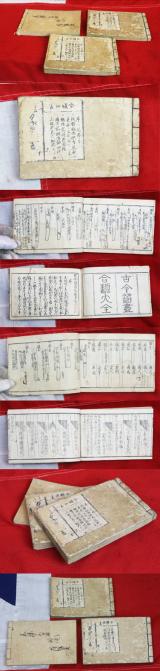
A Rare Collection of Three Original Early Edo Woodblock Hand Printed Books of Samurai Sword Oshigata, of Blade Forms Hamon and Kanji. Ideal For A Scholar Of Samurai Sword Master Makers, Or, A Collector Of Rare Samurai Sword History. Rarely Seen In England
Genealogy, history, plus hundreds of Samurai blades, engravings, blade patterns plus more
swords and sword making. An early printing and of amazing interest. For the not only academic study of the signatures on blade tangs, plus hamon patterns and horimono {blade decorative carvings} by old samurai sword master swordsmiths, but to wonder of the unique aspects of each sword blade and how the reverential study of all aspects of sword making that is unique to Japan for over 1000 years. These superb and beautiful hand made volumes are thus also fascinating and unique works or art, in themselves, hundreds of years old, and created for the study and enjoyment of the art of the true samurai sword.
These volumes of hand made, hand woodblock printed books, detail many aspects of very special swords and their makers. For example, one section of the volumes show hand drawn versions of smiths hamon temper lines the specialised hardening process of every sword’s edge.
Yaki-ire: Hardening the Edge
The hardening of the edge is in many ways the most important, and the most difficult, aspect of the sword-making process. It is the hardening of the edge that gives the blade its ability to take and retain amazing sharpness. To begin with, the blade is coated in yakibatsuchi, a mixture of water, clay, ash, and other ingredients. Every smith has his own special recipe, often a closely kept secret. The yakibatsuchi is applied over the surface, thicker along the spine and thinner at the edge. Working in a darkened forge room using only the light of the glowing coals, the smith carefully heats the blade. As the temperature rises, crystal structures within the metal begin to change. The smith carefully observes the color of the glowing blade, and when the critical temperature is reached the sword is quickly quenched in a trough of water.
At the critical temperature, around 750°C, the structure of steel changes to austenite, a phase where carbon thoroughly combines with iron. When the blade is quickly cooled by quenching, austenite changes to martensite, the hardest type of steel. However, where the thick yakibatsuchi was applied, the blade will cool more slowly, turning not into martensite but instead forming ferrite and pearlite, which are softer and more flexible. Like the kawagane and shingane, this combination of hard edge and softer body is what gives the blade its desirable qualities.
The hardening of the edge also creates a visible change in the surface of the metal. Depending on the way in which the clay mixture was applied, a variety of effects can be produced. This edge pattern is called the hamon, and is one of the most important aspects in the aesthetic appearance of a blade. Like the jihada, each of these patterns has a specific name. Suguha, for example, is a very straight hamon, while sanbonsugi describes a zigzag line in clusters of three.
After the hardening of the edge, if the smith is satisfied with the appearance and quality of the blade, it is then passed on to the polisher, who will give the blade its final partial mirrorlike polish, with a mixture of light and shade, displaying many different shades of grey steel, and then other craftsmen will make the scabbard {saya} and sword mountings {koshirae}. Complete mountings have many elements, including metalwork such as tsuba and menuki, lacquered wood, silk cords and wrapping, and ray-skin grips. Though these are all works of art in themselves, and some of these fittings can indeed be almost priceless in their beauty quality and indeed value, in their own right, but the blade remains the true centerpiece of the finished work, and in fact the age of the blade dictates the time period of the age of the whole sword, despite how ever old or young it’s additional fittings may be. It combines to be an example of the ingenuity of centuries of Japanese smiths and their desire to achieve the perfect blend of technology and art. read more
895.00 GBP

Samurai Katana Signed Kaneuji Around 1680, With The Toyatomi Clan & Imperial Kiri Kamon. With a Pair of Edo Ni Bu Ban Kin Rectangular ‘Bar’ Gold Coin Menuki. It Has an Amazingly Beautiful Polished Blade, With A Truly Elegant Curvature.
All original Edo mounts and a very fine original urushi lacquer saya. With most gorgeous Edo fuchi kashira, of very well executed high reliefs of arabesque vines, or karakusa. This style of carving is named Mino-bori it has within the design a kiri clan mon of the empress tree, the symbol of the the Toyotomi clan, that was later bestowed as a great honour to samurai family clan, by the Imperial Court, and the sword has matching kiri clan kamon of a pair of Edo period 2 Bubankin gold coins. The Kiri-mon (paulownia patterns) is a generic name for Monsho (crests or coats of arms) that are based on paulownia. It is also called Toka-mon. Since it was incused on money such as koban (former Japanese oval gold coin) after Muromachi period. A very nice Tetsu, gold inlaid, Bushu school sukashi tsuba.
Toyotomi-shi was a Japanese clan that ruled over the Japanese before the Edo period, and their symbol was the paulownia kiri kamon. The most influential figure within the Toyotomi was Toyotomi Hideyoshi, one of the three "unifiers of Japan". Oda Nobunaga was another primary unifier and the ruler of the Oda clan at the time. Hideyoshi joined Nobunaga at a young age, but was not highly regarded because of his peasant background. Nevertheless, Hideyoshi's increasing influence allowed him to seize a significant degree of power from the Oda clan following Oda Nobunaga's death in 1582. As the virtual ruler of most of Japan, Hideyoshi received the new clan name "Toyotomi" in 1585 from the emperor, and achieved the unification of Japan in 1590.
When Hideyoshi died in 1598, his son Toyotomi Hideyori was only five years old. Five regents were appointed to rule until his maturity, and conflicts among them began quickly. In 1600, Tokugawa Ieyasu deposed Hideyori and took power after winning the Battle of Sekigahara. In 1614, Hideyori came into conflict with the Tokugawa shogunate, leading to Tokugawa Ieyasu's Siege of Osaka from 1614 to 1615. As a result of the siege, Hideyori and his mother, Yodo-dono, committed seppuku in the flames of Osaka castle. After their death, the Toyotomi clan dissolved, leaving the Tokugawa clan to solidify their rule of Japan and the last member of the Toyotomi clan was Tenshuni ja (1609–1645). A rumor said that Toyotomi Hideyori's son Toyotomi Kunimatsu escaped execution, and another rumour said that Hideyori had an illegitimate son named Amakusa Shirō. The Kiri kamon became the Imperial mon and its use was permitted and granted as a mark of great honour by the imperial court and a sign of great favour awarded to a loyal and devoted samurai family
The stunning blade has just returned from artisan re-polishing and looks really,really beautiful.
The original Edo period urushi lacquer on the saya is in simply excellent condition and shows most elegant simplicity, yet a most intricate patterning in the black lacquer. it reveals within that simplicity the finest craftsmanship and beauty worthy of a master of the art of urushi decor. Japanese lacquer, or urushi, is a transformative and highly prized material that has been refined for over 7000 years.
Cherished for its infinite versatility, urushi is a distinctive art form that has spread across all facets of Japanese culture from the tea ceremony to the saya scabbards of samurai swords
Japanese artists created their own style and perfected the art of decorated lacquerware during the 8th century. Japanese lacquer skills reached its peak as early as the twelfth century, at the end of the Heian period (794-1185). This skill was passed on from father to son and from master to apprentice.
The first rectangular gold coin was the Ichibu Ban Kin, or One Bu Size Gold, introduced in 1599. This was long before any of the other forms of Japanese bar money, and it’s uncertain why it originated. Regardless, it circulated all the way through 1869 with a whopping 16 different varieties.
However, the overall design remained consistent throughout the years. Both sides are bordered by raised dots, and the obverse reads “Ichibu” (One Bu), with Kiri crests above and below. These crests represent the flower of the Paulownia tree, the symbol of the Office of the Prime Minister of Japan. The reverse features the signature of Mitsutsugu.
Over the years, they became smaller and were debased, from 85.7% to 57.4% gold. Even with such a long mintage, all varieties of these coins are rare today. Released in 1818, the Ni Bu Ban Kin (Two Bu Size Gold) was intended to make commerce easier. Most of the Koban coins in circulation by that point were broken, and this thicker, stronger rectangular coin was meant to replace them. Damaged Koban coins could be converted for free, provided they weren’t missing too much of their gold content.
However, people were not satisfied. The Ni Bu Ban Kin consisted of lower quality gold and was generally seen as a less reliable coin, so they didn’t see wide circulation. They started with 56.3% gold but were debased to only 22.3% by 1868.
In design, they are almost to the Ichibu Ban Kin. They are larger, of course, and have the denomination “Ni Bu” inscribed on the obverse, but all other elements are the same.
Every single item from The Lanes Armoury is accompanied by our unique Certificate of Authenticity. Part of our continued dedication to maintain the standards forged by us over the past 100 years of trading
39 inches long in saya total. Blade length tsuba to tip, 27.25 inches. read more
6450.00 GBP
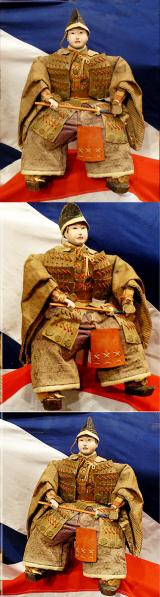
A Superb Antique Edo Period Musha-Ningyo Samurai General Warrior Doll. A Uniquely Japanese Art Form Representing The Legendary Samurai
Adorned with full traditional miniature armour of lacquerwork and lacings and court cap jingasa and damask silk clothing, he is holding a katana. He is seated on a traditional stool. Warrior dolls also known as musha-ningyo are very popular as fine Japanese traditional works of art among Western collectors. Embodying the martial spirit of the samurai, these figures are decked out in full military regalia with lacquered armour, weaponry. They frequently represent very specific historical characters and are a fascinating window into Japan’s rich military past. There may be a continuity in the making of the dogū, humanoid figures, by the ancient Jomon culture in Japan (8000-200 BC) and in the Haniwa funerary figures of the subsequent Kofun culture (around 300-600 AD). Expert Alan Pate notes that temple records refer to the making of a grass doll to be blessed and thrown into the river at Ise Shrine in 3 BC; the custom was probably even more ancient, but it is at the root of the modern doll festival or Hinamatsuri. There are various types of traditional dolls, some representing children and babies, some the imperial court, warriors and heroes, fairy-tale characters, gods and (rarely) demons, and also people of the daily life of Japanese cities. Many have a long tradition Musha, or warrior dolls, are usually made of materials similar to the hina dolls, but the construction is often more complicated, since the dolls represent men (or women) seated on camp chairs, standing, or riding horses. Armor, helmets, and weapons are made of lacquered paper, often with metal accents. There is no specified "set" of such dolls; subjects include Emperor Jimmu, Empress Jingu with her prime minister Takenouchi holding her newborn imperial son, Shoki the Demon-Queller, Toyotomi Hideyoshi and his generals and tea-master, and fairy-tale figures such as Momotaro the Peach Boy or Kintaro the Golden Boy. In the nineteenth century ningyo were introduced to the West.
Doll collecting has since become a popular pastime in the West. Famous well known collectors from the West include individuals such as James Tissot (1836–1902), Jules Adeline (1845–1909), Eloise Thomas (1907–1982), and Samuel Pryor (1898–1985). During the Meiji period, three men became pioneers in collecting ningyo, Shimizu Seifū (1851-1913), Nishizawa Senko (1864–1914), and Tsuboi Shogoro (1863–1913). The three men are referred to as "Gangu San Ketsu" (the three great toy collectors). They introduced a systematic approach to collecting ningyo in an effort to preserve and document the various forms of ningyo. Shimizu, an artist and calligrapher, put his artistic ability to use by creating an illustrated catalog of his own collection of 440 ningyo dolls. The catalog was published in 1891, under the title Unai no Tomo. Nishizawa, a banker, gathered a significant collection on hina-ningyo. He was an active researcher, collector of stories, documents, and information relating to the development of hina-ningyo during the Edo period. Nishizawa’s son Tekiho (1889–1965) inherited his collection but a great portion of the collection was lost in the Kanto earthquake of 1923. Tsuboi, founder of the Tokyo Anthropological Society, was the most trained of the three, and he brought a scientific element to the collecting of ningyo. Dolls have been a part of Japanese culture for many years, and the phenomenon of collecting them is still practiced. Many collections are preserved in museums, including the Peabody Essex Museum, Kyoto National Museum, and the Yodoko Guest House.
The doll is similar to the work of Maruhei a famous Japanese doll artist from Kyoto
Dimensions: 17.5 inches high
Condition: The doll is in very good condition according to age and with wonderful antique taste. Some wear and fading to fabric in places. read more
1595.00 GBP