
Antique Arms & Militaria

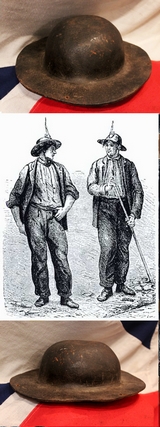
Most Interesting & Incredibly Rare 19th Century Cornish Tin Miner’s Leather 'Tull' Helmet
A most rare artefact of early English mining. this amazingly historical piece of the earliest British mining industry would make an incredible display for a former miner or miner's family.
These days they are only ever to be seen in museums or recreated for historical dramas such as 'Poldark'. A style of helmet that was copied by the British army to create the WW1 Brodie helmet. This helmet was formed from a single piece of boiled leather, some economy versions were made of shaped felt soaked in pine resin. Under the tull, miners would wear a strip of cloth; helping the tull to fit. Candles were attached to the tull using lumps of clay. While working the tull was usually removed and the candle stuck to a nearby ledge. 4 small holes to brim. GC read more
595.00 GBP

A Most Impressive Original 16th -17th Century Nuremberg 'Black and White' Comb Morion Helmet, The Very Same Form of Helmet As Was Made Famous by the Spanish Conquistador’s in Their Conquest of Central America
A most similar morion, was in the great historical collection of arms armour from the armoury of Fortress Hohenwerfen near Salzburg, Austria, that was augmented by H.I.R.H. Archduke Eugen. A collection that was sold, and entered the collectors market and various museums, in 1927, which contained some Nuremberg and Augsberg 'black and white' morion helmets such as this. Morion is a type of open helmet used from the middle 16th to early 17th centuries, such as by the Munich Town Guard, usually having a flat brim and a crest from front to back. Its introduction was contemporaneous with the exploration of North, Central, and South America. Explorers like Hernando de Soto and Coronado may have supplied them to their foot soldiers in the 1540s. The iconic morion, though popularly identified with early Spanish explorers and conquistadors, was not in use as early as the conquest of Mexico by Hernan Cortez or Francisco Pizarro's conquest of the Incas in South America. Thirty to forty years later, it was widely used by the Spanish, but also common among foot soldiers of many European nationalities, including the English; the first English morions were issued during the reign of Edward VI. The crest or comb on the top of the helmet was designed to strengthen it. Later versions also had cheek guards and even removable faceplates to protect the soldier from sword cuts.
The morion's shape is derived from that of an older helmet, the Chapel de Fer, or "Kettle Hat." Other sources suggest it was based on Moorish armor and its name is derived from Moro, the Spanish word for Moor. The New Oxford American Dictionary, however, derives it from Spanish morrion, from morro 'round object'. The Dictionary of the Spanish Language published by the Royal Spanish Academy indicates that the Spanish term for the helmet, morrion, derives from the noun morra, which means "the upper part of the head". A somewhat similar example is in the Metropolitan Museum in New York accession number 14.25.508
Every single item from The Lanes Armoury is accompanied by our unique Certificate of Authenticity. Part of our continued dedication to maintain the standards forged by us over the past 100 years of our family’s trading, as Britain’s oldest established, and favourite, armoury and gallery read more
4350.00 GBP

A Very Fine, 17th Century, King 'William & Queen Mary' Period Hangar Sword Cutlass of Senior Naval Officer's Admirals and Captains of the Royal Navy. Plus The Arm of Choice For All Infamous Pirates of The Day. With Stunning King's Head Armourer Stamp
The sword of choice for senior officer's {Admirals and Captain's} and pirates serving in the Royal Navy during the 17th and early 18th century.
This is a true and most fine original museum piece from the early days of piracy in the Caribbean, based, much around Port Royal, with easy access to the wealth, and thus the plundering of the Americas in South Carolina, and around the length of Florida. Also, in superb condition for age.
We show three portraits in the gallery of admirals of the age each bearing their very same swords, plus, the notorious Edward Teach {aka Blackbeard} the most famous of all the pirate fleet captains of history, bearing his sword.
Short flat sided blade. Antler handle made of antler of a male deer, called “hartshorn,” brass single knuckle bow bar hilt with cap pommel.
Blade bears two 'king's heads' armourer's marks. Overall in superb condition for its age.
Another very similar 'William and Mary hilted cutlass hangar was recovered {in a very poor state} from the wreck of notorious pirate, Captain Blackbeard's ship, the Queen Anne's Revenge, that was found at Beaufort inlet in 1996, the remains of the vessel have become the property of the people of North Carolina. And another 'William and Mary' period sword-cutlass is in a museum collection in Colonial Williamsburg in America.
William and Mary were the co-regnants over the Kingdoms of England, Scotland, and Ireland, namely the Dutch Prince of Orange King William III (& II) and his spouse (and first cousin) Queen Mary II. Their joint reign began in February 1689 after they were offered the throne by the Convention Parliament irregularly summoned by William after his victorious invasion of England in November 1688, the so-called Glorious Revolution. They replaced James II (& VII), Mary's father, who fled the country. Parliament offered William and Mary a co-regency, at the couple's behest. After Mary died in 1694, William ruled alone until his death in 1702. William and Mary were childless and were ultimately succeeded by Mary's younger sister, Anne.
This was the most popular form of sword used by the early British Naval Commanders when at sea. There are numerous great portraits in the National Gallery, and at the National Maritime Museum, of 17th and 18th century Admirals adorned with identical swords. Such as Admirals Benbow, Shovel et al. we show three such portraits in our gallery, of Hopsonn, Shovel and Benbow.
Vice-Admiral John Benbow (10 March 1653 – 4 November 1702) was an English Royal Navy officer. He joined the Navy in 1678, seeing action against Barbary pirates before leaving to join the Merchant Navy in which Benbow served until the 1688 Glorious Revolution, whereupon he returned to the Royal Navy and was commissioned.
Benbow fought against the French Navy during the Nine Years' War, serving on and later commanding several English warships and taking part in the battles of Beachy Head and Barfleur and La Hogue in 1690 and 1692. He went on to achieve fame during his military accomplishments, which included fighting against Barbary pirates such as the Salé Rovers, besieging Saint-Malo and seeing action in the West Indies against the French during the War of the Spanish Succession.
Admiral of the Fleet Sir Cloudesley Shovell (c. November 1650 – 22 or 23 October 1707) was an English naval officer. As a junior officer he saw action at the Battle of Solebay and then at the Battle of Texel during the Third Anglo-Dutch War. As a captain he fought at the Battle of Bantry Bay during the Williamite War in Ireland.
As a flag officer Shovell commanded a division at the Battle of Barfleur during the Nine Years' War, and during the battle distinguished himself by being the first to break through the enemy's line. Along with Admiral Henry Killigrew and Admiral Ralph Delaval, Shovell was put in joint command of the fleet shortly afterwards.
During the War of the Spanish Succession, Shovell commanded a squadron which served under Admiral George Rooke at the capture of Gibraltar and the Battle of Málaga. Working in conjunction with a landing force under the Earl of Peterborough, his forces undertook the siege and capture of Barcelona. He was appointed commander-in-chief of the Navy while at Lisbon the following year. He also commanded the naval element of a combined attack on Toulon, base of the main French fleet, in coordination with the Austrian army under Prince Eugene of Savoy in the summer of 1707. Later that year, on the return voyage to England, Shovell and more than 1,400 others perished in a disastrous shipwreck off the Isles of Scilly.
Thomas Hopsonn enjoyed a naval command on 18 May 1688, when James II appointed him to the Bonaventure. This ship was part of the fleet sent to The Nore under Strickland to prevent the Dutch invasion. However, Hopsonn was one of the conspirators within the fleet who supported William of Orange in the Glorious Revolution.
Following the revolution, Hopsonn retained command of the Bonaventure and was part of the squadron that relieved the siege of Derry in June 1689. On 28 October 1689, he was posted to the York, and commanded that vessel during the battle of Beachy Head the following year. Hopsonn's immediate commander in the battle was Sir George Rooke, who formed a high opinion of his gallantry and was afterwards much associated with him. He commanded Royal Katherine for two months starting in August 1690, before moving to command the St Michael. It was aboard the latter that he followed Rooke in the battle of Barfleur on 19 May 1692. In the same year, he was promoted to become a captain in the foot guards on the recommendation of admiral Edward Russell.
Blackbeard or Edward Teach (c.1680-1718) is one of the most infamous pirates to have ever lived.
Known for his fearsome image and daring acts on land and sea throughout the West Indies and along the North American East coast, his legacy has been the inspiration for many depictions of pirates throughout history. In possibly his most brazen act, Teach used his flotilla to blockade the port of Charlestown in the province of South Carolina. Over the course of a week, nine vessels were stopped and plundered as they attempted to sail out of the harbour, where Teach's fleet was moored.
Teach informed some of his prisoners that his fleet required medical supplies from the colonial government of South Carolina and that if none were provided, all would be beheaded and their ships burned.
Two pirates and a prisoner were sent to the town but when they did not return he moved eight ships into the harbour, causing panic and looting within the town. Shortly after his supplies were delivered and the prisoners released, after reportedly being robbed of all worthy possessions.
This siege represents the height of Teach’s notoriety, not just as a skilled captain but a fierce leader who was not confined to the sea and would maraud where he pleased. Exploits such as these made Teach was one of the most commonly reported pirates in the news and in the print of his age.
24 inches long overall, 19.25 inch long blade read more

A Simply Stunning Ancient Bronze Age Lobed Mace Head, from the Era of Rameses The Great, Pharoah of Egypt, Circa 1300 B.C. Possibly Used By The Sherden Mercenaries, Ramesses II's Personal Guard at The Battle of Kadesh 1274 B.C.
Ist to 2nd Millenium B.C. The type of lobed mace style used by the Sardinian warriors that fought for Rameses IInd, alongside Thutmoses IIIrd, considered the greatest Pharoah of all the ancient Egyptian dynasties.
The Sardinian warriors who fought for Ramesses II were known as the Sherden (or Shardana), one of the mysterious "Sea Peoples". Initially defeated by Ramesses II around 1278 BC, these skilled, horned-helmeted mercenaries were incorporated into his personal guard and fought with distinction at the Battle of Kadesh (1274 BC).
Origins: The Sherden are widely believed to be connected to the Nuragic civilization of Sardinia, as their depicted equipment matches bronze figurines found on the island, including horned helmets with a central ball, round shields, and long slashing Naue II swords.
After their capture, the Sherden proved to be highly effective, becoming elite members of the Pharaoh's army, with hundreds 500 fighting alongside Egyptians during the reign of Ramesses II.
They are clearly depicted on Egyptian reliefs, such as those at Abu Simbel and Medinet Habu, distinct from Egyptian soldiers due to their unique armour.
One of the most beautiful and finely crafted examples we have seen.
One of two maces from the same era and collection. This one is the more elaborate of the two. Items such as this were oft acquired in the 18th century by British noblemen touring Northern France and Italy on their Grand Tour. Originally placed on display in the family 'cabinet of curiosities', within his country house upon his return home. A popular pastime in the 18th and 19th century, comprised of English ladies and gentlemen traveling for many months, or even years, throughout classical Europe and the Middle East, acquiring antiquities and antiques for their private collections.
In use it would have slotted onto a wooden haft. The use of the stone headed mace as a weapon and a symbol of status and ceremony goes back to the Upper Paleolithic stone age, but an important, later development in mace heads was the use of bronze copper ally metal for their composition. With the advent of copper mace heads, they no longer shattered, and a better fit could be made to the wooden club by giving the eye of the mace head the shape of a cone and using a tapered handle.
The Shardanas or warriors from Sardinia who fought for Ramses II against the Hittities were armed with maces consisting of wooden sticks with bronze heads. Many bronze statuettes of the times show Sardinian warriors carrying swords, bows and original maces. Persians used a variety of maces and fielded large numbers of heavily armoured and armed cavalry (see cataphracts).
At the 1274 BC Battle of Kadesh, Ramesses II was saved from a surprise Hittite chariot ambush by his personal guard, known as the Narin (or Ne'arin), alongside elite Sherden mercenaries. When the Hittite chariots broke through the Egyptian Re division, the royal guard helped the king launch desperate countercharges, holding the line until reinforcements arrived.
The royal guard was positioned with Ramesses in the vanguard of the Amun division, enabling them to act quickly when the Hittite surprise attack hit the camp.
The guard consisted of trained Egyptian soldiers and, significantly, Sherden mercenaries—distinguishable by their horned helmets—who were appearing in Egyptian service for the first time.
The Narin (Ne'arin): These specialized, heavily armed, and fast-moving troops are credited with turning the tide of the battle by arriving just in time to surprise the looting Hittite charioteers.
Action: Ramesses II, along with his guard, personally led charges, described as "like Set in his moment," to scatter the Hittite forces
The enchanted talking mace Sharur made its first appearance in Sumerian/Akkadian mythology during the epic of Ninurta. Roman auxiliaries from Syria Palestina were armed with clubs and maces at the battles of Immae and Emesa in 272 AD. They proved highly effective against the heavily armoured horsemen of Palmyra.
Photos in the gallery of original carvings from antiquity in the British Museum etc.; Ashurbanipal at the Battle of Til-Tuba, Assyrian Art, British Museum, London 650-620 BC, Limestone, An Assyrian soldier waving a mace escorts four prisoners, who carry their possessions in sacks over their shoulders. Their clothes and their turbans, rising to a slight point which flops backwards, are typical of the area; people from the Biblical kingdom of Israel, shown on other sculptures, wear the same dress, on a gypsum wall panel relief, South West Palace, Nimrud, Kalhu Iraq, neo-assyrian, 730BC-727BC.
A recovered tablet from Egypt’s Early Dynastic Period (3150-2613 BCE) shows a Pharoah smiting his foe with a war mace. The mace is complete with its display stand as shown.
Approx. 6 inches high including stand. This wonderful piece would have been made and traded throughout the Western Asiatic region. As with all our items it comes complete with our certificate of authenticity. read more
1350.00 GBP

A Hugely Impressive Antique & Beautifully Gothic. A Medieval Form Piece, Mounted With A Pole Or Tiller Carved Gun-Stock, With a Tudor Rose Design, Likely Pre English Civil War Period. Of Light-Cannon Size, Yet Still Hand Portable.
This would make an exceptional wall mounted display piece. It has a 1.25 inch bore iron 'cannon form' barrel, with a carved hardwood tiller, probably later, bearing a beautifully carved Tudor rose. Likely a 17th century mounted long gun, and during it's later working life it has been in the possession and thus stored, in the 18th to 19th century, in the armoury of the Maharajah of Jaipur, as it bears the Maharajah’s armoury storage marks, stamped thereon near the breech.
This type of gun is typical of many surviving from the period 1420 to around 1480. It’s a most sturdy and massive forged iron barrel made by a armoury blacksmith, mounted with a wooden pole or tiller. Some version might have had a hook on the bottom of the barrel as does this, which could be used to hook the barrel over the top of a wall or shield, or as a close-quarters weapon.
The the late medieval term used was arquebus or harkbuss meaning a hand fired gun..
This gun can be fired by a single person if it is hooked over a wall, or more easily by two people, a gunner and a calinator due to it’s weight. The earlier weapons all rely on putting a lighted match into the touch-hole by hand. The matchlock gun represented a real advance. It held the lighted match on a pivoted trigger lever (known as a serpentine). This allowed the gunner to look at his target where aiming.
This style of gun was the highest technology of the medieval era, not widespread until after 1450, and continuing until perhaps 1550, when it grew in length and became the familiar musket of the English civil wars in the 1700’s.
Barrel 31.5 inches long, barrel muzzle 2.5 inches across, tiller 18 inches, and overall 50 inches. As with all our antique guns no license is required as they are all unrestricted antique collectables, barrel bore bears old tamper obstruction. read more
1875.00 GBP

A Rare, Original, 1st Century Roman 'Ballista' Siege Engine. Tanged, Four Sided Bolt Head. Province of Britannia Use and Recovered Near Camulodunum {Colchester} In the Early 1800's
The Roman ballista was a powerful torsion-powered siege engine used from the 3rd century BCE to the 4th century CE to launch iron-tipped bolts or stone projectiles over 500 yards. It came in several forms and of various sizes. some far more mobile than others. Adapted from Greek designs, it acted as a giant, highly accurate crossbow, often featuring in, or as part of, legions to break enemy formations and defenses.
It used two wooden arms inserted into tightly twisted skeins of animal sinew or human hair, which provided the tension to propel projectiles when released.
Ranged from large, stationary siege engines to smaller, portable versions known as the scorpio or cheiroballistra (hand ballista).
A single ballista could fire up to 1,000 projectiles in a day, often operated by a crew of up to eight men.
Used for both offense and defense in sieges, they were capable of piercing armour, shattering shield walls, and, in some cases, destroying ships.
Later imperial versions, such as the carroballista, were mounted on carts, allowing them to be moved rapidly around the battlefield.
They were crucial in major sieges, such as in the Second Temple of Jerusalem's destruction (70 CE) and the Siege of Alesia (52 BCE).
By the 1st century CE, they were a standard, integrated component of the Roman legion.
Beyond physical destruction, the ballista was a terrifying weapon that could break the morale of opposing forces
The Romans referred to the island of Britain primarily as Britannia. Following their invasion and conquest, which began in 43 AD, they established it as the province of Britannia. The name was a Latinization of the native Brittonic word Pretanī, which referred to the people of the islands.
The standard Latin name for the province.
Albion: An older, indigenous, or Greek term occasionally used, but largely replaced by Britannia by the 1st century BC.
Britannia Superior & Inferior: Later (roughly 197 AD), the province was divided into two, known as "Upper Britain" (South) and "Lower Britain" (North).
Caledonia: The term used for the unconquered northern region, roughly corresponding to modern Scotland.
The inhabitants were referred to as Brittones.
From the region from whence it was recovered, may indicate that it was part of the Romano British revolt by Queen Boudica of the Iceni
The Boudican revolt was an armed uprising by native Celtic Britons against the Roman Empire during the Roman conquest of Britain. It took place circa AD 60–61 in the Roman province of Britain, and it was led by Boudica, the Queen of the Iceni tribe. The uprising was motivated by the Romans' failure to honour an agreement they had made with Boudica's husband, Prasutagus, regarding the succession of his kingdom upon his death, and by the brutal mistreatment of Boudica and her daughters by the occupying Romans.
The Boudican Revolt at Camulodunum AD 60 - 61
was the first target of the rebels and was the former capital of the Trinovantes, Camulodunum (Colchester), which had been made into a colonia for Roman military veterans. These veterans had been accused of mistreating the locals. A huge temple to the former emperor Claudius had also been erected in the city at great expense to the local population, causing much resentment. The future governor Quintus Petillius Cerialis, then commanding the Legio IX Hispana, attempted to relieve the city, but suffered an overwhelming defeat. The infantry with him were all killed and only the commander and some of his cavalry escaped. The location of this battle is unknown.
The Roman inhabitants sought reinforcements from Catus Decianus, but he sent only two hundred auxiliary troops. Boudica's army attacked the poorly defended city and destroyed it, besieging the last defenders in the temple for two days before it fell. Archaeologists have shown that the city was methodically demolished. After this disaster, Catus Decianus, whose actions had provoked the uprising, fled to Gaul.
During the 6th century, Procopius described the effects of this weapon:
"But Belisarius placed upon the towers engines which they call "ballistae". Now these engines have the form of a bow, but on the under side of them a grooved wooden shaft projects; this shaft is so fitted to the bow that it is free to move, and rests upon a straight iron bed. So when men wish to shoot at the enemy with this, they make the parts of the bow which form the ends bend toward one another by means of a short rope fastened to them, and they place in the grooved shaft the arrow, which is about one half the length of the ordinary missiles which they shoot from bows, but about four times as wide...but the missile is discharged from the shaft, and with such force that it attains the distance of not less than two bow-shots, and that, when it hits a tree or a rock, it pierces it easily. Such is the engine which bears this name, being so called because it shoots with very great force.
The missiles were able to penetrate body-armour:
And at the Salarian Gate a Goth of goodly stature and a capable warrior, wearing a corselet and having a helmet on his head, a man who was of no mean station in the Gothic nation, refused to remain in the ranks with his comrades, but stood by a tree and kept shooting many missiles at the parapet. But this man by some chance was hit by a missile from an engine which was on a tower at his left. And passing through the corselet and the body of the man, the missile sank more than half its length into the tree, and pinning him to the spot where it entered the tree, it suspended him there a corpse.
Procopius became the principal historian of the 6th century, writing the History of the Wars, the Buildings, and the infamous Secret History.
Approx 4 inches long, weight, 1.17 ounces read more
285.00 GBP

Superb & Rare Original, Solid Silver, Medieval Longbow Archer’s Thumb Ring, Mid 14th Century. Of the Battle of Crecy. From Our Latest Antiquities Collection Aquisition Recovered From Crecy, Azincourt and Other Famous Battle Sites in The 1820’s
For those bowmen that used them in the 13th to 14th-century, archer's thumb rings were essential tools of war. This example, being of solid silver would have been used by a high ranked yeoman archer, maybe a leader of a large section of archers, within the ranks of the the kings army. It would also be worn as a symbol of his status and rank, and thus worn when not in combat as well
This archers thumb ring was made circa 1340, over 680 years ago, and this is a superb, beautiful and historical original artifact. Stunning age patination of the silver In superb aged condition.
A thumb ring is a piece of equipment designed to protect the archer’s thumb during archery. It is a ring of that can be made of leather, stone, horn, wood, bone, antler, ivory, metal {silver or bronze}, even ceramics, which fits over the end of the thumb, coming to rest at the outer edge of the outer joint.
Typically a flat area extends from the ring to protect the pad of the thumb from the bowstring; this may be supplemented by a leather extension. An absolute iconic original piece of British history. In superb battlefield recovered patinated condition, and very nice indeed. Beautiful Items such as this were oft acquired in the 18th and early 19th century by British noblemen and women touring battle sites in Northern France and Italy, in fact most of Europe and the Middle East, on their so-called ‘Grand Tour’. They were often placed on display upon their return home, within the family’s 'cabinet of curiosities', within their country house. Some significant British stately homes had entire galleries displaying the treasures and artefacts gathered and purchased on such tours, and some tours lasted many years, and the accumulated souvenirs numbered in their hundreds or even thousands. A popular pastime in the 18th and 19th century, comprised of English ladies and gentlemen traveling for many months, or even years, throughout classical Europe, and the Middle East, acquiring knowledge and education on the arts, and thus returning with antiquities and antiques as souvenirs for their private collections, and these travels have been thus called ‘Grand Tours’. We recently acquired some beautiful pieces acquired from the descendant family of the 10th Duke of Hamilton in the 1820's such as the archer's ring from just north of the Mave River at Crecy.
Although traditional English archers often used three fingers (Mediterranean draw) or finger tabs, but some were obviously trained in the Ottoman style of archery.
The Battle of Crécy took place on 26 August 1346 in northern France between a French army commanded by King Philip VI and an English army led by King Edward III. The French attacked the English while they were traversing northern France during the Hundred Years' War, resulting in an English victory and heavy loss of life among the French.
The English army had landed in the Cotentin Peninsula on 12 July. It had burnt a path of destruction through some of the richest lands in France to within 2 miles (3 km) of Paris, sacking many towns on the way. The English then marched north, hoping to link up with an allied Flemish army which had invaded from Flanders. Hearing that the Flemish had turned back, and having temporarily outdistanced the pursuing French, Edward had his army prepare a defensive position on a hillside near Crécy-en-Ponthieu. Late on 26 August the French army, which greatly outnumbered the English, attacked.
During a brief archery duel a large force of French mercenary crossbowmen was routed by Welsh and English longbowmen. The French then launched a series of cavalry charges by their mounted knights. These were disordered by their impromptu nature, by having to force their way through the fleeing crossbowmen, by the muddy ground, by having to charge uphill, and by the pits dug by the English. The attacks were further broken up by the effective fire from the English archers, which caused heavy casualties. By the time the French charges reached the English men-at-arms, who had dismounted for the battle, they had lost much of their impetus. The ensuing hand-to-hand combat was described as "murderous, without pity, cruel, and very horrible." The French charges continued late into the night, all with the same result: fierce fighting followed by a French retreat.
The English then laid siege to the port of Calais. The battle crippled the French army's ability to relieve the siege; the town fell to the English the following year and remained under English rule for more than two centuries, until 1558. Crécy established the effectiveness of the longbow as a dominant weapon on the Western European battlefield.
The 2009 Encyclopædia Britannica uses the figures of about 6,000 for the English and 20,000 to 30,000 for the French. Part of an original medieval collection we have just acquired, of Viking and early British relics of warfare some from ancient battle sites recovered up to 220 years ago.
When drawing a bow using a thumb draw, the thumb is hooked around the bowstring just beneath the arrow and its grip reinforced with the first (sometimes second) finger. The bowstring rests against the inner pad of the archer's thumb and the thumb ring protects the skin. The bowstring rests against the flat of the ring when the bow is drawn. Today, thumb rings are used by archers practicing styles from most of Asia and some regions of northern Africa. Ishi, the "last wild American Indian", used a thumb draw, but no skin protection.
Thumb rings have been in use in Asia since the Neolithic period. The first examples were likely made of leather,.
As early western armies mainly used peasants as archers, and bowmen fought on foot. some may have needed little training as they already were using bows to hunt, and were indeed required to be trained on archery, usually with a Mediterranean draw. Of course, armies fought foreigners, and probably learnt their opponent's methods/strategies, as well as travelers who brought back hunting/fighting technique, but it may have been marginal amongst archers as the thumb ring draw was difficult to learn.
The regular English and Welsh bowmen fought on foot, but while they fought the major battles on foot, there were mounted archers, those bowmen in the chevauchées against the French. Effective use of the longbow required regular practice and it wasn't easy to just pick up and use one (which is why inferior firearms replaced the bows - the firearms were easier to master). In this period, hunting was the domain of the uppermost classes. The land, and the animals in it, was the property of the king. Poaching could get you hanged.
In the chevauchées it would be unlikely longbows would be used while mounted. Unlikely dismounting to shoot, so using a smaller hunting bow is far more likely. Nobles hunted with shorter handbows commonly, but the bow and the technique were distinct from longbow. Both the length of the longbow, and the posture used for the longbow would make mounted archery quite difficult.
From our latest original antiquities collection arrival, that contain many pieces acquired from famous historical battle sites while on a ‘Grand Tour’ in the 1820’s, such as this superb piece, at Agincourt, and other pieces from such as Crecy and Poitiers, and Paris. read more
645.00 GBP

French Crossbowman’s Quarell Head, From a Crossbow Bolt, Fired At The English Longbowmen. From The Site of The Battle of Crecy. Recovered During a 'Grand Tour' Of the Area Of The Battle Site in the Early 1800's
Recovered During a 'Grand Tour' Of the Area Of The Battle Site in the Early 1800's In superbly conserved condition, an iconic antiquity and souvenir from one of the greatest engagement between the French and English in the 100 Years War. A battle where the famed Edward, the Black Prince gained his spurs. We recently acquired some other beautiful pieces, from the descendant family of the 10th Duke of Hamilton, that their ancestors had purchased in the 1820's during a Grand Tour, from just north of the Mave River at Crecy.
The Battle of Crécy took place on 26 August 1346 in northern France between a French army commanded by King Philip VI and an English army led by King Edward III. The French attacked the English while they were traversing northern France during the Hundred Years' War, resulting in an English victory and heavy loss of life among the French. The English army had landed in the Cotentin Peninsula on 12 July. It had burnt a path of destruction through some of the richest lands in France to within 2 miles (3 km) of Paris, sacking many towns on the way. The English then marched north, hoping to link up with an allied Flemish army which had invaded from Flanders. Hearing that the Flemish had turned back, and having temporarily outdistanced the pursuing French, Edward had his army prepare a defensive position on a hillside near Crécy-en-Ponthieu. Late on 26 August the French army, which greatly outnumbered the English, attacked. During a brief archery duel a large force of French mercenary crossbowmen was routed by Welsh and English longbowmen. The French then launched a series of cavalry charges by their mounted knights. These were disordered by their impromptu nature, by having to force their way through the fleeing crossbowmen, by the muddy ground, by having to charge uphill, and by the pits dug by the English. The attacks were further broken up by the effective fire from the English archers, which caused heavy casualties. By the time the French charges reached the English men-at-arms, who had dismounted for the battle, they had lost much of their impetus. The ensuing hand-to-hand combat was described as "murderous, without pity, cruel, and very horrible." The French charges continued late into the night, all with the same result: fierce fighting followed by a French retreat. The English then laid siege to the port of Calais. The battle crippled the French army's ability to relieve the siege; the town fell to the English the following year and remained under English rule for more than two centuries, until 1558. Crécy established the effectiveness of the longbow as a dominant weapon on the Western European battlefield. Edward the Black Princes role at Crecy; Early on 26 August 1346, before the start of the Battle of Crécy, Edward received the sacrament with his father at Crécy, and took the command of the right, or van, of the army with the earls of Warwick and Oxford (Sirs Geoffroy d'Harcourt and John Chandos) and other leaders.
An unconfirmed source says that they commanded 800 men-at-arms, 2,000 archers, and 1,000 Welsh foot soldiers. When the Genoese bowmen and the front line of the French became disordered, Edward apparently left his position to attack their second line. However, the Count of Alençon then charged his division, putting Edward in great danger, and the leaders who commanded with him sent a messenger to tell Edward III to beg for assistance. When Edward III learned that his son was not wounded, he responded that he would send no help, for he wished to give Edward the opportunity to "win his spurs" (despite already being knighted), and to allow the English army the honour of the victory. In the battle, Edward was thrown to the ground, then was rescued by Sir Richard Fitz-Simon, his standard-bearer, who protected Edwards as he regained his feet. Probably by this time, the French advanced to the elevated ground of the English position. Earl of Arundel, having been sent for help by Harcourt, forced back the French.13 Edward III with the Black Prince after the Battle of Crécy by Benjamin West, 1788 A flank attack on the side of Wadicourt was then attempted by the Counts of Alençon and Ponthieu, but the English were strongly entrenched there, and the French were unable to penetrate the defences. The French lost the Duke of Lorraine and the Counts of Alençon and Blois. The two front lines of their army were broken, and King Philip's division then engaged. Edward III perhaps advanced at the head of the reserve, and the rout was soon completed. When the battle was over, Edward III met his son and declared that he had acquitted himself loyally. The next day, the two paid funeral honours to King John of Bohemia. The legend states that Edward, the Black Prince, adopted the ostrich feather crest and "Ich Dien" motto of the blind King John of Bohemia after defeating him at the Battle of Crécy in 1346. While this story is popular, evidence suggests it may be a romanticized myth, as John actually used vulture wings, and the badge's origins are not fully verified. Following the Battle of Crécy, the Black Prince allegedly found the body of the blind King John of Bohemia and took his crest (ostrich feathers) and motto ("Ich dien" - I serve) to honour his bravery.
There is no solid historical evidence supporting this claim. King John's actual crest was vultures' wings. The story of the feathers first appeared in writing in 1376, the year the Black Prince died. The badge, which is not connected to native Welsh princes, consists of three white feathers in a gold coronet with the motto, and has been associated with the Prince of Wales since at least 1901. Some theories suggest the feathers were a nod to the Welsh archers who were crucial to the victory, with "Ich Dien" potentially being a corruption of the Welsh phrase "Eich Dyn" ("Your Man" Painting of Edward The Black Prince pays his respects to King John of Bohemia (John the Blind) in the aftermath of the Battle of Crécy 1346 read more
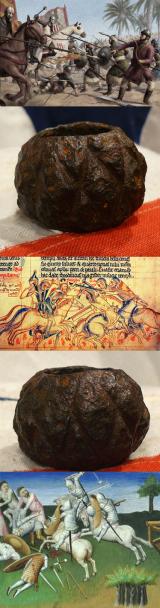
An Original Ancient 13th Century, Ancestral Crusader Knight's Iron Battle Mace & Scorpion Head. From The Site of the Battle of Crecy Fought on The 26 August 1346 Recovered in the 1800's During a ‘Grand Tour’
Pineapple shaped head with large mounting hole. The type as were also used as a Flail Mace, with the centre mount being filled with lead and then a chain mounted upon an inserted hook in the lead centre. Otherwise it was mounted upon a haft.
It has flattened pyramidical protuberances around its whole surface and probably English made.
Made for a mounted Knight in the era of the Crusades, to use as an armour smasher and a helmet crusher in mortal combat. Although made in the crusades era in the 1200's it would have been continually used up to the 14th century, up to and including the first decade of the hundred years war, at the Battle of Crecy, in 1346. We recently acquired some other beautiful pieces, from the descendant family of the 10th Duke of Hamilton, that their ancestors had purchased in the 1820's during a Grand Tour, from just north of the Mave River at Crecy.
On a Flail it had the name of a Scorpion in England or France, or sometimes a Battle-Whip. It was also wryly known as a 'Holy Water Sprinkler'.
King John The Ist of Bohemia used exactly such a weapon, as he was blind, and the act of 'Flailing the Mace' meant that his lack of sight was no huge disadvantage in close combat. Although blind he was a valiant and the bravest of the Warrior Kings, who perished at the Battle of Crecy against the English in 1346. On the day he was slain he instructed his Knights both friends and companions to lead him to the very centre of battle, so he may strike at least one blow against his enemies. His Knights tied their horses to his, so the King would not be separated from them in the press, and they rode together into the thick of battle, where King John managed to strike not one but at least four noble blows. The following day of the battle, the horses and the fallen knights were found all about the body of their most noble King, all still tied to his steed. His body was recovered and the Black Prince paid homage alongside, his father King Edward IIIrd, to this most brave and valorous king
The Battle of Crécy took place on 26 August 1346 in northern France between a French army commanded by King Philip VI and an English army led by King Edward III. The French attacked the English while they were traversing northern France during the Hundred Years' War, resulting in an English victory and heavy loss of life among the French.
The English army had landed in the Cotentin Peninsula on 12 July. It had burnt a path of destruction through some of the richest lands in France to within 2 miles (3 km) of Paris, sacking many towns on the way. The English then marched north, hoping to link up with an allied Flemish army which had invaded from Flanders. Hearing that the Flemish had turned back, and having temporarily outdistanced the pursuing French, Edward had his army prepare a defensive position on a hillside near Crécy-en-Ponthieu. Late on 26 August the French army, which greatly outnumbered the English, attacked.
During a brief archery duel a large force of French mercenary crossbowmen was routed by Welsh and English longbowmen. From the antiquities collection we also have a French crossbow quarrel head .
The French then launched a series of cavalry charges by their mounted knights. These were disordered by their impromptu nature, by having to force their way through the fleeing crossbowmen, by the muddy ground, by having to charge uphill, and by the pits dug by the English. The attacks were further broken up by the effective fire from the English archers, which caused heavy casualties. By the time the French charges reached the English men-at-arms, who had dismounted for the battle, they had lost much of their impetus. The ensuing hand-to-hand combat was described as "murderous, without pity, cruel, and very horrible." The French charges continued late into the night, all with the same result: fierce fighting followed by a French retreat.
The English then laid siege to the port of Calais. The battle crippled the French army's ability to relieve the siege; the town fell to the English the following year and remained under English rule for more than two centuries, until 1558. Crécy established the effectiveness of the longbow as a dominant weapon on the Western European battlefield.
Early on 26 August 1346, before the start of the Battle of Crécy, Edward received the sacrament with his father at Crécy, and took the command of the right, or van, of the army with the earls of Warwick and Oxford (Sirs Geoffroy d'Harcourt and John Chandos) and other leaders. An unconfirmed source says that they commanded 800 men-at-arms, 2,000 archers, and 1,000 Welsh foot soldiers. When the Genoese bowmen and the front line of the French became disordered, Edward apparently left his position to attack their second line. However, the Count of Alençon then charged his division, putting Edward in great danger, and the leaders who commanded with him sent a messenger to tell Edward III to beg for assistance.14 When Edward III learned that his son was not wounded, he responded that he would send no help, for he wished to give Edward the opportunity to "win his spurs" (despite already being knighted), and to allow the English army the honour of the victory. In the battle, Edward was thrown to the ground, then was rescued by Sir Richard Fitz-Simon, his standard-bearer, who protected Edwards as he regained his feet.15 Probably by this time, the French advanced to the elevated ground of the English position. Earl of Arundel, having been sent for help by Harcourt, forced back the French.13
Edward III with the Black Prince after the Battle of Crécy by Benjamin West, 1788
A flank attack on the side of Wadicourt was then attempted by the Counts of Alençon and Ponthieu, but the English were strongly entrenched there, and the French were unable to penetrate the defences. The French lost the Duke of Lorraine and the Counts of Alençon and Blois.13 The two front lines of their army were broken, and King Philip's division then engaged. Edward III perhaps advanced at the head of the reserve, and the rout was soon completed. When the battle was over, Edward III met his son and declared that he had acquitted himself loyally. The next day, the two paid funeral honours to King John of Bohemia.
The 2009 Encyclopædia Britannica uses the figures of about 6,000 for the English and 20,000 to 30,000 for the French. Part of an original medieval collection we have just acquired, of Viking and early British relics of warfare some from ancient battle sites recovered up to 220 years ago. read more
875.00 GBP
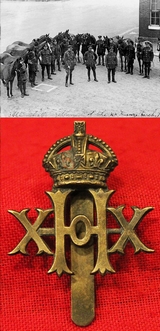
A Most Scarce Edward VIIth 20th Hussars Cap Badge, Used in The Boer War and WW1
The regiment was not deployed to South Africa until December 1901 for service in the Second Boer War and therefore only took part in the final drives against the Boer commandos in spring 1902. The regiment was based in Ireland again from 1908 to 1911.
The regiment, which was based in Colchester at the start of the First World War, landed in France as part of the 5th Cavalry Brigade in the 2nd Cavalry Division in August 1914 for service on the First World War. The regiment saw action at the Battle of Mons in August 1914 and both the First Battle of the Marne and the First Battle of the Aisne in September 1914. It went on fight at the First Battle of Ypres in October 1914, the Battle of Arras in April 1917 and the Battle of Cambrai in November 1917. It later took part in the German Spring Offensive in 1918, the Battle of Amiens in August 1918 and the final push as the war drew to a close read more
65.00 GBP