
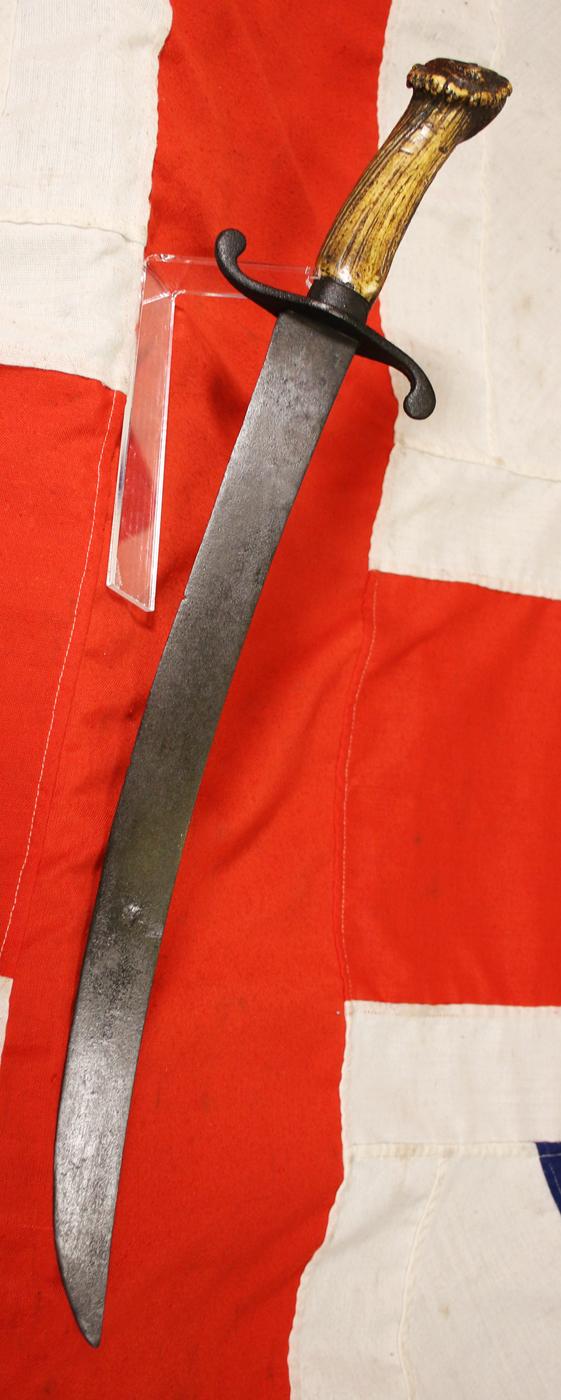
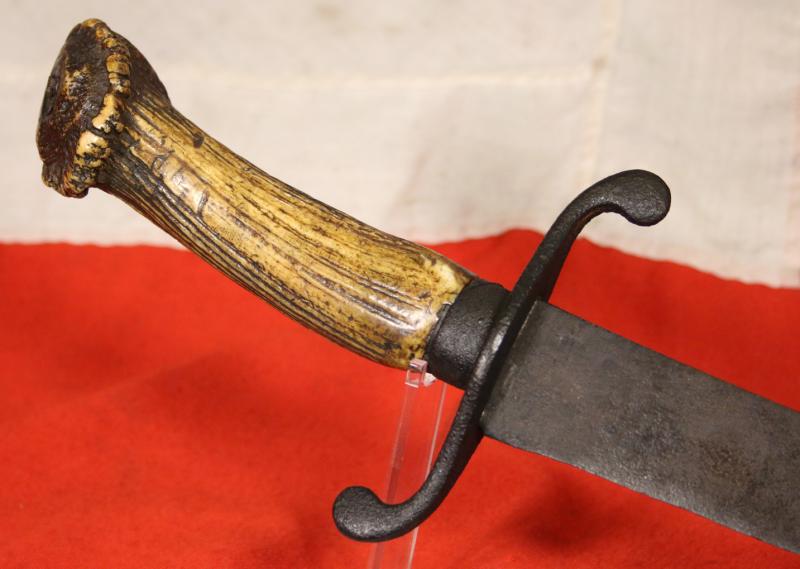
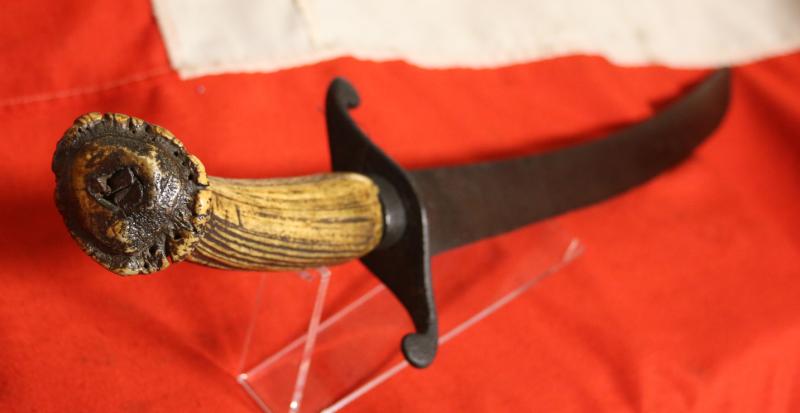
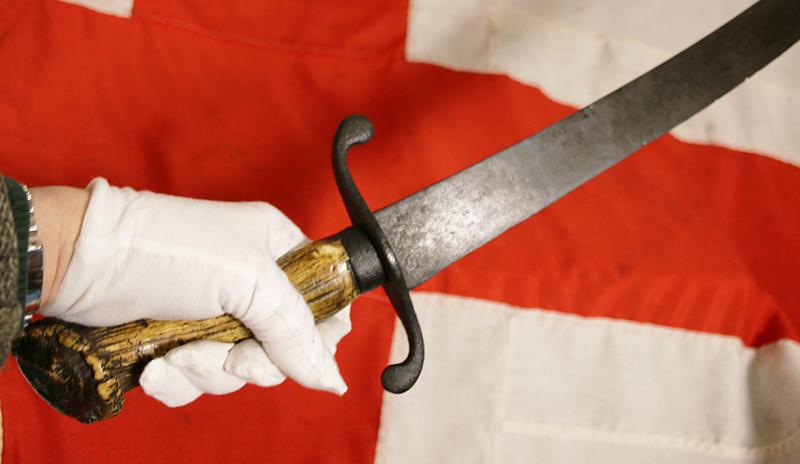
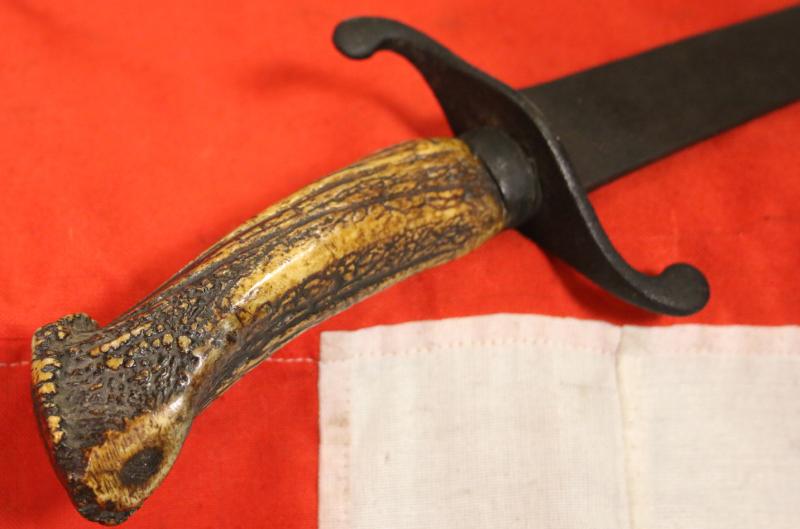
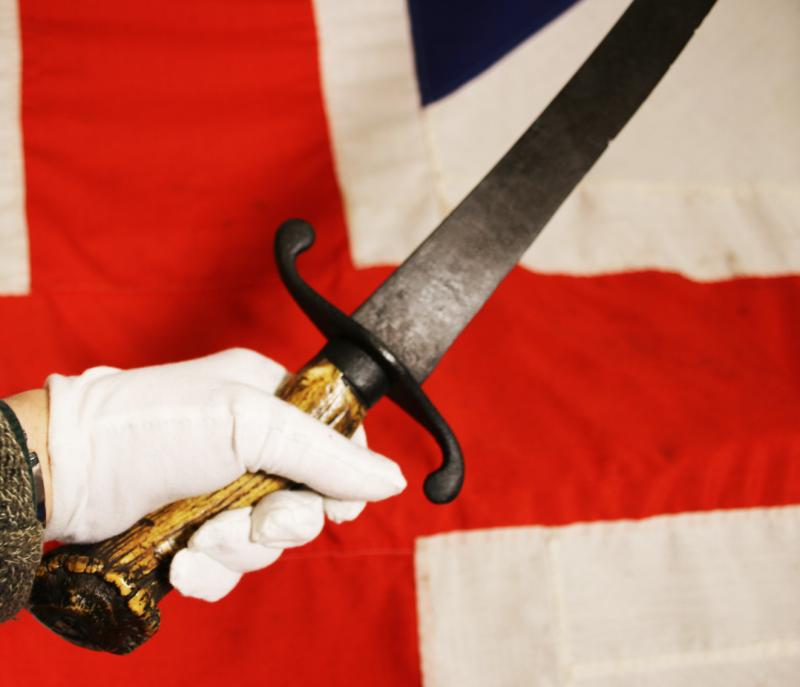
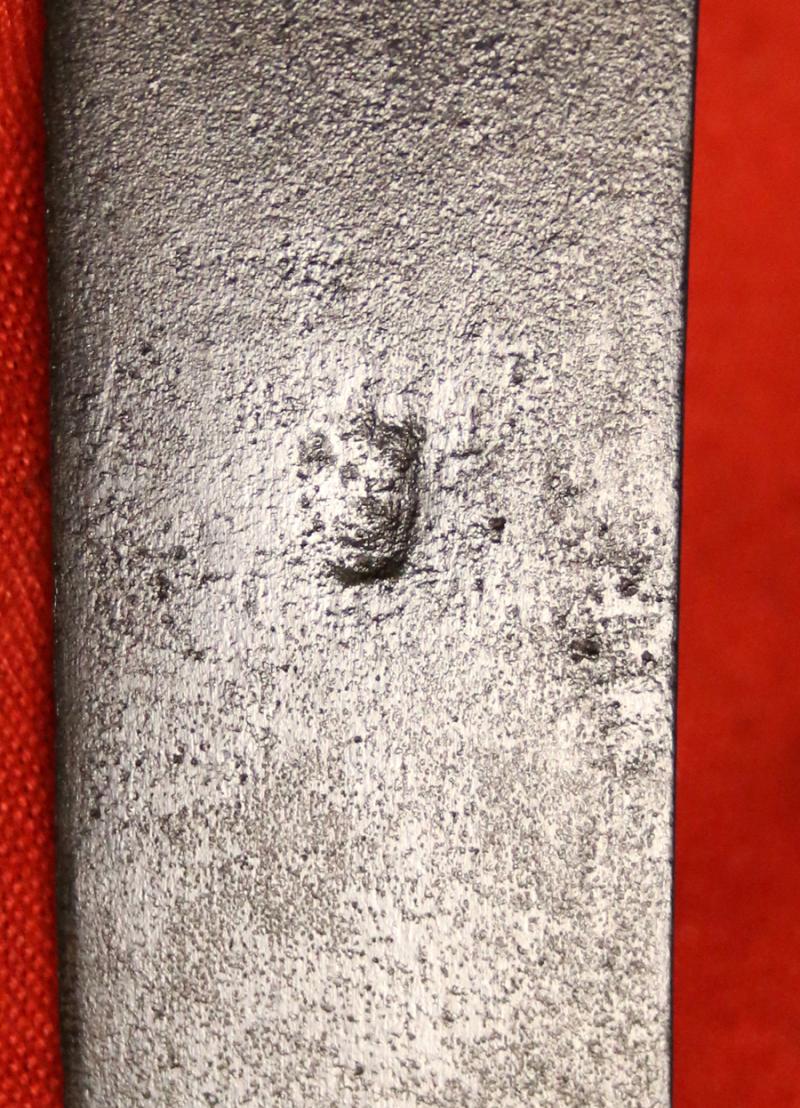
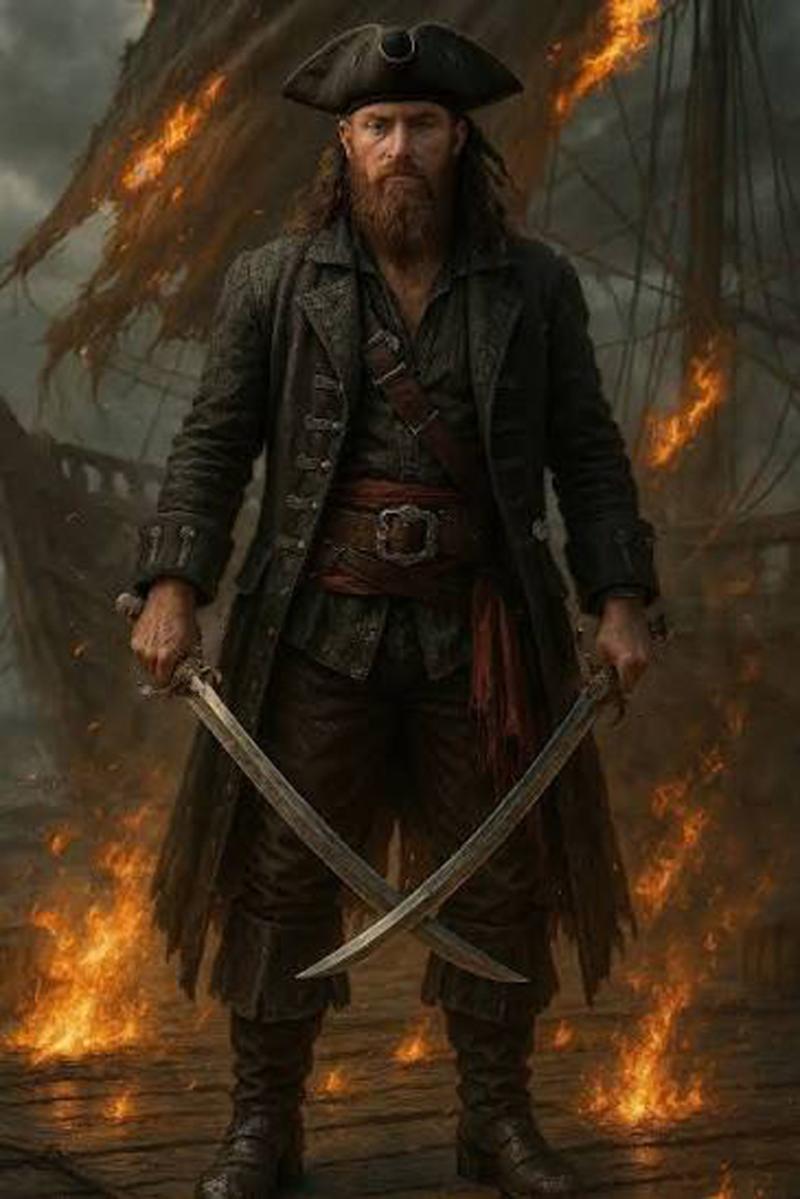
A Fabulous And Superb 17th Century Caribbean Pirate & Bucaneer Captain's 'Hounslow' Cutlass With Large Buck Antler Hilt, Wide And Powerful Curved Blade With Armourer's Stamp. Forged Iron, 'S' Form, Re-Curved Guard.
An exceptional and most beautiful example of a type of which very few have survived. The quintessential pirate and buccaneer captain's cutlass of the period of Spanish treasure fleets taking gold back to Spain, where the bucaneers and pirates fought hard to relieve the Spanish of the burden of all their heavy gold looted from the Incas and Aztecs in the Americas.
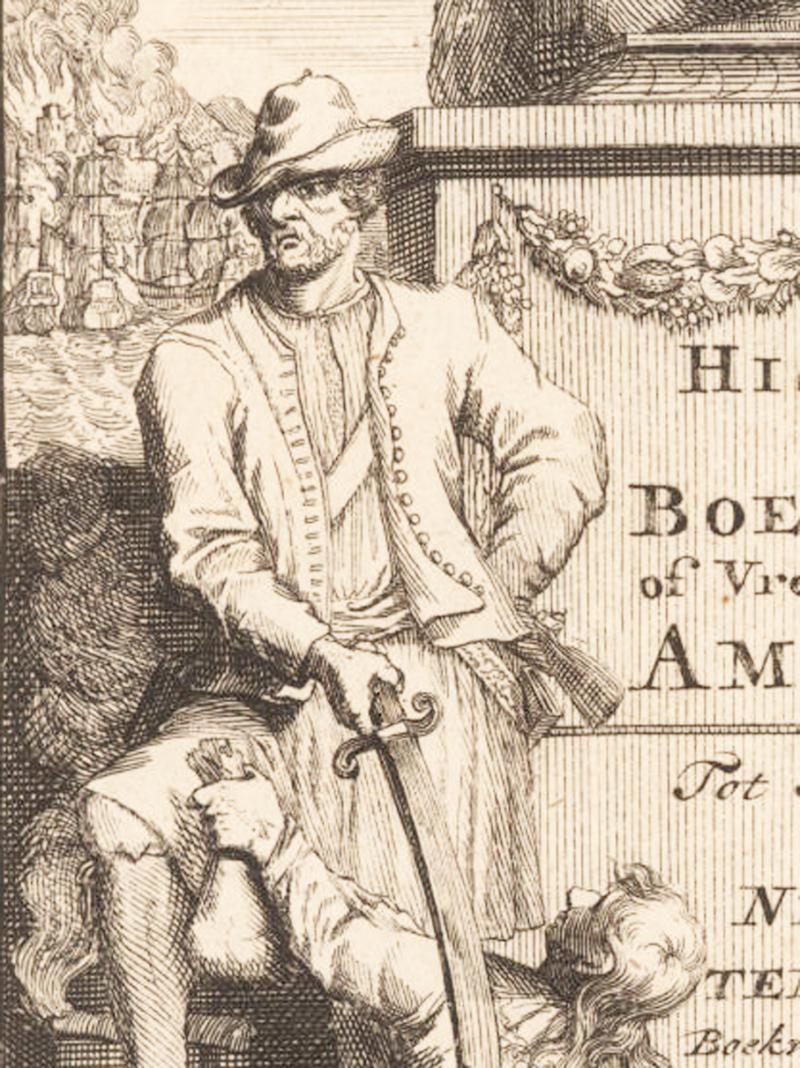
See 'Boarders Away', p.76 for five examples, hand-illustrated, attesting to their rarity.
See also 'Arms and Armor in Colonial America' pl.86 bottom for a closely related example described as early 17th century and op. cit., pl. 88 for the guard and pommel of an example excavated in New York State.
This Hounslow example was made for a man of exceptional stature. The blade is curved, The hilt is made in forged iron. The guard, recurved is forged iron. The grip is buck antler of large proportion. In the 17th century Scottish highlands produced large bucks in the absence of intense hunting pressure.
The Hounslow factory was set up in 1629 by John Haydon along the Duke of Northumberland's River and River Crane, flourishing through the 1630s and 1640s before closing in the 1670s.
The true story of piracy in the Caribbean, is proof positive that fact is stranger than fiction. From the moment the English established their first tiny colonies in the New World, semi-legal pirates took on the might of the Spanish Empire. The lure of Spanish gold was so strong that French and Dutch privateers soon joined them. Sometimes licensed by governments, but often not, desperate gangs of cut-throats dominated the Caribbean throughout the seventeenth century. Led by ruthless captains, they wrested many of the key islands from Spanish control, then fought each other for the region's strategic bases. Most notoriously, the 'brethren of the coast' established the pirate port of Tortuga, the infamous city of crime. From Piet Heyn's capture of the entire Spanish treasure fleet in 1628, to Henry Morgan's sack of Panama, this was the Age of the Buccaneers.
In the 17th century, buccaneers lived on the Caribbean island of Hispaniola and its tiny turtle-shaped neighbour, Tortuga. At first, they lived as hunters, and shot wild pigs with their long-barrelled muskets. Their name came from the special wooden huts called boucans where they smoked their meat.
Later, the governors of Caribbean islands such as Jamaica paid the buccaneers to attack Spanish treasure ships and ports. Some of the largest scale raids were led by the Welsh captain, Sir Henry Morgan (later knighted for his services). Although raids began in this way, with official backing, the buccaneers gradually became more and more out of control, eventually attacking any ship they thought carried valuable cargo, whether it belonged to an enemy country or not. The buccaneers had become true pirates.
As Spanish settlers set up new towns on Caribbean islands and the American mainland, these too came under pirate attack.
The Caribbean remained at the centre of lucrative trade as gold and silver gave way to slave trading, tobacco, sugar and so on ensuring a steady supply of attractive targets.
While the Caribbean was primarily a staging post for Spanish treasure on its way to Madrid, there was little incentive for the British, French or Dutch to do much to discourage piracy. As Spanish power declined and Britain and France asserted themselves as the dominant regional powers it became obvious that potentially lucrative colonies where slaves were growing tobacco or sugar were threatened by uncertainty at sea and something had to be done to stamp out piracy.
In 1670, the Royal Navy had just two ships in the Caribbean, by 1718 the presence had swelled to 124 and piracy had become a shadow of its former self. A hundred years after that and the French had lost Haiti (their main Caribbean possession) to a slave revolt and Britain had double its number of ships there. The Navy hunted down pirates ruthlessly and dispatched quick and summary justice to anyone they caught.
Outright piracy and the use of pirates as privateers for European states would occasionally flair up but rarely would it remain a significant problem for long. The use of privateers was largely abandoned after the signing of the Treaty of Paris in 1856.
From the 16th century, large Spanish ships, called galleons, began to sail back to Europe, loaded with precious cargoes that pirates found impossible to resist. So many successful pirate attacks were made that galleons were forced to sail together in fleets with armed vessels for protection.
Spain’s European rivals especially the French and British spent the next few hundred years in various shifting alliances and both would either rob the Spanish ships directly or issue warrants or ‘letters of marque’ to private ships (privateers) to do so without fear of being hung as pirates (unless of course they were caught by the Spanish)
Code: 26450
1595.00 GBP