
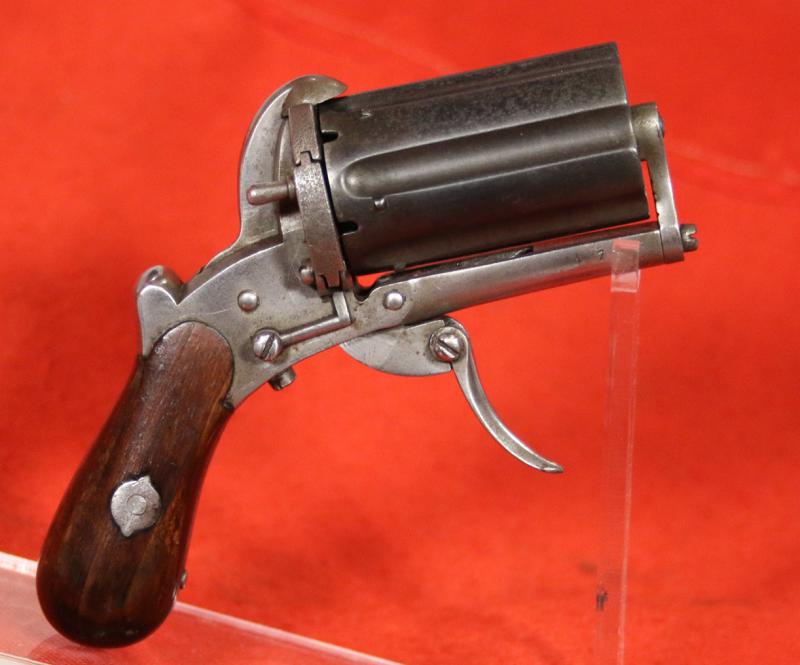
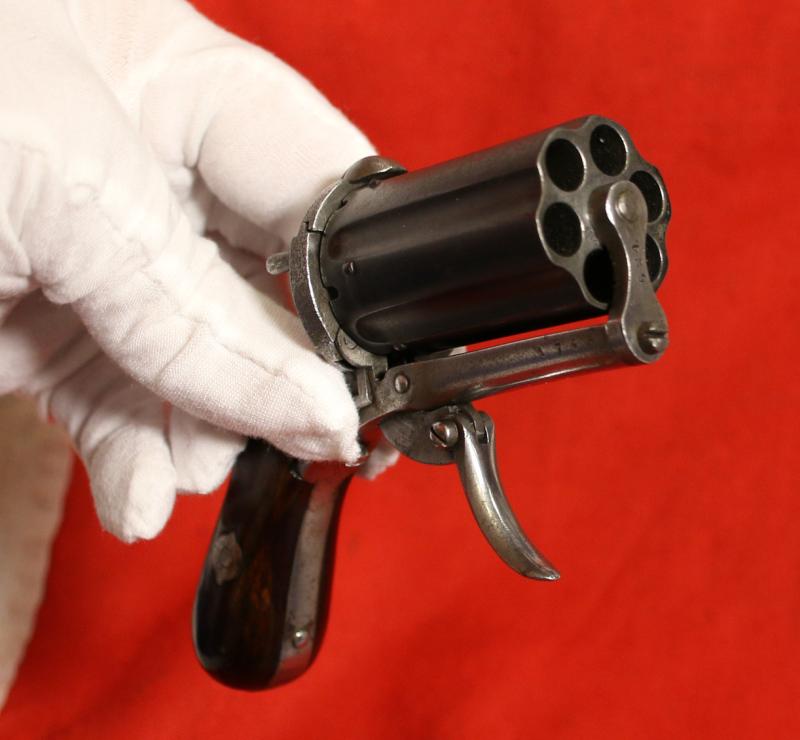
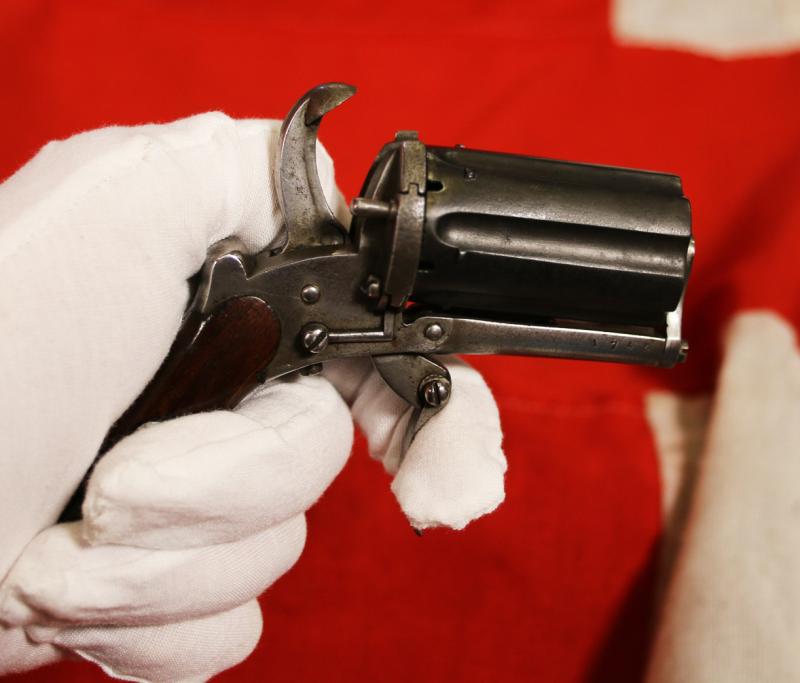
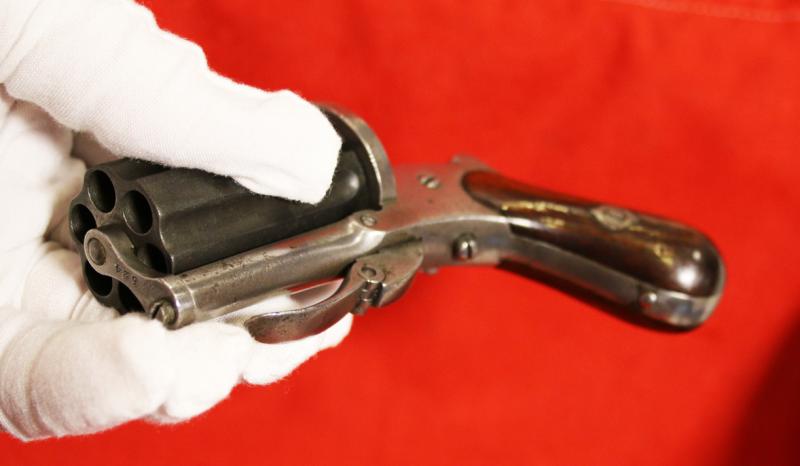
A Rare Six Shot 7mm "Apache" Casse Tête Pistol, Designed by Designer Louis Dolne of Liège. Pinfire Action With Six Revolving Barrels. In America Known as the Pocket Derringer Revolver. An Incredibly Attractive, Neat & Compact Revolver Made in Paris
1860's US Civil War period manufacture, used until the 1910's. In the mid-19th century, the introduction of self-contained metallic cartridge ammunition allowed the concept of the extremely small, multiple shot, easily concealed self-protection handgun to be revisited and taken to new levels. In America, the most famous example was the classic Remington Model 95 “Elliot’s Patent” over and under Derringer pistol. This design is well-known due to Hollywood’s use of these guns in hundreds of westerns as the preferred “hide out” gun of gamblers, ladies of the evening and heroes like James West in the television show Wild, Wild West. In Europe, the preferred variant of these deep concealment handguns was a folding trigger double action revolver rather than a two-shot over and under handgun and received the nickname “Apache”.
The concept and design of the “Apache” is credited to Belgian gun designer Louis Dolne of Liège. Stockel lists Dolne as working and as the creator of the “Casse Tête” (Brain Teaser) revolver which later received the nickname “Apache” due to the use of these revolvers by late 19th and early 20th century French criminals known colloquially as Les Apaches. As originally designed, Dolne’s concept combined a set of folding brass or iron knuckles with a revolving double action only miniature pepperbox style revolver that did not have a barrel. This allowed the knuckle fixture to serve as the revolver’s grip and also provided a built-in way to utilize the gun as an impact weapon in hand-to-hand fighting. Later versions of the guns were produced with folding knife blades and similar devices, turning the guns into a sort of “Swiss Army Knife” with multiple appendages and harkening back to the days of the James Rogers and Unwin & Rogers “Self-Protector” knife pistols of the percussion era.
The revolver portion of the gun typically included a five or six chambered cylinder that was loaded via a loading gate in the right rear of the frame and required a small rod that was often threaded into the grip for storage, to eject the spent rounds. The guns were primarily chambered for pinfire ammunition and usually in 7mm. The action was double action only and typically utilized a folding trigger to make the gun more concealable and less likely to snag when being drawn from a pocket when needed. To increase the concealability of the guns and again to reduce the possibility of being snagged when drawn, the hammers were almost universally spurless. The popularity of the concept resulted in guns being produced as firearms only without the attendant knuckles or blades and while not technically “Casse Tête” revolvers, these were still often given the nickname “Apaches.” As the popularity of the design grew, a new version appeared that included a removable barrel. While the standard versions typically used rifled chambers in the pepperbox cylinder, these new variants allowed a barrel to be screwed into the frame of the revolver, turning the discrete carry gun into a more viable revolver that was capable of being used beyond contact distances with some level of accuracy.
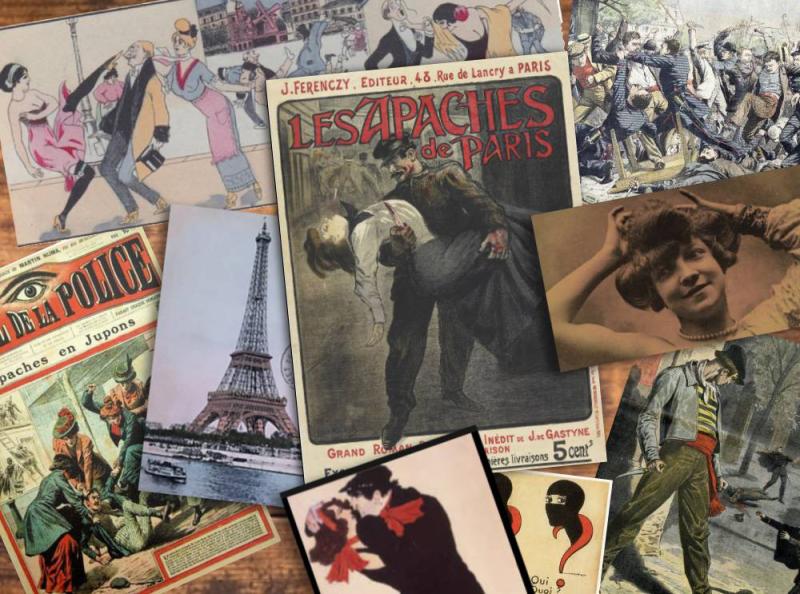
At the turn of the 20th century, the exploits and styles of Parisian Apache (pronounced Ah-pahsh) street gangsters fascinated the international bourgeoisie. Readers breathlessly followed the criminal exploits of “the Terror”, “Golden Helmet” and other infamous Apaches via tabloid newspapers; nightclubbers thrilled to the danse d’Apache, which acrobatically mimicked a violent encounter between an Apache pimp and a prostitute; slumming society ladies took classes in la langue verte (“the green language”), the secret slang of Montmartre brothels and back-alleys. Apache fashions, weapons and even their ingenious pickpocketing and mugging tricks became the subjects of high society discourse, and their lore was quickly absorbed into popular culture via pulp novels, Grand Guignol plays and silent film serials. The era’s local newspapers often described the violence perpetrated by these gangs as synonymous with the ferocity of Apache Indians in battle.
This lavishly illustrated presentation explores the extraordinary demimonde mystique of the Apache subculture during la Belle Époque
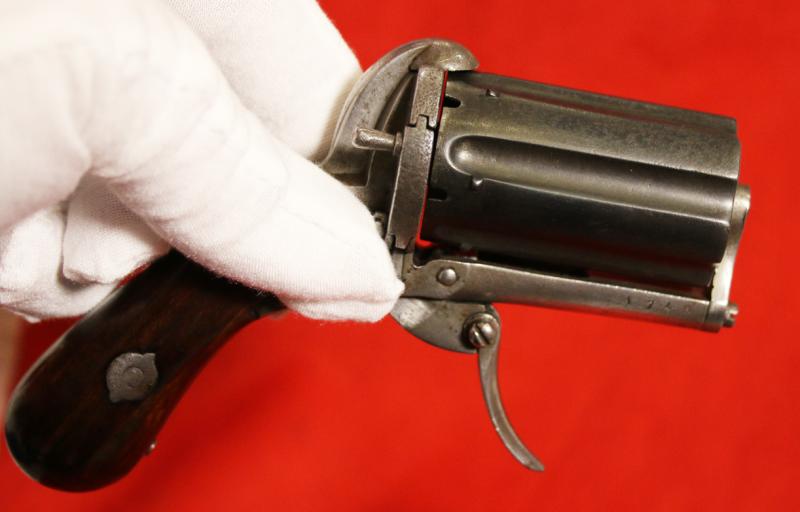
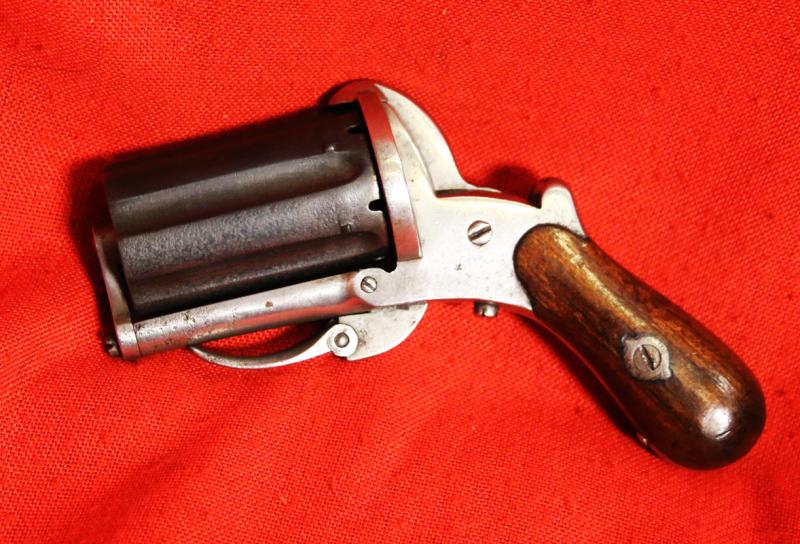
The revolver remains in fine condition.The gun includes the typical folding trigger to operate the double action only mechanism and loading gate at the left rear of the frame. Unlike some “Apache” this example does not incorporate any additional weapons into the design. Instead, it uses a conventional bag shaped grip with two-piece walnut grips. The gun is unmarked other than the assembly number 524 on the face of the barrel. As no Liège proof mark is present on the gun, it is likely a French-made example. The revolver measures a compact and concealable 4 3/4” inches overall length and is only 3 ¼” tall.
As noted, the gun remains in nice blued and steel condition, with most of the blue remaining on the barrel cluster. The blue does show some thinning and fading from age and pocket carry but remains good. The numbered markings remain clear and crisp as well. The design of the mechanism allows for the cylinder to rotate for loading and unloading without necessitating any additional manipulation of the action, placing the hammer on half cock or anything else. This simplifies the double action mechanism as traditionally a double action only system does not incorporate a half cock notch. The action design is similar to those produced under Joseph Chaineaux’s patent. The action of the revolver operates correctly and the revolver times, indexes and locks up as it should when the trigger is pulled. The loading gate operates correctly as well. The two-piece walnut grips are in good condition as well. The wood is solid, complete, and free of any breaks, cracks, or repairs. The grips showing only some light wear and minor handling marks and light dings.this would make a fine addition a collection of pepperboxes, derringers, and other concealment handguns.
With folding trigger to enable it to fit in a waistcoat or small pocket. Once each barrel is fired, the trigger requires to be pushed forward to engage fire the next cartridge, it was a finger movement that took barely a second.
Antique Firearm Exemption. Under Section 58(2) of the Firearms Act 1968, genuine pre-1939 pinfire revolvers are generally exempt from licensing if kept strictly as a "curiosity or ornament", as pinfire cartridges are on the UK's obsolete calibre list.
Code: 26442
690.00 GBP