
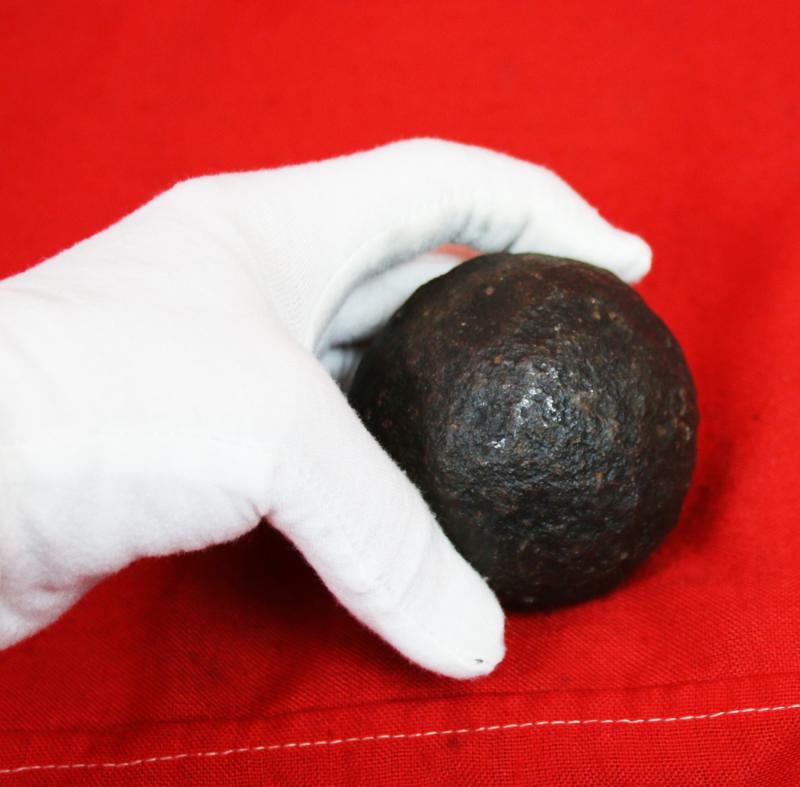
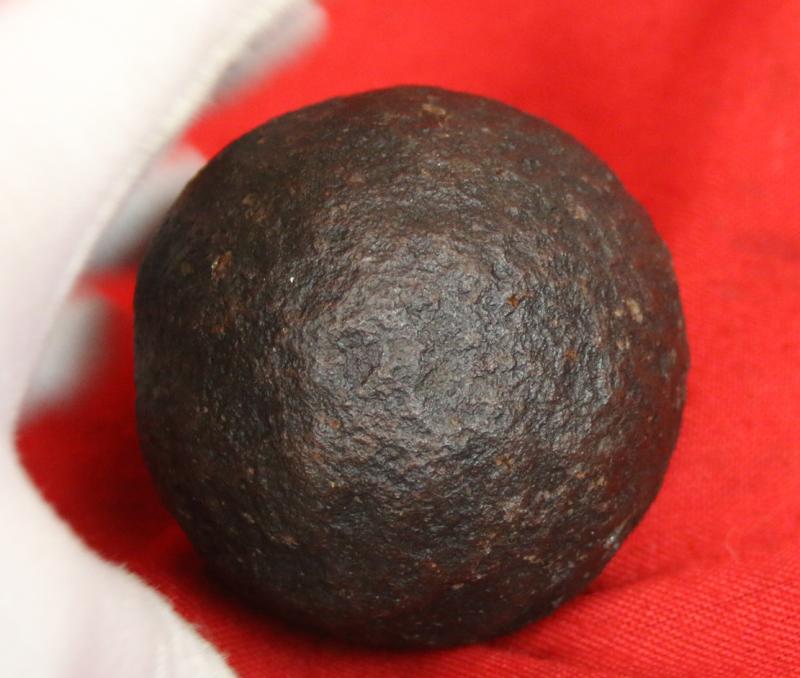
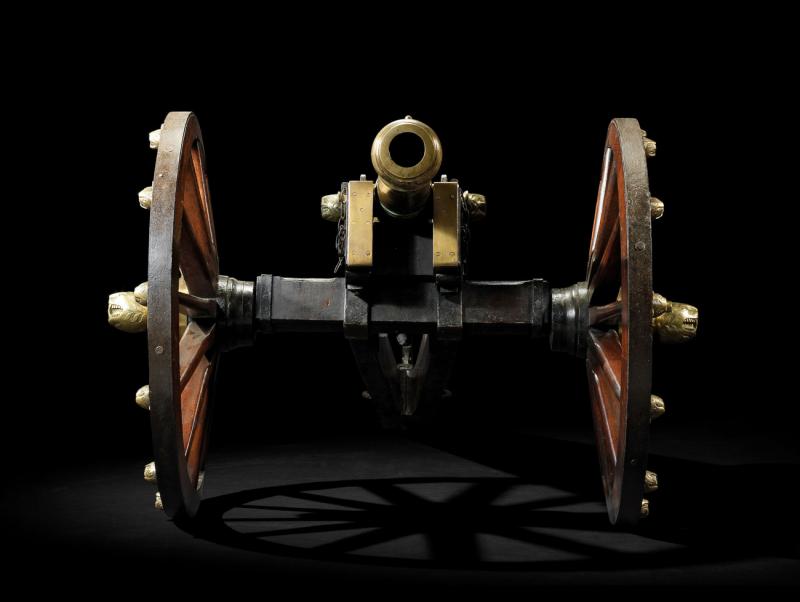
Battle Of Waterloo Recovered Near The Crossroads of La Haye Sainte, 3 Pounder Cannon Ball Used By The Kings German Legion at Waterloo Commanded by Cpt Andrew {Andreas} Cleeves. And Kept By Him after The Battle
The 3-pounder cannon were cast for the KGL at the Royal Woolwich Brass Foundry, by I.H. King. Master General of the Ordnance, 1806-1807. Mounted on a field carriage for battle, together with a limber and other accoutrement
The Royal Armouries at the Tower of London, holds two 3 pounder guns see H.L. Blackmore’s book “The Armouries of the Tower of London” page 84. Original documents from 1807 located at The National Archives, London, and, listed in the Order Book from The Board of Ordnance to the Royal Woolwich Brass Foundry, that show that the cannon were commissioned, {and they were subsequently present at the Battle of Waterloo} as per entry 11th June 1807, for the King’s German Legion – Hanoverian Regiment –
They were using their 3- pounders at the Battle of Waterloo, under Capt Andreas {Andrew} Cleeves} KGL, but prior to that, in 1809, with Capt Cleeves KGL in the Peninsular.
We also have his {Captain Andreas Clevees'} sword. For sale seperately.
The King’s German Legion (KGL) Artillery was a highly elite, veteran contingent within Wellington’s army at Waterloo. They were organized into two horse artillery troops and one foot artillery battery, fielding a total of about 543 men, and primarily utilized standard British 9-pounder cannons and 5.5-inch howitzers.The KGL Artillery units played pivotal roles in holding the center and right flank of the Allied line:1st Horse Artillery (Captain Augustus Sympher): Stationed near the critical crossroads of La Haye Sainte, this battery engaged in heavy counter-battery fire and helped repel aggressive French cavalry charges.2nd Horse Artillery (Captain Heinrich Jakob Kuhlmann): Placed with the Allied reserve, this unit moved into the frontline as casualties mounted, delivering devastating canister fire to break French infantry columns.2nd Foot Artillery (Captain Andreas Cleeves): Supported the right of the Allied line near Hougoumont, maintaining continuous artillery fire against French artillery and infantry throughout the day.The KGL artillerymen served with incredible distinction; their exceptional resilience resulted in approximately 130 casualties. For their bravery during the battle, Majors Kuhlmann, Sympher, and von Arentsschildt were knighted into the Order of the Bath.
The 4th Foot Battery saw action at Copenhagen and throughout the Peninsular War distinguishing themselves at Oporto, Talavera, Busaco, Albuera, Ciudad Rodrigo, Salamanca, Vittoria and Orthes. Then, final glorious action occurring at Quatre Bras and culminating in the battle of Waterloo, holding position behind La Haye Sainte in the centre-right of the Allied line on Mont St. Jean ridge. The regiment was commanded by Colonel Christian von Ompteda. Second-in-command was initially Major von Linsingen who was later succeeded by Majors Röttiger then Hartmann. The 4th foot battery was commanded initially by Captain Heise, then Sympher and finally Cleeve at the battle of Waterloo.
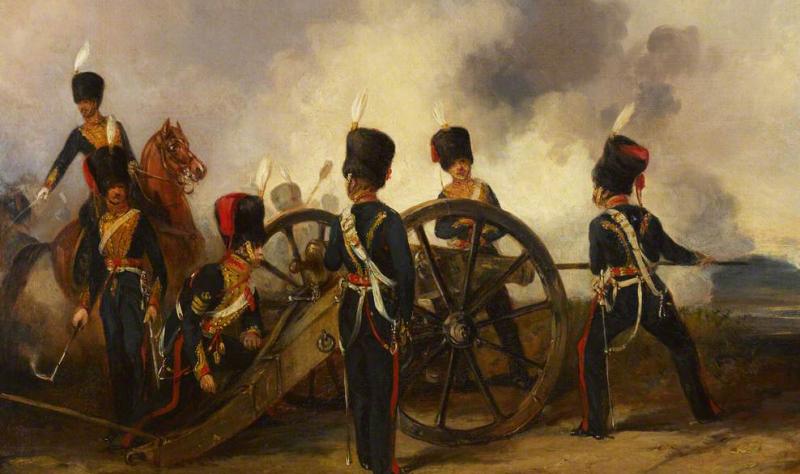
Normal more usual ordinance for this battery in the latter stages of the war were six nine-pounder guns and two 5.5-inch Howitzers. The 3 pounders were light artillery bronze cannon, known affectionately as British "Grasshopper" Guns: Famously used by the British Army as light field guns, these highly mobile 3-pounders were designed to be dragged by infantry or horses through rough terrain. Their lightweight split-trail mounts and propensity to jump backward upon firing earned them the nickname "grasshopper"
Code: 26279