
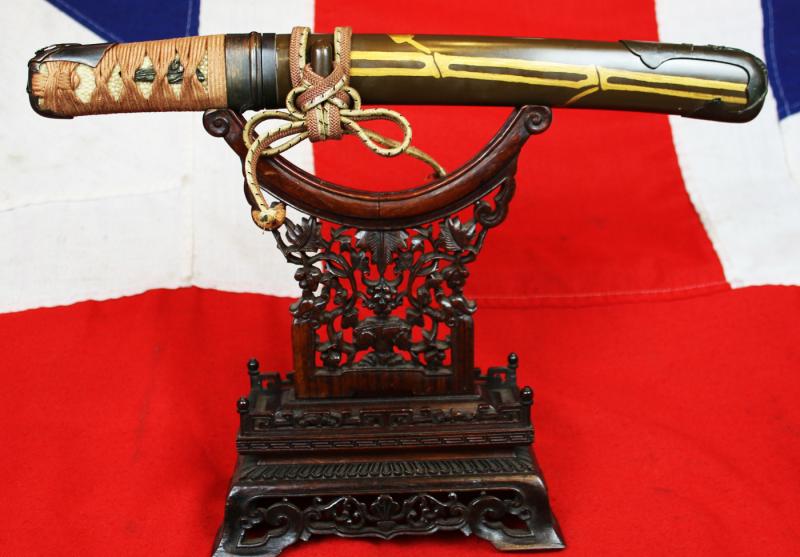
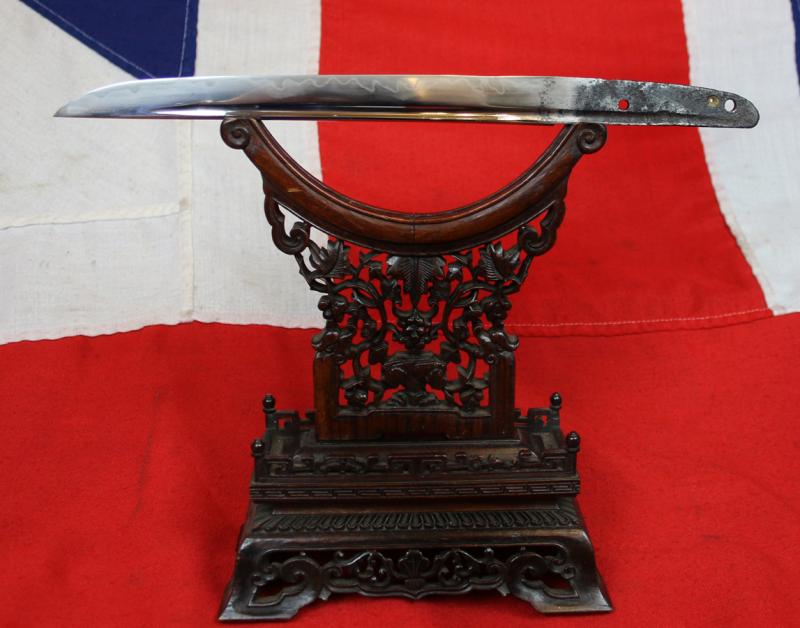
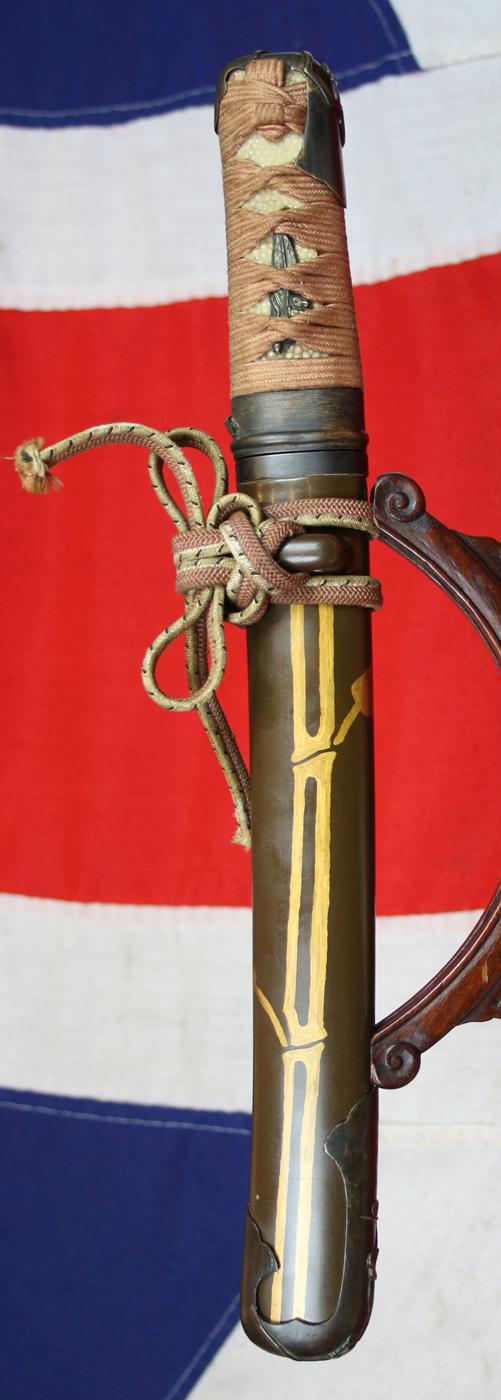
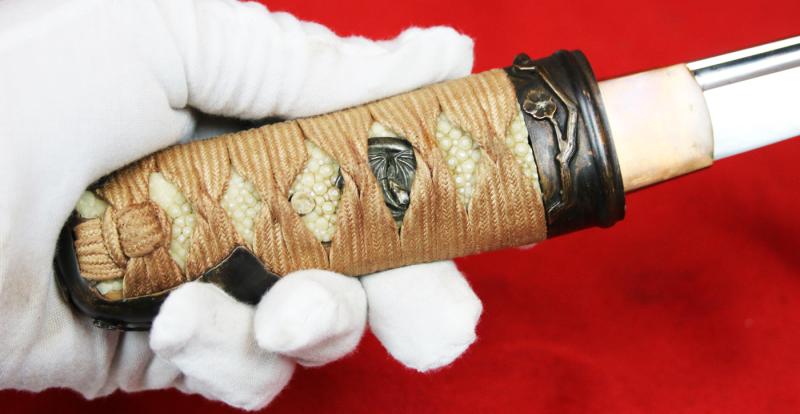
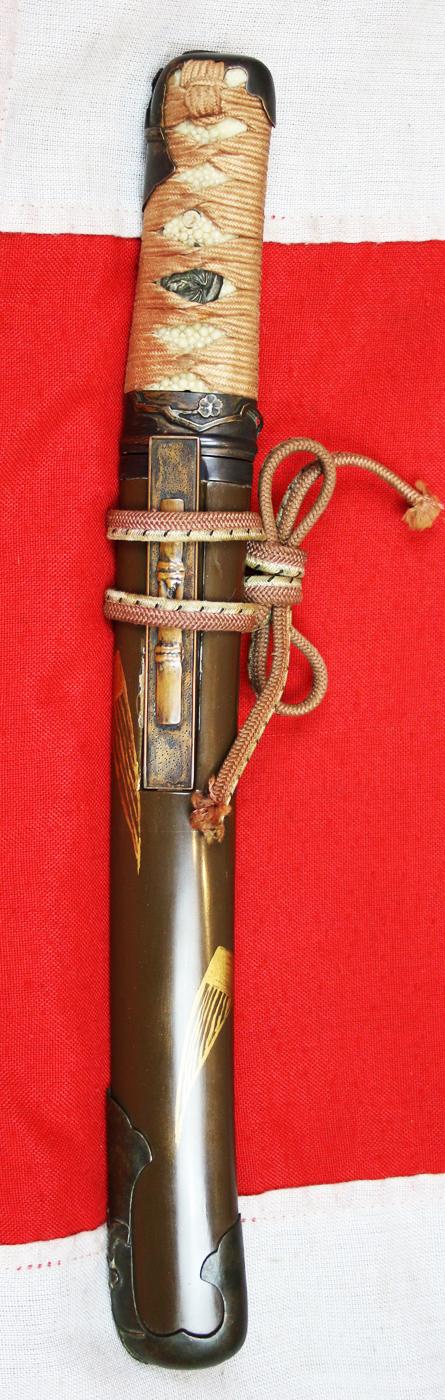
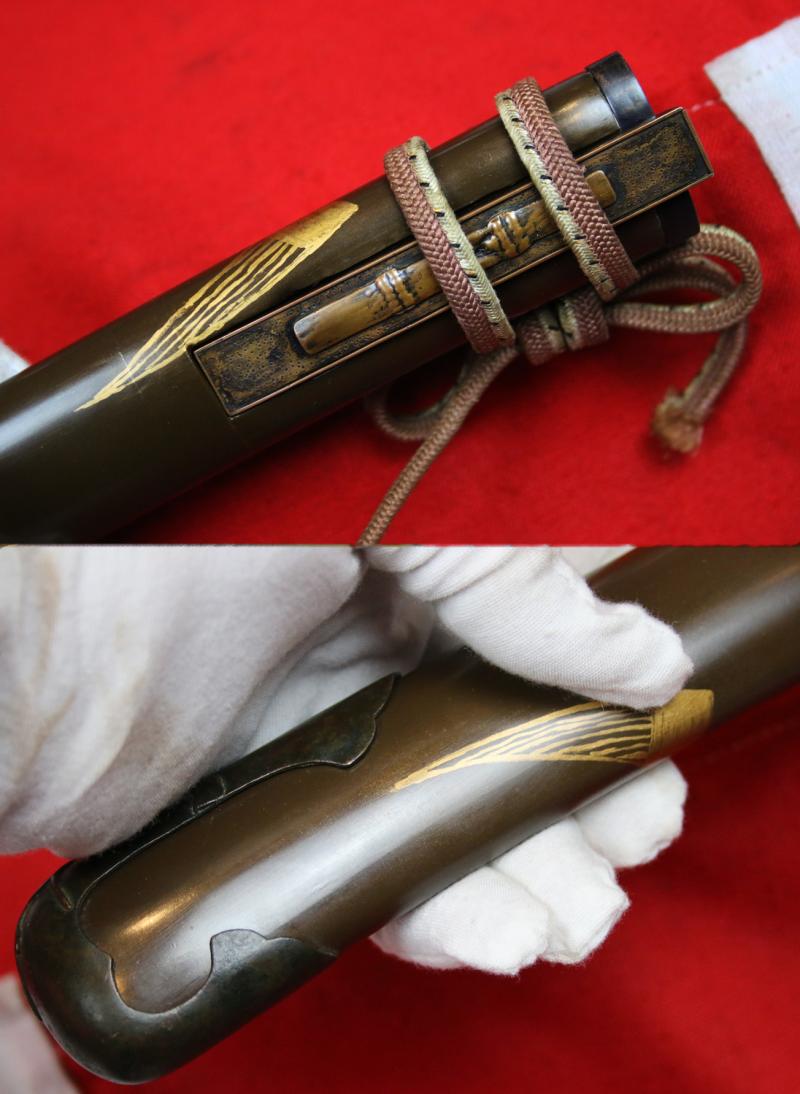
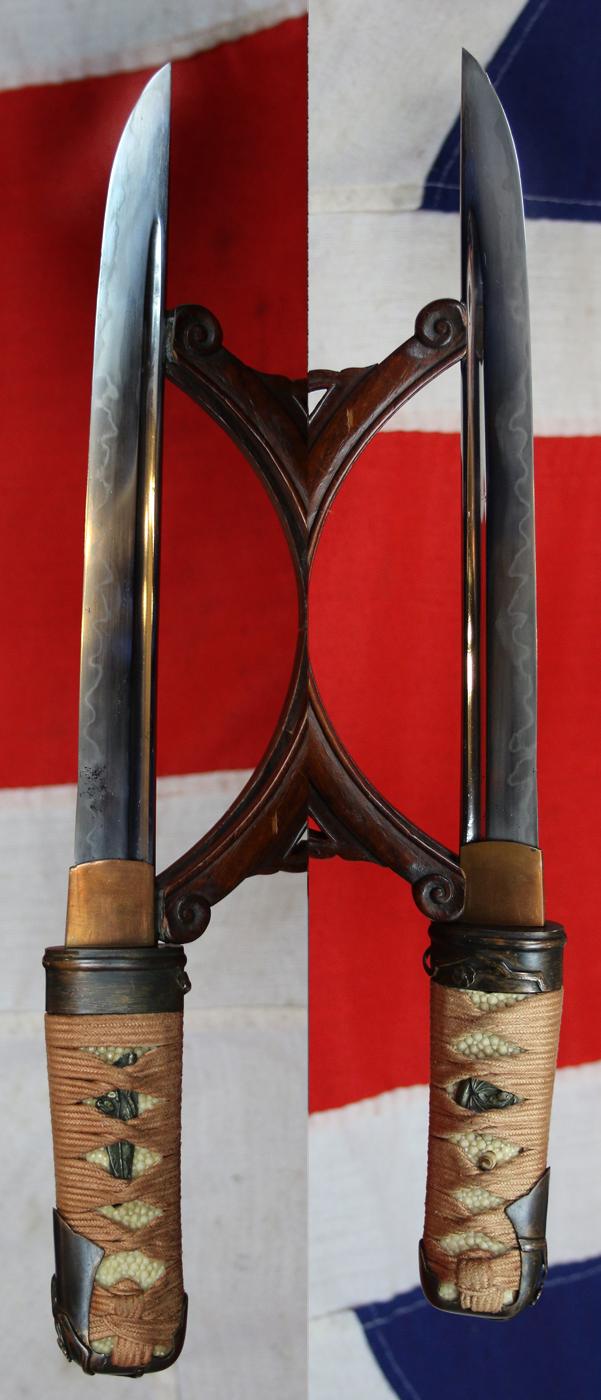
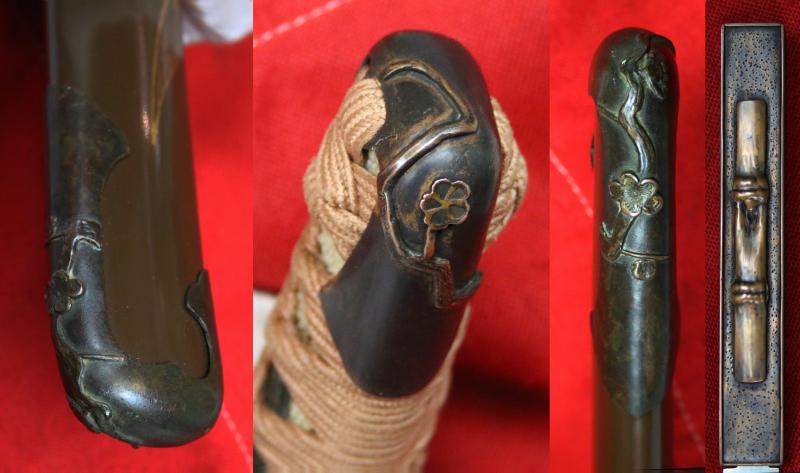
A Beautiful & Most Charming Aikuchi Tanto. Japanese Civil Wars Period Early, Koto Blade, Circa Late 14th Century, Delightful Takebori Matched Koshirae On The Theme of Japanese Plum {Ume} Blossom & Bamboo {Sho-Chiku-Bai}
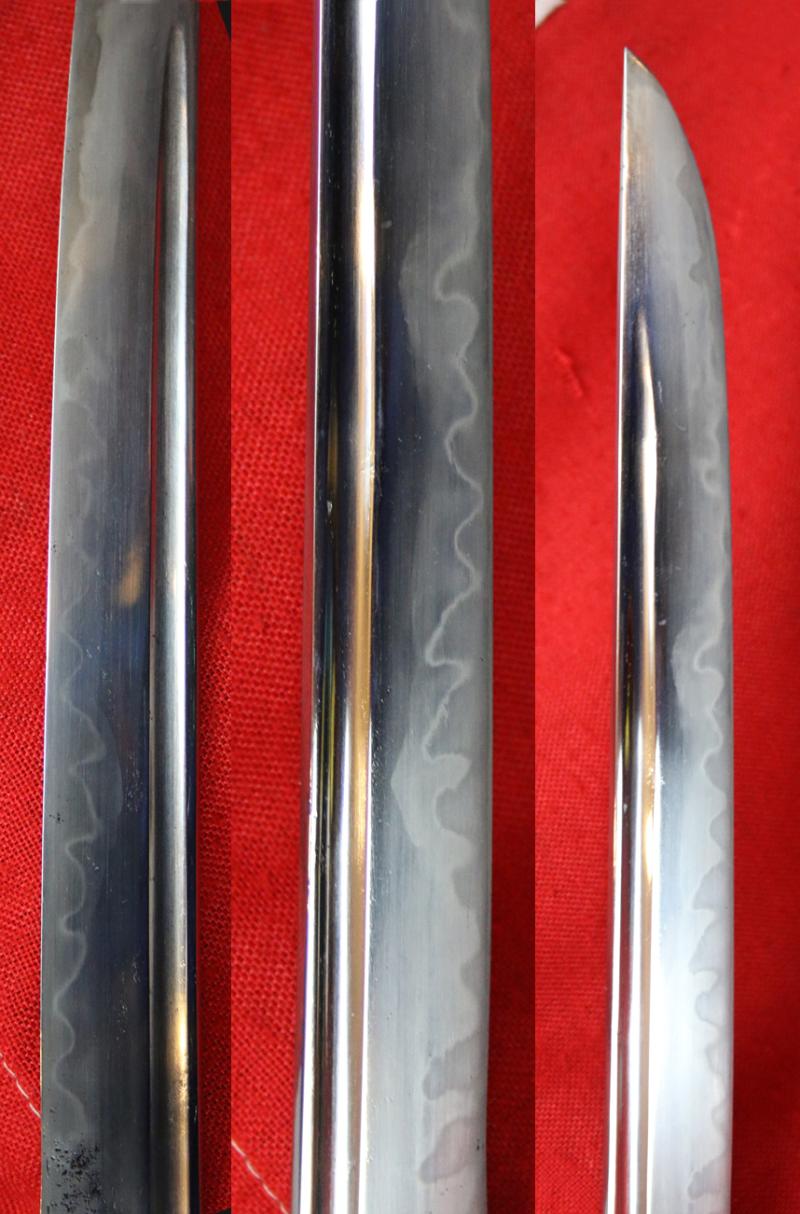
The blade is in beautiful polish, six hundred plus years old, in delightful condition, with an uneven sanbonsugi hamon. Dark gold lacquer saya with light gold bamboo decor, mounted in patinated sinchu suite of mounts with applied takebori design of ume and blossom, a kozuka of a bamboo stem, and wraparound sayajiri and fuchi. the menuki are of coiled vine and leaves, and bamboo leaves, beneath ivory coloured tsuka-ito, over samegawa giant rayskin.
All the suite of later koshirae are wonderful quality, and the entire piece is thoroughly delightful, and with elegance that compliment its most ancient blade, from the Kamakura era.
Japanese Civil Wars of 1331–1392, In 1331, fighting broke out between the forces of Emperor Go-Daigo and those of the Kamakura shogunate. The shogunate sent Hōjō general Ashikaga Takauji to fight the emperor’s army. However, Ashikaga, seeing more potential power for himself as an ally of the emperor than as an ally of the shogun, switched sides and fought against the shogun. Many generals and samurai followed Ashikaga, and the Kamakura shogunate fell.
Go-Daigo regained power, but the Kemmu Restoration lasted only from 1334 to 1338. In 1336, Ashikaga named himself shogun, and in 1337, he revolted against Emperor Go-Daigo. That year, the emperor fled Kyoto and took his court to Yoshino, where he established a southern court. When leaving Kyoto, Go-Daigo took with him the traditional symbols of the Japanese imperial line, including the sword, the jewel, and the mirror. In 1338, Ashikaga located his government in Muromachi in Kyoto and placed a second emperor on the throne in Kyoto. Japan’s imperial powers were split between the northern emperor in Kyoto and the southern emperor in Yoshino.
For more than fifty years, the northern Japanese and southern Japanese empires waged war. The northern emperors hoped to regain the traditional symbols of the Japanese imperial line and, thus, establish themselves as the legitimate imperial house. Although the northern armies were generally stronger, the southern armies were able to invade Kyoto and destroy it regularly.
While the southern and northern emperors battled, the leading families of Japan were also engaged in fighting. Although the various sections of Japan had been relatively independent under the Hōjō, the Ashikaga shogunate centralized power in Japan and created a federation of states. Each state was ruled by a daimyo, who functioned as a military governor. The daimyo, who owned huge estates and were the patriarchs of Japan’s leading families, retained samurai, or hired warriors, for the constant battles with each other for land, power, and the possibility of controlling the shogunate.
In 1392, through the diplomacy of Ashikaga Yoshimitsu, the southern empire yielded to the northern empire, and Japan was reunited under the northern emperor Go-Kamatsu and his court.
However, the most important outcome of the Japanese Civil Wars of the fourteenth century was the determination that the Japanese imperial family would descend from the northern emperors, not the southern ones.
In Japanese art, bamboo designs symbolize strength, resilience, and purity. Because bamboo bends in fierce winds without breaking and stays green all year, it represents endurance and prosperity. Its hollow stalk also signifies humility and an open, clear mind.
Sho-chiku-bai {Bamboo} is frequently paired with pine (matsu) and plum (ume) to form the "Three Friends of Winter". This classic trio represents steadfastness, as all three thrive during the coldest months.
Bamboo is also one of the Four Noble Plants (alongside orchid, plum, and chrysanthemum) representing the four seasons and the moral qualities of a virtuous scholar.
It features heavily in kadomatsu (traditional bamboo and pine New Year decorations) placed by doorways to ward off evil and welcome good fortune.
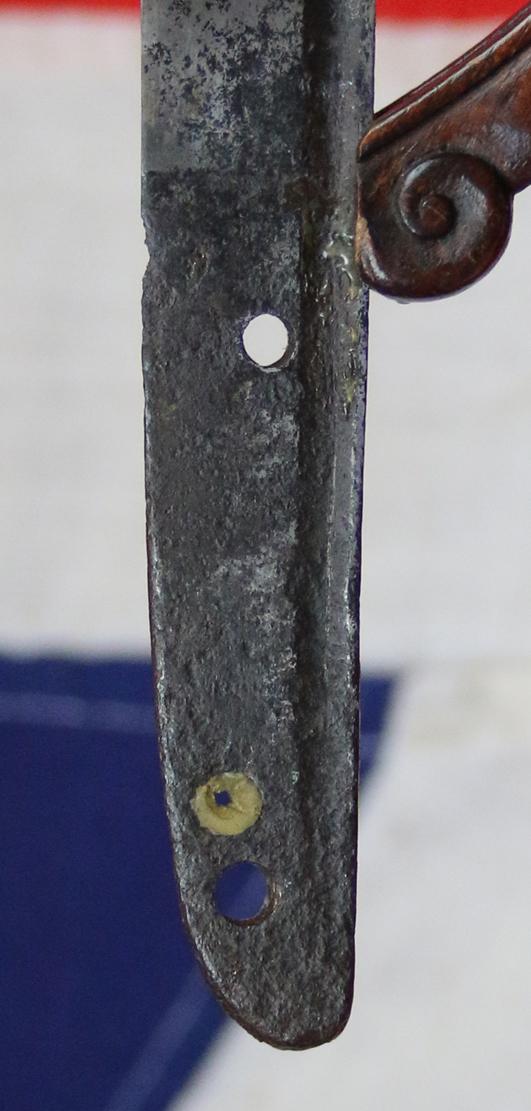
The stunning koshirae are later Edo or Taisho, in super condition, and the beautiful ancient blade is in very nice order, with just a very small thumbprint mark near the habaki on one side, and slight wear at the kissaki.
Code: 26241