
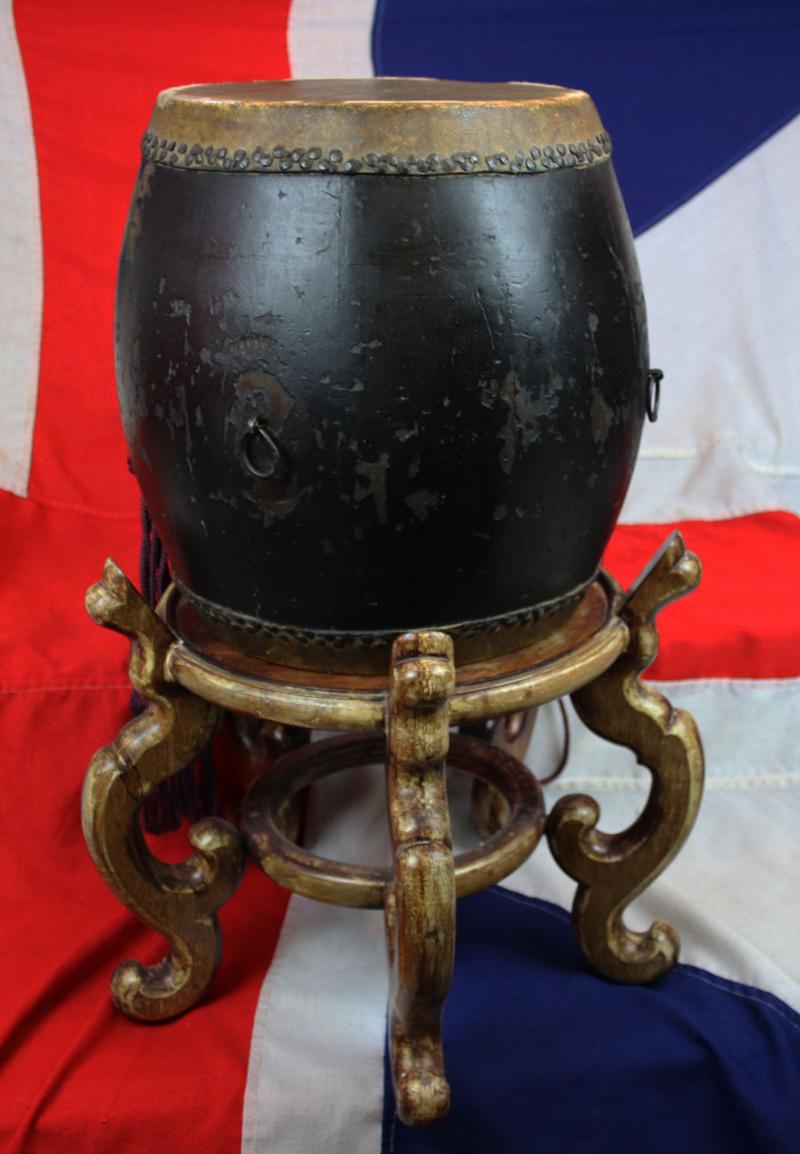
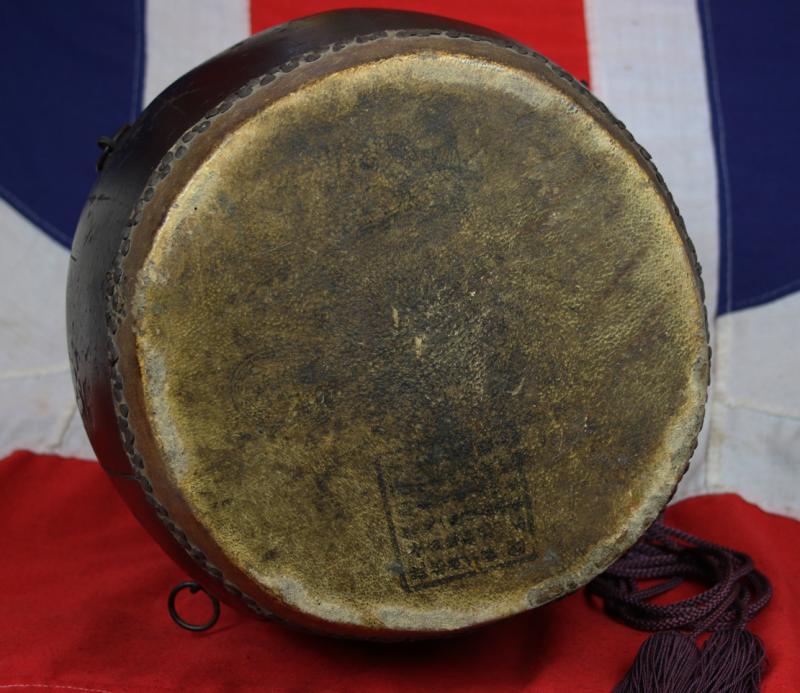
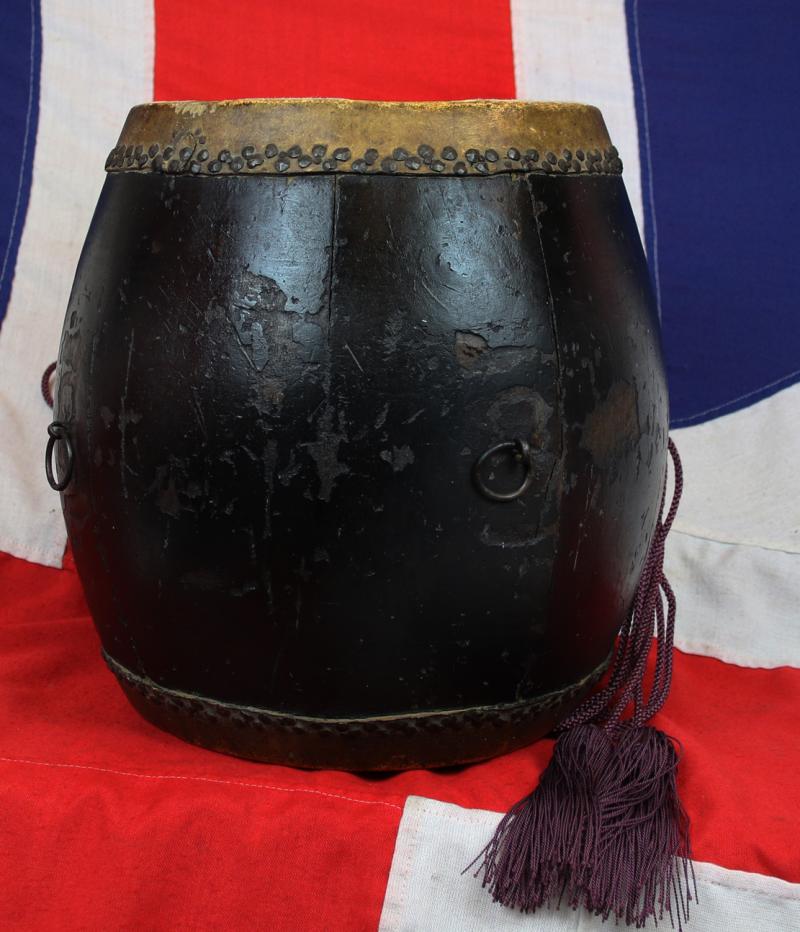
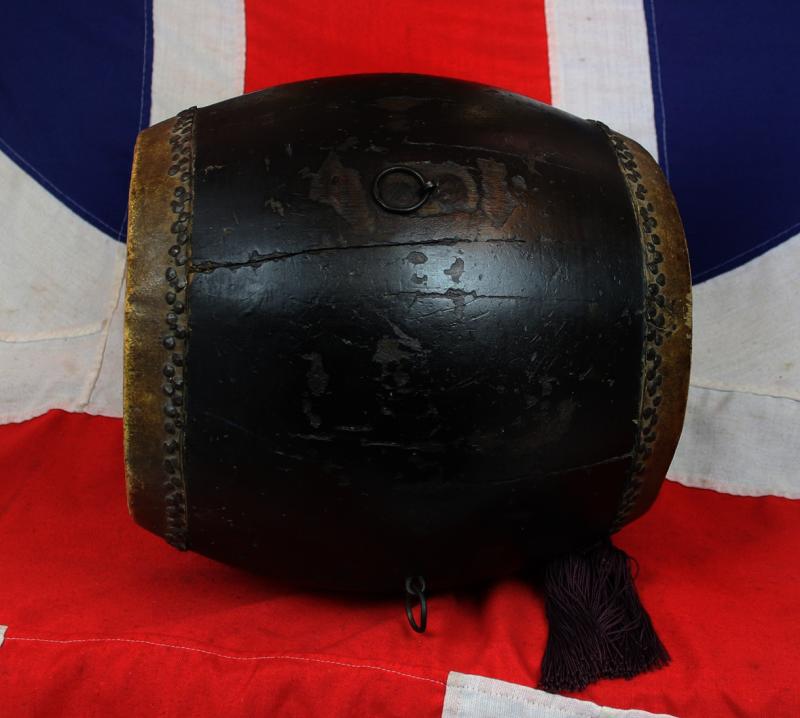
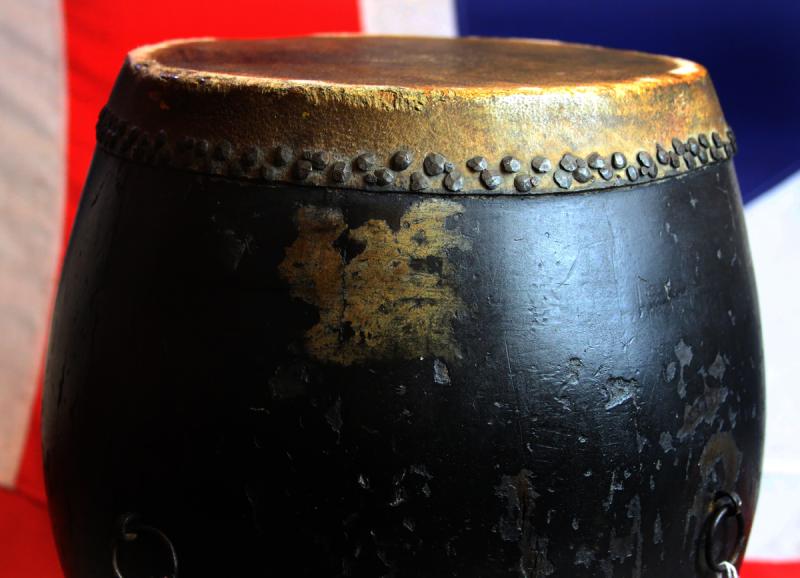

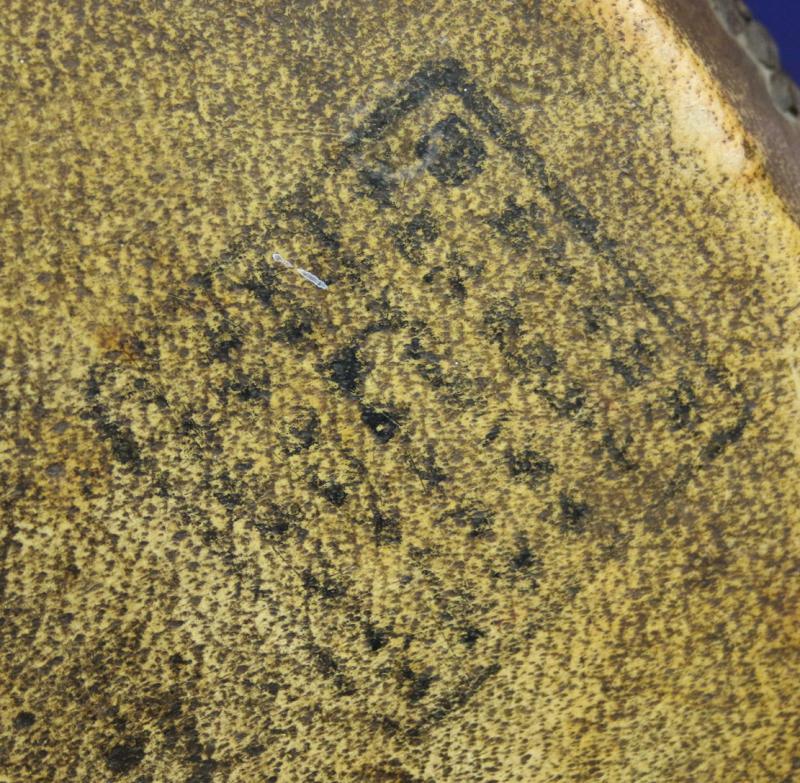
An Original, Edo Period, Antique Samurai Taiko War Drum, { Nagado-Daiko} For The Playing Of Samurai Taiko Battle Music. Wooden Barrel With Two Hides One Stamped with Square Kanji Seal. Set Upon Its 5 Legged Stand
A superb Taiko samurai war drum, Edo period, on carved wooden stand. The skin bears a square wood block kanji stamp but it is too old to read any longer.
The body it lacquered black with two fine skins attached with rows of handmade nails. Iron rings upon the body for carrying cords. This example is most unusual, as, within the body of the drum, is a bell type instrument, likely as a symbolic accompanying sound, for the drum beat, of some kind
From the Sensei Roald Knutsen Collection.
Samurai used taiko drums as vital communication and psychological warfare tools on the battlefield. Ranging from the 6th century up through the 16th-century Sengoku (Warring States) period, the thundering rhythms allowed warlords to coordinate troop movements, set marching paces, and boost soldier morale over the chaos of war.
Because visual signals were easily obscured by dust, smoke, and distance, taiko drums served as an auditory command system. Specific rhythmic patterns acted as distinct orders. For instance, according to the historical text Gunji Yoshū, nine sets of five beats summoned allies, while nine sets of three beats signaled an advancing charge.
Drummers established a steady tempo to keep massive formations of ashigaru (foot soldiers) and samurai marching in sync, typically setting the pace to six steps per beat.
The deep resonance of taiko drums, often vibrating at frequencies that mimic rolling thunder, was used to instill fear in opposing armies and disorient enemy formations.
The drumming unified the troops, reminding them of their shared purpose and boosting their courage before a clash. The Japanese verb for encouraging someone—kobu suru (鼓舞する)—literally translates to "beat a drum and dance".
During the 16th century, the prominent warlord Takeda Shingen famously utilized a specialized 21-drummer troop called Osuwa Daiko to coordinate his armies and intimidate enemies.
Warlords like Oda Nobunaga utilized massive taiko drums to strike fear into enemies and coordinate complicated maneuvers during decisive battles, such as the Battle of Nagashino in 1575.Gojinjo Daiko: In 1577, during the Noto Peninsula conflict, the villagers of Nafune successfully utilized unique taiko drumming to terrify the invading Uesugi Kenshin army, ultimately forcing a retreat.
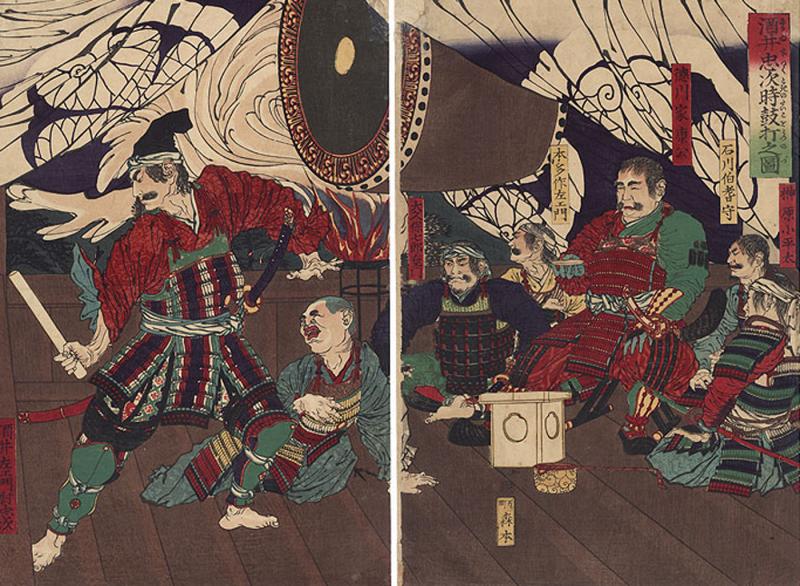
One picture in the gallery of a view of Sakai Tadatsugu Striking the Clock Drum, 1874 - Terrific scene of Sakai Tadatsugu beating a drum during the Battle of Mikatagahara between the forces of Tokugawa Ieyasu and his ally, Oda Nobunaga, and Takeda Shingen. The defeated Ieyasu managed to retreat to Hamamatsu Castle, but cleverly ordered the gates left wide open and bonfires lit, while Sakai beat the drum loudly. Takeda's pursuing troops were confused, and thinking there must be some trick, did not attack the unattended castle, but camped outside and left the next day. Sakai strikes a bold pose in the center, gripping a drumstick, as the weary general sits on a folding stool at right holding a shallow cup of sake. Flame and smoke rise from a fire on a small stand in the drum tower, while a huge bonfire lights up the dark night sky at upper left. Warriors returning from the battlefield gather below, one flying a red banner with the Oda Clan crest on it. A dramatic composition with wonderfully detailed figures.
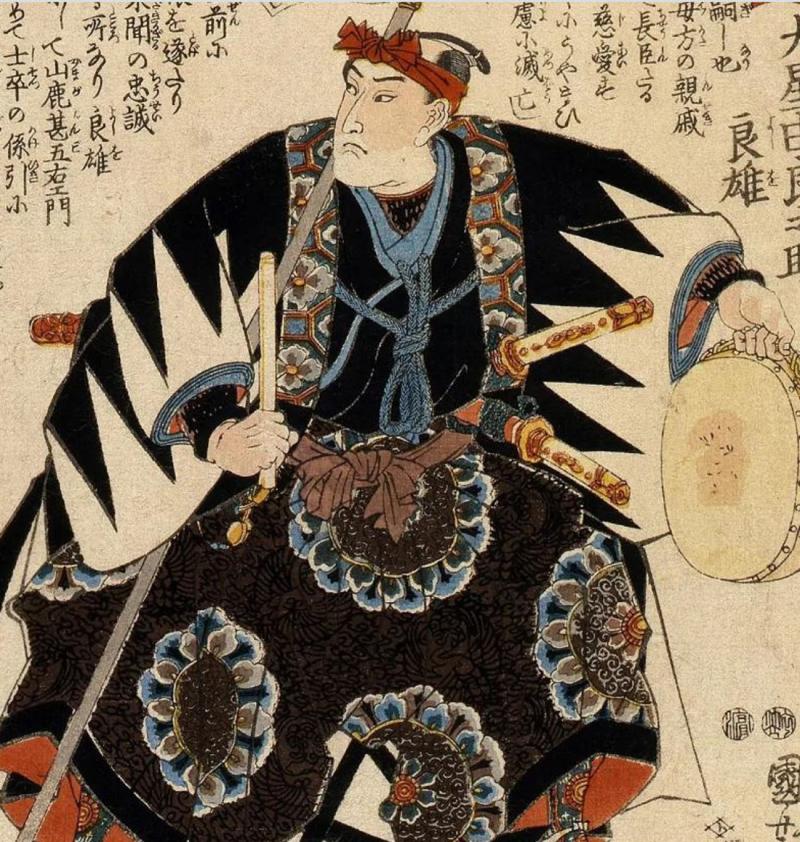
Another picture of 47 loyal samurai. Obosi, Kuranosuke Yoshio, sitting on a folding chair, holding the drum stick and the supporting shoulder spear
It was formerly part of the collection of sensei Roald Knutsen, likely the worlds foremost expert and author on samurai polarms and their use in combat, with various pieces acquired with, or from, Henry Russell Robinson's private collection. (7 May 1920, Hackney, London - 15 January 1978) He became Keeper of Armour at The Tower Of London The Japanese armour exhibition in 1965, which featured samurai artefacts arranged to demonstrate evolving defensive technologies and cultural contexts, drawing thousands of visitors to the Tower.
He was a British military armourer and historian.He served in the RAF during the Second World War making models interpreting aerial photographs. This was when he met Sir James Mann, Master of the Armouries at the Tower of London. Robinson joined the staff of the Tower Armouries in 1946 as a Temporary Assistant, before rising to Assistant Keeper and finally, in 1970, Keeper of Armour.
Robinson was a founder member and president of the Arms and Armour Society. In 1965, he was elected a Fellow of the Society of Antiquaries of London. In 1977, he was awarded an honorary MA by the University of Newcastle upon Tyne.
Between 1967 and 1969, he (a practical armourer) worked with Charles Daniels to interpret and reconstruct the Roman armour nowadays known as 'lorica segmentata'. He produced a series of reconstructions of the two sub-types of armour from the Roman site at Corbridge and one from Newstead in time for them to be exhibited at the 1969 Congress of Roman Frontier Studies held in Cardiff.
His work on the armour featured in one of his best-known books, The Armour of Imperial Rome. Published in 1975 by Lionel Leventhal at the Arms and Armour Press, it included line illustrations by his friend, Peter Connolly. Robinson's system of categorizing Roman helmets has been widely adopted in the UK and USA but never really found favour in Europe.
Robinson was not only known for Roman armour, since he worked on an exhibition of Japanese armour at the Tower Armouries and subsequently wrote two books on the subject. He was also an authority on Native American artefacts and was responsible for the production of the replica of the revised reconstruction of the Sutton Hoo helmet and wrote a guide to the Stibbert Museum.
The black body lacquer is worn throughout but the thick unbleached rawhide skins are excellent, and the body very sound indeed.
The drum is 13 inches high, on the stand its 24 inches high
Code: 26225
1395.00 GBP