
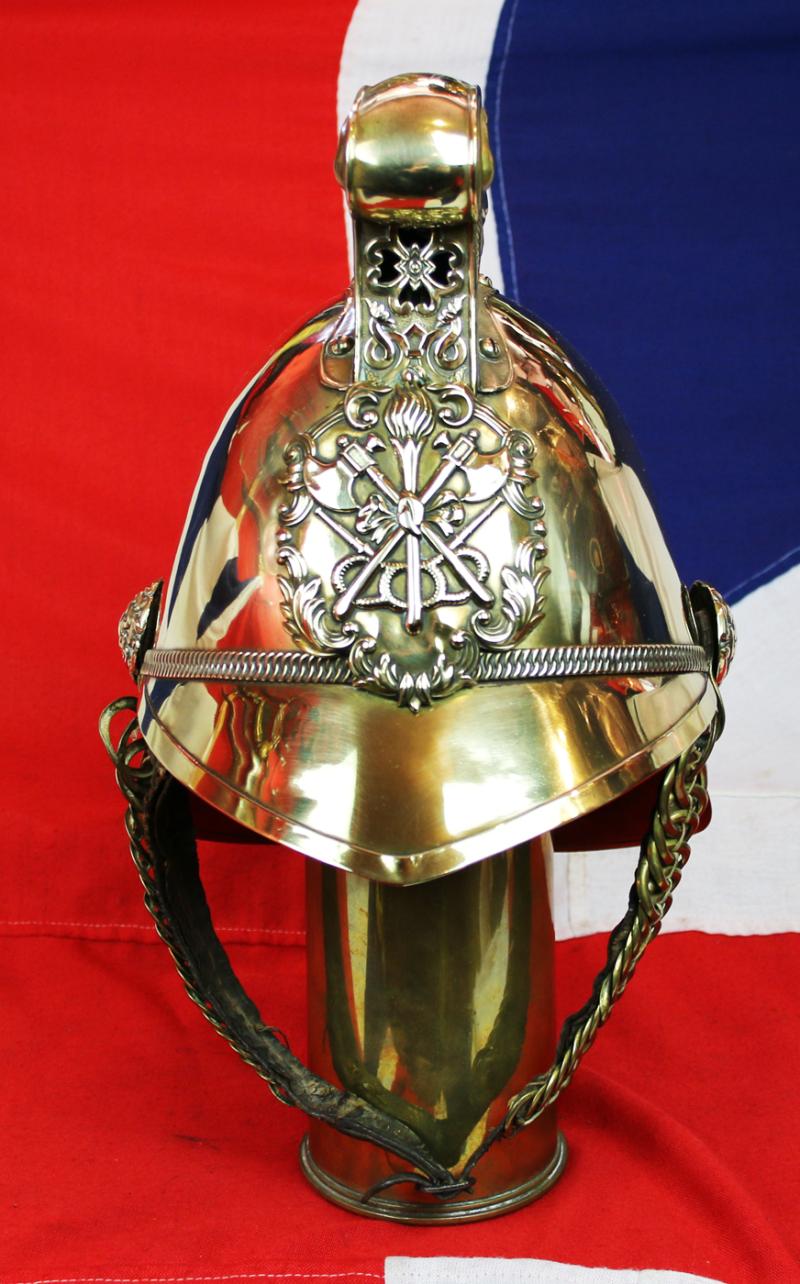
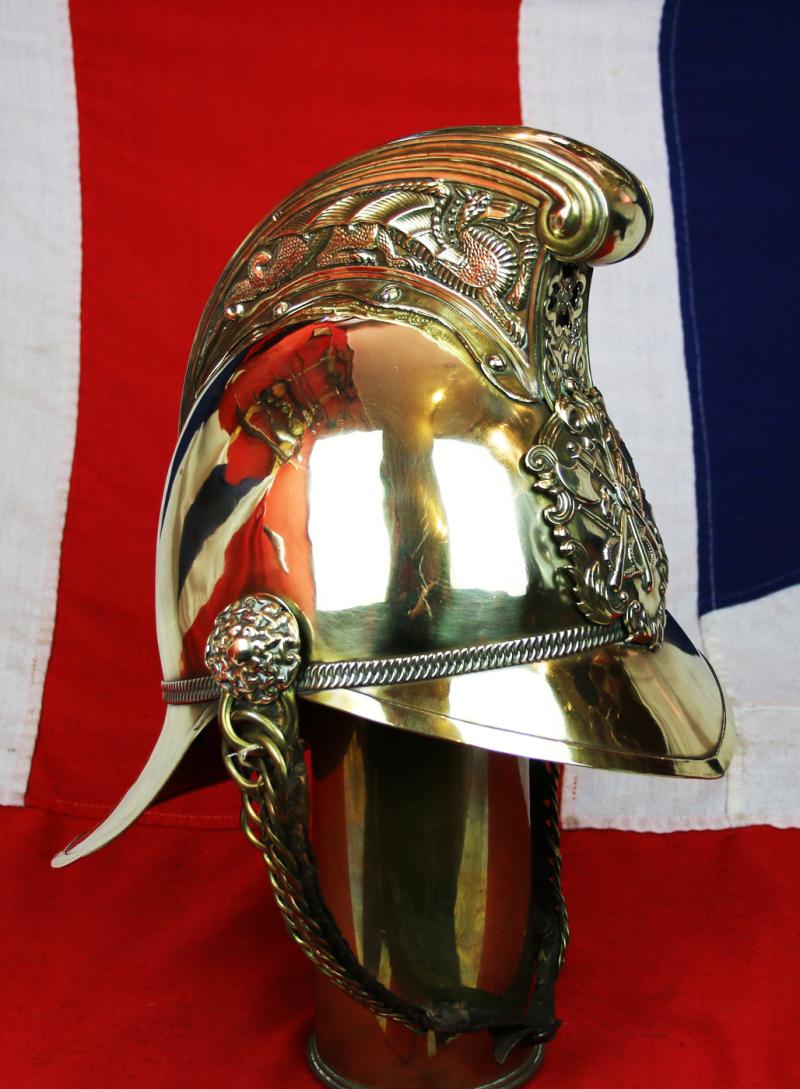
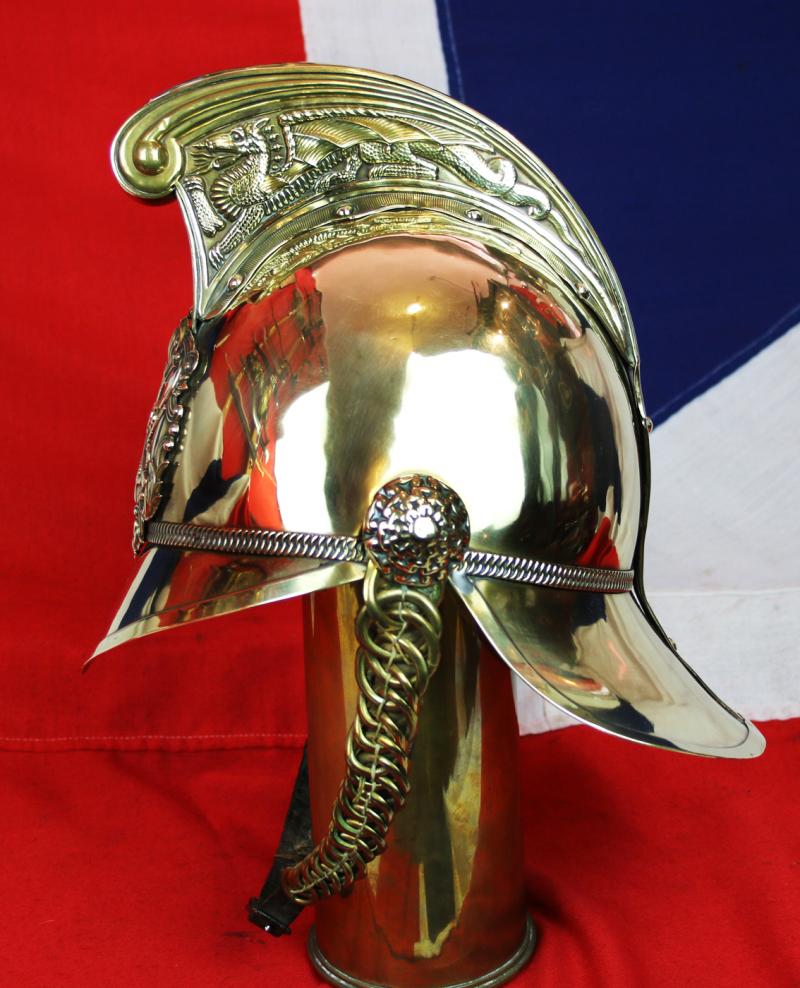
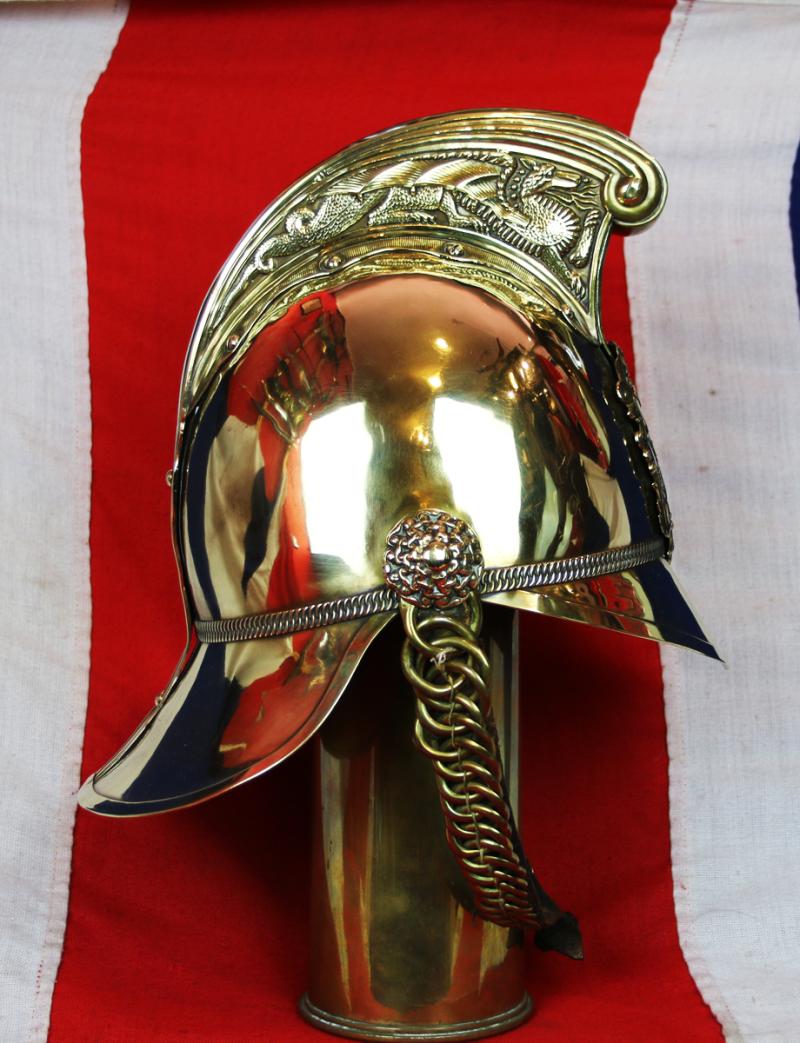
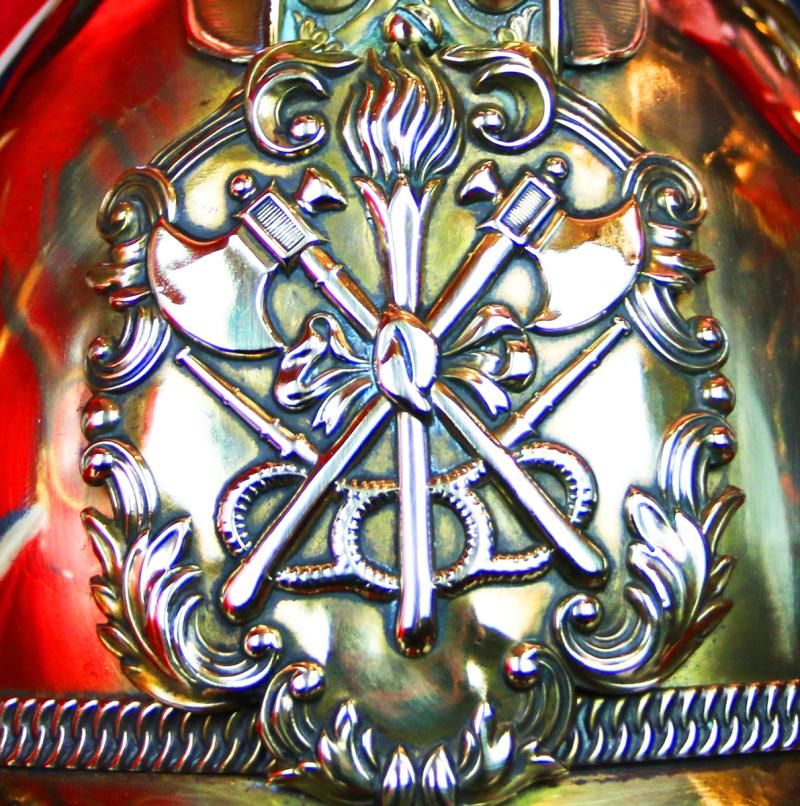
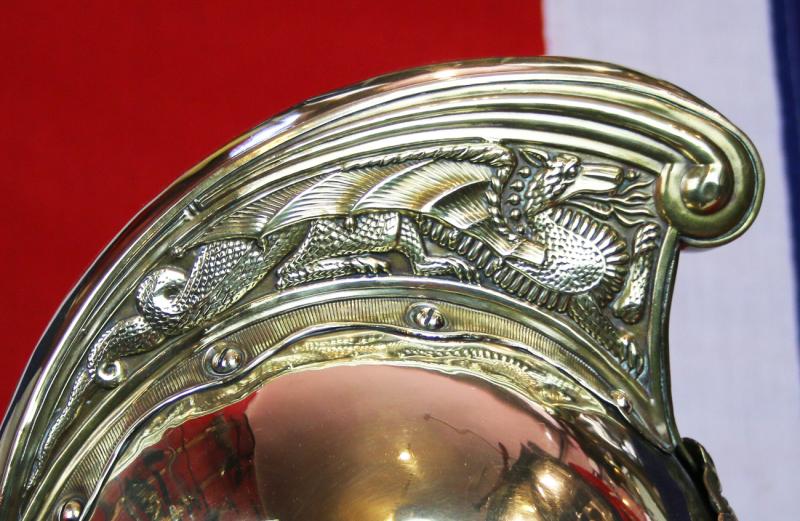
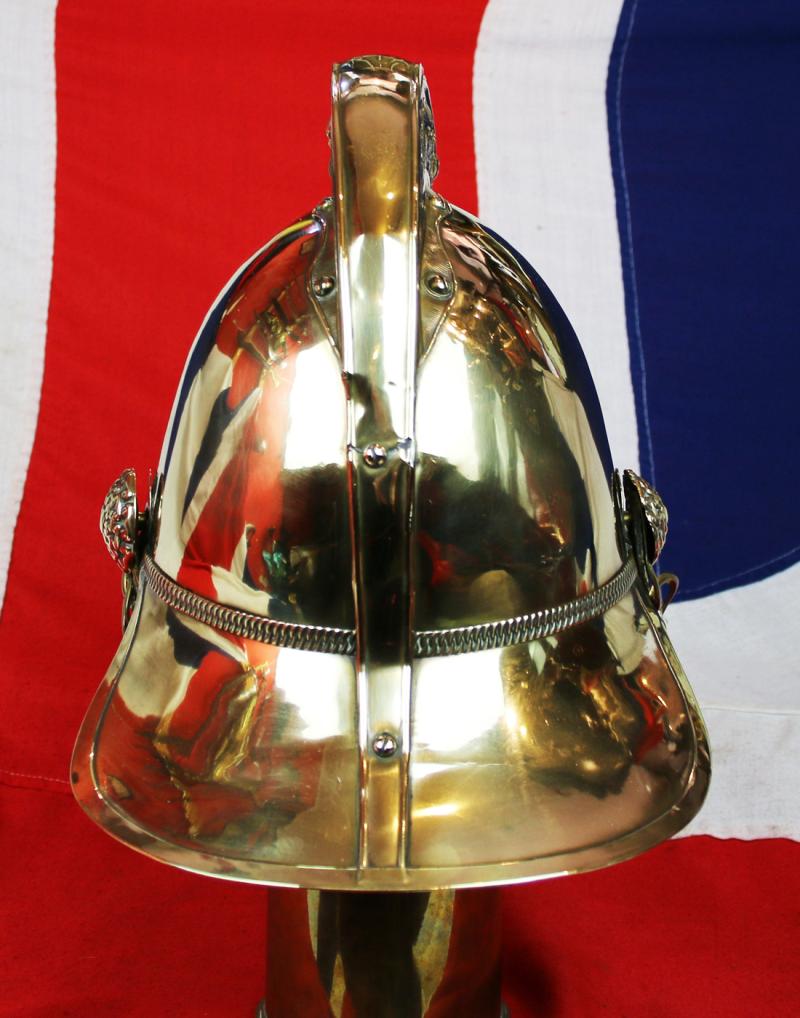
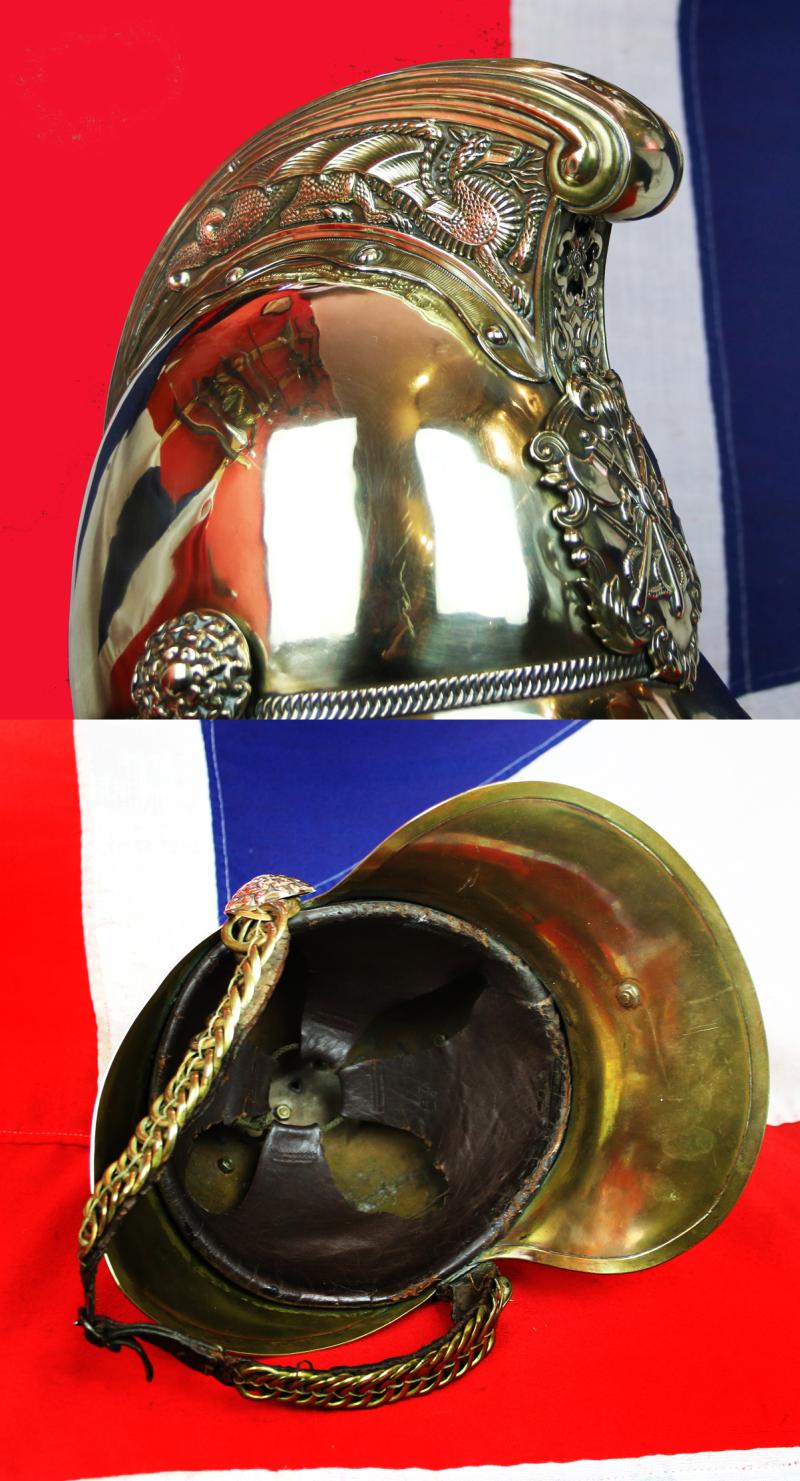
A Most Beautiful, Original, Victorian, Merryweather British Fire Service Helmet, In Brass With Gilt Dragon Comb & Chinscales In Fabulous Condition. Used When British Firefighters Were The Bravest In The Land.
An original British Victorian fire service helmet, with signs of service use, but certainly not abuse, it is part of its character, to demonstrate this is a piece that saw service but was used as it should, yet cared for, and beautifully preserved for posterity.
The traditional two-piece skull has the embossed raised dragon comb, rose bosses, crossed axe and hoses helmet plate, and complete original leather liner. Overall in every way in fine condition for age.
The desirable standard pattern of Fire Service helmet used by all British county and city Fire Services in the Victorian era and just past WW1.
The earliest fire brigade was Roman and that is the first fire brigade of which we have any substantial history was created by Marcus Licinius Crassus. Marcus Licinius Crassus was born into a wealthy Roman family around the year 115 BC, and acquired an enormous fortune through (in the words of Plutarch) "fire and rapine." One of his most lucrative schemes took advantage of the fact that Rome had no fire department. Crassus filled this void by creating his own brigade ‘500 men strong’ which rushed to burning buildings at the first cry of alarm. Upon arriving at the scene, however, the fire fighters did nothing while their employer bargained over the price of their services with the distressed property owner. If Crassus could not negotiate a satisfactory price, his men simply let the structure burn to the ground, after which he offered to purchase it for a fraction of its value. Emperor Nero took the basic idea from Crassus and then built on it to form the Vigiles in AD 60 to combat fires using bucket brigades and pumps, as well as poles, hooks and even ballistae to tear down buildings in advance of the flames. The Vigiles patrolled the streets of Rome to watch for fires and served as a police force. The later brigades consisted of hundreds of men, all ready for action. When there was a fire, the men would line up to the nearest water source and pass buckets hand in hand to the fire.
Rome suffered a number of serious fires, most notably the fire on 19 July AD 64 and eventually destroyed two thirds of Rome.
In the UK, the Great Fire of London in 1666 set in motion changes which laid the foundations for organised firefighting in the future. In the wake of the Great Fire, the City Council established the first fire insurance company, "The Fire Office", in 1667, which employed small teams of Thames watermen as firefighters and provided them with uniforms and arm badges showing the company to which they belonged.
However, the first organised municipal fire brigade in the world was established in Edinburgh, Scotland, when the Edinburgh Fire Engine Establishment was formed in 1824, led by James Braidwood. London followed in 1832 with the London Fire Engine Establishment.
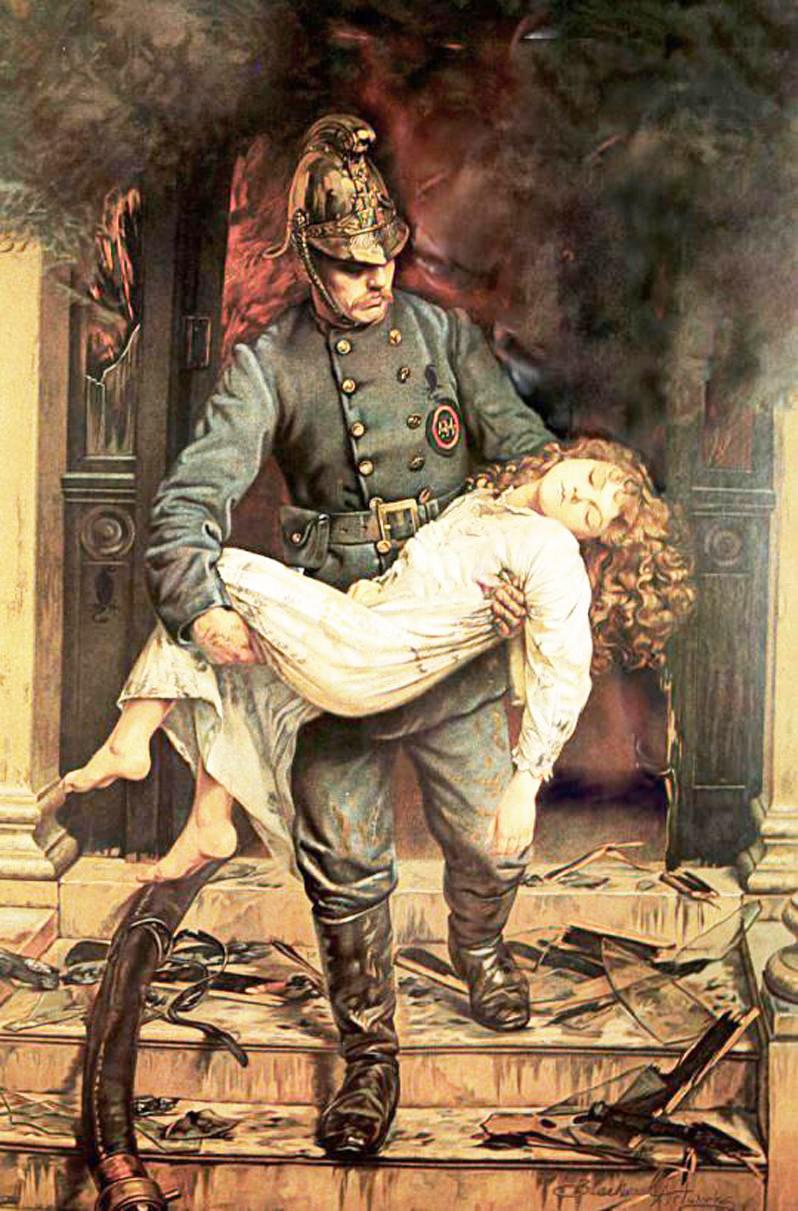
Our historically legendary fire service personnel had, in the past, a reputation for magnificent feats of bravery, only to be expanded beyond measure during the Blitz in WW2. See the gallery paintings of firemen fulfilling their duty, to show just two examples of their well deserved reputation. See picture 9 in the gallery, a depiction of a fireman exiting a burning building rescuing a young girl. This represents actual and genuine real events, repeatedly happening, every day, and every night, up to a thousand times a day, in just London alone, during the blitz. Please note, no fireproof clothing, and no respirator, with only his brass helmet for protection. In order to put his life on the line, time and time again, every single day, in order save others. Not for honours, not for money {many were volunteers} and not for just King & Country, but because they were good, decent and brave beyond measure.
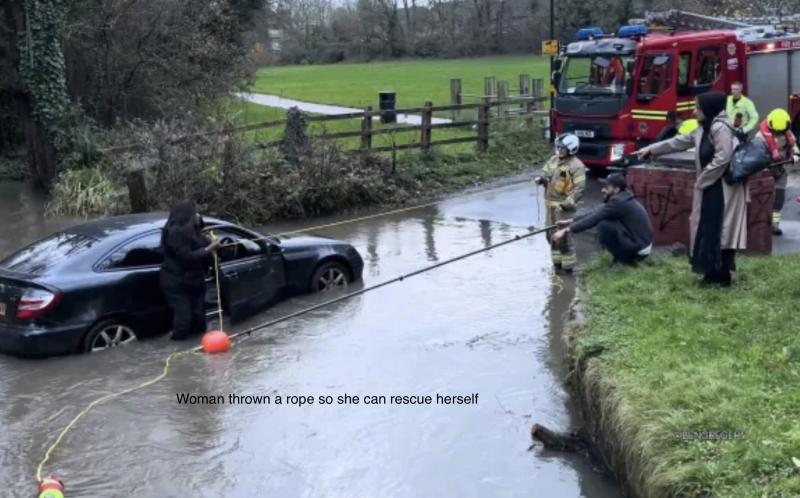
However, 85 years later, under the umbrella of the 21st century Risk Assessed’ UK Fire Service, a woman in the UK was rescued from her car by firefighters in December 2025 after becoming stranded in about 1 foot of water, a situation that gained viral attention and sparked debate, according to reports from Metro and various social media sources.
The Incident: The incident occurred during Storm Bram in the West Midlands. The driver, in a Mercedes, was stranded and necessitated a rescue by emergency services.
The Rescue: Firefighters used a throw bag (a rope rescue technique) to guide the woman out of her car. While the water was described as around "knee deep" (approx. 1 foot) in some reports, it was treated as a potential danger, and she was brought to safety.
Safety Protocols: Emergency services must follow strict safety protocols regarding flooding, which include conducting a risk assessment before attempting any rescue, particularly when dealing with potentially swift water, as per standard procedures.
Controversy and Commentary: The incident was widely shared on social media, with some users questioning the necessity of the rescue and suggesting it was an overreaction for a "puddle". However, emergency services advise that “all flood calls are handled as potentially dangerous and life-threatening.”
Therefore, for the sake of fair balance, this water incident might have become an dangerous issue {it didn’t} and it might have been a raging torrent {it wasn’t} the water was relatively still, like a pond for example, it was on a road service, not mud, and in daylight, see incident photo 10 in the gallery.
‘Brave lady rescues herself so as not to put the firefighters lives at risk.” See firefighter far right, very sensibly wearing a life jacket as a precaution the lady might splash water upon him/her during her flight from raging torrent! apologies, typo, should read.. puddle
In 2012, a man who fell into a lake drowned after firefighters called to the scene said they could not enter the water if it was higher than ankle deep for health and safety reasons, an inquest has been told.
Simon Burgess, a 41-year-old charity shop worker died at Walpole Park, in Gosport, Hampshire, on 10 March. He is believed to have had an epileptic seizure either before or after falling into the water while feeding swans.
Witnesses raised the alarm, but the hearing was told on Tuesday that members of a fire crew refused to get to him because the water was more than ankle deep. Instead, they waited for a specialist water rescue team and Burgess was only taken out of the lake 28 minutes after the alarm was raised.
Gillian Hughes, 53, told the inquest, at Portsmouth coroners court, that she had phoned emergency services and urged them to rescue Burgess when they arrived. She said: "The firemen arrived with the police, and I said: 'He's only been there five or 10 minutes, so if you hurry you might save him.'
"He just said: 'We're not allowed', and I said: 'But that's your job.'
Hughes added: "I said to one of the firemen: Why don't you go in?' and he said they couldn't if the water was higher than ankle deep. I said: 'You're having a laugh'. He said: 'No, that's health and safety' – but I thought that was their job."
She said that another fire crew arrived and started walking around the lake, putting in a pole and measuring the depth but, by this time, Burgess had drifted from one side of the lake to the other.
Police, ambulance and coastguard { YES, THE COASTGUARD} were also sent as standard for a water rescue," she added. "The specialist teams are there to deal with water which is over half a boot in depth. At 12.20pm, the fire crew confirmed attendance and at 12.25 they told us a male was floating face down."
"The water support unit arrived at 12.31pm. At 12.46, we received a message requesting our press officer attend the scene. At 12.52, an update came in saying a male had been recovered, and at 12.58 he was taken to hospital."
He drowned in a public park lake, not in the middle of the North Sea, but a lake, so they sent for the coastguard, as it was procedure.
Burgess was pronounced dead at 1.42pm after he was taken to hospital.
We must make it quite clear, any firefighter, however highly commended for their past bravery, that ignores risk assessment procedures, could face instant dismissal.
Code: 26222
1150.00 GBP