
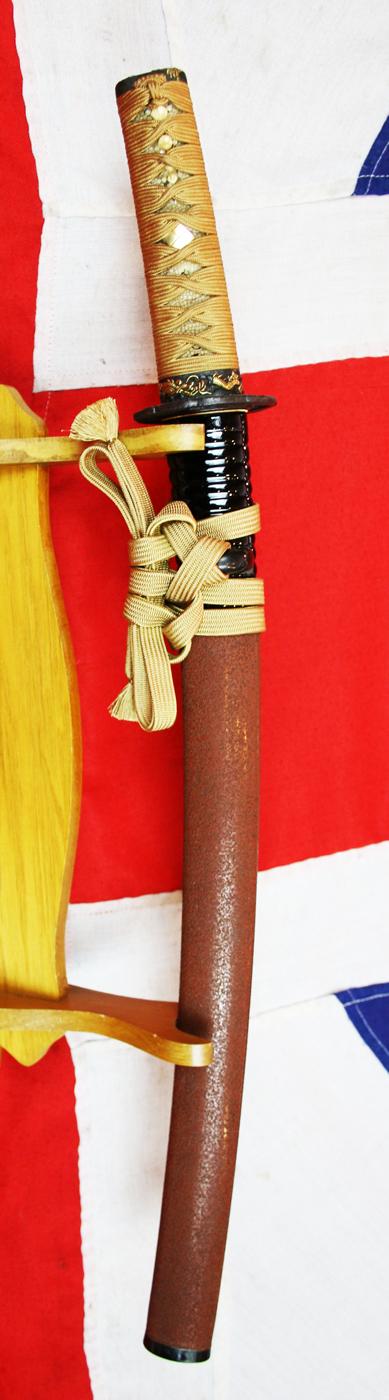
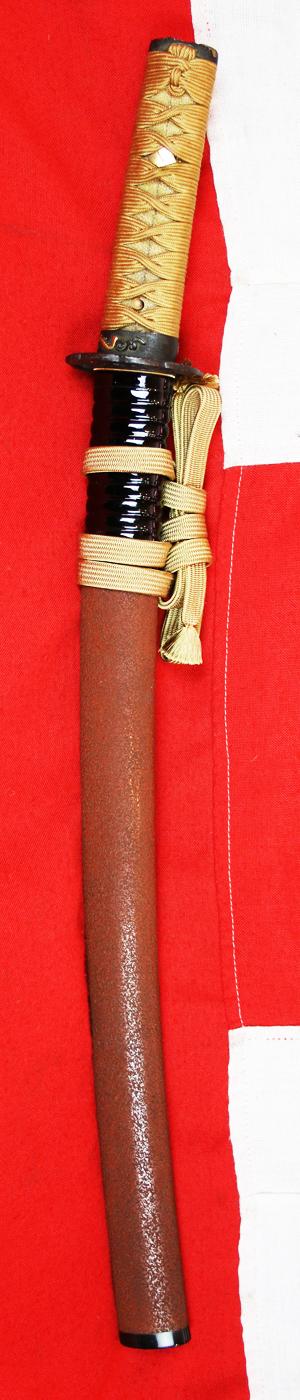

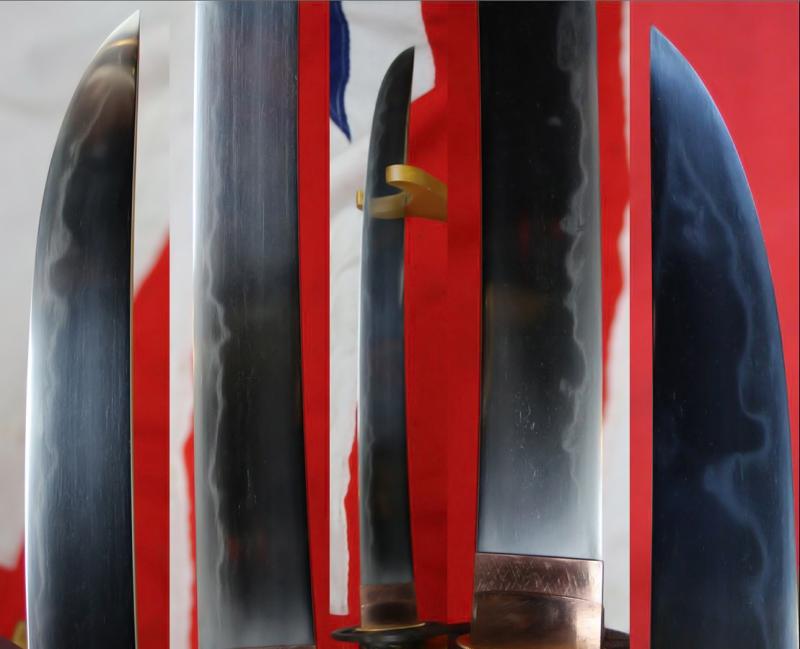
A Simply Breathtaking and Spectacular O-Tanto By One Of The Shinto Period, Great, 'Best of the Best' Samurai Sword Smiths Dewa Daijo Fujiwara Kunimichi circa 1615, With Glorious & Fine Soten Gold Dragon Fuchigashira And A Tsurumaru O-Sukashi Tsuba
Dewa Daijo Kunimichi is considered to be among the “best of the best” (jo-jo saku) of the Shinto period. Dewa Daijo Fujiwara Kunimichi (出羽大掾藤原国路) was a prominent early Edo period swordsmith (1615–1658) in Kyoto and a top student of the Horikawa Kunihiro school. His works, including O-tanto and wakizashi, are highly regarded as Jō-jō-saku (above superior) and Wazamono (excellent cutting ability).
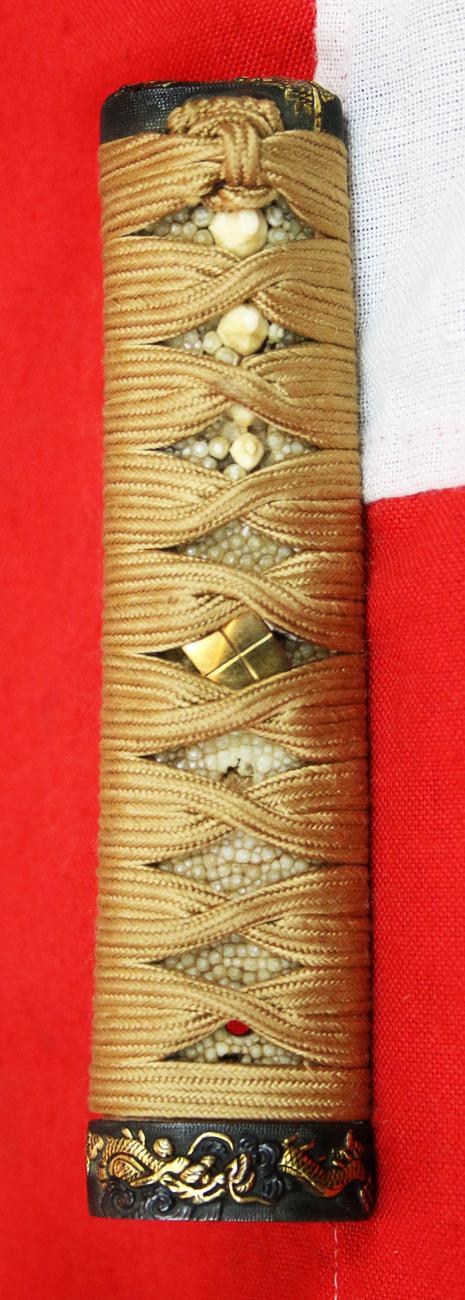
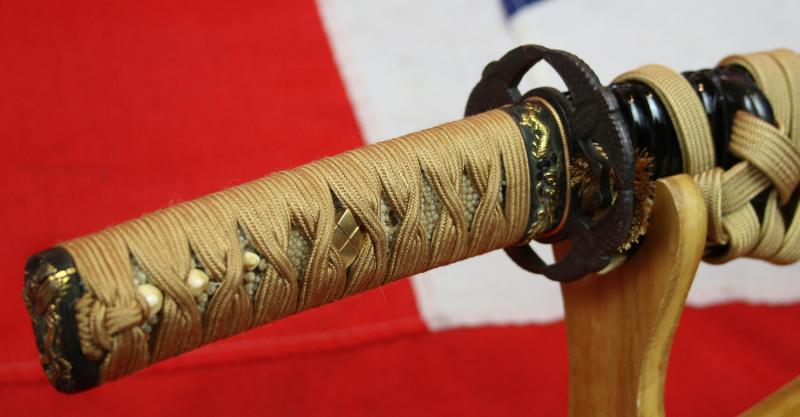
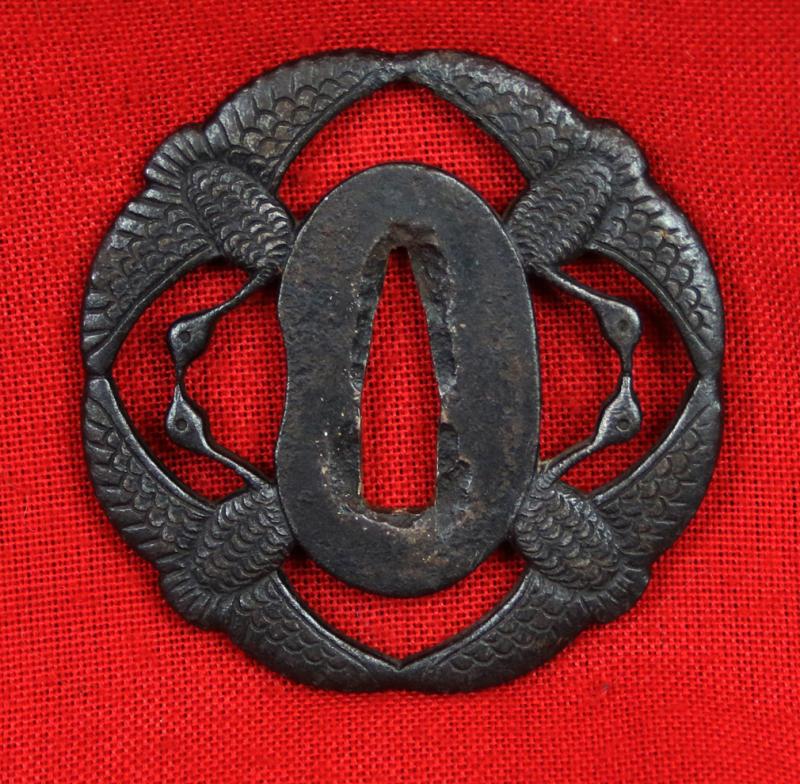
Superb original Edo Soten school fuchigashira of pure gold takebori dragon over shakudo nanako ground. Gold menuki of Takeda Shingen's clan of four diamond mon. Another clan symbol of Takeda were pairs of cranes {Tsuru}, heads bowing, symbolically represented in this sword by the O-Sukashi tsuba. Descendants of the Takeda Shingens clan would take prominent positions in the Tokugawa shogunate, established in 1603 The Matsumae clan (松前氏, Matsumae-shi) was a Japanese aristocratic family of the Takeda, bearing the four diamond mon, who were daimyo of the Matsumae Domain, now in Matsumae, Hokkaido, from the Azuchi–Momoyama period until the Meiji Restoration. They were given the march as their fiefdom in 1590 by Toyotomi Hideyoshi, and charged with defending it, and by extension the whole of Japan, from the Ainu "barbarians" of the north. They were descendants of Takeda Nobuhiro (1431-1494), son of Takeda Nobukata (1420-1471) of the Aki Takeda.
Takeda Shingen (武田 信玄, December 1, 1521 – May 13, 1573) was daimyo lord of Kai Province during the Sengoku period of Japan. Known as the "Tiger of Kai", he was one of the most powerful daimyo of the late Sengoku period, and credited with exceptional military prestige. Shingen was based in a poor area with little arable land and no access to the sea, but he became one of Japan's leading daimyo. His skills are highly esteemed and on par with Mōri Motonari. To bear the gold mon of the clan of Takeda Shingen indicates a descendant clan member of the highest rank. Tokugawa Ieyasu recognized the skill of Takeda troops and samurai, integrating many into his own army. The Hachiōji sen'nin-dōshin, a group of 1,000 former Takeda retainers, served the Tokugawa shogunate as defenders of Kai Province until the Meiji Restoration.
Legacy and Legitimacy: Ieyasu even claimed to be the "spiritual successor" to Takeda Shingen to gain loyalty in the former Takeda territories.
While the main Kai-Takeda line ended, minor, cadet branches of the Takeda family survived and continued into the Edo period
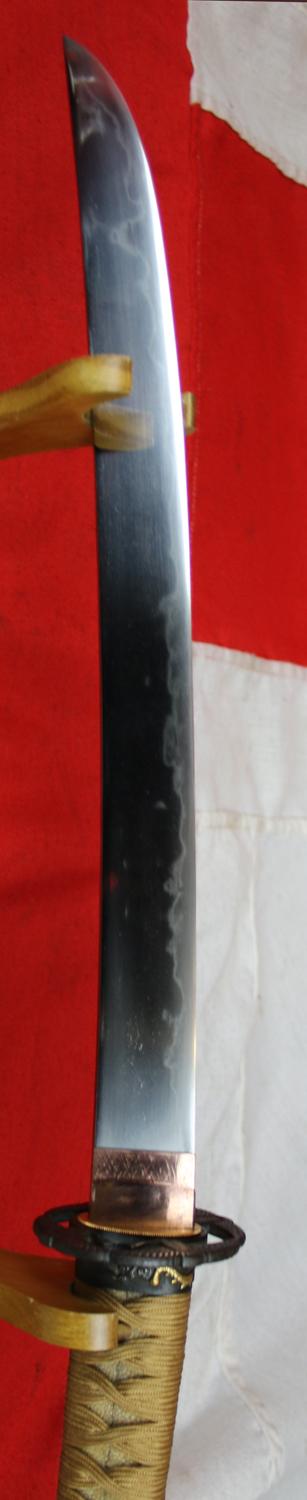
The complex hamon, typical of his work, and the blade condition is incredible and looks amazing, and it would be perfectly at home in the King's Royal Collection. This tanto is at present reserved.
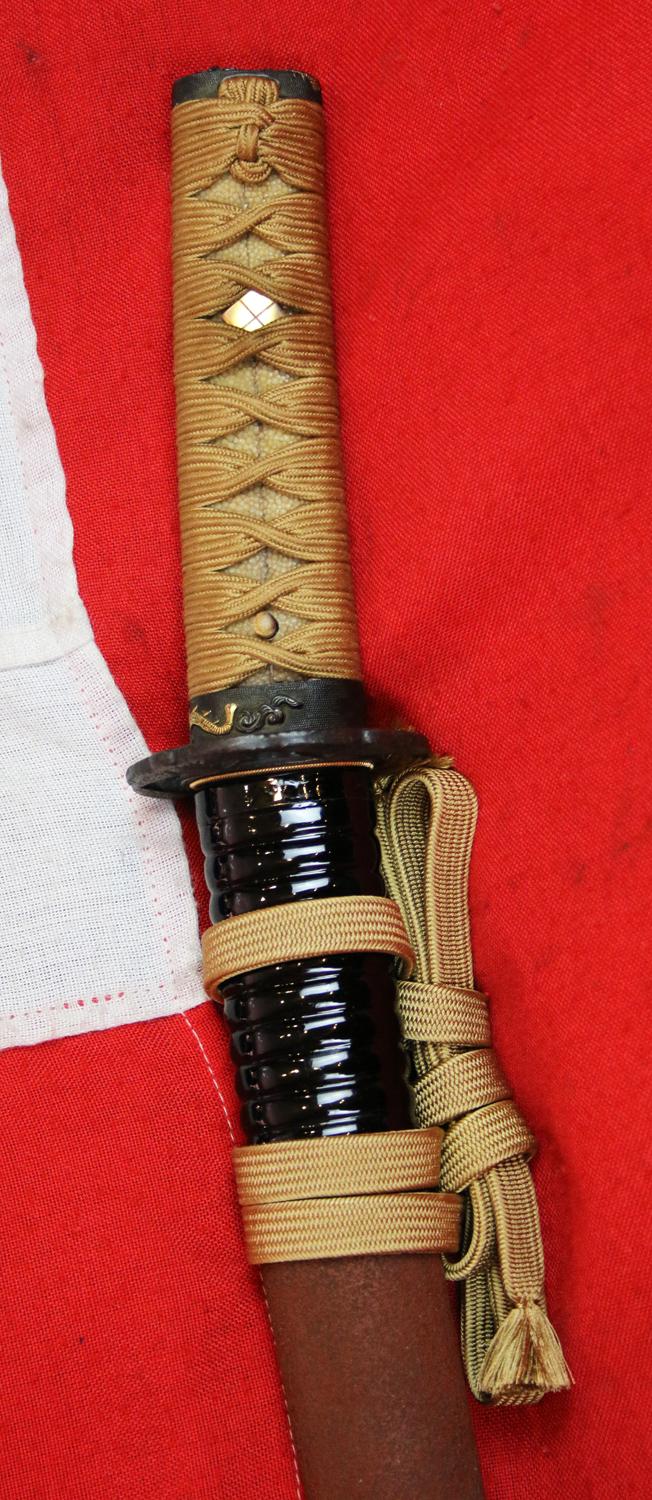
Mid brown ishime stone finish saya, wonderfully crafted by a master of the craft, with black urushi ribbing at the top section, and gold tsukaito over gold Takeda clan menuki, set upon traditional samegawa giant rayskin. All of these amazing quality features are a joy to behold. Making the entire sword of museum quality and a piece to treasure and admire for generations to come.
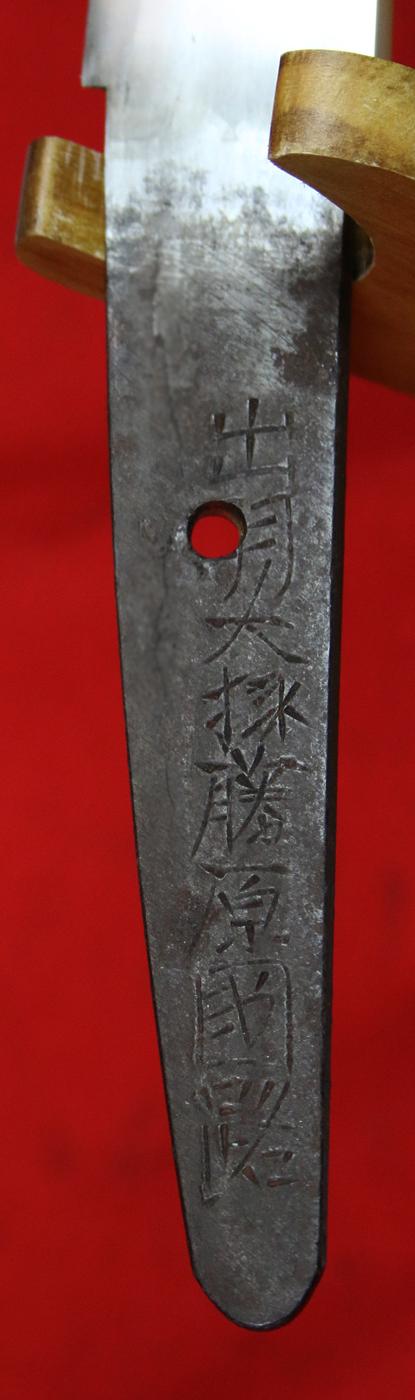
This blade signed by Dewa Daijo Fujiwara Kunimichi (出羽大掾藤原国路), who was especially active during the the Genna-Meireki era (1615-1658: Early Edo period) in Yamashiro province (today’s Kyoto prefecture).
It is said that Kunimichi originally belonged to Mishina school at the beginning of his career and later started to serve Horikawa Kunihiro school. He also signed Heianjo Kunimichi (平安城国道), Heianjo Jyu Kunimichi (平安城住国路), Dewa Daijo Fujiwara Rai Kunimichi (出羽大掾藤原来国路).
He was born in the 4th year of the Tensho era (1576: Azuchi Momoyama period). Based on available records, he started to officially appear in Japanese sword history in the 13th year of the Keisho era (1608: The beginning of the Edo period).
He first signed Kunimichi (国道). As you can see, the letter of Michi is different from the one seen on this blade. Those who belonged to Mishina (三品) school used Michi (道) as their maker’s names, such as Iga no Kami Kimichi (伊賀守金道). That is why it is believed that Kunimichi originally belonged to Mishina school. Also, at the end of his career, he used Rai (来) in his maker’s name, which is the only characteristic of the swordsmiths who belonged to Mishina school back then.
This is an iron tsuba (Japanese sword guard) "Tsurumaru" or crane circle, featuring a four crane sukashi (openwork) design. The crane is a deeply significant motif in Japanese culture, representing longevity, purity, and good fortune.
The design depicts four cranes arranged symmetrically. In Japanese art, cranes are often portrayed as "dancing" or in flight, symbolizing high status and refined elegance. The style emphasizes wabi-sabi—simple, elegant, and sophisticated aesthetics popular with the samurai class, with a delicate, "positive silhouette" (positive, or ji-sukashi) that is characteristic of the Kyoto school.
Sukashi, this technique involves cutting away sections of the iron plate to create negative space. This not only adds aesthetic beauty but also lightens the guard to balance the sword’s weight.
While similar designs are found across several schools, this style—with its balance of openwork and strong iron lines—is characteristic of Kyo-Sukashi (Kyoto) or Owari schools from the Edo period (1603–1868).
It is a maru-gata (circular) tsuba, which was the most prevalent form for centuries.
Nanako Ji: "fish roe ground" A surface decoration produced by forming very small raised bosses by a sharply struck punch or burin called 'nanako tagane'. Shakudo is the metal most often used, but copper and gold are quite often employed. The harder metals, shibuichi, silver and iron are rarely decorated in this way. The size of the dots vary from 0.04" to 0.008" (25 to 125 and inch) and the regularity of the work is marvelous as the dots must be spaced entirely by touch. The dots are usually arranged in straight lines or in lines parallel to the edge of the piece being decorated, but sometimes in more elaborate patterns. Used on guards since the Momoyama period although the technique existed since much earlier periods. Usually done by specialist 'nanako-shi', but sometimes done by the maker of the guard himself.
Shakudo is a billon of gold and copper (typically 4-10% gold, 96-90% copper) which can be treated to form an indigo/black patina resembling lacquer. Unpatinated shakudo Visually resembles bronze; the dark color is induced by applying and heating rokusho, a special patination formula.
Both of these features are stunningly represented on the Soten fuchi kashira. There’s fittings are without doubt, in our opinion, first division Soten school fittings, decorated in pure hammered gold embellished solid shakudo mounts. Soten, alongside Goto, are the two great Japanese schools of sword fittings. The original design of these fittings, were by renowned artisan Mogarashi Nyudo Soten, a master craftsman from Hikone in Goshu Province.
Code: 26211