
An Early 17th Century ‘Pillow’ Sword by Arnoldt Brach of Solingen. The Simplest of Sword Types Made But None The Less Effective For That. Short Rapier Form Blade, Walnut Hilt
Arnoldt Brach (1573-1640): A bladesmith active in the late 16th and early 17th century in Solingen, sometimes associated with the "crowned T" mark. Armourer stamped Arnoldt Rot. Bras {Brach} Me Fecit { translation from the 17th century Latin; ‘Arnoldt Brach I Made This’ } On the obverse blade side, Arnoldt Rot. Bras {Brach} Salingen {sic} plus armourer’s stamps of cross symbols to both sides.
A pillow sword is a small, light 17th-century European sword, often featuring a straight double-edged blade, designed as a compact personal weapon. Popularly believed to be kept under a pillow for bedroom protection—hence the name—it was more likely a practical, stylish "town sword" worn daily, often associated with a waist sash. 17th century status symbols and for personal defence, particularly in busy cities like Amsterdam, London, Seville, or Rome where long rapiers were impractical.
There has been a long held belief that the naming of the sword type was due to a flat sword that could be kept under the nobles pillow in order to make a rapid defence, during a nighttime’s slumber, against an assassin’s nefarious attack. There is no specific evidence to confirm this likely myth, however, as the saying goes ‘alls fair in love and war’, thus, if needs must, a flat ‘pillow’ sword would be the only form of sword that could be concealed at close quarter, and at instant reach, within the bedchamber, by a fearful potential victim.
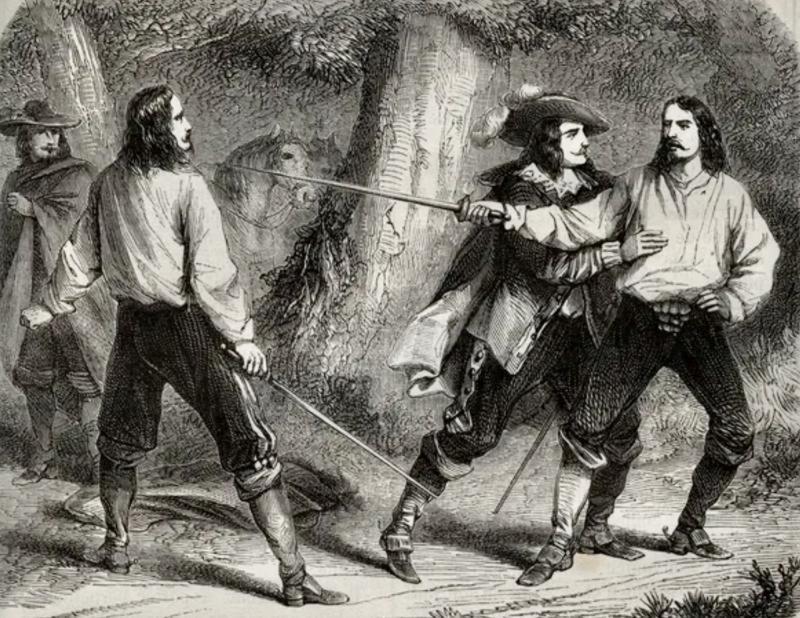
17th-Century Dueling: Noblemen of this period, such as those in France or Naples, frequently engaged in duels of honour, often using rapiers, daggers, or sabres to settle disputes, sometimes over trivial matters
These weapons featured smaller hilts, sometimes with a single side-ring, or none at all, making them far less cumbersome than full-sized rapiers. Many examples may or may not include cross-guards and plain wooden or wire-bound wooden grips. Often the simpler the better, and one couldn’t get more simple than this example. The blade is very fine with superb and clear named armourer maker stamps of Arnold’s Brach of Solingen
Code: 26184
Price
on
Request