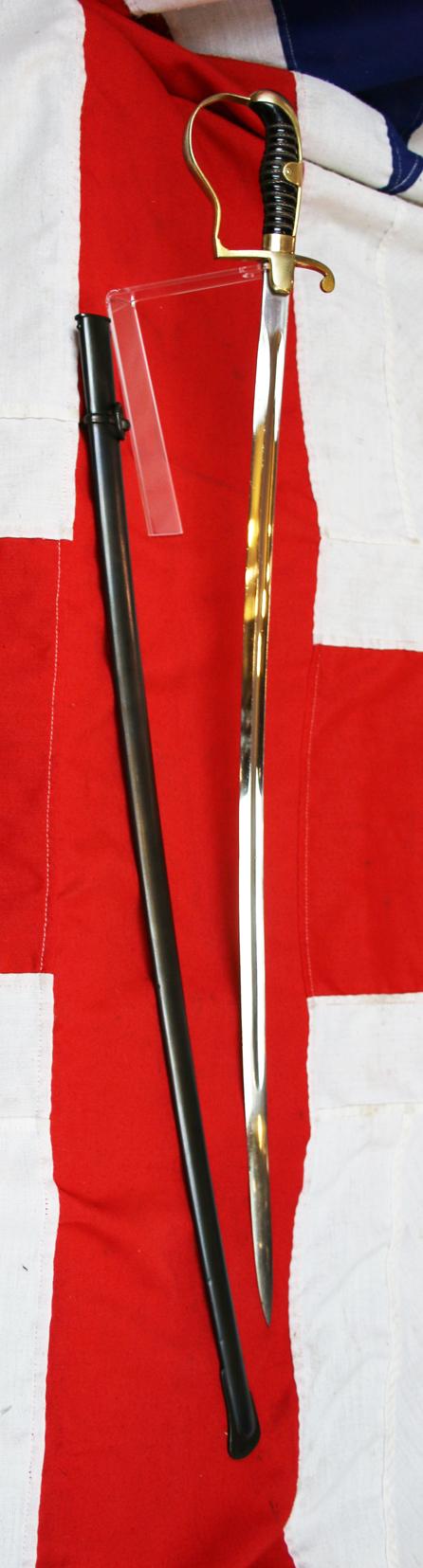
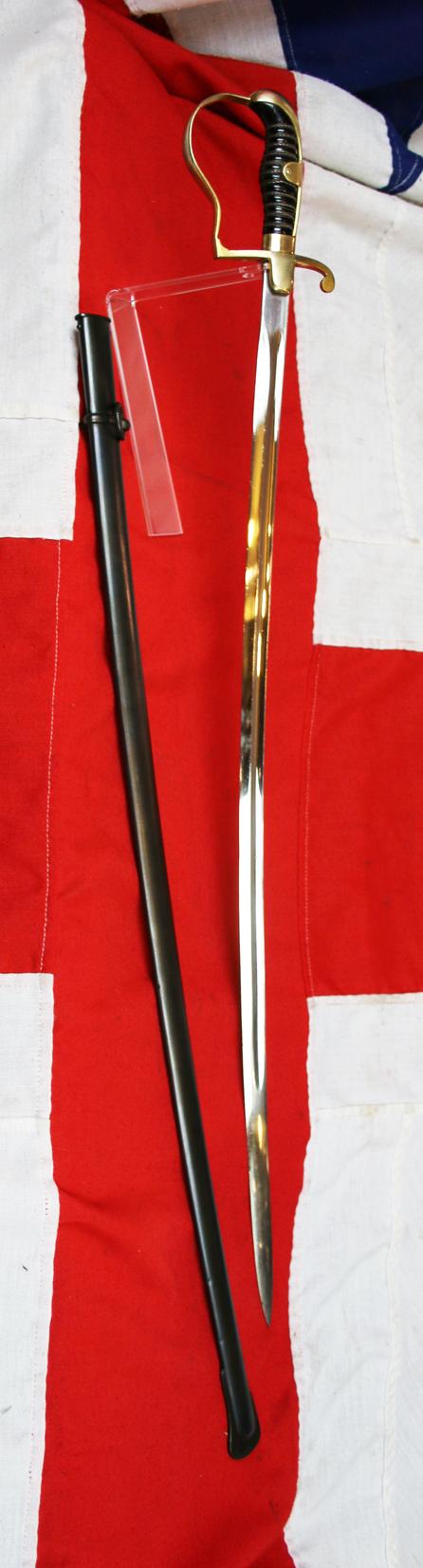
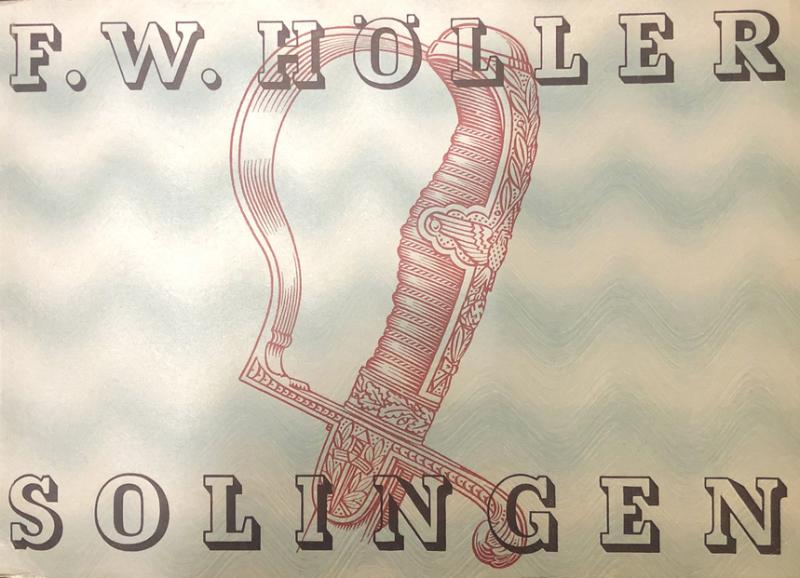
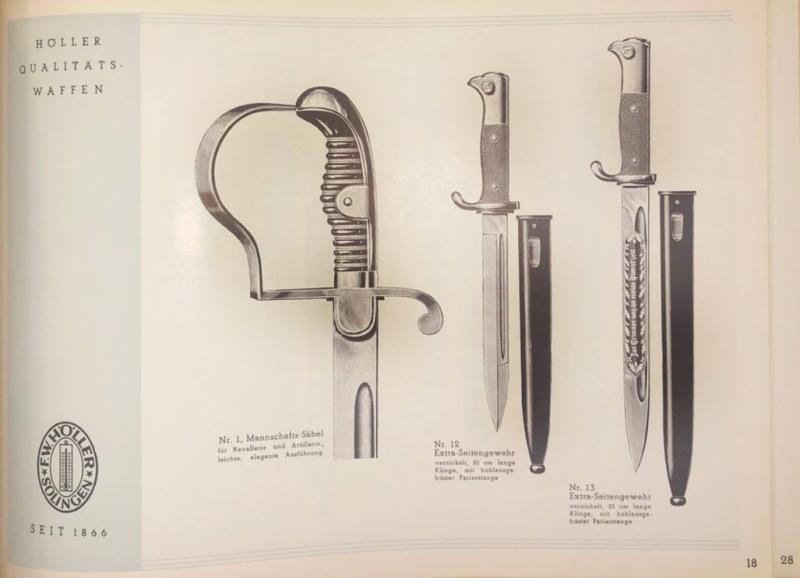

WW2 F.W. Höller (FW Holler) of Solingen, Germany German Third Reich NCO/Officer's Dove Head Cavalry Sword. Gilt Hilt With Original Multi Wire Binding Over Celluloid Grip. With Stunning, Near Mint, Mirror Bright Blade and Blued Steel, Dent Free Scabbard
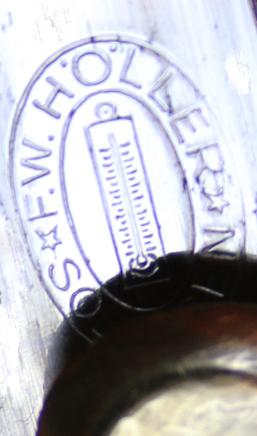
F.W. Höller (FW Holler) of Solingen, Germany, was a prominent manufacturer of military swords, daggers, and cutlery during the 1930s and Third Reich period (1933–1945). Known for high-quality craftsmanship, the firm often marked its blades with a "thermometer" logo, sometimes accompanied by the letters "RZM" for party-ordered items.
The sword has an overall length in the scabbard of approximately 36 inches, with a blade length of approximately 30 inches. The blade shows light wear marks but overall it is mirror bright and makes a wonderful appearance. The ricasso bears the thermometer trademark of the F.W. Holler firm.
The Third Reich used cavalry extensively in World War II, contrary to the image of a fully mechanized army. While motorized early on, the German army relied heavily on horses for logistics, transport, and cavalry units, peaking at six cavalry divisions by February 1945. Key units included the 1st Cavalry Division (later 24th Panzer) and the SS Cavalry Brigade/8th SS Cavalry Division.
As for weapons, every horse-mounted soldier carried a saber in a leather pouch when riding. After 1939, every officer carried the MP-38 and later the MP-40 submachine gun. All others carried the standard infantry issue Karabiner 98K carbine, a modified version of the long standard 98a, its shorter length making it more suitable for mounted troops. The carbine was based on an 1898 design, and while five rounds could be pressed into the magazine, it required a manual opening and closing of the bolt action to eject a spent round and cycle a new round into the chamber. In contrast, the standard U.S. issue Garand, a gas-operated semiautomatic design, required no bolt action and thus increased its firepower. Many veterans on both sides said this was often the difference between life and death on the battlefield. Officers, sergeants, and medical personnel also carried the Pistole 08, a 9mm semiautomatic, better known as the famous Luger. Some horse troops were issued the new 7.92 MPi 43/44 assault rifles, predecessors of the modern infantry weapons of today.
Horses were essential for logistics, with most German infantry divisions relying on them for transportation throughout the war. Cavalry units (mounted infantry) were used for reconnaissance, security, and "bandit-fighting" (partisan warfare) on the Eastern Front, particularly by the SS Cavalry Brigade.
Major Units:
1st Cavalry Division: Formed in 1939, it was the only mounted division in the early war before conversion to the 24th Panzer Division in 1941.
SS Cavalry Brigade / 8th SS Cavalry Division "Florian Geyer": Commanded by Hermann Fegelein, this unit was responsible for massive atrocities during "pacification" operations behind the front lines in the Soviet Union.
I Cavalry Corps: Formed late in the war (1944-1945), it fought on the Eastern Front (Operation Bagration) and in the final "Spring Awakening" offensive in 1945.
Horsemanship was also taught at the SS academies, as it was considered part of the legacy of the Teutonic Knights to which the Nazis ascribed. Unlike American cowboy movies in which, miraculously, no horse is ever injured during blazing gun battles, horses littered the roads and fields of Europe, killed by machine guns, mortars, artillery fire, and air attack. During the killing Russian winters, pampered German farm and riding horses, lashed to heavy wagons, dropped in their tracks. Often they became food for the starving soldiers.
The WWII German cavalry corps, which in wartime consisted of horse, bicycle, and motorcycle troops, contained 18 horse regiments. Disbanded at the outbreak of the war in 1939, they were reformed into divisional reconnaissance battalions, followed in 1943 by what is considered the rebirth of the German cavalry. Three regiments were reconstituted.
Logistical Importance: Despite motorized propaganda, horses were essential to German logistical, transport, and reconnaissance functions, with a steady supply maintained until 1945.
End of War: Cavalry units fought until the surrender in May 1945. Some, like the I Cavalry Corps, retreated into Austria and were taken prisoner by the British.
Each squad of horse soldiers consisted of nine troopers, and an MG 34 light machine gun provided additional firepower. Horses were also integral to the mobile field kitchens and the blacksmith, ammunition, and weapons wagons. While each troop had a motorcycle dispatch rider for maintaining long-distance communication with command, most communication on horseback consisted of 25 standard hand signals.
Code: 26177
645.00 GBP