
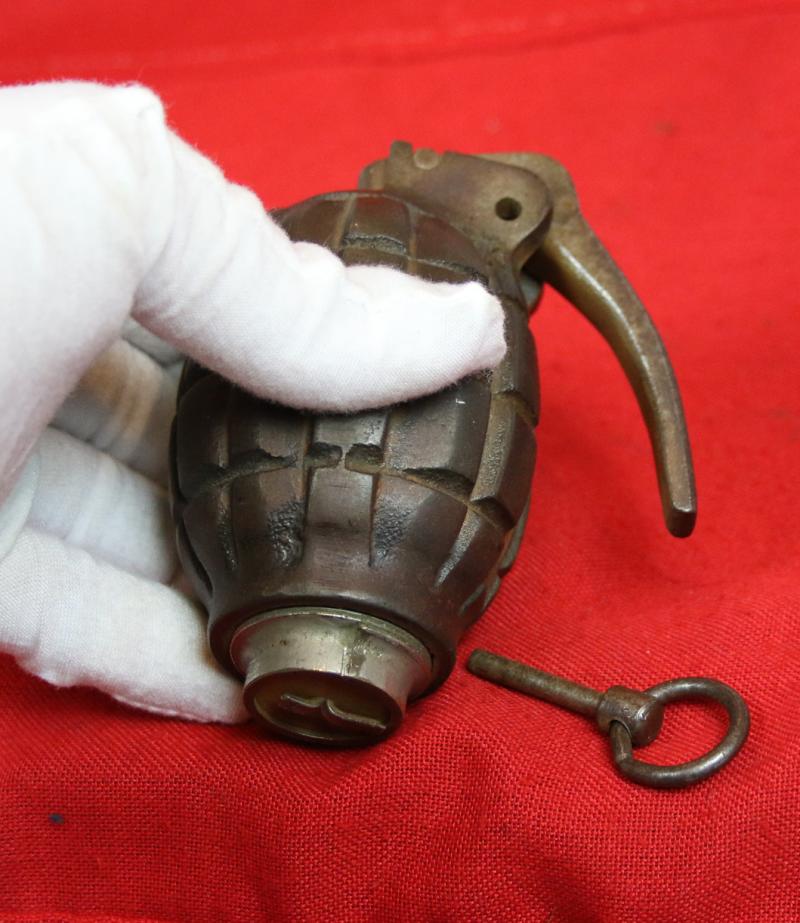
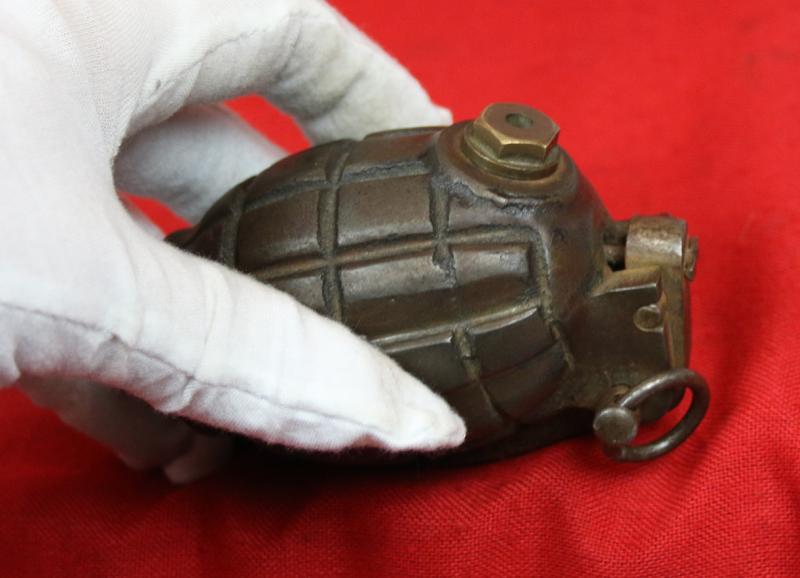
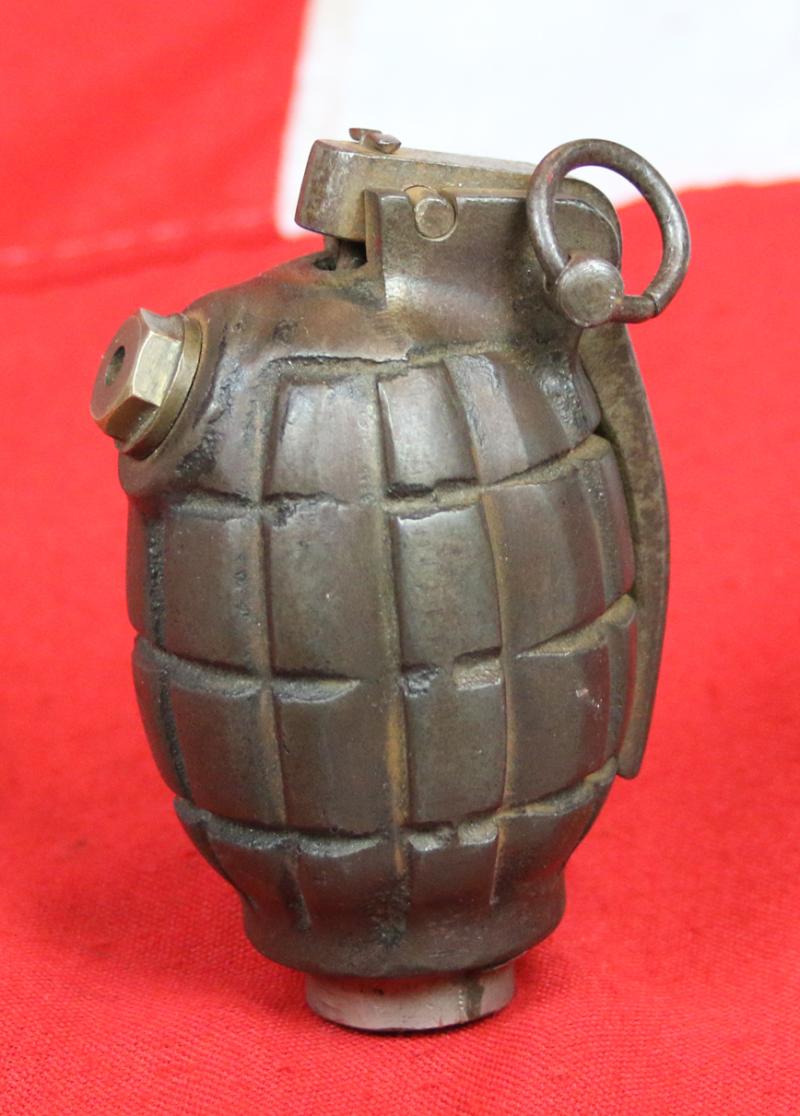
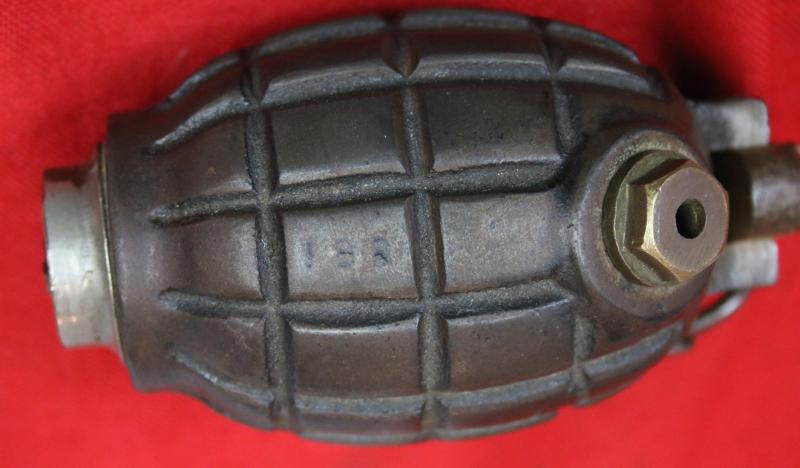
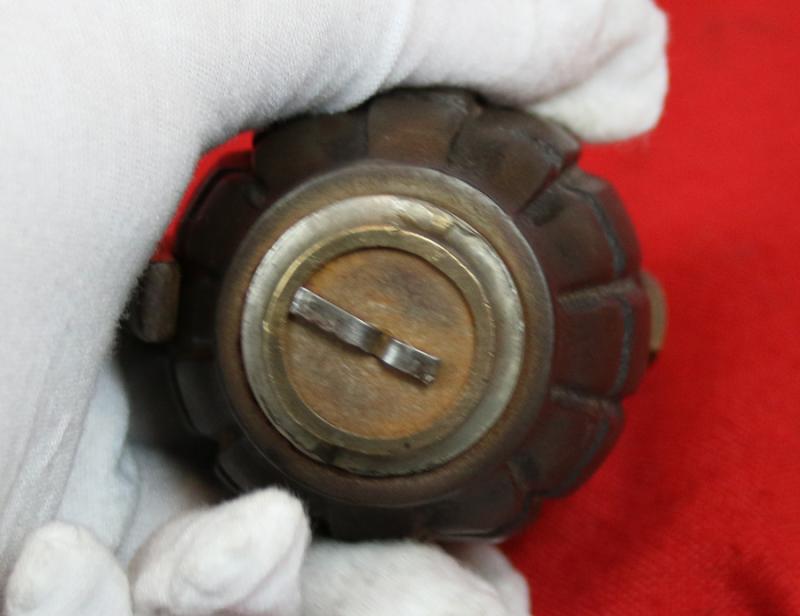
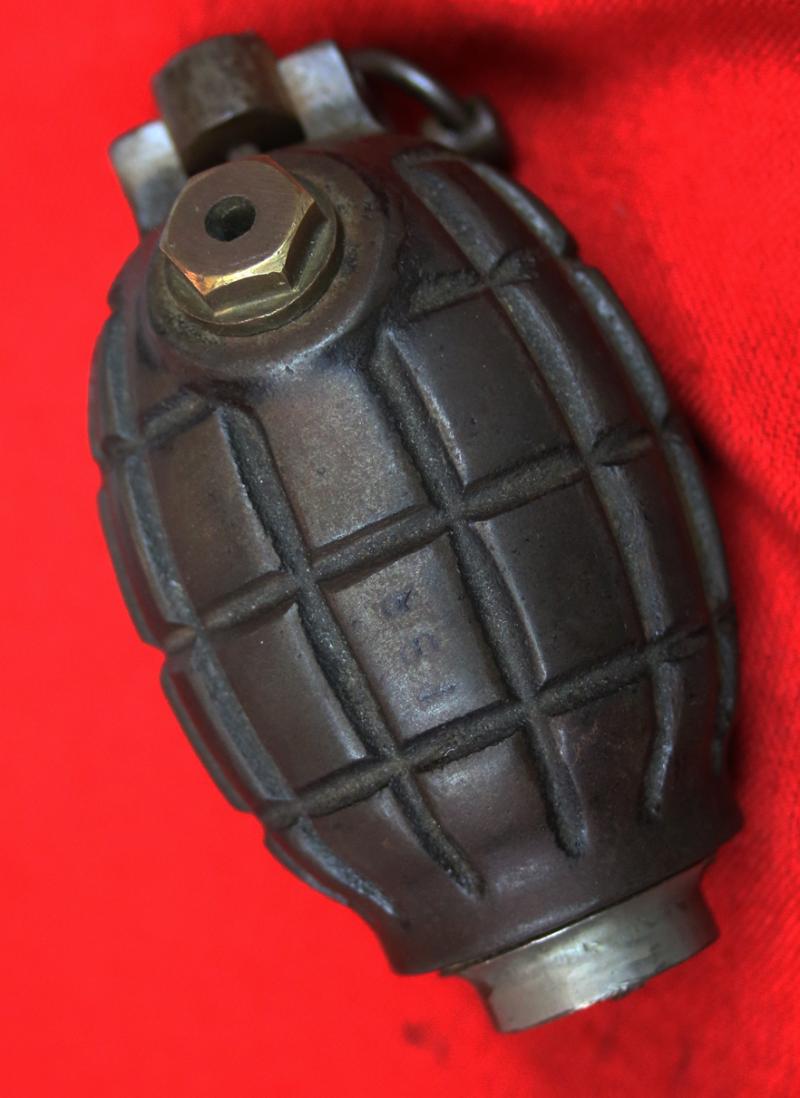
An Original, Inert, WW2 Service Issue British 'Mills Bomb' Grenade. Maker Stamped, I.B.R. by The Maker IBR {Ideal Boilers and Radiators} Ltd. Fitted With Automata Action
A most interesting and intriguing, original, collector's item of British WW2 Ordnance.
Adapted by a WW2 Royal Engineer armourer, to create an extraordinary desk ornament, made from an original grenade 'Mills Bomb'. A WW2 service souvenir, and conversation piece, that now has a spring loaded lever release and return automata action. Empty, inert, deactivated, and safe.
Very nicely marked A super example of these interesting collectables William Mills—a hand grenade designer from Sunderland—patented, developed and manufactured the "Mills bomb" at the Mills Munition Factory in Birmingham, England, in 1915. The Mills bomb was adopted by the British Army as its standard hand grenade in 1915, and designated as the No. 5. It was also used by the Irish Republican Army.
The Mills bomb underwent numerous modifications. The No. 23 was a variant of the No. 5 with a rodded base plug which allowed it to be fired from a rifle. This concept evolved further with the No. 36, a variant with a detachable base plate to allow use with a rifle discharger cup. The final variation of the Mills bomb was the No. 36M, which was specially designed and waterproofed with shellac for use initially in the hot climate of Mesopotamia in 1917, but remained in production for many years. By 1918 the No. 5 and No. 23 were declared obsolete and the No. 36 (but not the 36M) followed in 1932.
The Mills was a classic design; a grooved cast iron "pineapple" with a central striker held by a close hand lever and secured with a pin. Although the segmented body helps to create fragments when the grenade explodes, according to Mills' notes the casing was grooved to make it easier to grip and not as an aid to fragmentation. The Mills was a defensive grenade: after throwing the user had to take cover immediately. A competent thrower could manage 30 metres (98 feet) with reasonable accuracy, but the grenade could throw lethal fragments further than this. It could be fitted with a flat base and fired with a blank cartridge from a rifle with a "cup" attachment, giving it a range of around 150 m.
At first the grenade was fitted with a seven-second fuse to accommodate both hand and rifle launch, but during combat in the Battle of France in 1940 this delay proved too long—giving defenders time to escape the explosion, or even to throw the grenade back—and was reduced to four seconds.
The heavy, segmented bodies of "pineapple" type grenades result in an unpredictable pattern of fragmentation. After the Second World War Britain and the US adopted grenades that contained segmented coiled wire in smooth metal casings. The No. 36M Mk.I remained the standard grenade of the British Armed Forces and was manufactured in the UK until 1972, when it was completely replaced by the L2 series. The 36M remained in service in some parts of the world such as India and Pakistan where it was manufactured until the early 1980s. That the Mills bomb remained in use for so many years says much about its effectiveness.
Not suitable for export.
Code: 26124