
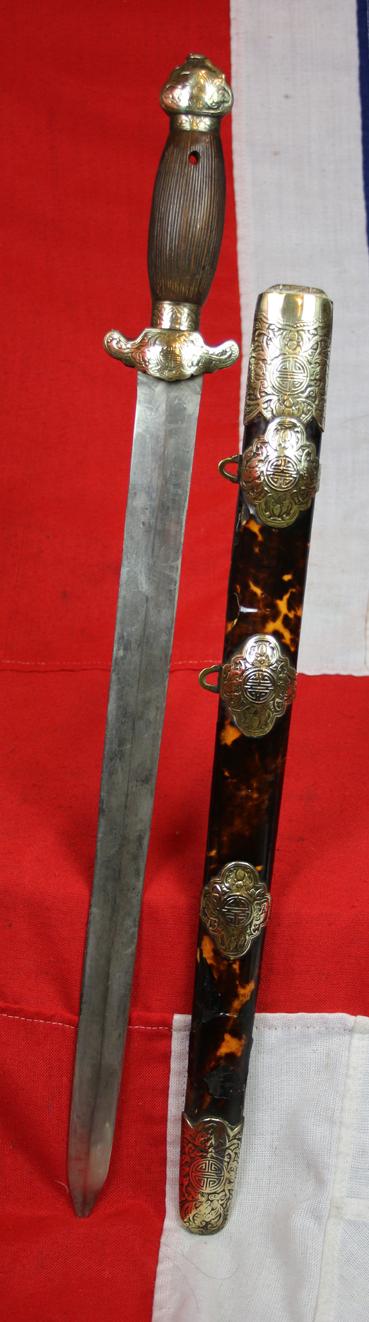
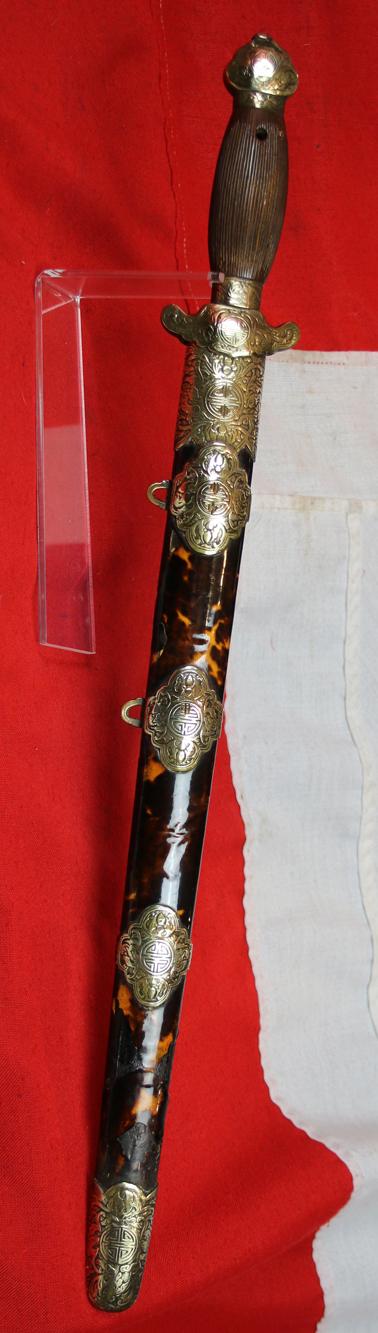

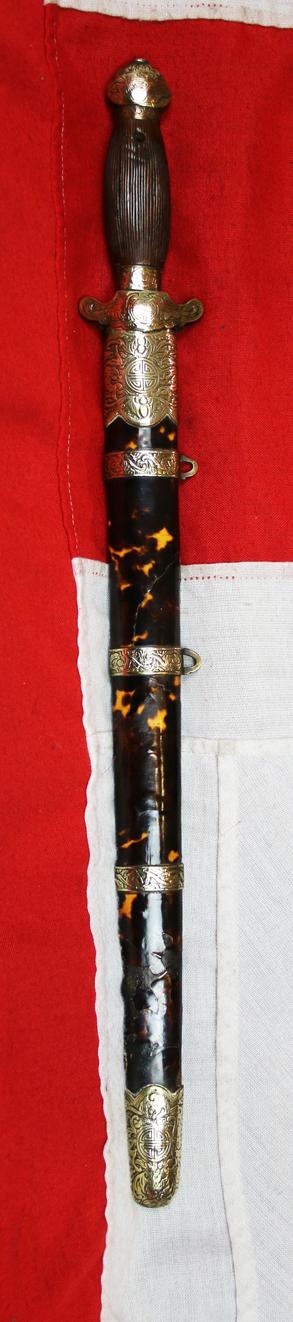
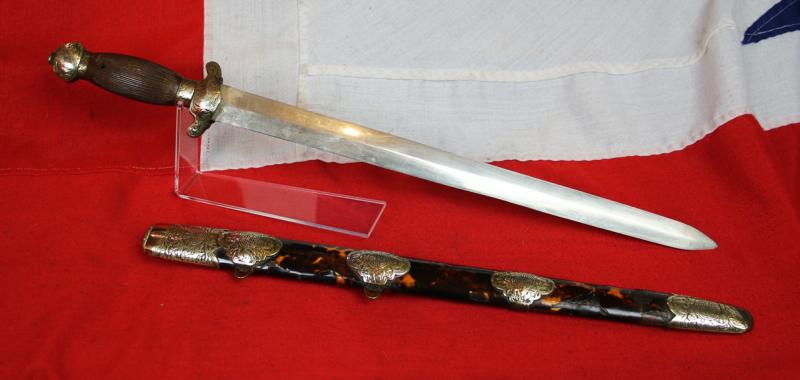
An Antique Ching Dynasty Chinese Small Sword Jian, Late 18th Early 19th century. Near Identical to Admiral Sir James Hanway Plumbridge's Sword in the National Maritime Museum Collection
This sword we acquired only last week due to our another example {now sold} that was shown on our website last week and immediately sold on.
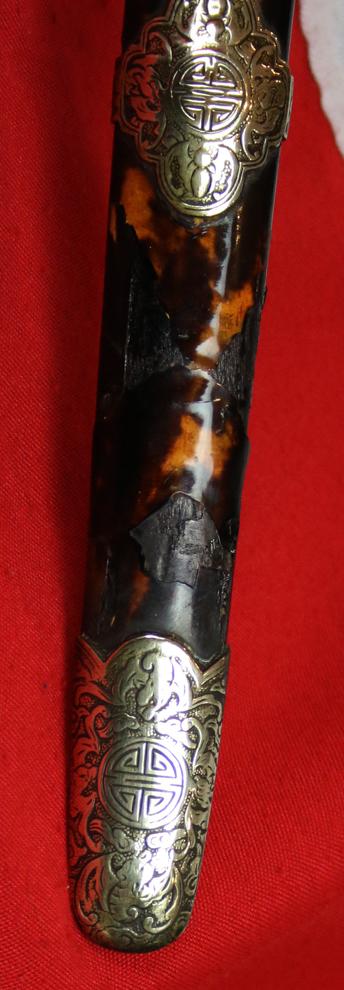
A Chinese jian sword, double edged blade lined darkwood grip, tortoishell covered scabbard, with typical stylized brass mounts, typically decorated with a traditional, intricate, bat and seal design. Double edged blade. Overall with stunning original patination that has been now revealed. It has just returned from ten hours of museum grade hand conservation and polishing.Thanks to such extraordinarily successful efforts, this would be a Chinese antique sword that would unlikely be to improve upon.
Likely brought back to England as a souvenir of the Opium War period to the Boxer Rebellion. Truly original, antique, Chinese weapons are very scarce indeed, as historically, few swords were ever brought back from China. Porcelain and silk were far more popular and preferable souvenirs and exports for Europeans, and in China, in the mid 20th century, nearly all the surviving antique edged weapons were melted down and destroyed in the era of Mao, under Chairman Mao's Cultural Revolutionary instructions, in order to create new steel.
A fabulous example that has breathtaking natural age patina.
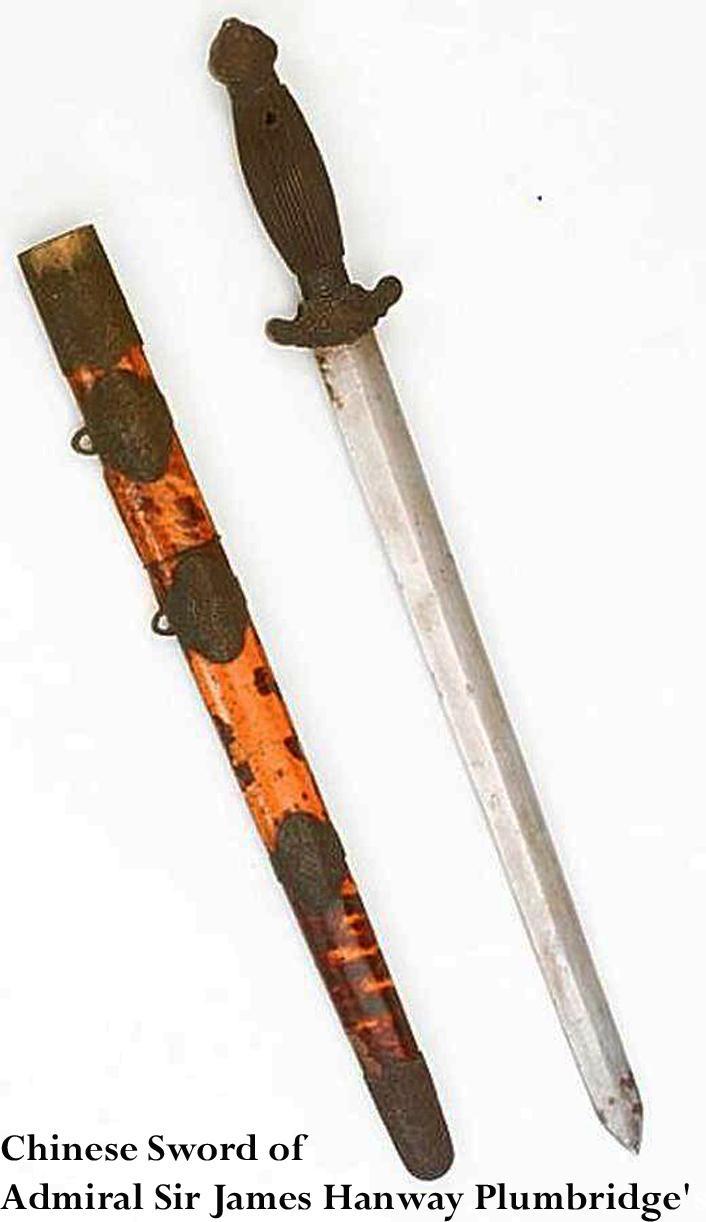
A near identical sword was once belonging to Admiral Sir James Hanway. His family believed he wore it as a midshipman at the Battle of Trafalgar in 1805. It is on display in the National Maritime Museum, exhibit number; WPN1157. Described as follows
Chinese sword, which belonged to Admiral Sir James Hanway Plumbridge (1787-1863). The hilt of the sword consists of a gilt pommel and crosspiece with very short down-turned quillons, and a fluted brown grip. The hilt is ornamented with a design of bats, which are a symbol of good luck. The steel blade is straight and double-edged. The point of the blade has evidently been broken off; it is about an inch too short for the scabbard and is rather roughly ground. The wooden scabbard is covered with lacquered paper actually tortoishell, and has four gilt lockets and a chape, which is ornamented with a design of bats. The two middle lockets are fitted with loops. This sword was offered to the National Maritime Museum as the sword which was worn by Admiral Sir James Hanway Plumbridge when he was a Midshipman at Trafalgar. It is inconceivable that he wore a Chinese weapon at Trafalgar. He probably obtained the sword during one of his three commissions in the East Indies. Admiral Sir James Hanway Plumbridge (1787-1863) entered the Royal Navy on the 6th September 1799 and was a Midshipman in HMS 'Leda' in the expedition to Egypt in 1801. At Trafalgar he was acting 6th Lieutenant in HMS 'Defence', and on the 20th August 1806 he was confirmed in rank. See photos 9 and 10 in the gallery, it shows the admiral's identical Jian sword on display in the National Maritime Museum, the photos are sadly poor quality
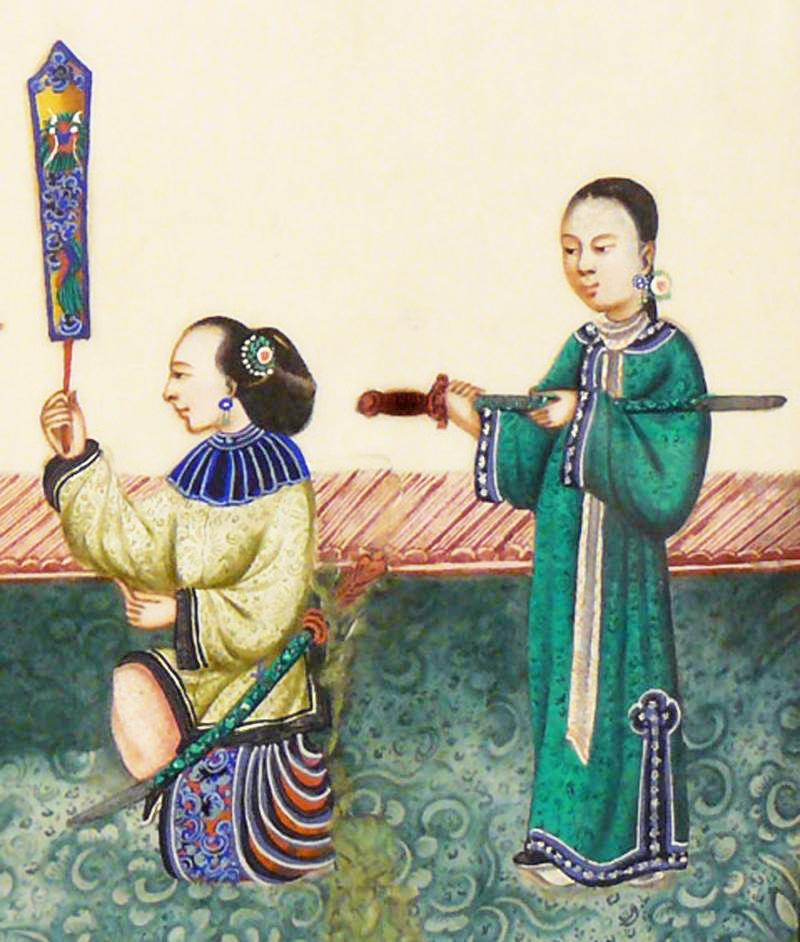
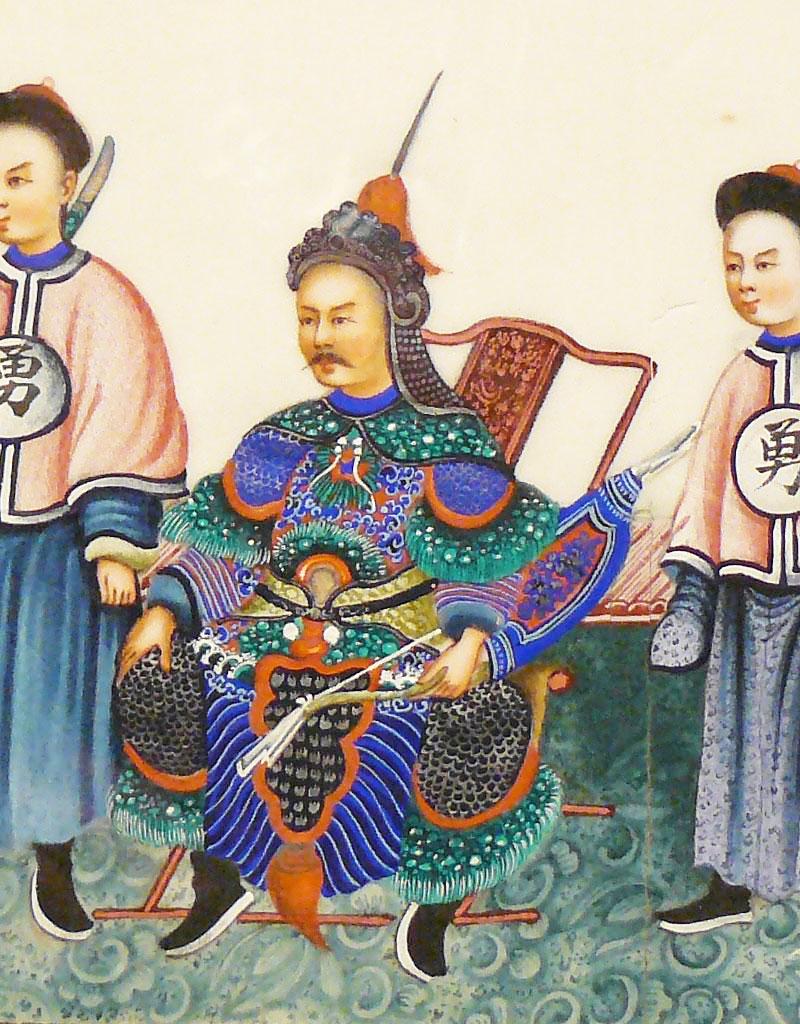
The two paintings in the gallery are original Chinese gouache of a seated Ching Emperor, and his sword bearer, holding the same type of Jian sword, but with a green tortoiseshell scabbard.
The antique Chinese jian is a straight, double-edged sword used in China for over 2,500 years, with the earliest examples dating to the 7th century BC. We actually have some original, ancient jian museum pieces, from this era, acquired by us from the world renown Dove Collection. See them offered for sale within our website.
It was a multi-purpose weapon, optimized for thrusting but also capable of cutting and slashing, and was a symbol of status. The design was effective and remained relatively consistent over long periods, with minor variations in length, weight, and balance.
The jian's most defining feature is its straight, double-edged blade. While it could be used for both cutting and thrusting, it was often considered more optimized for thrusting than the single-edged dao (sabre).
The jian was a symbol of power and status, wielded by the elite and sometimes carried as a symbol of authority.
Its use dates back to the Spring and Autumn period, with some of the earliest specimens being the Sword of Goujian.
Design variations: The length, balance, and weight of the jian varied significantly across different periods and purposes.
It is a crucial tool in traditional Chinese martial arts training.
Military use: It was a formidable weapon on the battlefield and, due to its length and reach, was sometimes used like a long spear to favour thrusting techniques.
The jian is a significant symbol in Chinese culture and history, frequently appearing in films, historical reenactments, and museum exhibits.
Antique jian are valuable as historical artifacts, collectibles, and striking decorative pieces.
The jian is a double-edged straight sword used in China for the last 2,500 years. The first Chinese sources that mention the jian date to the 7th century BC during the Spring and Autumn period;47 one of the earliest specimens being the Sword of Goujian.
Historical one-handed versions have blades varying from 45 to 80 centimeters (17.7 to 31.5 inches) in length. The weight of an average sword of 70-centimeter (28-inch) blade-length would be in a range of approximately 700 to 900 grams (1.5 to 2 pounds). There are also larger two-handed versions used for training by many styles of Chinese martial arts.
In Chinese folklore, it is known as the "Gentleman of Weapons" and is considered one of the four major weapons, along with the gun (staff), qiang (spear), and the dao.
The bottom section of the tortoishell has small areas of repair.
Code: 26035
1000.00 GBP