
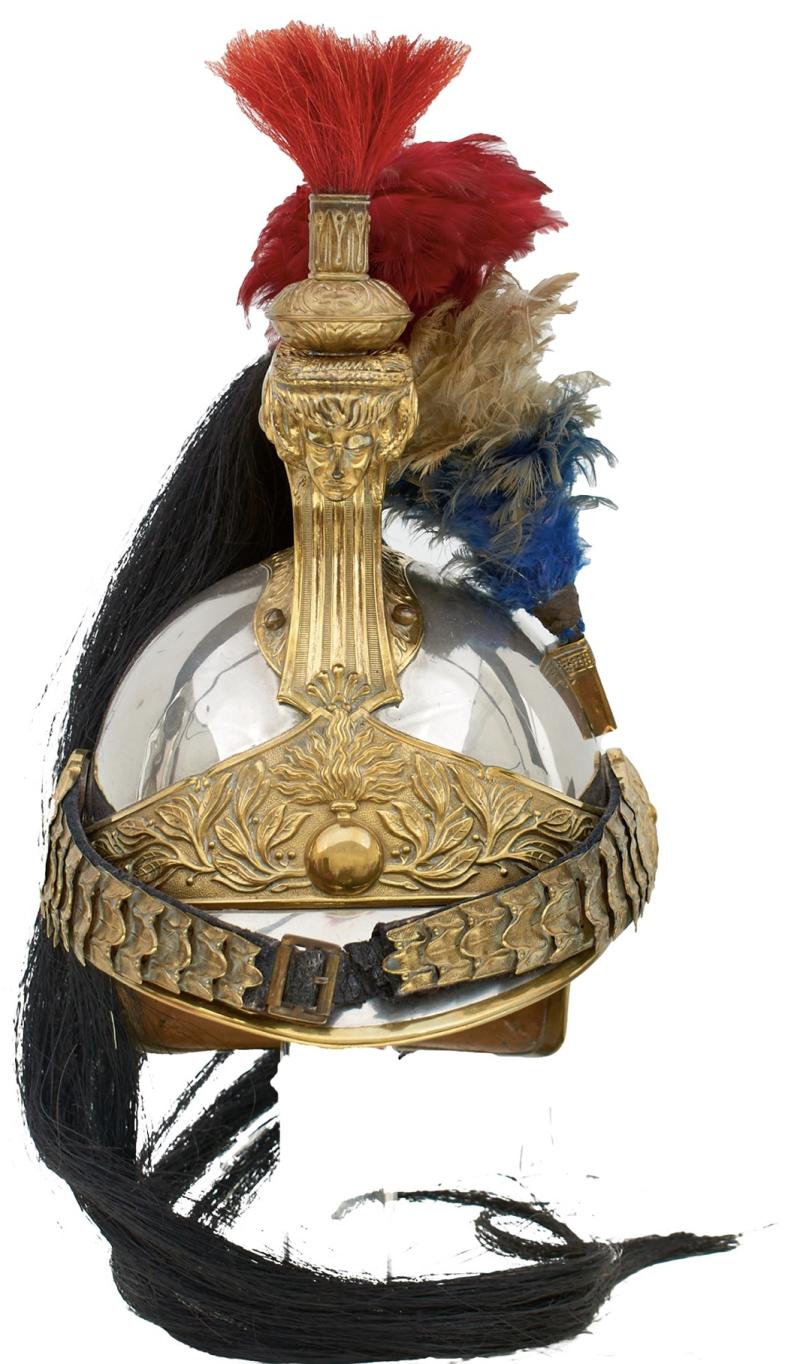
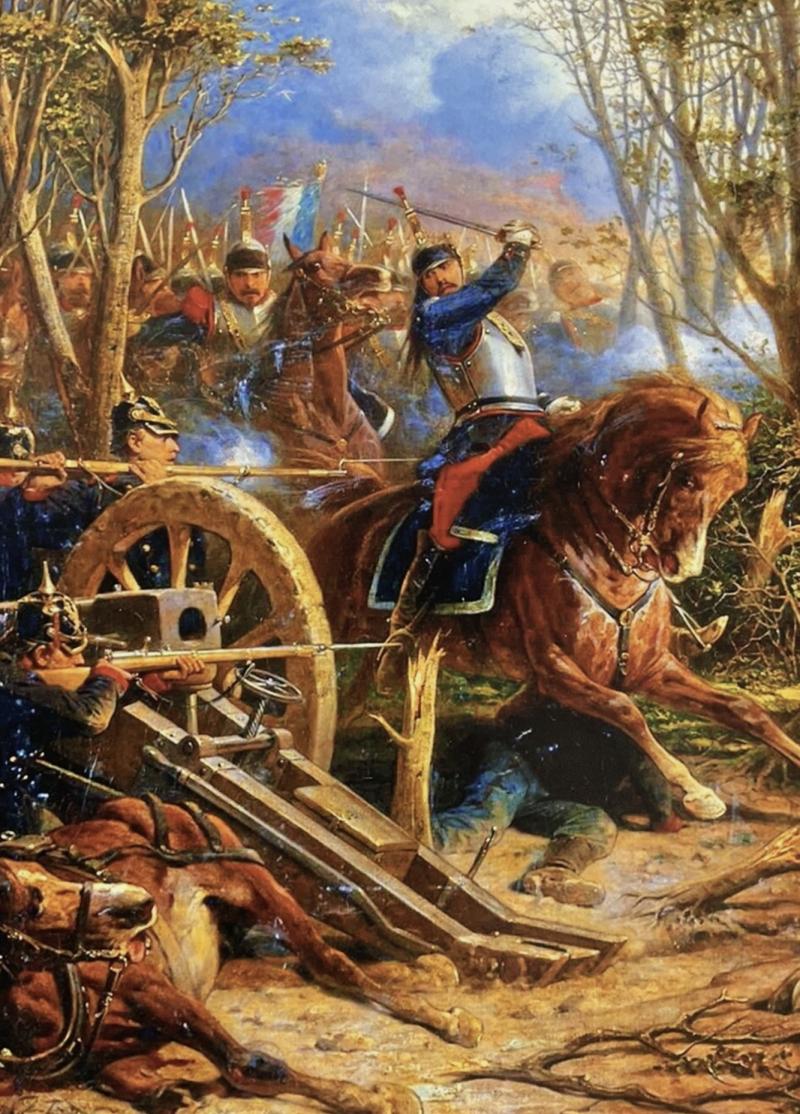
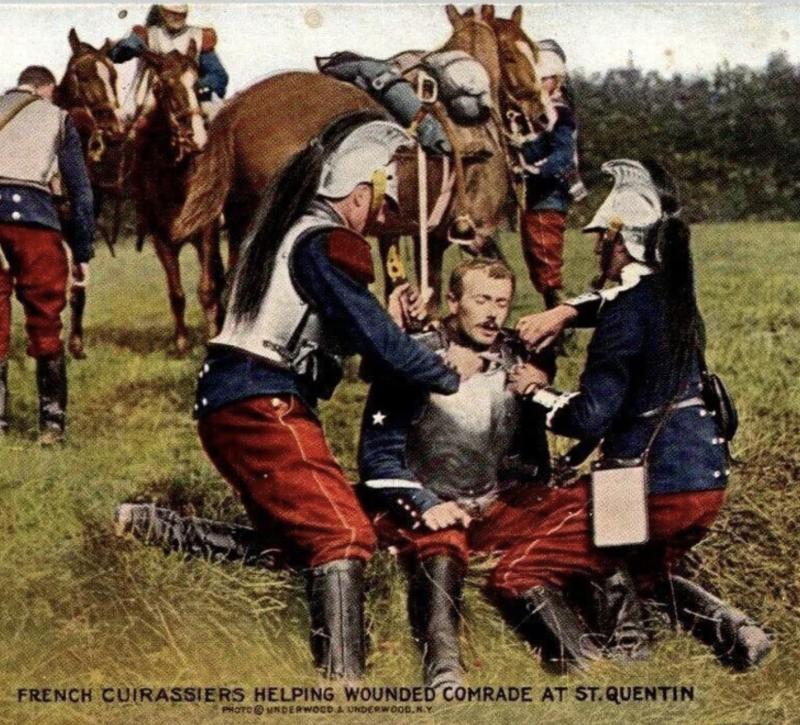
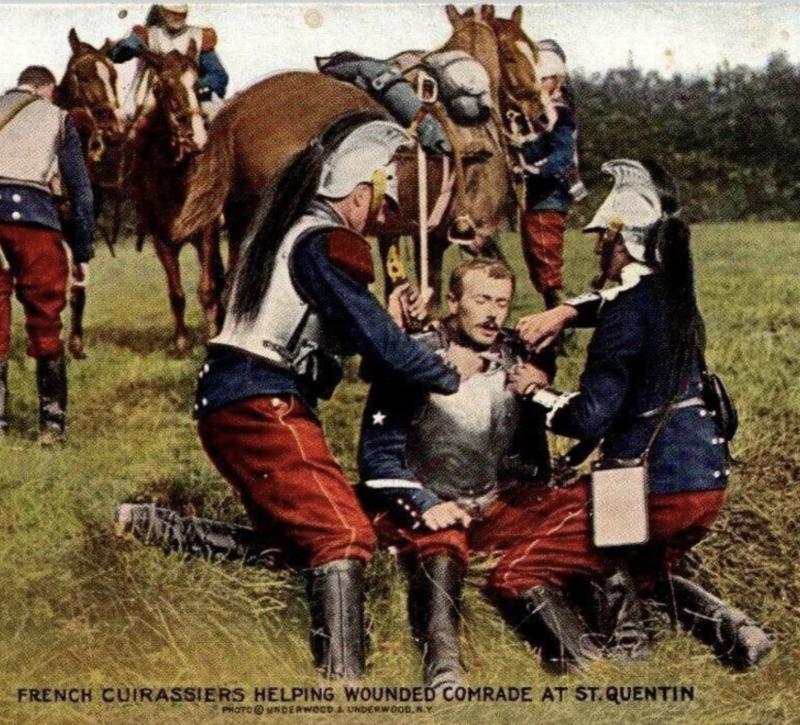

A Magnificent Antique, Original, French Cuirassiers Helmet 1872. French Cuirassiers Still In Combat Service in World War I, 1914. They Were the Last Troops Combat In Full Dress Armour in History. Possibly The Best Example You May Ever See
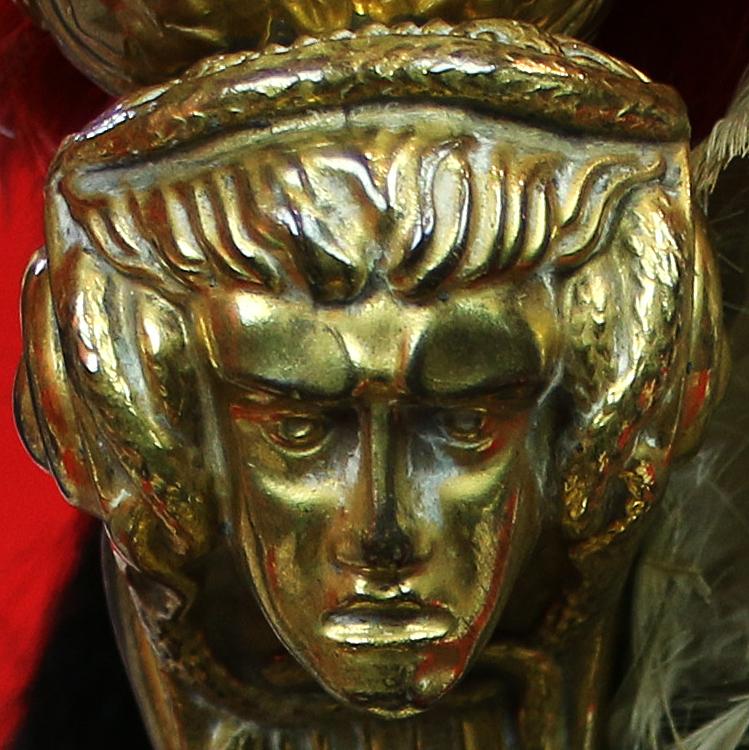
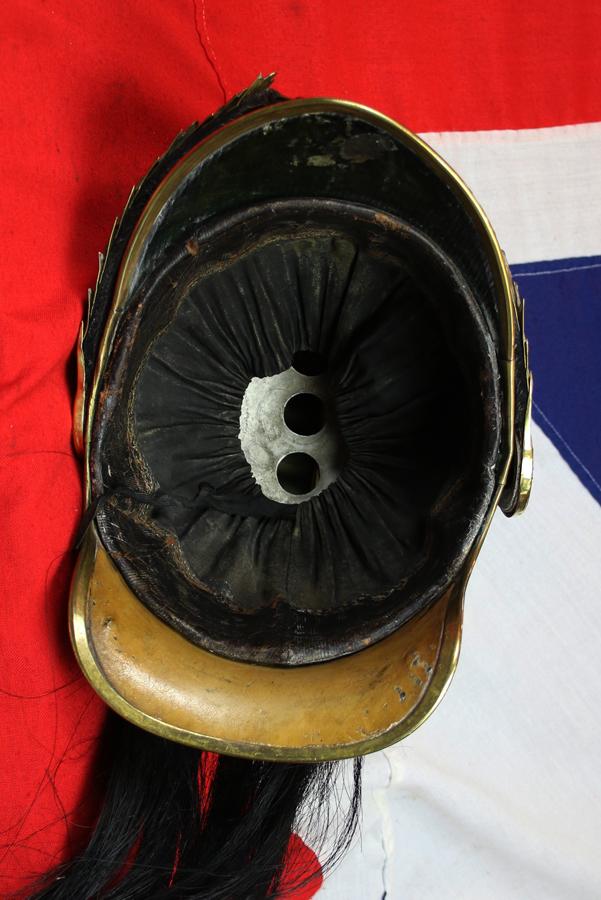
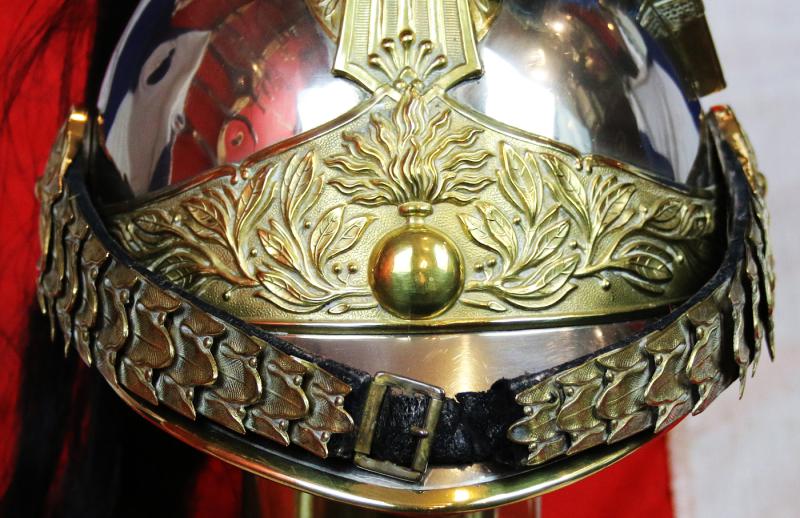
With liner, black horsehair tail and red white and blue feather plume, original chinscales with strap and buckle, virtually dent free throughout, and in fabulous overall condition. The plated metal skull with brass trim, laurel and grenade embossed headband with a stippled ground, acanthus embossed raised comb with Medusa head, acanthus and laurel embossed cushion-shaped plume holder marmousel with red horse hair plume, black horse hair mane, square section hackle holder with red white and blue feather hackle, foliate decorated bosses.
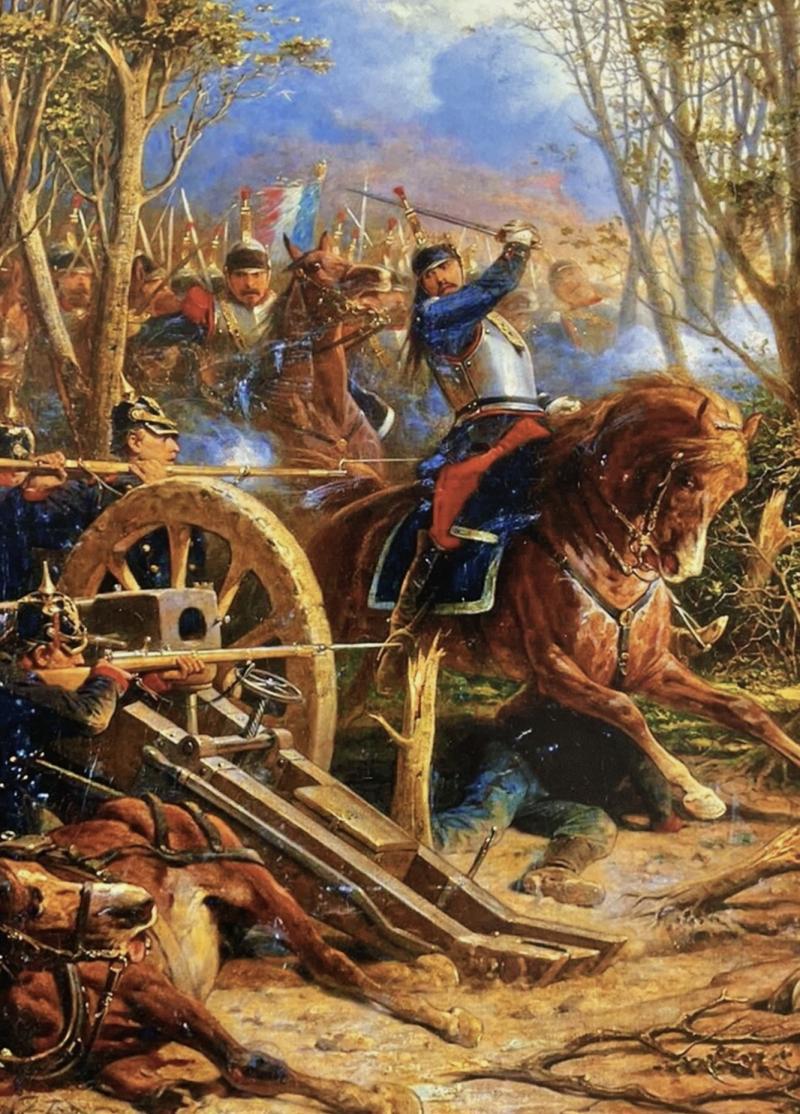
There is no doubt, that despite losing to the invading Germans in the Franco Prussian War, there were no braver horse mounted combatants in the world, renown for their loyalty, dedication and tenacity in combat for La Belle France. Which continued still into WW1 40 years later.
Photos and price will be added today
A magnificent French Cuirassiers helmet of the M1872 pattern. Designed immediately after the defeat of France at the Franco Prussian War. These were still in combat wear in August 1914 by the troops of the French Cuirassiers who were in that early period engaged in reconnaissance, guarding the flanks & covering the infantry as well as liaison & escort.
The skull, peak & neckguard are made from cast sheet steel which from a lobster tail to the rear with Medusas head to the front of the crest & thirteen palmettes separated by water lillies. All of the fittings & the badge are of brass this including the chin scales which are adjusted by use of a partially concealed strap inner buckle system. The plume socket is set into the side of the helmet with its red plume. The front plate has a grenade set into two laurel branches this integrating with the bottom edge of the crest as the top grenade flame reaches upwards. To the crest is mounted black horsehair with a pleat which allowed it to be tied up so it did not flutter in the face of the cavalryman. Interior of the helmet has survived in very good order. The leather liner tongues are all good with no damage to holes.
Looking back at the pre-war 1870 landscape, there are parallels that can be drawn today, including notably the role of populist disruptors in triggering international conflict. Emperor Napoleon III of France and Prussia's Otto von Bismarck were both products of the 1848 revolutions and master media manipulators who exploited the power of nationalism. Napoleon did so first, sweeping to power in the December 1848 presidential elections on the promise of ‘making France great again’, as it had been under his uncle, the first Napoleon. Four years later, just before his original term should have expired, he made himself emperor, and quickly reasserted French prestige by launching a succession of wars, including against Russia in the Crimea (1853-56).
Napoleon III's wars had unintended outcomes. One of these was that they turned Russia from being a bastion of the international order into a revisionist power. This in turn gave space to Bismarck to wreck what remained of the European system in a way that was definitely not to France's advantage. Austria was the main victim initially in the shake-up that followed, losing its position in Italy following military defeat at the hands of France in 1859, and more spectacularly forfeiting its prime role in Germany to Prussia after defeat in 1866.
This set the scene for the 1870 Franco-Prussian war. France, determined to thwart Prussia’s further rise, sought to block the candidacy of a Prussian prince to the Spanish throne in what looked like a good, old-fashioned, dynastic succession crisis. What made things different from earlier centuries was the weight of public opinion, in an age of universal male suffrage. Policy makers in Berlin and Paris sought to exploit the rising tide of nationalism on both sides of the Rhine, and this increased the risk of an explosion. That explosion came on 19 July.
A rapid French rout
Experts at the time expected the French to win. They overlooked serious weaknesses on the French side, which Sir Michael Howard's analysis shows extended far beyond the narrow military field, to wider political and societal disadvantages. These were reflected above all in the French conscription system, inherited in its essentials from the first Napoleon. This imposed upon the male population an obligation to serve, but in practice, only a small fraction was ever called up, who then served for seven years and often more. In consequence, the French army lacked the ability to 'scale-up' by calling on a mass of reservists.
The Prussian army, in contrast, drew upon the entire male population, producing a substantial body of trained reservists upon mobilisation. Prussian military planning, conducted by the famed General Staff headed by Helmuth von Moltke, made best use of the resulting numerical advantage, not least through the clever exploitation of railways.
Many military observers nonetheless preferred the French system, which produced an essentially professional force that was far better-suited to the near-continuous overseas deployments that Napoleon III's global ambitions demanded. Most damaging of all, despite its elitist pretensions, the French army was socially rather low-status. This was because the rich were allowed to pay for replacements to serve instead of their sons, should they be unlucky enough to be called up. No such facility existed in Prussia, with the result that its army more fairly approximated the nation-in-arms.
The consequence in 1870 was a French rout. General Philip Sheridan, American Civil War veteran, observed the Franco-German conflict at first hand, and his summary of the reasons for the outcome can hardly be bettered:
"The earlier advantages gained by the Germans may be ascribed to the strikingly prompt mobilization of their armies, one of the most noticeable features of their perfect military system, devised by almost autocratic power; their later successes were greatly aided by the blunders of the French, whose stupendous errors materially shortened the war, though even if prolonged it could, in my opinion, have had ultimately no other termination."
Code: 26018
2195.00 GBP