
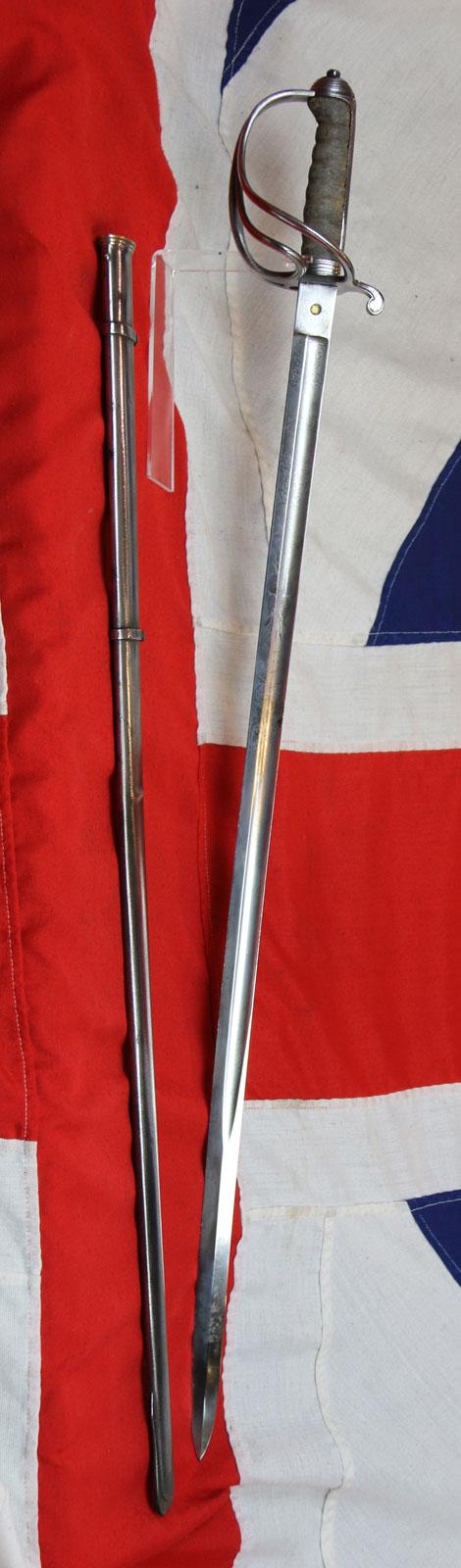
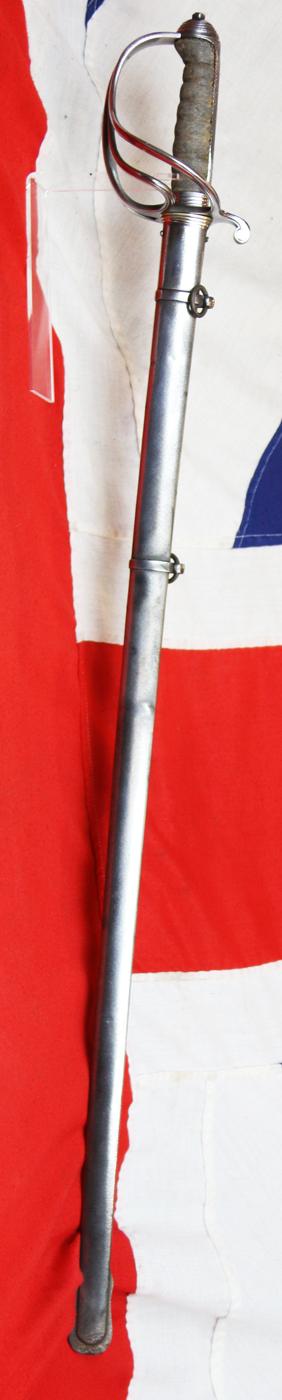
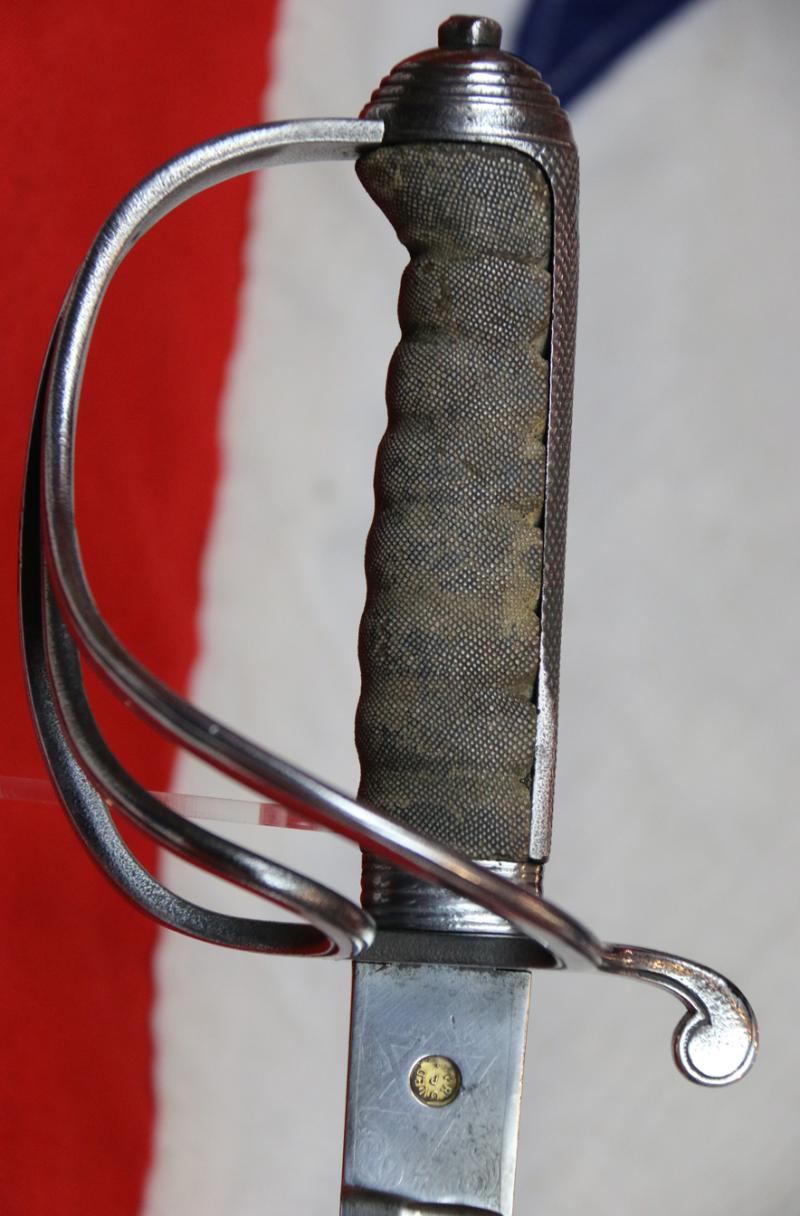
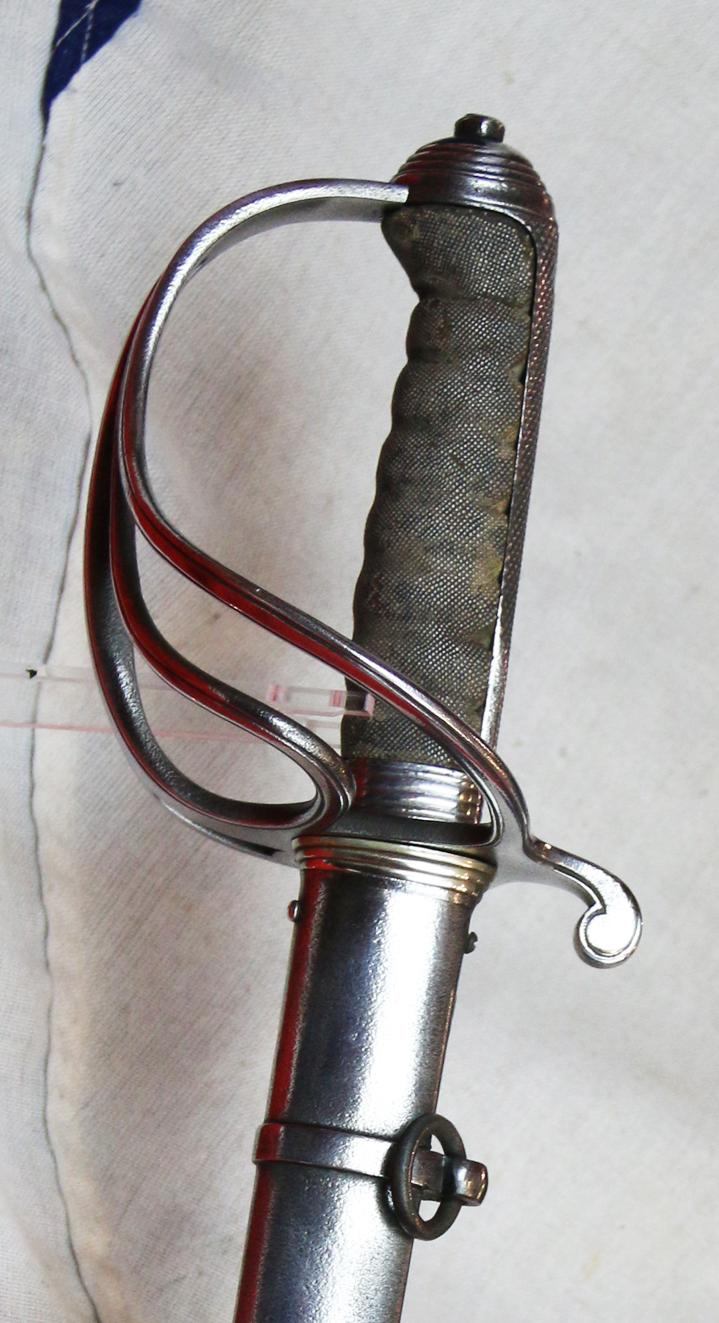
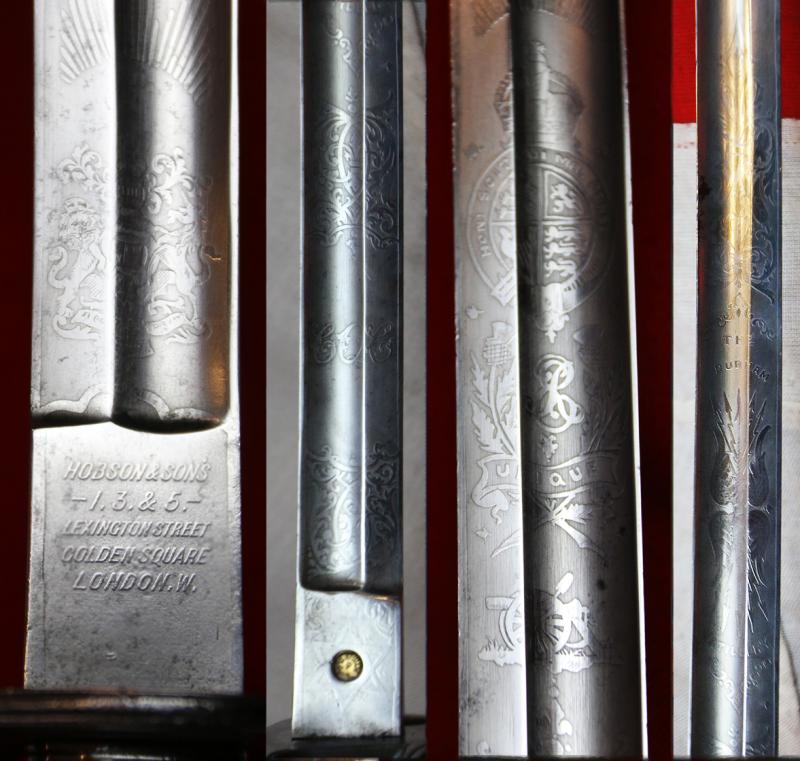

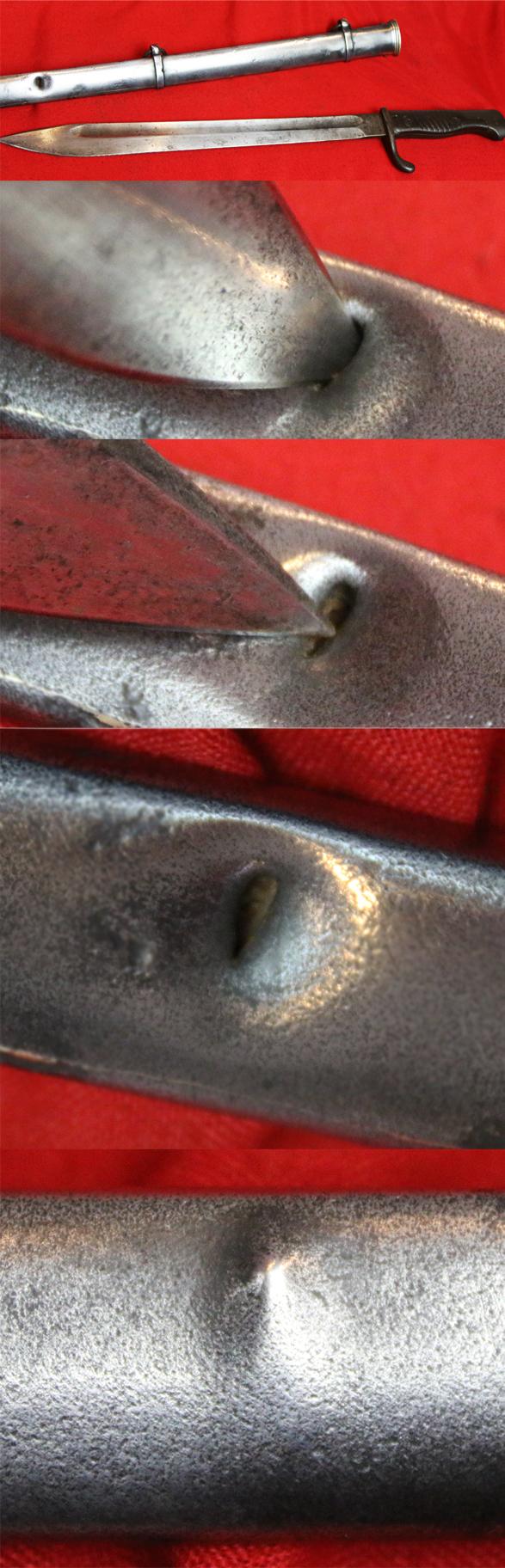
A Superb Durham Artillery Regimental Officer's Combat Sword Used In Combat at the First Battle of Ypres in October 19 to November 22, 1914 WW1 When The Guns Were Over Run & The Scabbard Impacted By Bayonet Charge
Fully etched regimental blade with monogram . Lightning flashes above and below Durham Artillery and the royal cypher of King Edward VIIth.
Steel combat scabbard in good condition, but, historically interesting and remarkable as it has been partially thrust through, in close combat, by a German Mauser bayonet. But as it 'nearly' went through both sides of the scabbard, the blade couldn't have been within it but being used in hand to hand fighting, likely to defend the heavy artillery piece during the 1st Battle of Ypres, where the guns were over run by the Germans.
The Durham artillery at Ypres;
Durham Garrison Artillery at the First Battle of Ypres:
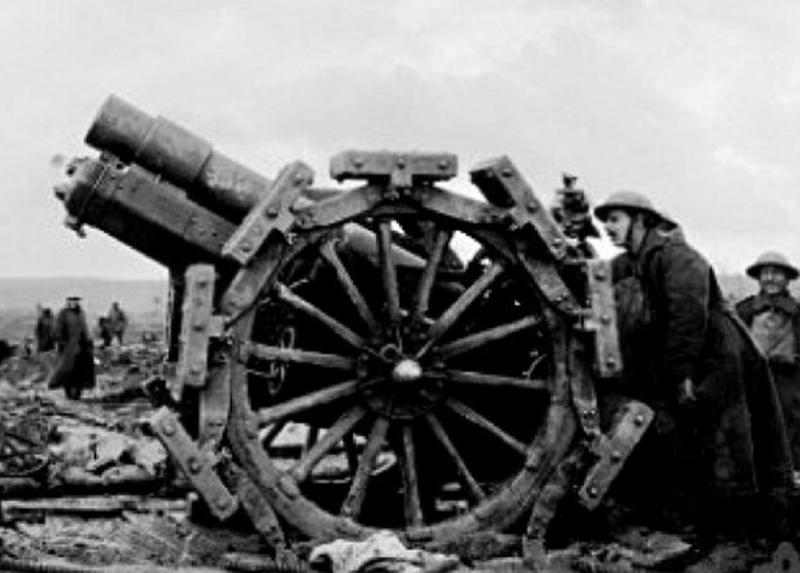
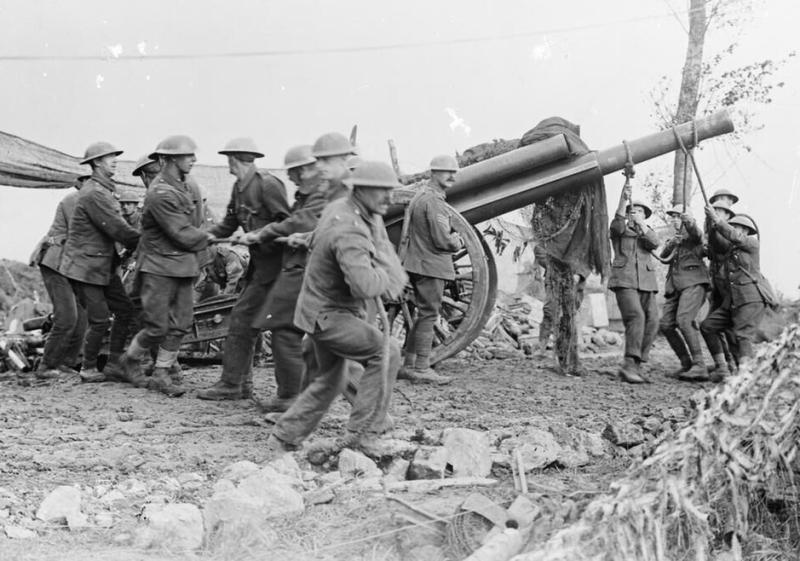
The 142nd (Durham) Heavy Battery, Royal Garrison Artillery, was part of the massive artillery reserve used by IX Corps in the battle.
They participated in bombardments before attacks, including one on October 23rd where their artillery demonstrated "the crushing effect of well co-ordinated massed artillery".
Their actions were instrumental in supporting infantry advances.
The First Battle of Ypres took place from October 19 to November 22, 1914.
It was a series of engagements fought to control the strategic city of Ypres and prevent German forces from breaking through to the English Channel.
The battle was characterized by intense trench warfare, heavy artillery bombardments, and high casualties on both sides.
The battle was part of a larger "Race to the Sea" where both sides were trying to outflank each other.
The First Battle of Ypres saw intense fighting and significant losses for both sides, with the British artillery facing challenges from the outset.
The German artillery inflicted heavy casualties and disrupted British communication lines.
In some instances, British guns were overrun by advancing German infantry, particularly during the early stages of the battle.
The heavy fighting and lack of observation points for British artillery made them vulnerable.
While the British did manage to hold their lines, the First Battle of Ypres was marked by intense fighting and a significant number of guns being overrun by the enemy.
The Arras offensive continued for several weeks. On 22 April, 142nd Hvy Bty transferred to 44th (South African) HAG. At the end of June, the battery moved back to Fifth Army, now at Ypres preparing for the Flanders Offensive (the Third Battle of Ypres). 142nd Heavy Bty did not stay under Fifth Army long: it briefly joined 14th HAG on 29 June, then 4th on 1 July, but moved to 59th HAG with Third Army on 6 July. It therefore missed the early stages of the offensive. It came under 39th HAG on 9 August, but then on 1 September it rejoined Fifth Army with 65th HAG.1013 The offensive was re-launched with the Battle of the Menin Road Ridge (20 September), followed by the battles of Polygon Wood (26 September), Broodseinde (4 October), Poelcappelle (9 October) and finally the First and Second Battle of Passchendaele (12 and 26 October). Conditions for the artillery were by now very bad: British batteries were clearly observable from the Passchendaele Ridge and suffered badly from CB fire, while their own guns sank into the mud and became difficult to aim and fire. The fighting died down after 10 November.
Interesting fact; The very first two medals for heroism, the Military Medal, every issued,after when the medal was first approved, were both Durham artillery men Acting Bombardier J.J. Hope and Bombardier F.W. Mallin, awarded for their heroic defence of defending Scarborough, Hartlepool and Whitby from Admiral Hipper's fleet.
On the morning of 16 December 1914, a German naval force under Rear Admiral Franz von Hipper approached the coast of North East England to mount a Raid on Scarborough, Hartlepool and Whitby. The battle cruisers SMS Seydlitz and SMS Moltke, with the armoured cruiser SMS Blücher, concentrated on Hartlepool, which was a base for light Royal Navy warships. The port was defended by two batteries. On the day in question, 11 officers and 155 other ranks of the Durham RGA were manning Heugh Battery (two 6-inch guns manned by No 4 Company) and Lighthouse Battery (one 6-inch gun)The action ended at 08.52 when the batteries fired their last rounds at 9200 yards' range at the withdrawing warships. The Germans had fired 1150 shells, killing 112 and wounding over 200 civilians and doing extensive damage to the town and docks. The Durham RGA suffered two killed, and in firing a total of 123 rounds had inflicted at least seven direct hits, killing 8 German seamen and wounding four.
Code: 25856