
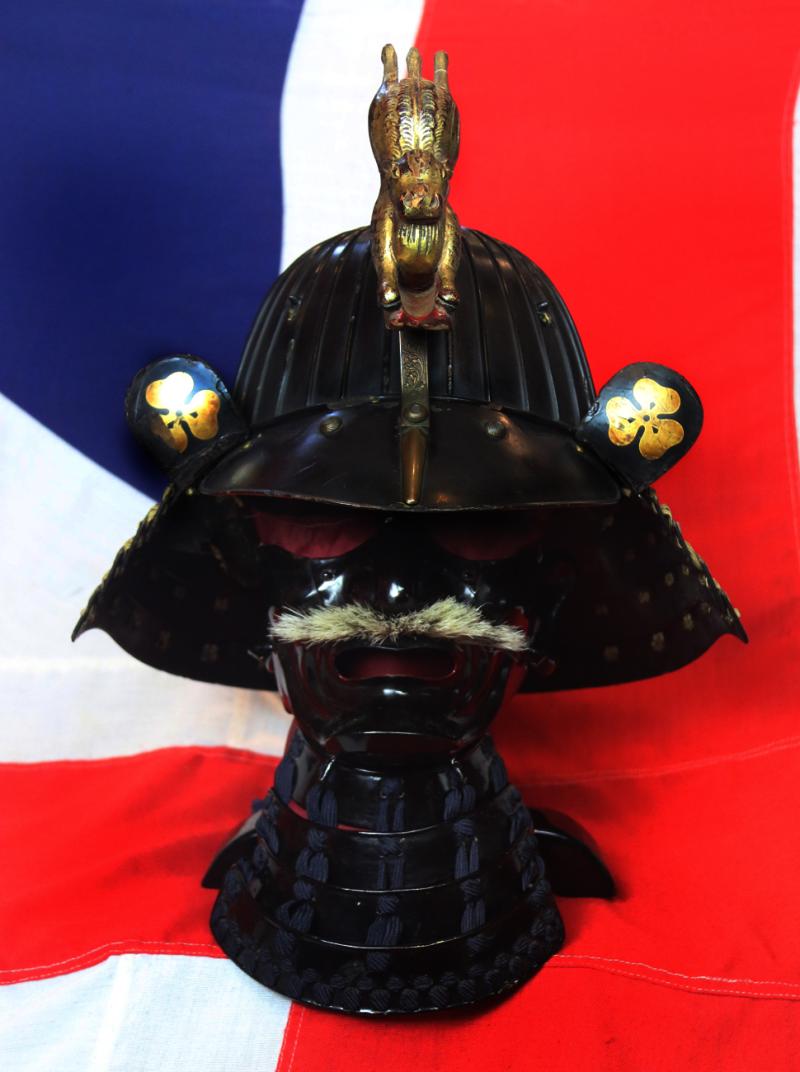
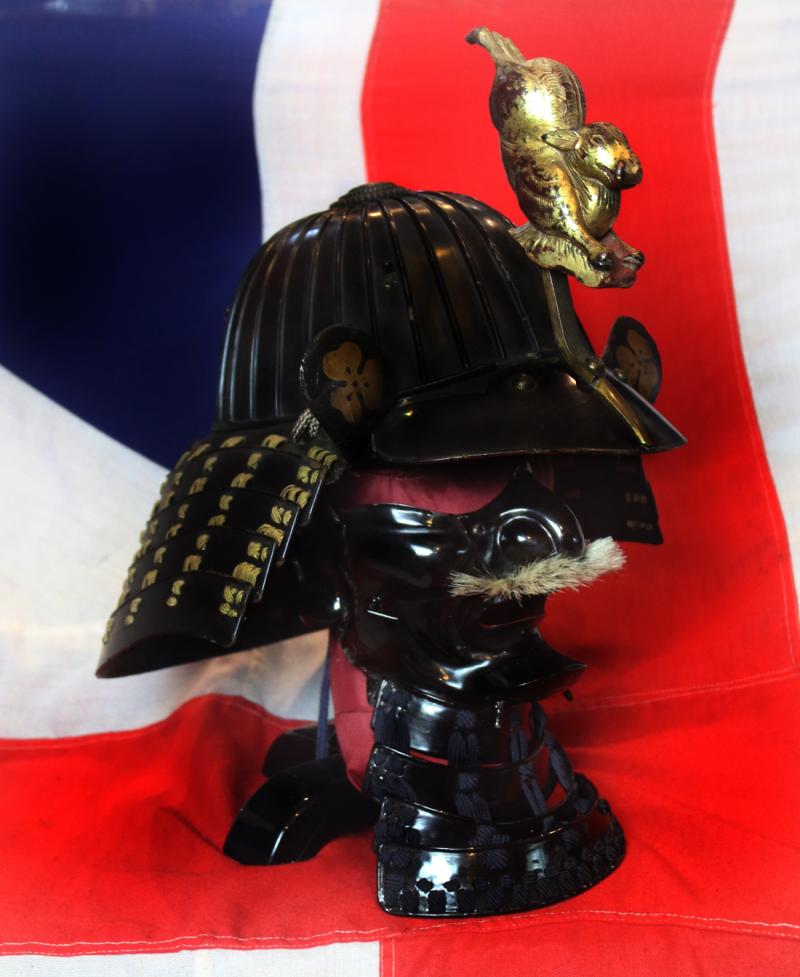
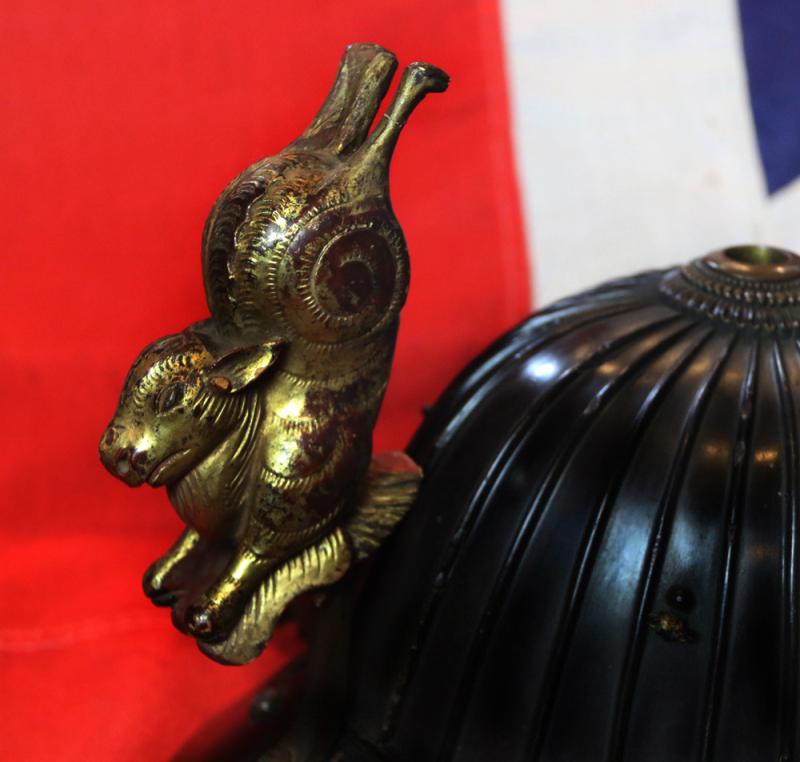

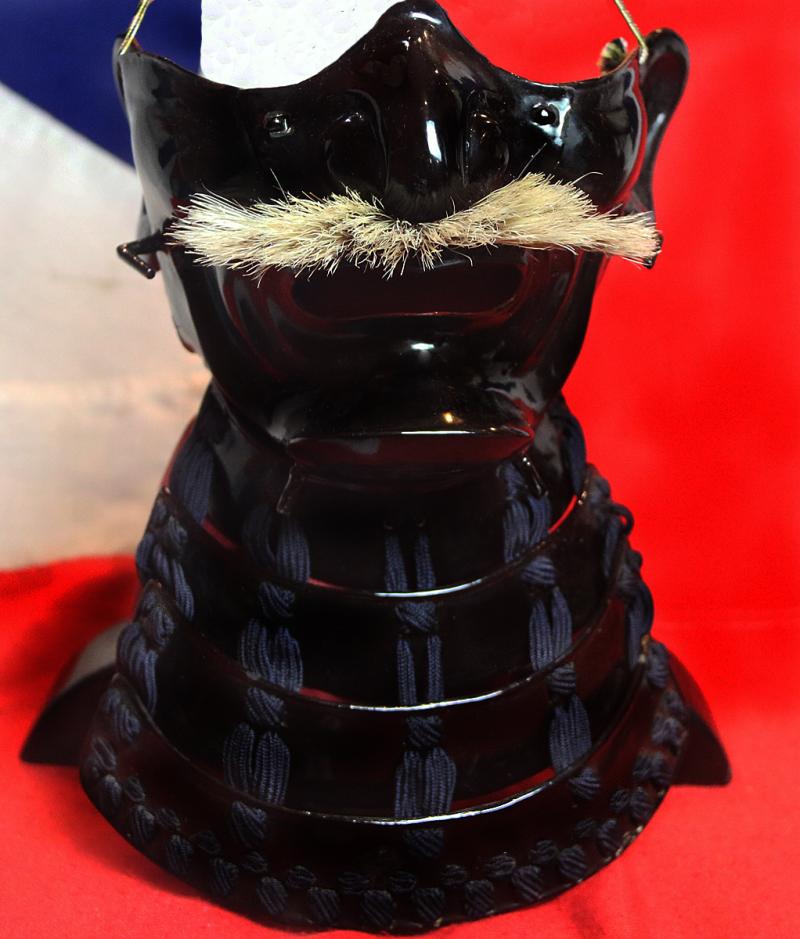
Superb Early to Mid Edo, Museum Quality Samurai War Helmet Kabuto, by Nobutada. 21 'Helmet Skull Bowl Plates', With Carved Wood & Gold 月の兎, Tsuki no Usagi Moon Rabbit Maedate & Clan Mon of the Sakai Clan, & “Fierce Face” Ressai, Face Armour
A truly fabulous, original, signed Edo samurai's antique kabuto, war helmet, worthy of a museum display, the best samurai or Japanese art collections, or as a single 'statement' piece for any home.
This is, without doubt, one of the most beautiful and fine original antique samurai war helmets, kabuto, we have seen for a jolly long time. Helmets of such beauty and quality as this can be prized and valued as much as a complete original samurai armour.
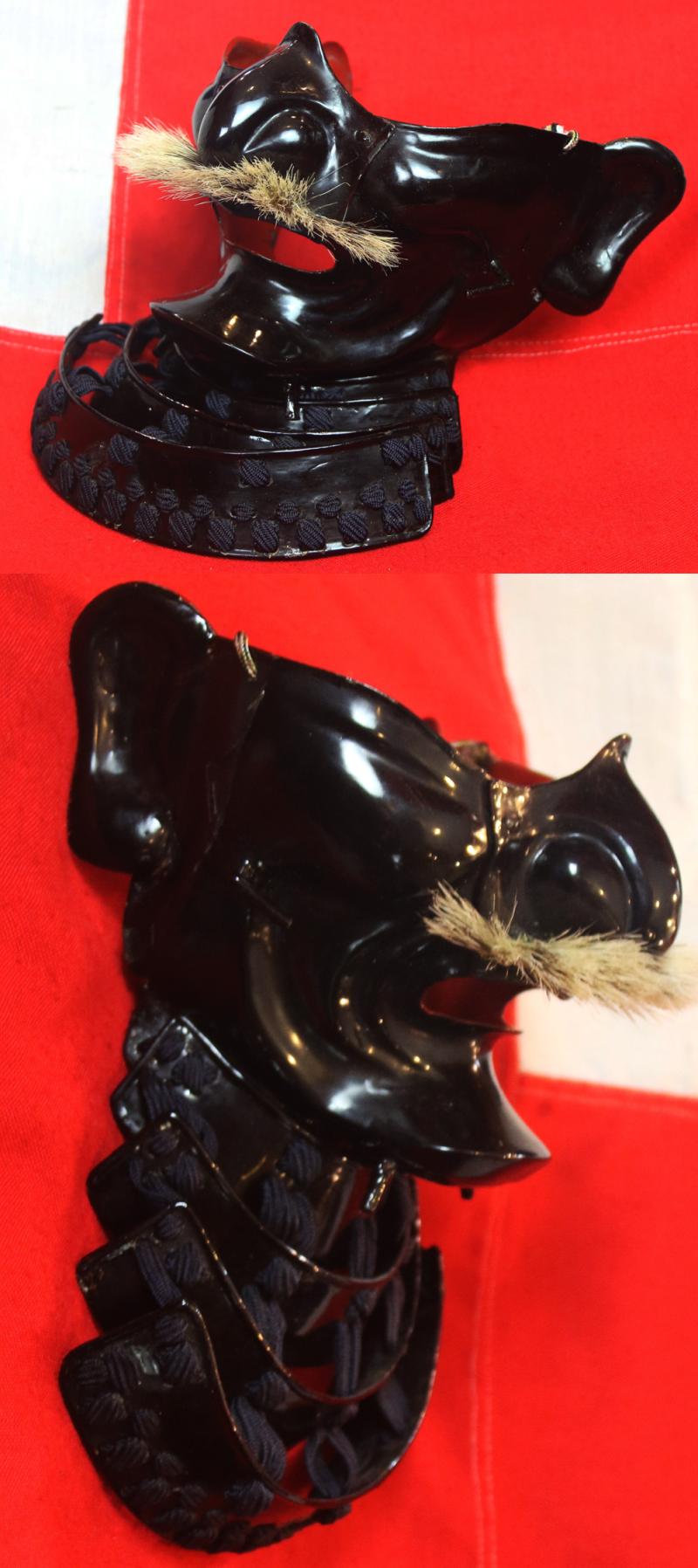
The imposing beauty of the helmet is entrancing, and the menpo {the moustached, grimacing expression face armour} sets it off superbly with a most intimidating presence. When this was worn by its fierce-some armoured samurai he must have looked spectacularly impressive.
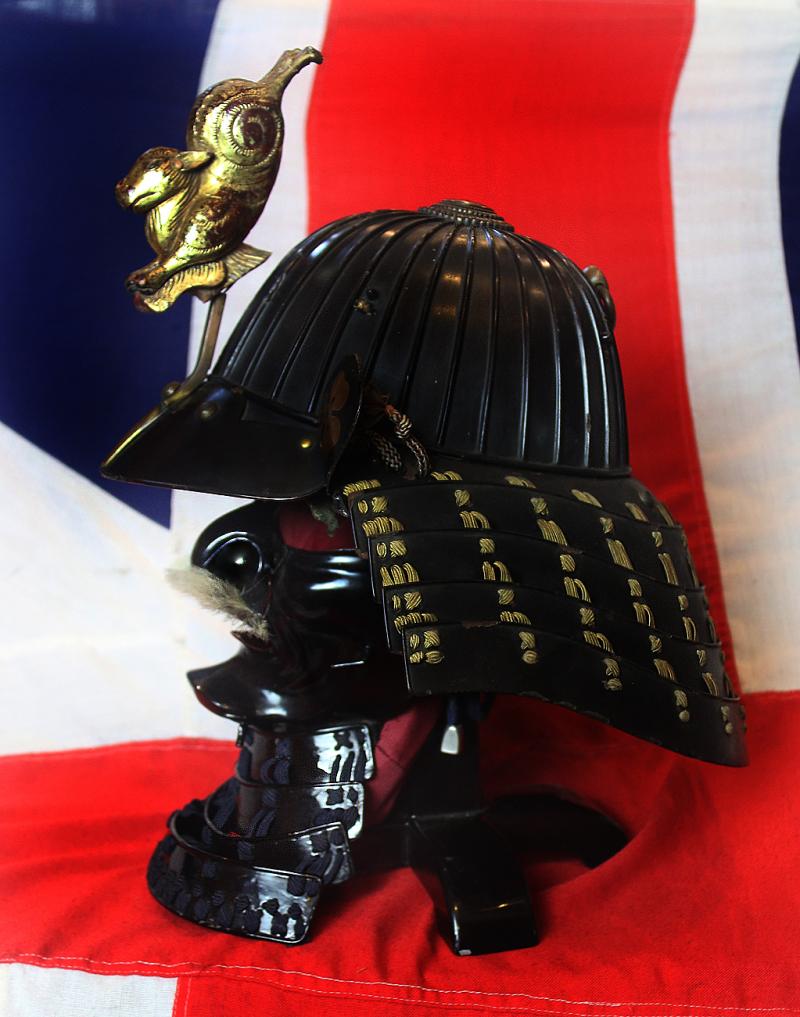
A 21 plate goshozan sujibachi kabuto, with ressei {fierce face } mempo face armour.
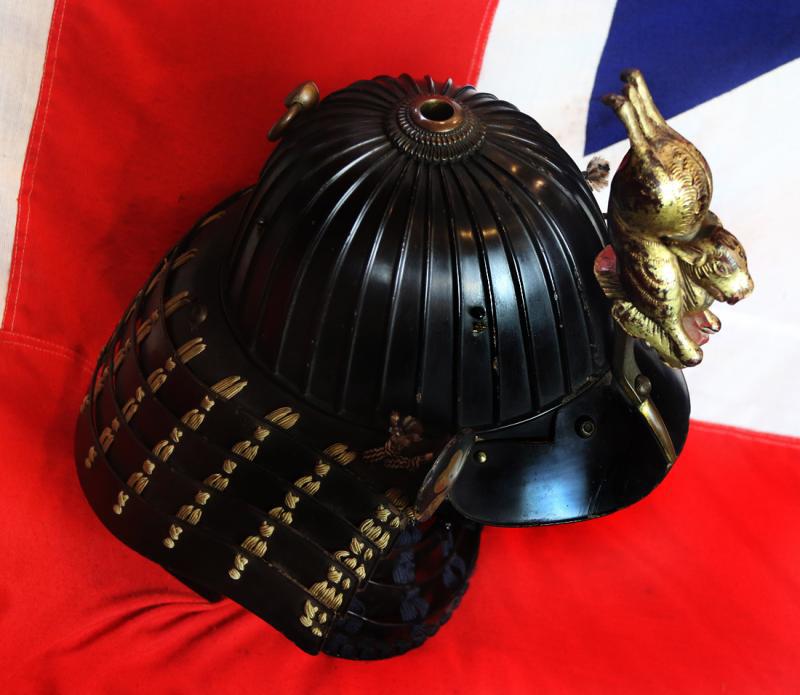
Probably a 17th-18th century, 21 ken plate, Sujibachi, which is a multiple-plate type of Japanese helmet skull bowl with raised ridges or ribs showing where the 21 tate hagi-no-ita (helmet plates) come together creating the main skull bowl bachi, and culminating at the multi stage tehen kanamono finial, with the fukurin metal edges on each of the standing plates.
The mabisashi peak is lacquered and it has a four-tier lacquered iron hineno-jikoro neck-guard laced with gold, and the skull is surmounted by a gilt-lacquered wood leaping animal, the maedate (forecrest), depicts the 月の兎, Tsuki no Usagi Moon Rabbit, the Fukigaeshi small front wings shows the mon crest symbol of a plain form katabami mon {the wood sorrel flower}.
The story and representations of the Japanese moon rabbit (月の兎, Tsuki no Usagi)
Early samurai warriors revered the moon rabbit (known as Tsuki no Usagi or Gyokuto) because it perfectly embodied the most sacred virtues of their strict warrior code, Bushido, alongside vital tactical attributes for the battlefield. Far from being just a cute folklore character, the rabbit was a potent, formidable symbol of ultimate self-sacrifice, speed, agility, and forward-moving determination
To the samurai, this narrative was the ultimate expression of loyalty and selflessness. A warrior was expected to lay down his life for his lord (daimyo) and his honour at a moment's notice without hesitation. The rabbit represented a fearless embrace of death for a higher duty.
Biologically, rabbits are known for jumping and running forward, finding it difficult to move backward easily. This physical trait was translated by the warrior class into a martial philosophy of relentless forward momentum. Just like the dragonfly (another popular samurai motif), the rabbit symbolized a warrior who never retreats on the battlefield. The moon was a symbol of clarity, enlightenment, and divine protection. By wearing a moon rabbit themed sword or a kabuto helmet with a moon rabbit crest, a samurai was channeling the mystical, shifting power of both the moon and the sea to overwhelm their enemies
It's one of popular kamon that is a design of the flower of oxalis corniculata.
The founder of the clan that chose this flower as their mon had wished that their descendants would flourish well. Because oxalis corniculata is renown, and fertile plant.
the mon form as used by clans such as the Sakai, including daimyo lord Sakai Tadayo
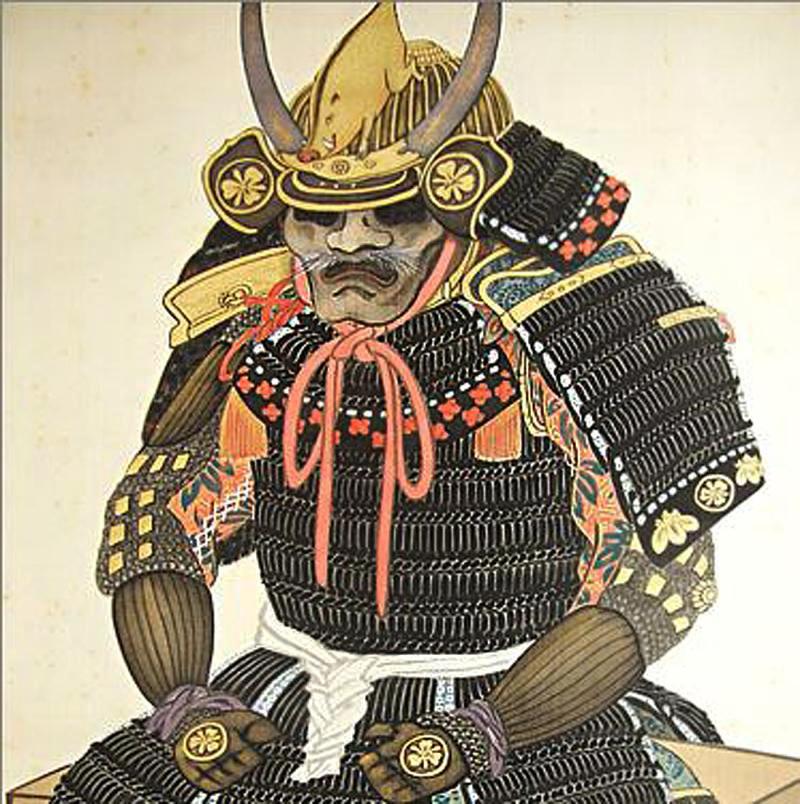
One of the great Sakai clan lords was Sakai Tadayo (酒井 忠世, July 14, 1572 – April 24, 1636). He was a Japanese daimyō of the Sengoku period, and high-ranking government advisor, holding the title of Rōjū, and later Tairō. You can see his image in the gallery wearing the very same form of war helmet kabuto.
The son of Sakai Shigetada, Tadayo was born in Nishio, Mikawa Province; his childhood name was Manchiyo. He became a trusted elder (rōjū) in Toyotomi Hideyoshi's government, alongside Tokugawa Ieyasu. Under Hideyoshi, he was made lord of Kawagoe Castle (in Musashi Province, today Saitama Prefecture) and later of Nagoya Castle in Kyūshū's Hizen Province. In 1600, in the lead-up to the decisive Sekigahara campaign, he fought against the Tokugawa at Aizu, and submitted to them at the siege of Ueda. Thus, having joined the Tokugawa prior to the battle of Sekigahara itself, Sakai was made a fudai daimyō, and counted among the Tokugawa's more trusted retainers. He served under Ieyasu for a time, and under the second shōgun, Tokugawa Hidetada, as a hatamoto.
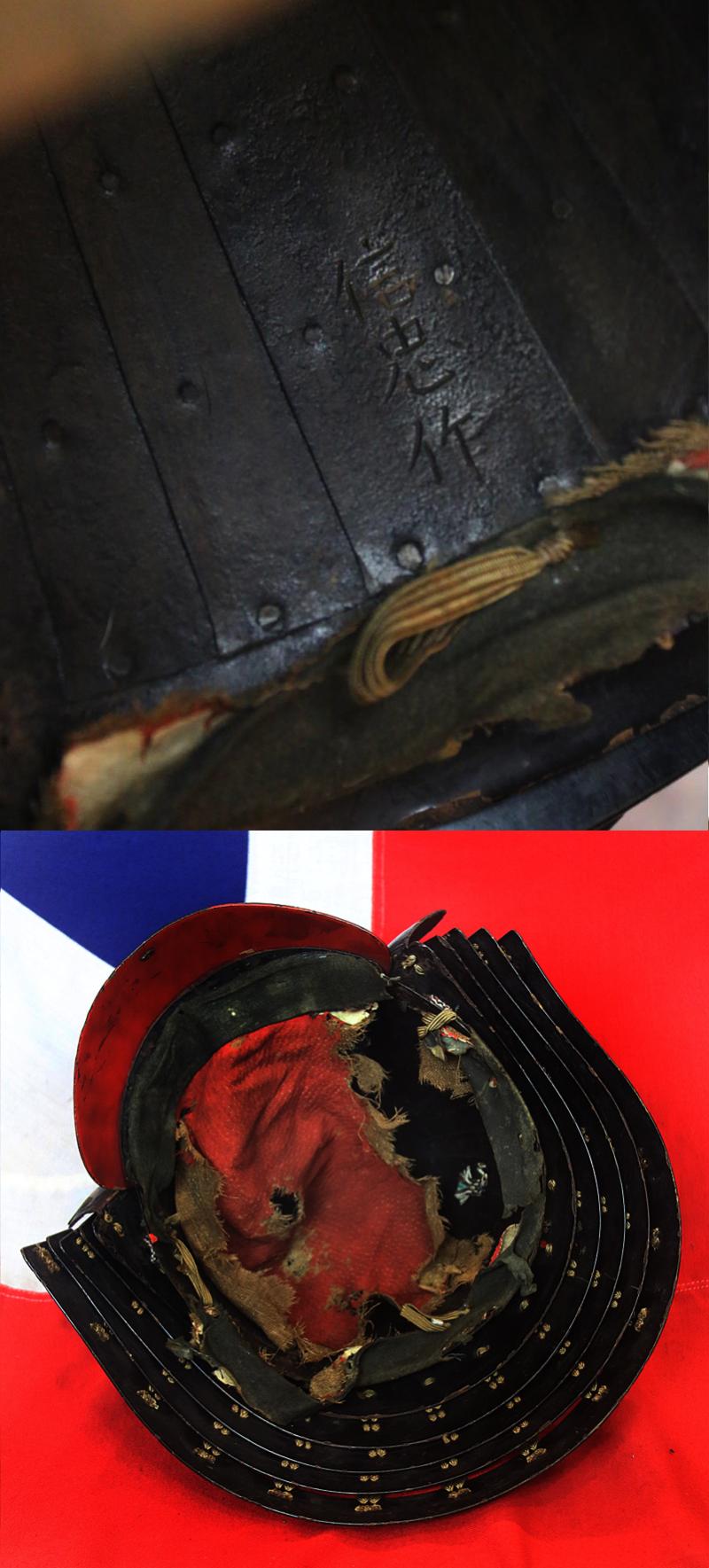
The lacquered iron menpo (face mask) with four-lame yodarekake face armour. The kabuto is signed on the interior Nobutada saku Nobutada made this
After the introduction of firearms, smoke blanketed many battlefields, causing confusion for the troops. So they could be more readily identified, samurai began to wear helmets with elaborate ornaments at the front, back, or sides, often featuring an intricate crest (maedate).
In their quest for unique and meaningful armour, samurai turned to nature, folklore, or religion for inspiration. Whatever the source, they selected designs for their armor that would set them apart and communicate their personality and beliefs, whether whimsical, frightening, or spiritual.
An antique woodblock print in the gallery, likely of Sakai Tadayo, showing his same form of war helmet kabuto, decorated with his same Sakai clan mon of the katabami, and he also has a leaping animal, gold covered carved wood, as his maedate helmet crest as has ours. And he has the same 'fierce face' mempo face armour with the very same style of elaborate, pronounced moustache.
The Fukigaeshi on the left facing side of the helmet shows the mon crest symbol of a plain katabami mon but small surface lacquer area partly missing. There are very small age nicks to the helmet lacquer. It has its original helmet lining but most removed back to reveal the signature.
The story of the Moon Rabbit
The Japanese tale appears in Konjaku monogatarishū. A fox, a monkey, and a rabbit were traveling in the mountains when they came across a shabby-looking old man lying along the road. The old man had collapsed from exhaustion while trying to cross the mountains. The three animals felt compassion for the old man, and tried to save him. The monkey gathered fruit and nuts from the trees, the fox gathered fish from the river, and they fed the old man. As hard as he tried, the rabbit, however, could not gather anything of value to give to the old man. Lamenting his uselessness, the rabbit asked the fox and monkey for help in building a fire. When the fire was built, the rabbit leaped into the flames so that his own body could be cooked and eaten by the old man. When the old man saw the rabbit’s act of compassion, he revealed his true form as Taishakuten, one of the lords of Heaven. Taishakuten lifted up the rabbit and placed it the moon, in order that all future generations could be inspired by the rabbit’s compassionate act. The reason it is sometimes difficult to see the rabbit in the moon is because of the smoke which still billows from the rabbits body, masking his form somewhat.
Every single item from The Lanes Armoury is accompanied by our unique Certificate of Authenticity. Part of our continued dedication to maintain the standards forged by us over the past 100 years of our family’s trading, as Britain’s oldest established, and favourite, armoury and gallery
Code: 25056
7950.00 GBP