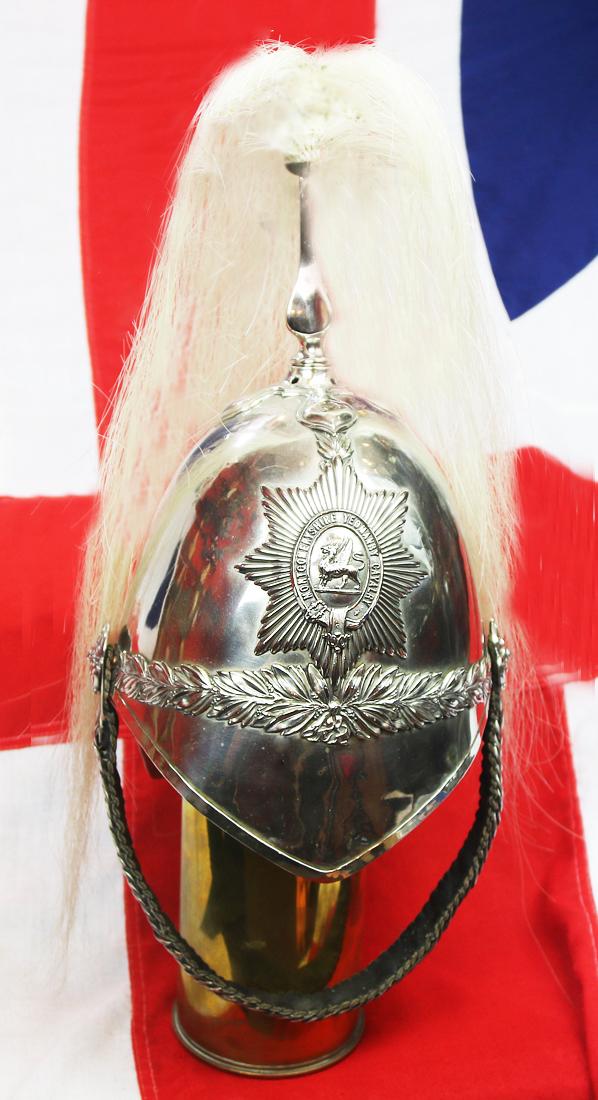
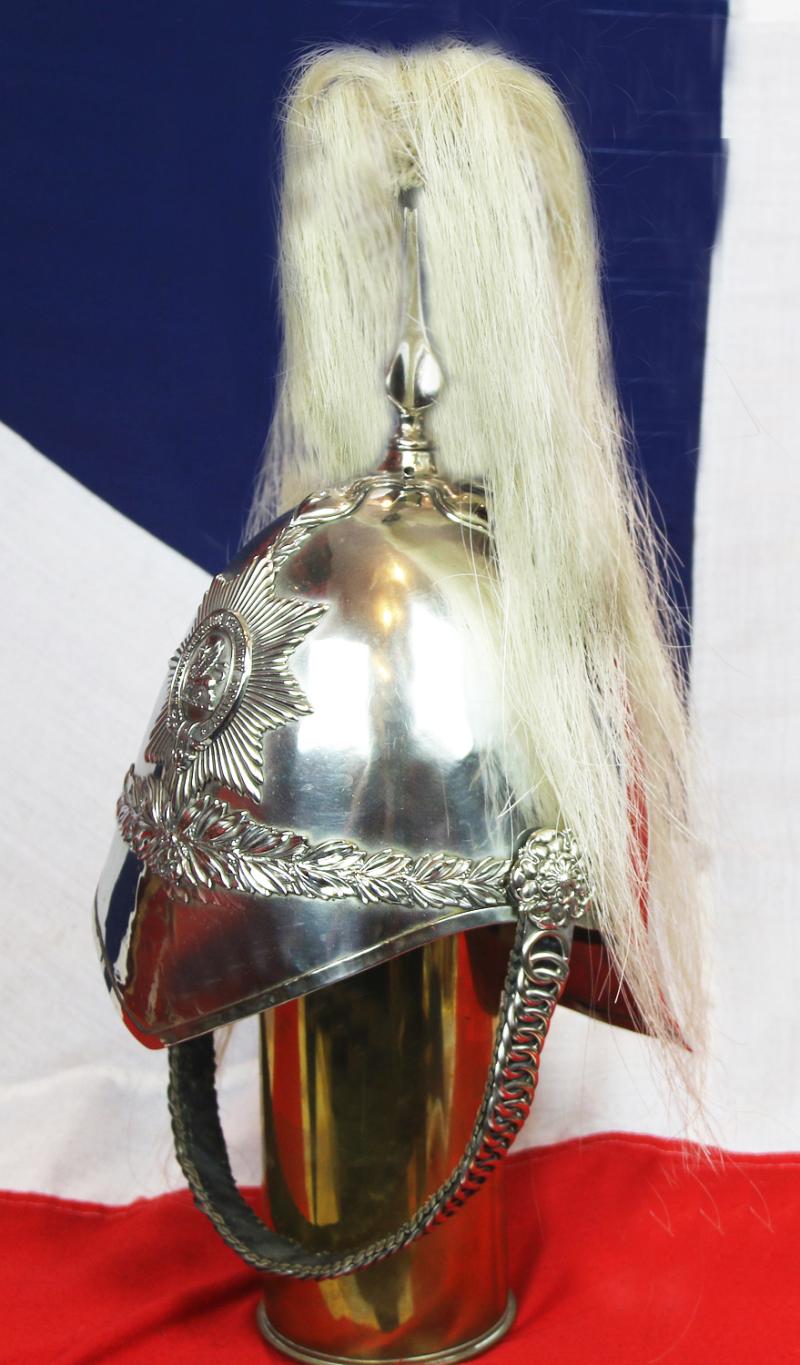
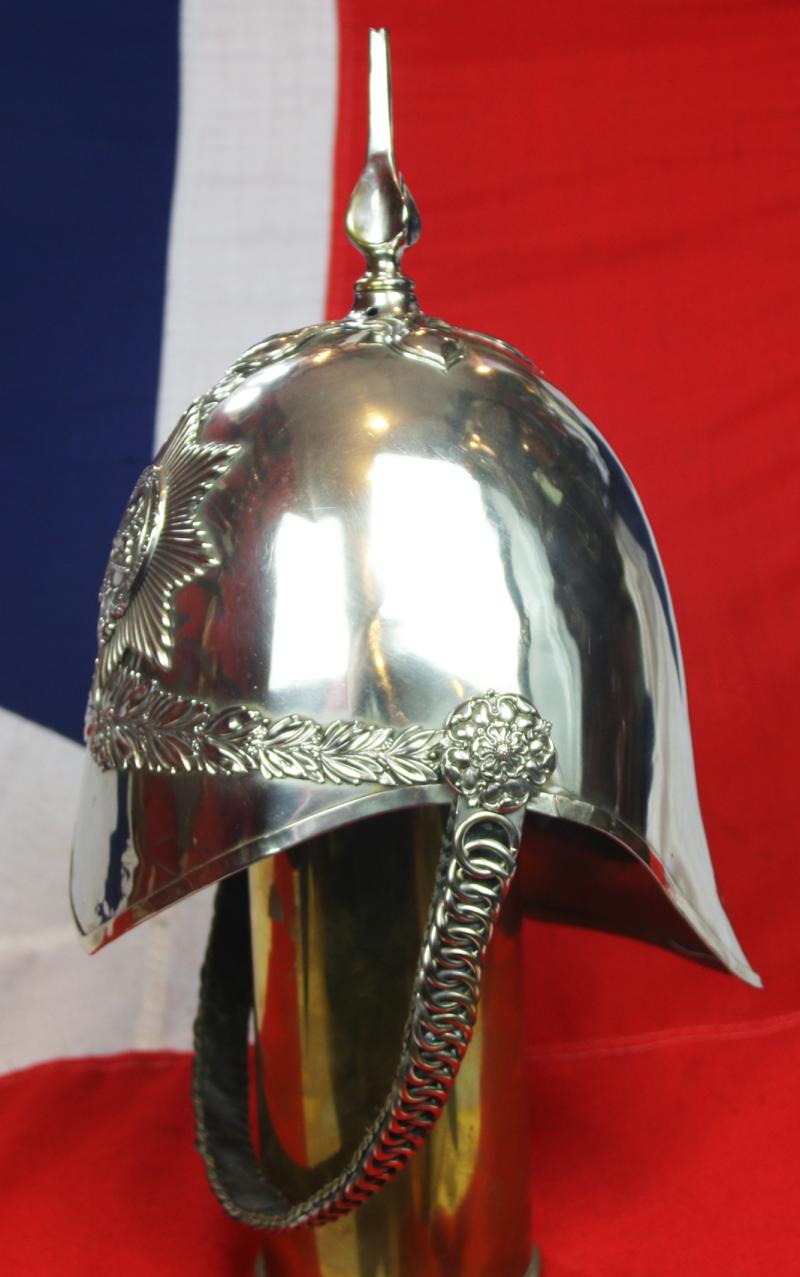
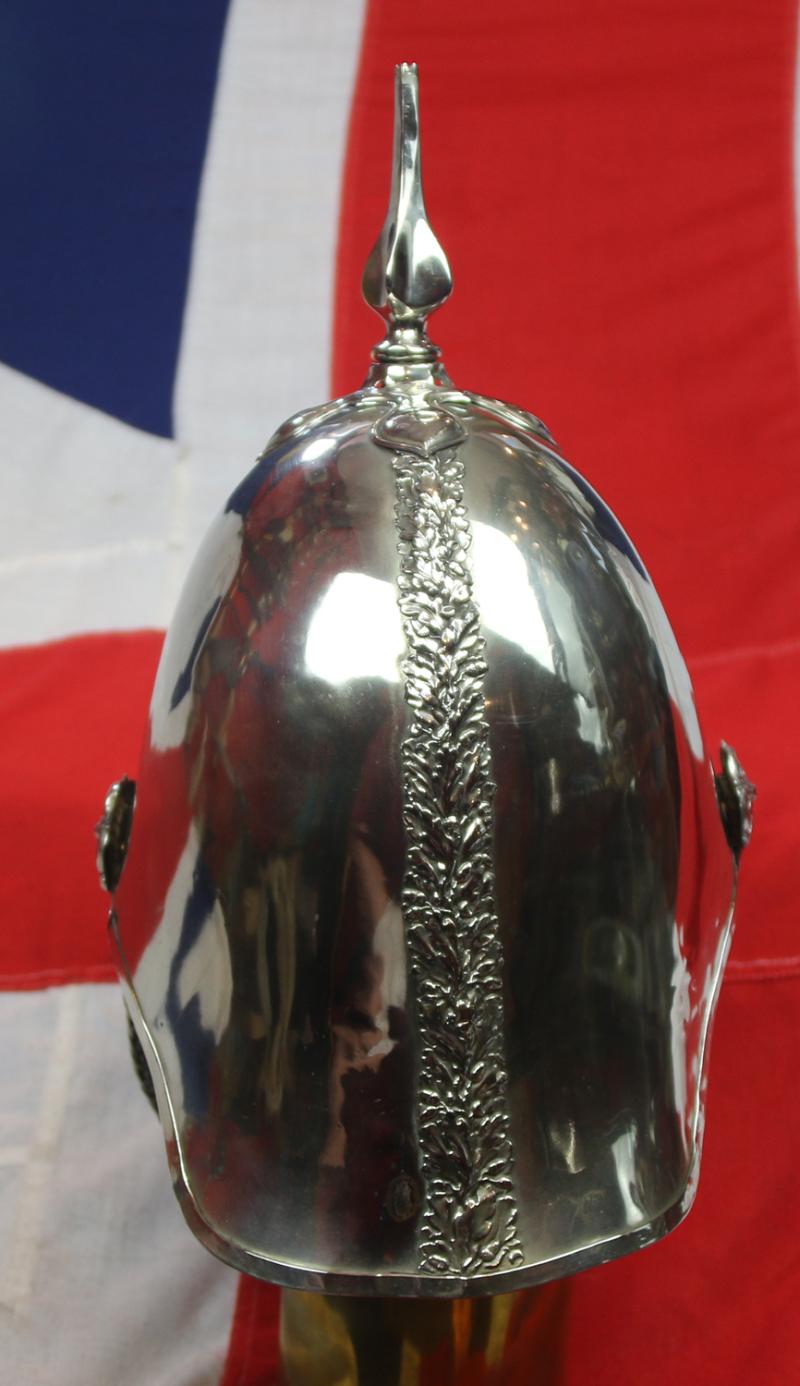

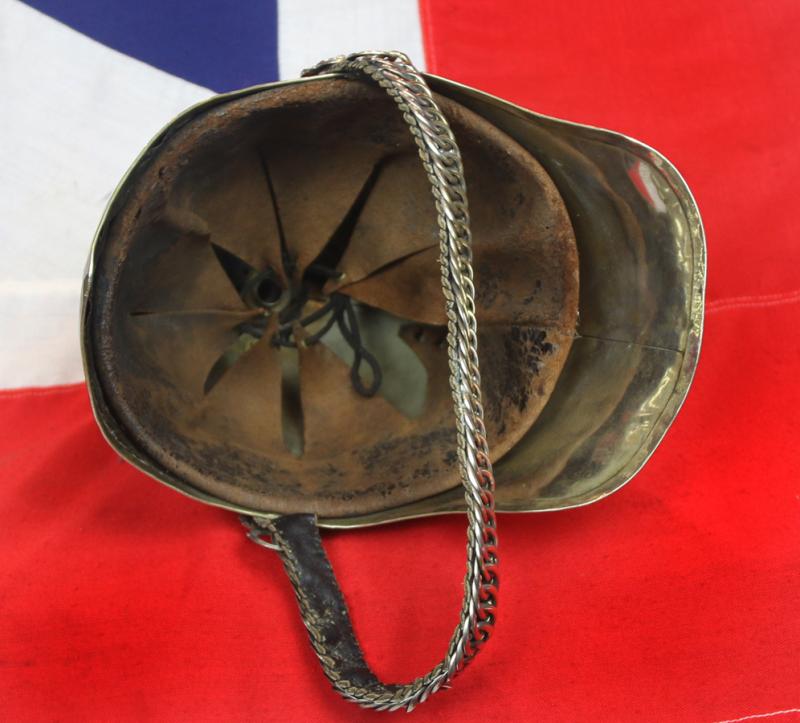

Antique Albert Pattern Montgomeryshire Yeomanry Cavalry Helmet of the Boer War
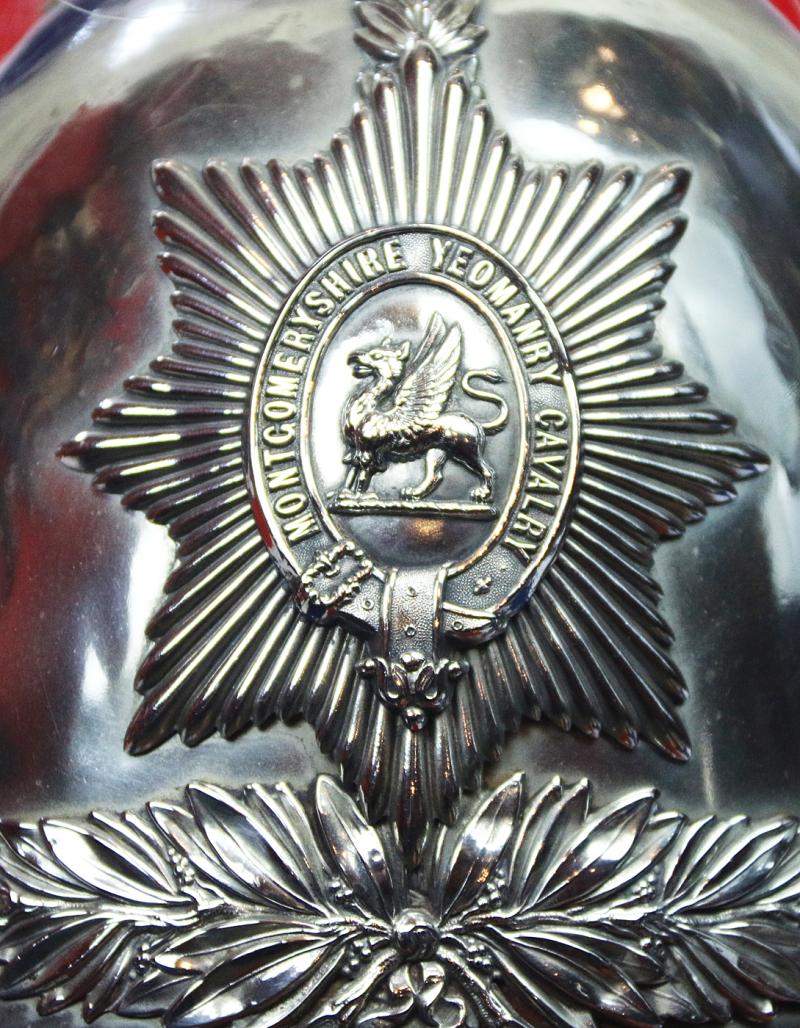
With a white plume this beautiful helmet is finished in fine white metal with the crest of Montgomeryshire Imperial Yeomany and a female Winged Griffin the male Griffins were wingless Very good condition for age, with original liner and chinscales. The horsehair plume was re-trimmed by the King's plume maker, to as good as new, with original conserved Victorian horsehair, and looks fabulous. New photos to be added..
Photos in the gallery are included with the plume removed, in what was called undress or combat mode. When the cavalry charged in combat, plumes may be removed.
During the French Revolutionary Wars of the 1790s a number of English and Welsh counties formed part-time units of Yeomanry Cavalry and Volunteer Infantry for home defence and internal security duties. The Welsh county of Montgomeryshire failed to raise any yeomanry or volunteers at this time.However, after the shortlived Peace of Amiens broke down in 1803, under the leadership of Charles Watkin Williams-Wynn, Member of Parliament for Montgomeryshire, the county rapidly two formed Troops of Yeomanry cavalry, at Montgomery and Welshpool by August 1803. Williams-Wynn took command as Major-Commandant, and a third troop soon followed at Newtown and Abermule. By 2 November this had expanded into a large force, the Montgomeryshire Volunteer Legion. In contemporary terminology a 'Legion' was an all-arms force, and soon after its formation the Montgomeryshire unit comprised three Troops of Yeomanry cavalry each 40 strong, and 20 Companies of Volunteer infantry, with Watkins-Wynn as Lieutenant-Colonel-Commandant and commander of the legion's cavalry. Charles Hanbury-Tracy was the second lieutenant-colonel
in early December 1899, the British government realised that it would need more troops than just the regular army to fight the Second Boer War, particularly mounted troops. On 13 December, the War Office decided to allow volunteer forces to serve in the field, and a Royal Warrant was issued on 24 December that officially created the Imperial Yeomanry (IY). The Royal Warrant asked standing Yeomanry regiments to provide service companies of approximately 115 men each for one year. In addition to this, many British citizens (usually mid-upper class) volunteered to join the new force.1920212223
The Montgomeryshire Yeomanry raised two companies for the first contingent of the IY, which both landed in South Africa on 6 April 1900 and were assigned to the 9th (Welsh) Battalion, Imperial Yeomanry:7202324252627
Imperial Yeomanry galloping over a plain during the Second Boer War.
31st (Montgomeryshire) Company
49th (Montgomeryshire) Company
When the first contingent returned home in 1901 after their one-year term of service, enough veterans of the 31st and 49th stayed on to reform the companies, while the Montgomeryshire Yeomanry raised two further companies for the second contingent, which also served in the 9th Battalion
88th (Welsh Yeomanry) Company
89th (Montgomeryshire) Company
This service earned the regiment its first Battle honour: South Africa 1900–01. Sir Herbert Williams-Wynn, who was instrumental in raising the four companies, was awarded a CB in 1902 He was appointed Honorary Colonel of the regiment when he retired in 1907.
Captain Robert Williams-Wynn, younger brother of the CO, went to South Africa with 31st Company. During the campaign he was twice Mentioned in Dispatches and was afterwards promoted to major and awarded the DSO
The Albert helmet is a type of dragoon helmet introduced by the British military in the 19th century. The helmet was developed by Prince Albert of Saxe-Coburg and Gotha in 1842, and was first introduced for service with the Household Cavalry in 1843. The helmet was introduced to other heavy cavalry units in the British Empire in 1847.
The Albert helmet was developed by, and named for, Prince Albert, the husband of Queen Victoria in 1842. It was a metal helmet based on those worn by cavalry in the Prussian Army.2 It was adopted by the Household Cavalry, where it replaced the bearskin-crested 1822 pattern helmet, from 1843 and by other heavy cavalry regiments from 1847.
The Albert helmet was metal (gilt with silver fittings for officers and brass with white metal fittings for other ranks). It was surmounted with a spike from which a hair plume was attached. The plumes varied between the regiments. In the Household Cavalry the Royal Horse Guards wore a red plume and the 1st (Royal) Regiment of Dragoons black. The two regiments of Life Guards both wore white plumes, the distinction being in how the plume fell. In the 1st Regiment it fell normally, in the 2nd Regiment it was gathered into a ball-shaped "onion" at the top of the spike, before falling.7 The dragoon guards regiments wore black plumes until 1857 when the 1st King's Dragoon Guards switched to a red plume. When on active duty overseas the plume was often plaited or not worn at all.
The helmet received generally good reviews in the media. One observer called them "handsome, light and convenient" and the United Service Gazette described it as "light, fits well to the head, produces an evenness of pressure and undeniably offers the best kind of protection against a bullet or sword cut".92 However the helmet proved unpopular when worn for strenuous activity and for such purposes the Kilmarnock cap was often worn.
The helmet was modified in 1865 as a result of lessons learnt from the Indian Mutiny and Crimean War. The resulting helmet, less ornamental than the original, has been retained by the Household Cavalry in full dress ever since.
The Albert helmet was also worn historically by a number of cavalry regiments in the Canadian Militia.
The regiment was awarded the following Battle honours:
South Africa 1901
Egypt, 1916–17
Palestine, 1917–18
France and Flanders, 1918
Code: 24958