
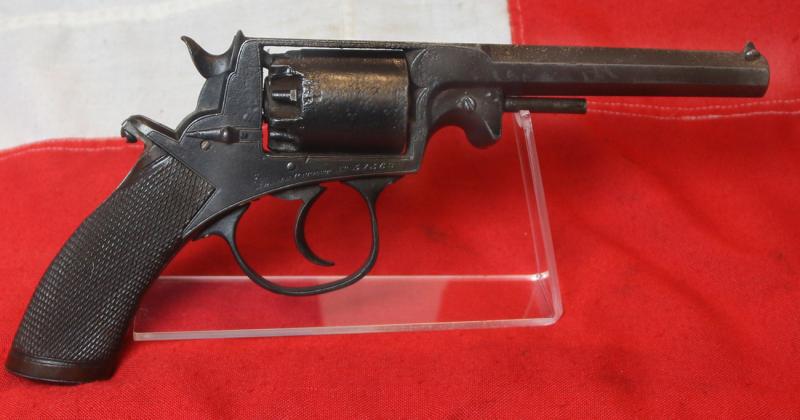
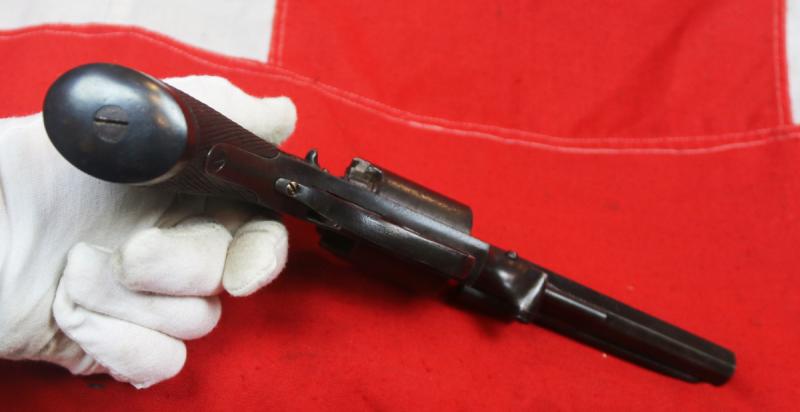
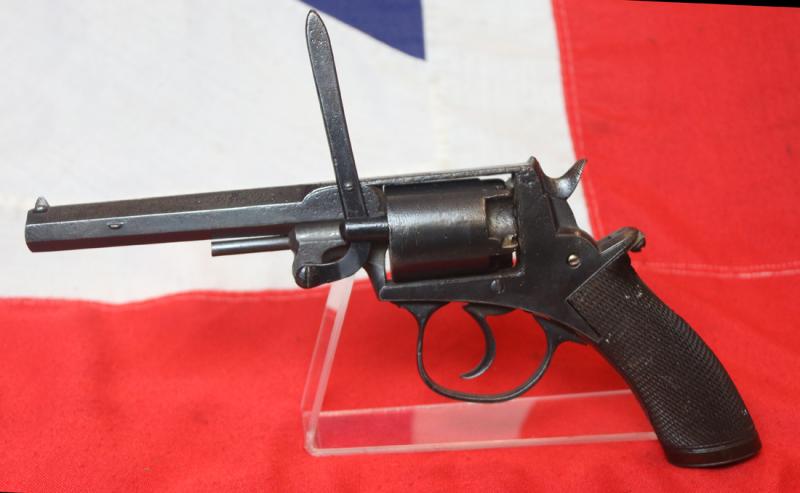
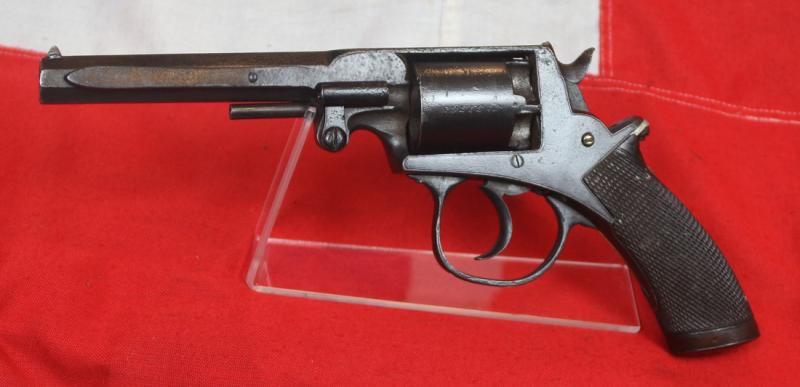
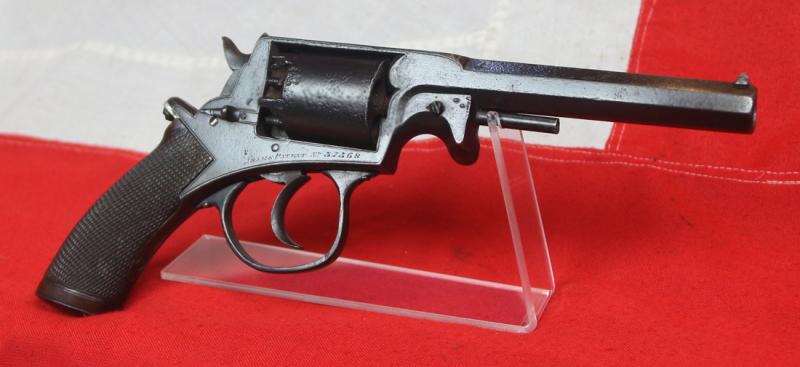
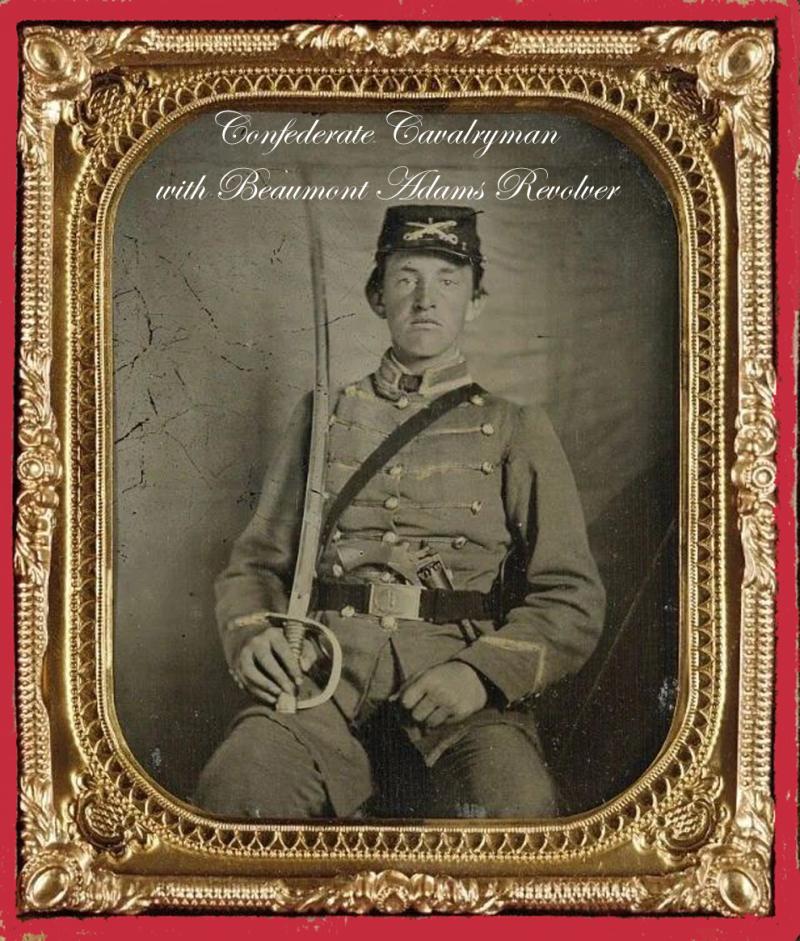
A British Beaumont Adam's 1862 .442 Cal Revolver, London Armoury Co. 'Confederate' Civil War Purchase, Matching Twin Serial Number
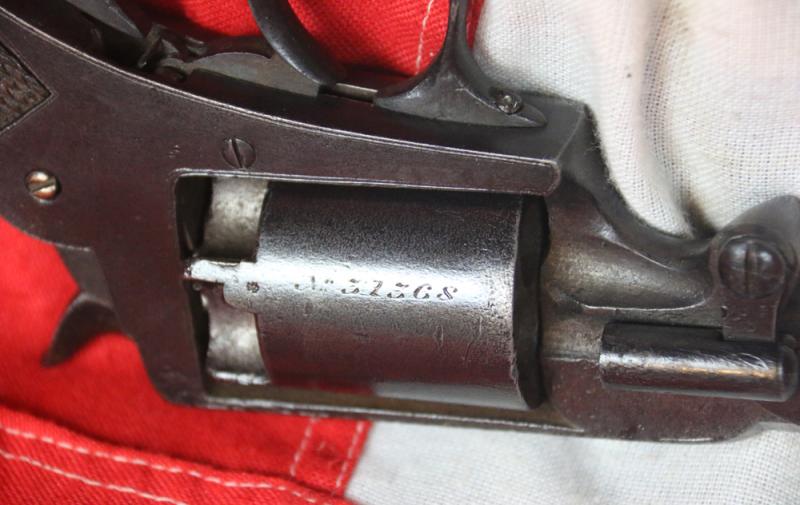
large calibre heavy grade percussion revolver, that has seen undoubted combat use in its working life with commensurate wear as such. Serial number to cylinder 37368. Adams patent, and serial no. 37368 to the frame. We have here a big Beaumont Adams Revolver with a serial number that matches those bought from and sent by the London Armoury Co. to the Confederacy during the Civil War. In their book 'The English Connection', by Pritchard and Hue, it indicates that there are considerable historic relationships to the confederacy for guns acquired by the London Armoury Company, founded and part owned by Robert Adams, all specifically between serial number ranges from 33,000 to 42,000, and the gun should not have any dealer markings on the top strap and it should be blank, as is this revolver.
The Beaumont–Adams revolver is a black powder, double-action, percussion revolver. Originally adopted by the British Army in .442 calibre (54-bore, 11.2 mm) in 1856.
The Adams revolver was favoured by British officers in the Crimean War and colonial conflicts due to the stopping power of its larger 54 bore (.442 cal) bullet (compared with their main competitor, the smaller .36 cal Colt Navy revolvers), and the speed of the Adams trigger-cocking action for close-quarters fighting (over the more cumbersome Colt action).
The Board of Ordnance did favour Colt with some orders for the Royal Navy, but they eventually chose the Beaumont-Adams for general adoption by the Army. This decision, coupled with the public's flagging enthusiasm for his wares, caused Colt to close the London factory after only 4 years of operation. Even though the Colt Dragoon revolvers were every bit as powerful as the Adams, their finish was not as good, and they were half again as large. For want of other arms, Dragoons and Navies were used in the Mutiny, though officers discarded them for more "modern" weapons as soon as they had the chance. Because of this, Beaumont Adams .442 seem to have been the most favoured, if not most widely used, handguns during the Mutiny.
Trials by a select small-arms committee showed that the singlel-action Colt navy had greater long-range accuracy than the Adams, but that the Adams was more powerful (both .442 and .50-calibre versions were available), and that it could be discharged much more rapidly than the Colt--two features that were favoured by British officers.
During the Civil War, both the Union and Confederacy realised early, particularly Jefferson Davis’ government in Richmond, Virginia, that neither side was adequately armed for a protracted confrontation. Both Lincoln and Davis began sending representatives to England and France in efforts to supplement the production of American-made firearms, especially rifles and handguns. It was the British who had the most experience in manufacturing muskets and revolvers. Several of England’s leading arms-makers answered the call to aid Abraham Lincoln’s besieged government as well as the estranged administration of former U.S. Secretary of War Jefferson Davis, now the newly elected president of the Confederate States of America.
Immediately after the April 12, 1861, attack on Fort Sumter by Confederate forces, Jefferson Davis made a decision to send Major Caleb Huse to Europe to evaluate the purchase and importation of arms to the South. A Major Anderson joined Huse was joined in May. As the war escalated in the summer, Davis issued orders for the importation of as many revolvers and muskets as possible. Lincoln had also sent Union officers and purchasing agents abroad. Thus in a way, old enemies and allies were being called upon to cooperate in the affairs on a nation that they had once fought against.
The London Armoury Company eventually become a major arms supplier to the Confederacy, delivering tens of thousands of revolvers.
In the United States the Massachusetts Arms Company obtained a contract and produced 19,000 Beaumont-Adams Revolvers which would be used by both sides of the American Civil War. Overall russet surface, action a/f, replaced cylinder spindle, requires two nipples, chequered wooden grip ears lacking.
Code: 24579
1995.00 GBP